CCSD Code H3334: Low anterior resection billing guide
CCSD Code H3334: Definition and clinical scope CCSD Code H3334 covers an open an...

Last Updated: Oct 16, 2026
ICD-10 Code X50.9XXD is the billable external cause code for other and unspecified overexertion or strenuous movements or postures, subsequent encounter. Coders use it when a patient returns for follow-up care of an overexertion injury and the note names no more specific mechanism. It always follows the injury code on the claim, and its 7th character D is a frequent coding error. This reference covers the code’s structure, sibling codes, payer rules, common errors, and where it fits in the medical billing process.

X50.9XXD is an external cause code, so it always follows the principal diagnosis that describes the injury or condition.
The 7th character D means subsequent encounter: the patient is in the healing or recovery phase, whatever the visit number.
Activity (Y93), place of occurrence (Y92) and status (Y99) codes are reported once, at the initial encounter, and not repeated on D visits.
X50.9 is the residual subcode. A documented heavy load, awkward posture or repetitive motion points to X50.0, X50.1 or X50.3 instead.
Pabau submits and tracks claims from one place, so the team can spot a stalled follow-up claim early.
The official descriptor for ICD-10 Code X50.9XXD is “Other and unspecified overexertion or strenuous movements or postures, subsequent encounter.” It belongs to category X50 in Chapter 20 of ICD-10-CM. The table below breaks down each character so coders can check the full 7-character string.
The XX placeholders follow the ICD-10-CM placeholder-character convention in Section I.A.4 of the Official Guidelines. Without them, the code string is invalid and the claim is likely to reject at the clearinghouse. The CDC ICD-10-CM web tool confirms the full descriptor for the current fiscal year.
X50.9XXD is an external cause code, not a condition code. It explains how an injury happened rather than describing the injury itself. It can never stand as the principal or first-listed diagnosis.
The ICD-10-CM Chapter 20 hierarchy for this code runs as follows.
Chapter 20 codes are supplementary, so they always follow the injury or condition code. That is usually a strain or sprain from the S chapter, or a musculoskeletal code from the M chapter. The CMS ICD-10 coding page publishes the annual code update files.
Neighboring codes from other chapters, including the injury codes X50.9XXD sits behind, are covered in our ICD-10-CM code guides.
The 7th character D in X50.9XXD means the patient is receiving routine or follow-up care for an overexertion injury in the healing or recovery phase. It does not mean the second calendar visit. It means active treatment of the injury has ended.
A frequent coding error in this code family is assigning A to every visit. Some coders read it as the first time they saw the injury. The phase of treatment decides A, not the visit number. Once active treatment ends and care becomes routine monitoring or therapy, D is correct on the second visit or the tenth.
X50.9XXD applies when a patient returns for ongoing care of an overexertion injury and the note names no more specific mechanism. Typical encounters include physical therapy visits for musculoskeletal strains and occupational medicine follow-ups for work-related overexertion. Sports medicine return visits qualify too, when the note records overexertion without a load, posture or repetitive motion.
Therapy notes need to state the encounter type clearly, because it drives the 7th character. Before assigning D, the coder should confirm three points in the documentation.
Flag any note that records overexertion without naming the mechanism. If the provider confirms a heavy load, an awkward posture or repetitive motion, switch to X50.0, X50.1 or X50.3. The activity itself, such as running or yoga, belongs in a Y93 code at the initial encounter.
ICD-10-CM guideline I.C.20 pairs external cause codes with three related families: activity (Y93), place of occurrence (Y92), and external cause status (Y99). Each is reported once, at the initial encounter for treatment. They are not repeated on a subsequent encounter, so a claim carrying X50.9XXD normally lists none of them.
There is also no national requirement to report external cause codes, unless a state mandate or payer policy asks for them. Knowing which codes belong on which encounter makes submitting a clean claim simpler on follow-up visits.
When a payer asks about the circumstances of the injury, point to the initial encounter’s claim. A leisure injury coded Y99.8 at the first visit stays on that first claim and is not added again at follow-up.
X50.9 is the residual subcode in the X50 family. The X50 subcodes classify the type of overexertion, not the named activity. When the note documents a heavy load, a prolonged or awkward posture, or repetitive motion, a more precise subcode applies. The chart below walks through both choices in order.
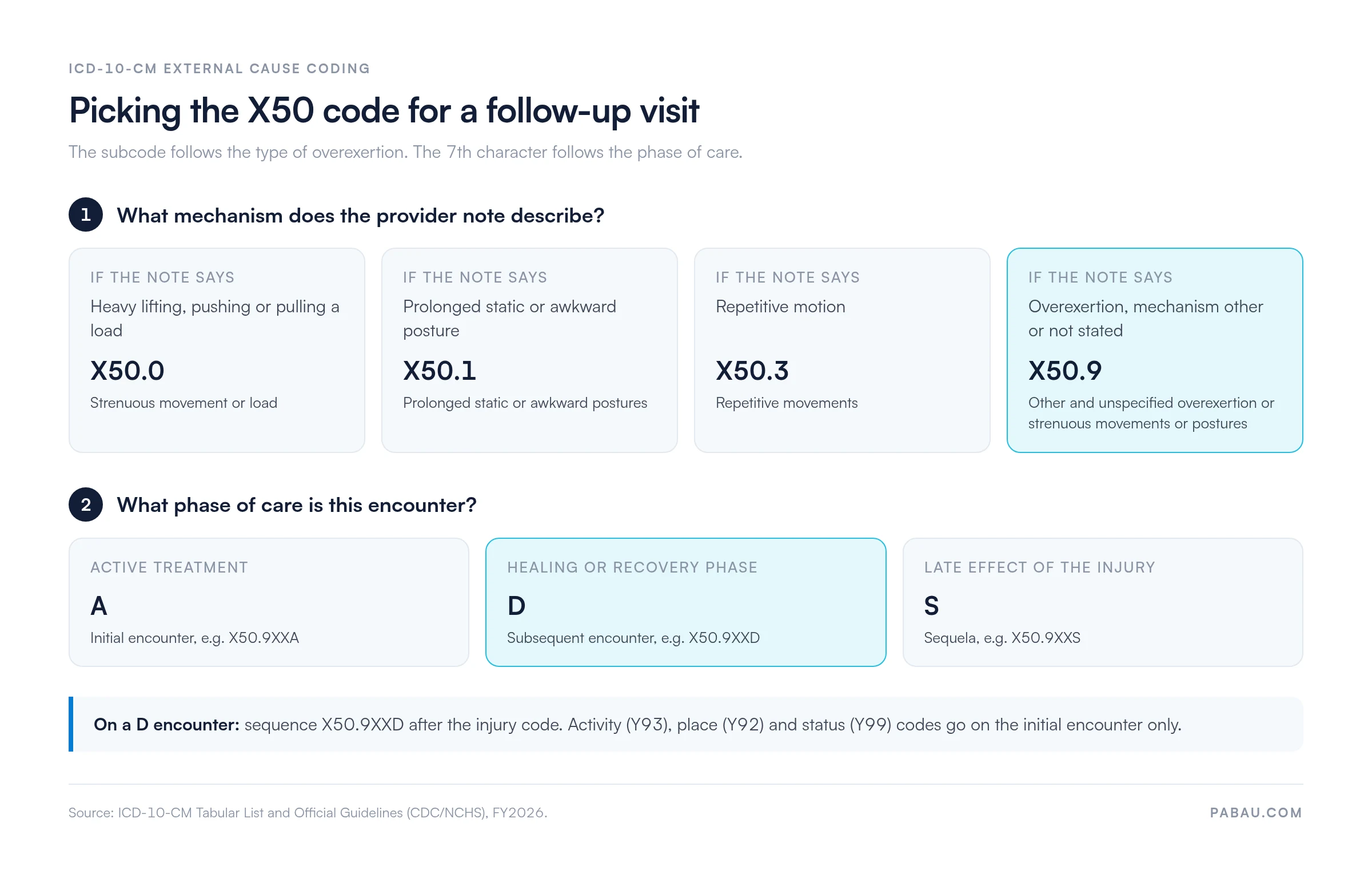
Use this table to check which X50 subcode fits the documentation before defaulting to X50.9XXD.
The AAPC Codify ICD-10-CM lookup lets coders browse the full X50 subcategory and check current-year descriptors against their documentation.
X50.9XXD cannot be sequenced as a principal or first-listed diagnosis under any payer’s claim rules. That rule comes from the ICD-10-CM Chapter 20 guidelines rather than from payer policy. Every claim must lead with the injury or condition code.
Medicare: Medicare Administrative Contractors (MACs) judge coverage on the principal diagnosis and the service billed. X50.9XXD is not the subject of a specific LCD, so it rides along with the injury code that drives the claim. Practices that send claims through the Claim.MD clearinghouse can check eligibility before the visit and track each claim after submission.
Workers’ compensation: Some state workers’ compensation carriers ask for external cause codes on occupational injury claims. Requirements vary by state and carrier, so confirm them with the payer before the first claim goes out. Meeting billing compliance requirements means checking each state’s rules rather than assuming a national standard.
Commercial insurers: Commercial payers do not universally require external cause codes. Reporting them where the documentation supports it gives the payer the mechanism of injury without a separate records request.
Claims carrying X50.9XXD tend to run into trouble over sequencing, the 7th character, and the subcode choice. Solid denial management workflows treat these as checks before submission rather than fixes after a denial.
A coder can only assign X50.9XXD with confidence when the provider note covers four points. Check each one before the claim goes out.
Build a documentation prompt into occupational medicine and physical therapy intake templates. Ask the provider to record the overexertion mechanism, even when it is unspecified. Ask them to note whether this is an initial or follow-up visit for the injury, too.
Many practices code a follow-up visit in one tool, build the claim in another, and chase its status by phone. Each handoff is another chance for X50.9XXD to land in the wrong position or carry the wrong 7th character.
Pabau, the practice management platform we build, keeps the provider note, the coded encounter, and the claim in one patient record. Its claims software for practices pre-fills the claim from that record, then submits and tracks it from one place. In the US, claims go out through Claim.MD.
Your coder still owns the sequencing and the 7th character. What changes is that the team sees each claim’s status and payment without leaving the system, so a stalled follow-up claim gets worked sooner.
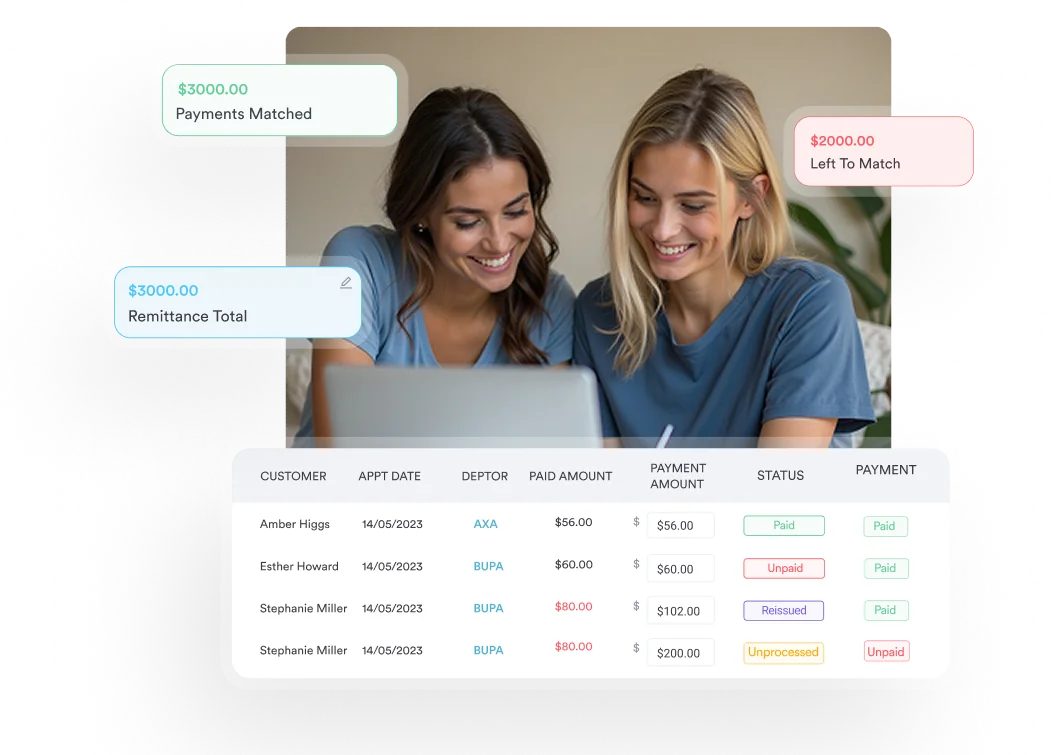

Pabau pre-fills each claim from the patient record, then submits and tracks it from one place. Your team sees which X50.9XXD follow-up claims are paid and which need attention.

X50.9XXD turns on two details in the provider note: the overexertion mechanism and the phase of care. When the note names no load, posture or repetitive motion, X50.9 is correct. When the patient is healing rather than in active treatment, D is correct.
Keep in mind that X50.9XXD only explains how the injury happened. The injury code carries the claim, and the activity, place and status codes stay on the initial encounter. A coder who queries the provider once, early, avoids most rework later.
Book a demo to see how Pabau submits and tracks follow-up claims from the same record your providers document in.

Need to understand how clearinghouse submission works for external cause codes? Medical claims clearinghouse guide explains how claims move from practice to payer and where coding errors surface first.
Want a structured approach to reducing coding-related denials? Denial codes in medical billing covers the CARC and RARC codes your team may see on X50.9XXD rejections.
Looking for guidance on superbill setup for overexertion and musculoskeletal encounters? Superbill documentation guide walks through what goes on the superbill and how to structure it for clean claim submission.
ICD-10 Code X50.9XXD is a supplementary external cause code for other and unspecified overexertion or strenuous movements or postures, subsequent encounter. It records the mechanism of an overexertion injury at a follow-up or recovery visit when the note names no more specific mechanism.
X50.9XXA applies when the patient is receiving active treatment for an overexertion injury. X50.9XXD applies once the patient moves to routine follow-up, recovery, or rehabilitative care. The type of treatment at that encounter decides it, not the visit number.
No. X50.9XXD is an external cause code and cannot be sequenced as the principal or first-listed diagnosis under any payer’s claim rules. It must always follow the injury or condition code that describes what is being treated.
Not on a subsequent encounter. ICD-10-CM guidelines report activity (Y93), place of occurrence (Y92) and external cause status (Y99) codes once, at the initial encounter for treatment. They are not repeated on X50.9XXD follow-up visits.
Requirements vary by state and carrier. Some carriers ask for external cause codes on occupational injury claims, so confirm the requirements with the payer before submitting.
Frequent coding errors include X50.9XXD submitted as the principal diagnosis, or A used for a follow-up visit that warranted the D character. A missing principal diagnosis code and vague documentation of the overexertion mechanism cause problems too. Each one can be corrected before submission with a pre-claim review.