ICD-10 code S32.038G: Other L3 fracture with delayed healing
ICD-10 code S32.038G at a glance ICD-10 code S32.038G is the billable ICD-10-CM ...

Last Updated: Nov 2, 2026
Billable Code Specific Code
X82.2XXS is the billable ICD-10-CM code for intentional collision of motor vehicle with tree, sequela.
Coders use it when a patient returns for treatment of a late effect of a prior suicide attempt by crashing a vehicle into a tree. Typical late effects include chronic pain, neurological deficits, and psychological conditions. The code sits in category X82, subcategory X82.2. Placeholder X characters fill positions five and six, so the 7th character S lands in position seven. It is reported as a secondary code and never listed first.
Let Pabau's smart automation suggest the right codes, reduce claim denials, and keep your practice compliant—effortlessly.
Automate repetitive tasks and focus on what matters most—your patients.
Reduce coding errors and ensure compliance with the latest regulations.
Clean claims, fewer denials, and faster reimbursements.
Powerful insights and reporting to help your practice thrive.
HIPAA compliant SOC 2 certified GDPR-compliant Trusted by 4,000+ clinics worldwide

X82.2XXS reports the sequela of an intentional collision of a motor vehicle with a tree, not the acute crash encounter.
Use the 7th character S only for a late effect of the crash. Use A during active treatment and D for routine healing-phase care.
Two placeholder X characters in positions 5 and 6 are required, and omitting either one makes the code invalid.
X82.2XXS is always a secondary code and is never sequenced as the principal or first-listed diagnosis.
A deliberate crash into a train belongs to X82.1, not X82.2, so the record must name a tree to support this code.
ICD-10 Code X82.2XXS is the billable code for the sequela of an intentional collision of a motor vehicle with a tree. It sits in subcategory X82.2, which covers intentional self-harm by deliberately crashing a motor vehicle into a tree. The official descriptor is Intentional collision of motor vehicle with tree, sequela. The code is valid in the current ICD-10-CM code set published by the Centers for Medicare and Medicaid Services.
This is an external cause code. It describes the mechanism and intent behind an injury rather than the injury itself. Coders use it to show that the condition treated today is a late effect of a prior deliberate crash. The tree qualifier matters, because X82.2 applies only when the vehicle struck a tree. A deliberate crash into another motor vehicle, a train, or a different object takes another X82 subcategory.
The 7th character in X82.2XXS signals the phase of care being documented. ICD-10-CM offers three 7th characters for this category: A (initial encounter), D (subsequent encounter), and S (sequela). Picking the wrong one is a common and avoidable reason X82.2 claims come back.
Sequela (S) applies when the visit treats a condition that arose as a direct result of the original injury, after its acute phase has ended. The sequela is a separate, ongoing condition caused by the prior crash. Examples include chronic symptoms after a traumatic brain injury, spinal cord dysfunction, or post-traumatic psychological conditions. Each one traces back to the documented deliberate crash into a tree.
A common error is assigning X82.2XXD to a psychiatric visit after a prior suicide attempt by crashing into a tree. The D character covers routine healing-phase care of the crash injuries, such as a cast change or a follow-up X-ray. If the visit treats a late-effect condition instead, X82.2XXS is the correct choice. Language that ties a current condition to the prior crash supports S.
Check what the physician note is treating. Use the 7th character A while the crash injuries are in active treatment, and D for routine healing-phase care. Use S for a late-effect condition caused by the crash. This single check resolves most X82.2 7th character errors before a claim reaches a payer.
All three codes share subcategory X82.2, intentional collision of motor vehicle with tree, and differ only in the 7th character. The table below maps the clinical scenario, the documentation trigger, and the most common coding error for each one.
Before you reach the 7th character, two earlier answers in the record have to point to X82.2. The flow below puts all three questions in the order a coder settles them.
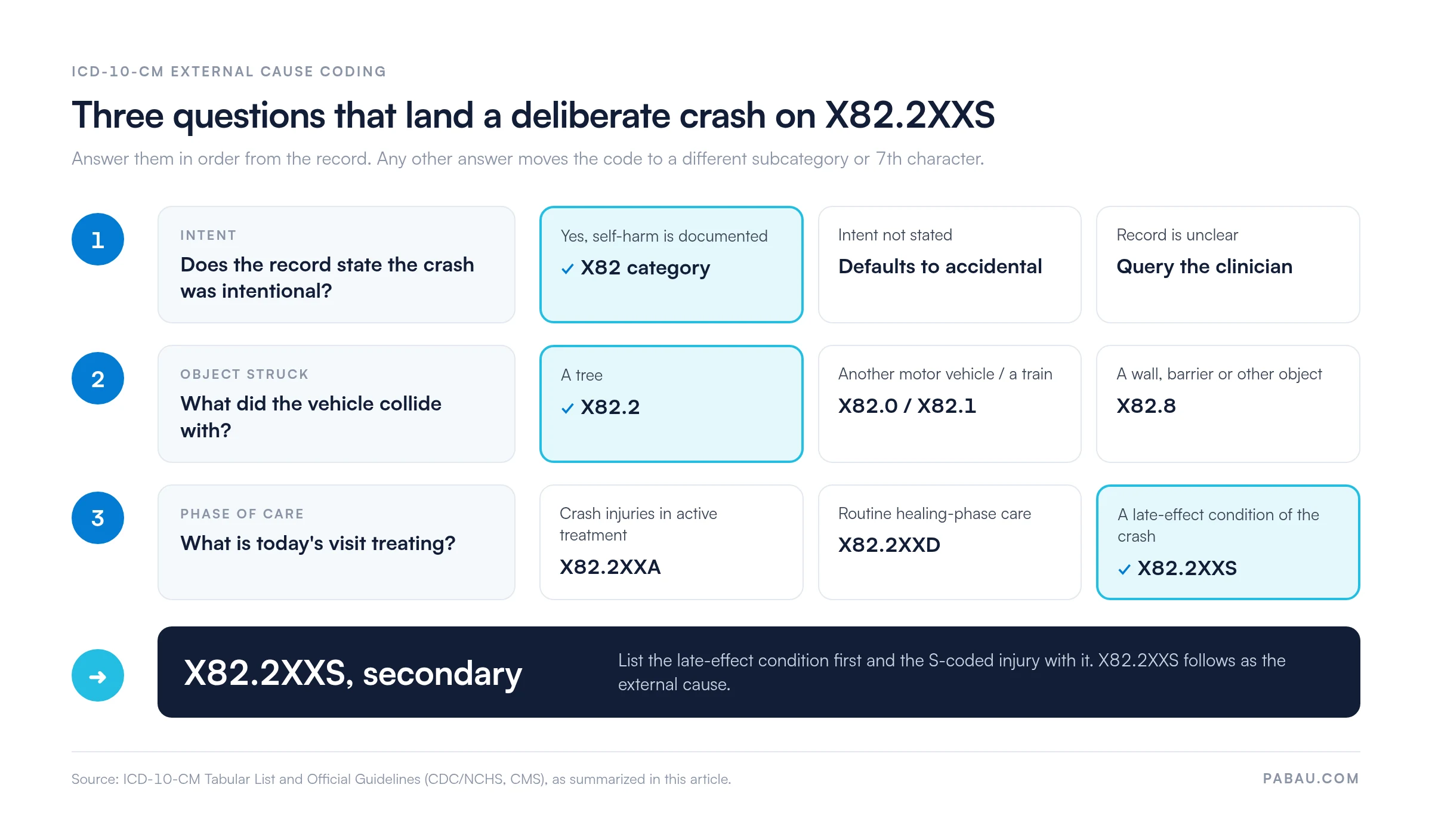
X82.2XXS contains two placeholder X characters, one in position 5 and one in position 6. ICD-10-CM requires them because the X82 category takes a 7th character, while X82.2 has only four characters. The placeholders fill the unused positions so the 7th character lands in the correct slot. The CDC/NCHS ICD-10-CM coding tool shows this structure for the X82 category.
The code breaks down as follows:
Omitting either placeholder produces an incomplete code that fails the HIPAA code set standard. Most claim systems reject it at the front end before human review. Encoder software usually expands the code automatically. Coders working from a code book or a manual lookup should check the full seven-character code, X82.2XXS.
The X82 category covers intentional self-harm by crashing a motor vehicle, and it splits by what the vehicle collided with. Choosing the wrong subcategory misreports the mechanism of injury. The AAPC ICD-10-CM code lookup lists the full X82 family.
A deliberate crash into a train is coded to X82.1, never to X82.2. X82.2 needs documentation that the vehicle struck a tree. X82.8 covers other deliberate crashes, such as into a wall, a barrier, or another fixed object. ICD-10-CM has no unspecified X82.9 subcategory, so an unclear record calls for a clinician query.
X82.2XXS is always a secondary code. It explains the cause of a condition, not the condition itself. Under the ICD-10-CM Official Guidelines for Coding and Reporting, the first-listed diagnosis is the late-effect condition being treated. A note that ties today’s condition to the prior crash makes that sequencing easy to defend.
Codes commonly reported alongside X82.2XXS include:
The injury code carries the 7th character S, and X82.2XXS follows it as the external cause. Never report X82.2XXS without a first-listed diagnosis that names the condition being treated.
Claims billed with X82.2XXS need documentation that establishes three points. These are the intent behind the original crash, the mechanism of a motor vehicle striking a tree, and the link to the current condition. Sound medical billing compliance practices lower the risk of payer audits on intentional self-harm claims.
The medical record must contain:
If the record does not state intent, ICD-10-CM defaults the cause to accidental. Query the clinician rather than assuming self-harm. Some commercial payers also exclude self-inflicted injuries under their policy terms. Check the payer’s coverage policy before submitting X82.2XXS on a commercial claim.
X82.2XXS claims are denied for a predictable set of reasons. Most are preventable with a pre-submission check of the 7th character, the placeholders, and the sequencing. In Pabau, the billing and EHR software we build, claims reach payers through the Claim.MD clearinghouse, which checks them against payer edits first. For broader denial management workflows, tracking self-harm code denials in one place saves rework.
Understanding medical billing denial codes helps when appealing X82.2XXS denials. The claim adjustment reason code (CARC) on the remittance shows which problem the payer found. CARC 16 means the claim lacks information or has a billing error. CARC 11 means the diagnosis is inconsistent with the procedure billed. Submitting a clean claim on the first attempt prevents most of these outcomes.
Run a pre-bill check on every X82 claim. Confirm both placeholder X characters, check that X82.2XXS sits after the first-listed diagnosis, and confirm that diagnosis is a specific condition code. A five-minute check prevents a long appeal cycle.
The United States still uses ICD-10-CM for diagnosis coding in all HIPAA-covered transactions. ICD-11 has not been adopted for US clinical coding, and CMS and NCHS have announced no transition date. The WHO ICD-11 browser places intentional self-harm in its chapter on external causes of morbidity or mortality. US practices should not report ICD-11 codes on current claims.
When the US eventually moves to ICD-11, practices will need to remap active X82 codes to their ICD-11 equivalents. The CMS ICD-10 codes page publishes code set updates and will be the authoritative source for crosswalk tables when they become available.
A sequela claim for a deliberate crash often draws on records written months apart. Intent sits in an old psychiatric note, the mechanism in a discharge summary, and the late effect in today’s visit note. When one piece is missing, the claim stalls for a clinician query or goes out unsupported.
Pabau keeps clinical notes, diagnosis codes, and claims in one patient record. Clinicians can capture intent, mechanism, and the late-effect link in custom note templates, so coders read the full history in one place. Coders then add the first-listed condition and X82.2XXS to the claim, and Claim.MD submits it and tracks its status.
The result is fewer queries back to clinicians and fewer X82.2XXS claims returned for missing documentation.

Pabau helps mental health and multidisciplinary practices keep clinical notes, diagnosis codes, and claims in one record, so coders spend less time chasing missing documentation.

X82.2XXS is narrow by design. It fits only a late effect of a deliberate crash into a tree, reported after the condition it explains. A crash into a train belongs to X82.1 instead. Missing placeholders, a misread 7th character, or first-position sequencing will sink an otherwise valid claim.
The fix starts in the record. A note that names the intent, the tree, and the late-effect link gives the coder what the claim needs. To see how Pabau keeps that record and the claim together, explore our claims management software or book a demo.

Need to understand how clearinghouse validation catches code errors before submission? Pabau’s Claim.MD clearinghouse guide explains real-time claim editing, payer connectivity, and how front-end validation reduces rework.
Want a framework for managing external cause code denials systematically? What is revenue cycle management covers the end-to-end process for turning coding accuracy into collected revenue.
Want ICD-10, CPT, and HCPCS rules on one page? The medical coding cheat sheet covers CPT, ICD-10, HCPCS, and E/M code basics in one quick reference.
ICD-10 Code X82.2XXS is the billable external cause code for the sequela of an intentional collision of a motor vehicle with a tree. It applies when a patient is treated for a late-effect condition caused by a prior deliberate crash into a tree. The code is always secondary and is listed after the condition being treated.
X82.2XXA applies to each encounter where the patient receives active treatment for the crash injuries. X82.2XXS applies when the visit treats a late-effect condition caused by the crash, such as chronic post-traumatic headache or a psychological sequela. The phase of care, not the number of visits, decides which 7th character applies.
Use S when the visit treats a condition that arose as a direct result of the original injury. Use D for routine care during the healing or recovery phase after active treatment, such as a cast change or follow-up imaging. Late-effect language in the note supports S, and healing-phase follow-up language supports D.
No. ICD-10-CM has no national requirement to report external cause codes, although some states and payers mandate them. The Official Guidelines encourage reporting them for injuries whenever they apply. On a sequela visit, X82.2XXS documents the cause behind the condition, which supports the claim if it is audited.
Use X82.1, intentional collision of motor vehicle with train, plus the 7th character that matches the encounter. X82.2 covers only a deliberate crash into a tree. X82.0 covers a crash into another motor vehicle, and X82.8 covers other deliberate crashes.