ICD-10 Code D25.9: Leiomyoma of uterus, unspecified
ICD-10 Code D25.9: Definition and quick reference ICD-10 Code D25.9 is the billa...

Last Updated: Nov 24, 2026
Billable Code Specific Code
X13.1XXA is the billable ICD-10-CM code for other contact with steam and other hot vapors, initial encounter. It records steam that burns the skin or eyes, while steam that is breathed in is coded to X13.0XXA.
It is always a secondary code, listed after the burn T code it explains. Where the injury happened is reported separately, with a Y92 place of occurrence code.
Let Pabau's smart automation suggest the right codes, reduce claim denials, and keep your practice compliant—effortlessly.
Automate repetitive tasks and focus on what matters most—your patients.
Reduce coding errors and ensure compliance with the latest regulations.
Clean claims, fewer denials, and faster reimbursements.
Powerful insights and reporting to help your practice thrive.
HIPAA compliant SOC 2 certified GDPR-compliant Trusted by 4,000+ clinics worldwide

X13.1XXA is the billable ICD-10-CM external cause code for other contact with steam and other hot vapors, initial encounter.
It covers steam that touches the skin or eyes. Steam that is breathed in is coded to X13.0XXA, inhalation of steam and other hot vapors.
Category X13 has no place-of-occurrence axis, so a home kitchen and a restaurant kitchen take the same code. Report the place separately with Y92.
List X13.1XXA after the burn T code it explains, and give it the 7th character for the encounter: A, D or S.
Pabau’s practice management platform sends 837P claims through Claim.MD, so the burn code, X13.1XXA and the note behind them leave together.
ICD-10 code X13.1XXA means “Other contact with steam and other hot vapors, initial encounter.” That is the official descriptor in the CMS ICD-10-CM code set, which lists inhalation separately under X13.0. The code records steam that touches the skin, eyes or other body surfaces. It is an external cause code, so it explains how a burn happened and sits behind the burn code on the claim.
The code belongs to the X10-X19 block (Contact with heat and hot substances) in Chapter 20, External causes of morbidity. Category X13 holds only two subcategories, and they split on how the steam reached the patient.
Only the full code is billable. X13 and X13.1 are headers, and the two “X” placeholders hold the 7th character in position. A claim line that drops a placeholder or the 7th character is rejected as an invalid code. The burn T codes and Y codes that travel with X13.1XXA each have an entry in Pabau’s code library for coders.
X13.1XXA applies when steam or another hot vapor burns the outside of the body by accident. The mechanism must be vapor, not a hot liquid, a hot object or a flame. Where the injury happened does not change the code.
Clinical scenarios where X13.1XXA is the correct external cause code:
The four scenarios share one code, X13.1XXA, even though they happen in a home, a cafe and an industrial site. The setting is captured by a Y92 place-of-occurrence code, not by the X13 subcategory.
X13.1XXA and X13.0XXA share the same agent and differ on route. X13.0XXA is inhalation of steam and other hot vapors, so it explains a burn of the airway. X13.1XXA covers every other contact, which in practice means the skin and the eyes.
The injury code is the quickest check. A T27 respiratory tract burn paired with X13.1XXA is a mismatch, and so is a skin burn paired with X13.0XXA alone. When one event burns both the face and the airway, report both external cause codes, each linked to its own injury.
ICD-10-CM guidelines allow as many external cause codes as the record needs. List first the one that explains the most serious injury, which is often the airway burn and X13.0XXA.
Ask the documenting clinician to state two facts in the note: whether the patient inhaled the steam, and which body surfaces it touched. Those two lines decide between X13.0XXA and X13.1XXA. They also support the burn T codes, which makes the claim easier to defend in an audit.
Category X13 sits in the accident section of Chapter 20, so X13.1XXA assumes the burn was accidental. Steam burns with a documented intent go to other categories.
When the record says nothing about intent, the guidelines direct you to code it as accidental. Use Y27.0XXA only when the documentation states that intent cannot be determined.
X13.1XXA carries no Excludes notes of its own. The X10-X19 block carries an Excludes1 note for exposure to fire and flames (X00-X08) and exposure to excessive natural heat (X30). A burn caused by flame or natural heat is coded to X00-X08 or X30, not X13. A steam contact injury in the same event still takes X13.1XXA.
Adjacent codes frequently confused with X13.1XXA:
The 7th character tells the payer which stage of care the claim covers. All three X13.1 codes describe the same mechanism, and only the episode of care differs.
A common error is reading “initial encounter” as the first visit. The 7th character A applies while the patient is still receiving active treatment, even on the third or fourth visit. Switch to D once care has moved to routine healing-phase follow-up.
External cause codes from Chapter 20 are never the principal or first-listed diagnosis. X13.1XXA always follows the injury code that describes the condition being treated. The diagram below runs the full choice, from intent and route through to the order of codes on the claim.
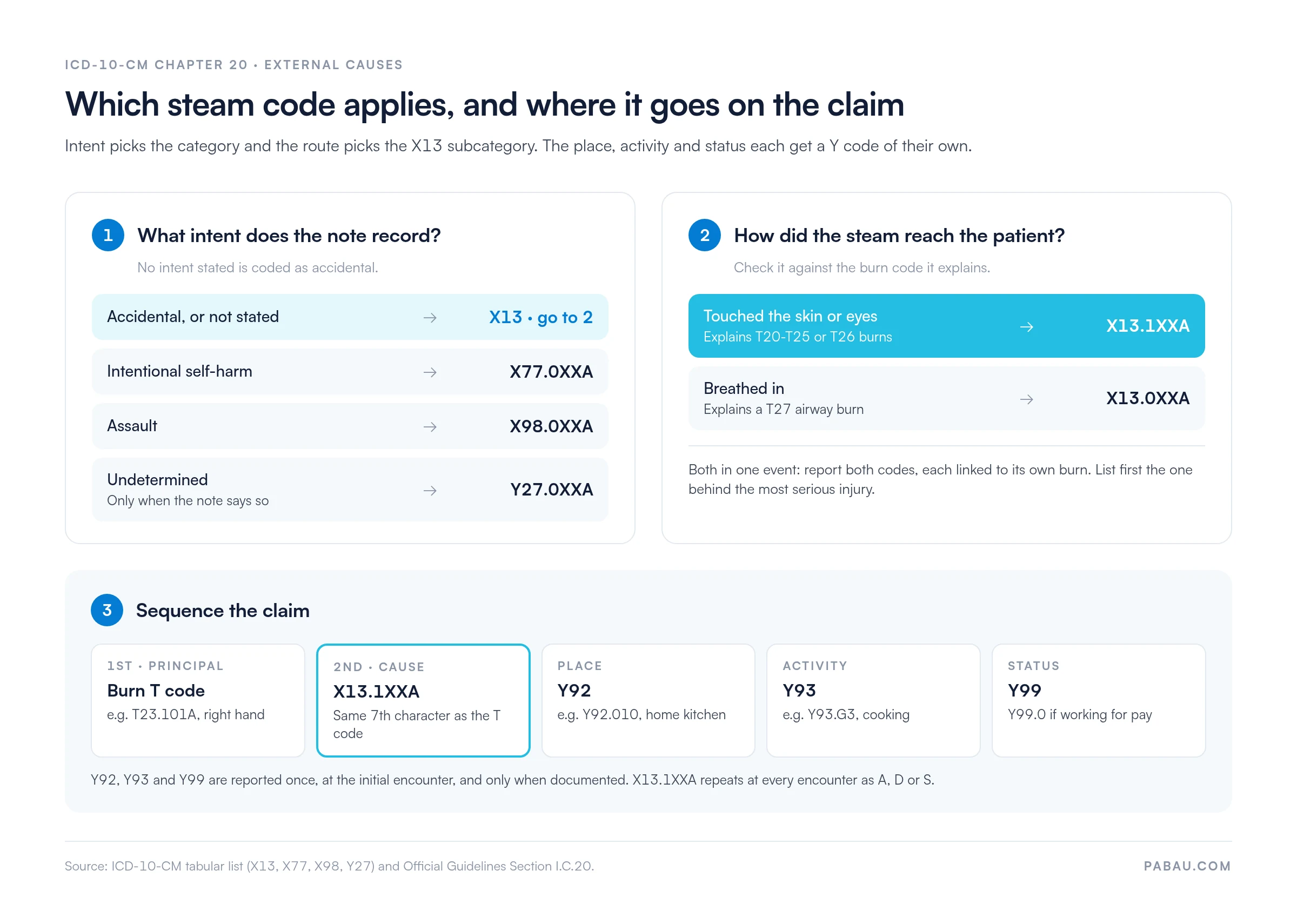
Correct sequencing for a steam burn to the hand, sustained while cooking at home:
The Y92, Y93 and Y99 codes are reported once, at the initial encounter, and carry no 7th character. X13.1XXA repeats on every encounter for the injury, moving to D or S as care progresses.
Do not use Y92.9 when the place is not stated. Leave the place code off instead, and treat Y93.9 the same way when the note does not name the activity. Cooking at home is non-work activity, which is why the example takes Y99.8 rather than Y99.0.
A clean claim submission depends on this order. A claim with X13.1XXA as the first-listed diagnosis typically comes back with an edit error or a review hold. Practices that send claims to Claim.MD from Pabau see those rejections against the claim they came from.
The provider note must establish four elements to support X13.1XXA, plus the details that feed the Y codes. Missing any of the four leaves the code open to challenge.
An ED note that reads “accidental steam burn to right hand from pressure cooker while cooking at home, no inhalation” covers every element. A note that says “burn to right arm, treated” supports the T code and nothing more. Query the provider when the mechanism or the route is missing, rather than assigning X13.1XXA on inference.
Section I.C.20 of the ICD-10-CM Official Guidelines for Coding and Reporting governs every external cause code, including X13.1XXA. Four instructions from that section shape how the code is used:
The guidelines also note that external cause reporting has no national mandate. It is required where a state reporting rule or a payer policy asks for it. Most hospital systems report these codes routinely for trauma registries and quality reporting, so check each payer’s medical billing compliance rules before leaving them off.
Medicare, Medicaid and commercial payers treat X13.1XXA as an informational secondary code. It explains the burn, but reimbursement is driven by the injury codes and the procedures performed.
Billing teams that understand medical billing fundamentals set the right expectation for these codes. They inform the payer, but they do not carry a charge. Pabau’s claims software for billing teams keeps the external cause codes on the same claim as the burn diagnosis they explain.
External cause code denials follow predictable patterns. These are the six most common problems on X13.1XXA claims and the correction for each.
Effective denial management workflows include a pre-submission check for a Chapter 20 code with no companion injury code. The AAPC ICD-10-CM code lookup lists X13.0 and X13.1 with their 7th-character variants.
Run a monthly audit of claims carrying Chapter 20 external cause codes. Pull any with a denial for “invalid principal diagnosis” or “code not billable as primary.” Both are fixed with a sequencing correction on resubmission.
A steam burn claim needs up to five codes that agree with each other: the burn, X13.1XXA, and the place, activity and status codes. In many practices the provider writes the note and a biller reads it days later to pick each code. A detail missing from the note becomes a denial or a provider query.
In Pabau, the burn diagnosis, the external cause codes and the clinical note sit on the same patient record. Pabau sends the claim as an 837P through Claim.MD and brings the remittance back to that record. A denied external cause line can be traced to the note that produced it, so it gets fixed at the source.

Pabau keeps the burn diagnosis, the external cause codes and the clinical note in one patient record, then submits the claim through Claim.MD. Fewer external cause lines come back for a missing code or a mismatched encounter.

X13.1XXA turns on one question: did the steam touch the patient, or did the patient breathe it in? Contact takes X13.1XXA and inhalation takes X13.0XXA, wherever the injury happened. Put the place in a Y92 code, list the burn T code first and match the 7th character to the encounter.
Ask for a note that names the steam, the surfaces it touched and whether it was inhaled. With those three facts, a coder settles each choice on the first pass. Book a demo to see how Pabau keeps the note and the burn codes on one claim.

Coding the burn that X13.1XXA explains? ICD-10 code T23.309A covers a third-degree burn of an unspecified hand, the kind of T code X13.1XXA follows on a claim.
Debriding a steam burn? CPT code 97598 explains the add-on for each extra 20 sq cm of selective debridement.
Seeing repeat denials across your injury claims portfolio? Denial management in healthcare covers the workflows and audit structures that reduce systematic rejection patterns.
Want to understand how the 837 file carries your ICD-10 codes to payers? The 837 EDI file guide explains the transaction set that carries your diagnosis codes, external cause codes included, to the payer.
ICD-10 code X13.1XXA means other contact with steam and other hot vapors, initial encounter. It records steam that burns the skin or eyes by accident. It belongs to Chapter 20, External causes of morbidity, and is reported as a secondary code after the burn T code it explains.
Yes, X13.1XXA is a billable 7-character ICD-10-CM code. It cannot be the only code on a claim, because it needs a principal diagnosis from the T20-T32 burn codes. The parent codes X13 and X13.1 are not billable on their own.
X13.1XXA applies while the patient is receiving active treatment for the steam burn. X13.1XXD applies in the healing phase, once care has moved to routine aftercare such as dressing changes or wound checks. The 7th character follows the nature of the visit, not its number in a series.
Yes, always. Section I.C.20 of the ICD-10-CM Official Guidelines makes every Chapter 20 external cause code a secondary code, never the principal diagnosis. The burn T code (T20-T32) comes first, and X13.1XXA follows it on the claim.
The six most frequent problems are X13.1XXA listed as the primary diagnosis, the wrong 7th character, and a missing burn T code. The others are a 7th character mismatch between the T code and X13.1XXA, and X13.1XXA paired with an airway burn. The last is documentation that does not name the steam, the route of contact or the intent.
The CPT codes depend on the treatment performed, not the external cause. Common companions include 16020-16030 for burn dressings and debridement, and 97597-97598 for selective wound debridement. Severe steam burns may need split-thickness autografts (15100-15121) or full-thickness grafts (15200-15261).
Use X13.0XXA when the patient inhaled the steam or hot vapor, which usually comes with a T27 burn of the respiratory tract. Use X13.1XXA when the steam touched the skin or eyes. If both happened in the same event, report both codes, each with its own burn code.
X13.1XXA does not record where the injury happened, so add a Y92 place of occurrence code whenever the record documents the place. Y92.010, for example, is the kitchen of a single-family house. Report it once, at the initial encounter, and leave it off rather than using Y92.9 when the place is not stated.