ICD-10 code S61.201A: Open wound of left index finger without nail damage
ICD-10 code S61.201A covers a left index finger wound of unstated type ICD-10 co...

Last Updated: Oct 16, 2026
Billable Code Specific Code
T23.309A is the billable ICD-10-CM code for burn of third degree of unspecified hand, unspecified site, initial encounter.
One warning before you assign a code in this family. T23.309A is often confused with T23.139A, and the two codes describe entirely different injuries. T23.139A is a burn of first degree of unspecified multiple fingers (nail), not including thumb. Only the T23.3xx series carries third-degree burns of the wrist and hand.
The code sits within the T23 category, burns and corrosions of wrist and hand, in ICD-10-CM Chapter 19. That chapter covers injuries, poisonings, and certain other consequences of external causes.
According to the CMS ICD-10-CM code files, T23.309A has been valid since the FY2016 implementation of ICD-10-CM and remains active in the FY2026 code set.
Let Pabau's smart automation suggest the right codes, reduce claim denials, and keep your practice compliant—effortlessly.
Automate repetitive tasks and focus on what matters most—your patients.
Reduce coding errors and ensure compliance with the latest regulations.
Clean claims, fewer denials, and faster reimbursements.
Powerful insights and reporting to help your practice thrive.
HIPAA compliant SOC 2 certified GDPR-compliant Trusted by 4,000+ clinics worldwide

ICD-10 code T23.309A describes a third-degree (full-thickness) burn of an unspecified hand at an unspecified site, initial encounter – billable for FY2026
Use T23.309A only when the chart records neither laterality nor a specific hand site. T23.301A (right) and T23.302A (left) come first when the record names a side
T23.309A is not the same as T23.139A, which describes a first-degree burn of multiple fingers rather than a third-degree burn of the hand
7th character A covers active treatment, D covers routine healing care, and S covers sequela. Picking the wrong character is a leading audit trigger
Practice management software like Pabau pairs ICD-10 codes with procedure codes and tracks denial patterns across burn injury claims
Every character in a T23 code carries one decision, and reading them in order is the fastest way to avoid the T23.139A mix-up. The fourth character sets the degree. The fifth sets the site within the wrist and hand. The sixth sets laterality, and the seventh sets the encounter type.
Two of those seven characters record silence rather than a finding. The breakdown below shows which value each one would take if the chart had spoken.
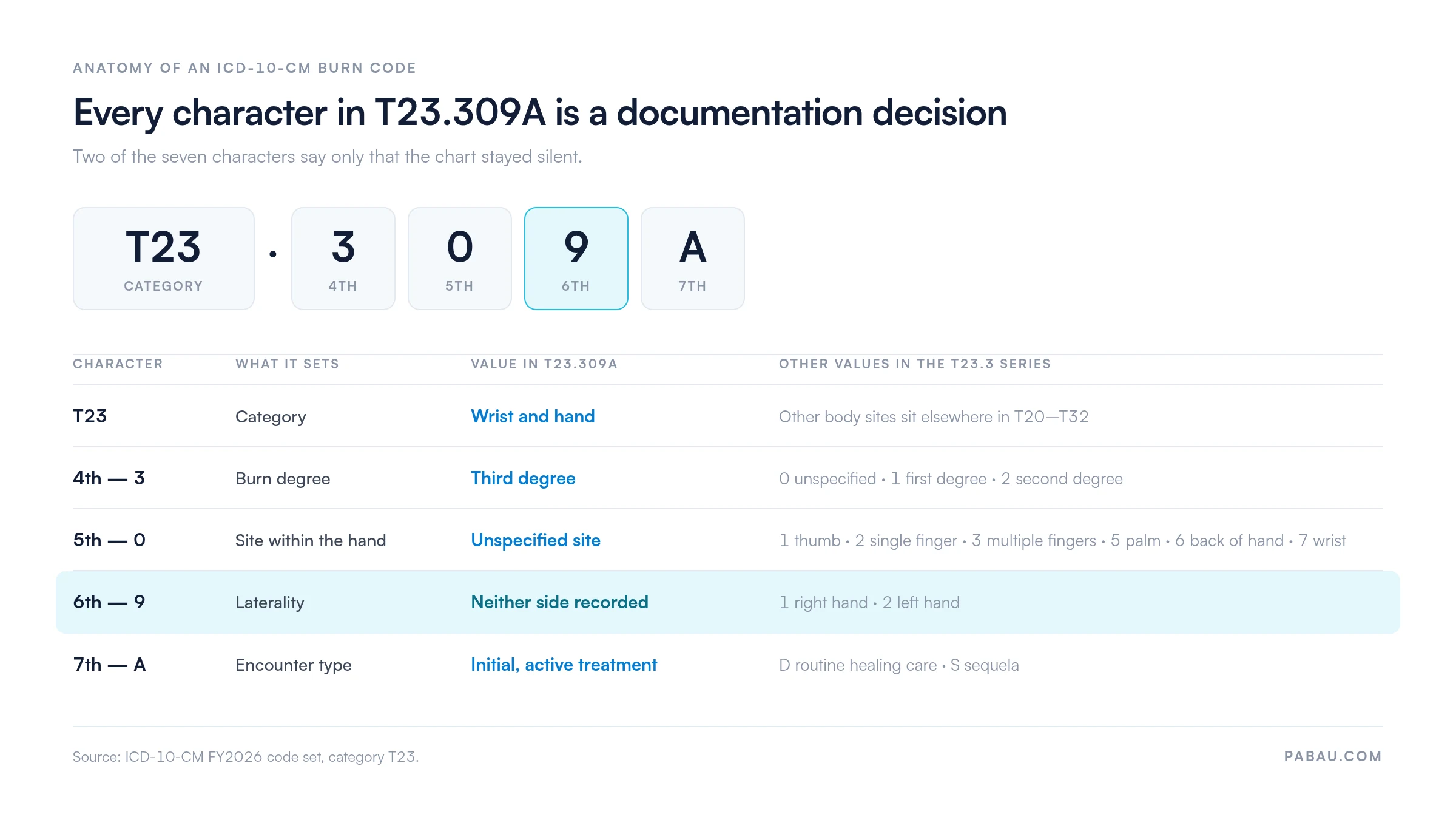
Run T23.139A through the same reading and the difference becomes obvious. Its fourth character is 1, so the burn is first degree. Its fifth character is 3, so the site is multiple fingers, not including the thumb. That code cannot describe a third-degree hand burn under any documentation.
A third-degree burn destroys the epidermis and full dermis, extending into subcutaneous tissue. These injuries typically present with a leathery, waxy, or charred appearance.
They are painless at the burn site itself, because the nerve endings there have been destroyed. Hand burns at this depth almost always require surgical intervention, including escharotomy, skin grafting, or reconstruction.
The “unspecified” elements in T23.309A signal two documentation points at once. Laterality was not recorded, and no specific site within the hand was named either. Per the ICD-10-CM Official Guidelines, coders should assign the most specific code the clinical record supports.
When multiple burn degrees exist at the same anatomical site, ICD-10-CM guidelines direct coders to the highest degree present. A hand presenting with both second and third-degree involvement maps to the third-degree code.
The T23 category covers all burns and corrosions of the wrist and hand. It is structured around two axes: burn degree, and anatomical site within the wrist and hand. Laterality runs as a third dimension through every sub-code grouping.
For third-degree burns of the hand at an unspecified site, three laterality variants exist. Selecting between them depends entirely on what the provider documented. Per CDC/NCHS ICD-10-CM guidance, unspecified codes are a last resort, not a default.
A common coder error is defaulting to T23.309A because it is “easier.” Payers, including Medicare, flag this pattern as a documentation deficiency during post-payment audits. If the chart says “right,” code T23.301A. Using T23.309A when laterality is actually documented is an audit liability, not a coding shortcut.
The fifth character records the site within the hand, and T23.309A leaves it unspecified. That makes it the wrong choice whenever the note names the thumb, a finger, the palm, or the back of the hand. The codes below all carry unspecified laterality and the 7th character A. Swap the sixth character for 1 or 2 when the side is documented.
Reserve T23.309A for records that genuinely name no site and no side. Our ICD-10-CM code index carries the neighboring T-series entries you may need alongside it.
The 7th character in T23.309A is not a technicality. It changes the clinical meaning of the code entirely. The wrong character is one of the most common triggers for retrospective audits on burn injury claims.
The ICD-10-CM Official Guidelines (Section I.C.19.a) confirm that 7th character A applies throughout the course of active treatment. That holds even when a patient has multiple visits for the same injury. A patient returning for graft revision at week three still receives T23.309A, not T23.309D, because active surgical treatment is ongoing.
Per the AAPC ICD-10-CM coding reference, the switch from A to D comes later. It happens once the provider documents that active treatment has concluded and the visit is now for healing or monitoring care.
The sequela character (S) is often misapplied. It does not mean “late visit.” It means the burn itself has fully healed. The patient now presents for a condition that resulted from the burn, such as scar contracture limiting hand range of motion. When S is used, sequence the residual condition code first, followed by T23.309S as the cause.
ICD-10-CM instructs coders to assign external cause codes as additional codes with T23.309A. They describe the cause of the burn, the place of occurrence, and the patient’s activity at the time of injury. Some payers treat external cause codes as optional for reimbursement. CMS still encourages their use, and several state trauma registries require them for reporting.
The most common presentation of T23.309A is a kitchen or workshop thermal burn. X10 covers contact with hot drinks, food, fats, and cooking oils. X19 covers contact with other and unspecified heat and hot substances. Report the external cause information as a secondary code after T23.309A on the claim.
T31 codes are advisable rather than mandatory. ICD-10-CM Official Guidelines Section I.C.19.d.6 calls a category T31 code advisable once a third-degree burn involves 20% or more of total body surface area. The guideline frames this as reporting and burn-mortality data for burn units, not as a payment requirement.
A hand-only burn rarely approaches that threshold, since the palmar surface of one hand covers roughly 1% of total body surface area. In a multi-site burn pattern, though, the aggregate third-degree area can cross 20%. A T31 code becomes worth adding at that point.
The pattern continues in the same shape up to T31.9 for burns covering 90% or more of the body surface. Read the final digit as the third-degree portion, not the total. That is the digit the 20% guidance is measured against.
ICD-10-CM draws a firm line between thermal burns and chemical corrosions. T23.309A covers thermal burns only: heat from flames, hot surfaces, hot liquids, steam, and radiation. Chemical agents such as acids and alkalis cause corrosions, which use a separate block of T23 sub-codes.
Burns run from T23.0 to T23.3 by degree, and corrosions run from T23.4 to T23.7 in the same order. Corrosion codes also need an additional code from the T51-T65 range to identify the chemical substance involved.
Verify the mechanism of injury in the provider’s note before assigning T23.309A. Never default to the thermal burn code when the chart documents a chemical exposure. The CDC ICD-10-CM files carry the full T20-T32 tabular list, including the 7th character and laterality structure.
Payer audits on burn claims typically look for four elements in the clinical record before accepting T23.309A. Missing any one of them creates a vulnerability during a retrospective review.
Documentation deficiency and laterality mismatch are the two most frequent denial triggers on T23-series claims. A pre-submission checklist for burn cases brings both rates down. Standards for medical billing compliance require that coded diagnoses be supported by the provider’s own words, not inferred from procedure notes alone.
Run a quarterly audit of every T23.309A claim your practice submits. Flag any claim where the chart also records a side or a specific hand site, since that is the overcoding pattern auditors look for. Correcting to T23.301A, T23.302A, or a site-specific code before a payer finds it avoids recoupment. Add a second check for T23.139A on burn claims. That code is a first-degree finger burn, so it should never appear on a third-degree hand case.
Third-degree hand burns typically drive higher-acuity DRG assignments than first or second-degree injuries. Inpatient burn cases with a graft group to MS-DRG 928 or MS-DRG 929.
DRG 928 covers a full thickness burn with skin graft or inhalation injury, with CC/MCC. DRG 929 is the same group without CC/MCC. Cases without a graft fall to MS-DRG 934 instead.
The DRG depends on the full claim picture, not on T23.309A alone. Accurate degree coding still matters, because it determines whether the burn is treated as a full thickness case at all.
For outpatient burn care, T23.309A maps to Ambulatory Payment Classifications (APCs) tied to wound care and burn treatment procedures. The diagnosis code itself does not set reimbursement. The CPT procedure codes for debridement, grafting, or evaluation and management determine the base payment, with T23.309A confirming medical necessity.
Three denial reasons dominate T23.309A claims:
A clearinghouse pre-scrub catches all three before submission. That costs far less than reworking a denial after the remittance arrives.
Most practices code a burn encounter in one system, scrub the claim in another, and track denials in a spreadsheet. A laterality mismatch or a wrong 7th character then surfaces weeks later, in a remittance file. By then the encounter has closed and the coder has moved on.
Practice management software like Pabau keeps the diagnosis, the procedure, and the claim in one record. Pabau’s software for billing teams pairs ICD-10 codes with procedure codes at charge entry. A T23.309A line then reaches the clearinghouse with its supporting CPT codes attached.
Claims go out electronically through Claim.MD, which reaches thousands of US payers, and code validation runs before the claim leaves the system. Remittance data lands back in the same record, so you can see which diagnosis codes drive your rejections.
The outcome is a shorter path from the burn encounter to payment. You also get a denial pattern you can act on while the chart is fresh.


Pabau’s claims management software pairs ICD-10 codes with procedure codes automatically and flags common denial patterns. Clean claims go out through the Claim.MD clearinghouse to thousands of US payers.

T23.309A is the right code only when the record shows a third-degree hand burn with no side and no specific site named. The rest of the T23.3xx series is more specific, and the T23.1xx series is a different injury altogether. Getting this code right depends on reading the documentation, not on reaching for a familiar-looking code.
The practical move is to query the provider for laterality while the encounter is still open. A one-line clarification at that point is cheaper than a recoupment two years later. To see how Pabau pairs ICD-10 codes with procedure codes on burn claims, book a demo with our team.

Need a framework for tracking burn claim denials? Denial management in healthcare covers systematic approaches to reducing recurring rejection patterns by diagnosis code.
Wondering how T31 TBSA codes interact with MS-DRG assignment? Revenue cycle management explains how diagnosis coding drives inpatient reimbursement groupings.
Submitting burn claims to Medicare and commercial payers? Comparing clearinghouse options helps you choose the right submission pathway for high-acuity injury claims.
Not sure what a clearinghouse does to your claim before a payer sees it? Medical claims clearinghouse walks through the pre-scrub checks that catch coding errors early.
Reading remittance files to find your denial patterns? Electronic remittance advice explains how to trace an adjustment back to the diagnosis code that caused it.
ICD-10 Code T23.309A is a billable diagnosis code for a third-degree, full-thickness thermal burn of an unspecified hand. It covers an unspecified site on that hand, at the initial encounter for active treatment. It belongs to ICD-10-CM subcategory T23.3, which covers third-degree burns of the wrist and hand, and it is valid for FY2026 claims.
No. T23.139A is a burn of first degree of unspecified multiple fingers (nail), not including thumb, initial encounter. It is a first-degree finger code and cannot be used for a third-degree hand burn. Third-degree hand burns sit in the T23.3xx series, where T23.309A is the unspecified-hand, unspecified-site option.
The 7th character A designates the initial encounter, meaning the patient is receiving active treatment for the burn. It applies to ED visits, debridement, graft surgery, and any visit where the provider is actively managing the injury. Prior visits for the same burn do not change that.
All three describe a third-degree burn of the hand at an unspecified site, at the initial encounter, and they differ only by laterality. T23.301A is the right hand, T23.302A is the left hand, and T23.309A is an unspecified hand. Use T23.309A only when the chart genuinely does not record which hand was burned.
ICD-10-CM guidelines instruct coders to assign external cause codes as additional codes with T23.309A. They cover the cause (such as X10-X19 for thermal contact), the place of occurrence, and the patient’s activity. Some payers require them, CMS encourages their use, and several state trauma registries mandate them for injury reporting.
Use T23.309S only when the original burn has fully healed. The patient must now present for a residual condition caused by it, such as scar contracture or chronic pain. While the burn is still under active treatment, T23.309A applies, no matter how many visits have already taken place.
ICD-10-CM Official Guidelines Section I.C.19.d.6 calls a category T31 code advisable, not required, once third-degree burns reach 20% of total body surface area. The palmar surface of one hand covers roughly 1% of body surface, so a hand burn rarely reaches that point alone. In a multi-site burn that does, add the matching T31 code as a secondary code.
Burns come from thermal sources such as heat, flames, hot liquids, and radiation, and they occupy the T23.0xx to T23.3xx range by degree. Corrosions come from chemical agents such as acids or alkalis, and they occupy T23.4xx to T23.7xx in the same order. A corrosion also needs a T51-T65 code to identify the substance involved.