ICD-10 Code D25.9: Leiomyoma of uterus, unspecified
ICD-10 Code D25.9: Definition and quick reference ICD-10 Code D25.9 is the billa...

Last Updated: Nov 24, 2026
Billable Code Specific Code
H04.129 is the billable ICD-10-CM code for dry eye syndrome of unspecified lacrimal gland. It sits under the non-billable header H04.12, alongside three laterality codes: H04.121 for the right eye, H04.122 for the left and H04.123 for both.
Use H04.129 only when the record does not say which eye is affected. When the chart names the right eye, the left eye or both, the matching laterality code applies instead.
Let Pabau's smart automation suggest the right codes, reduce claim denials, and keep your practice compliant—effortlessly.
Automate repetitive tasks and focus on what matters most—your patients.
Reduce coding errors and ensure compliance with the latest regulations.
Clean claims, fewer denials, and faster reimbursements.
Powerful insights and reporting to help your practice thrive.
HIPAA compliant SOC 2 certified GDPR-compliant Trusted by 4,000+ clinics worldwide

H04.129 is the billable ICD-10-CM code for dry eye syndrome when the record does not state which eye is affected.
H04.12 is a non-billable header, so a claim that carries it alone is rejected as an invalid code.
Three laterality siblings exist: H04.121 (right), H04.122 (left), and H04.123 (bilateral). Use H04.129 only when the chart does not specify.
Missing or inconsistent laterality documentation drives many dry eye denials, so the SOAP note should say why laterality is unspecified.
Pabau, a practice management platform, submits and tracks dry eye claims through Claim.MD and checks the patient’s eligibility before submission.
ICD-10 Code H04.129 is the billable code for dry eye syndrome of unspecified lacrimal gland, used when the record names no affected eye. CMS’s FY2027 ICD-10-CM code files list it as a valid code, while its parent H04.12 is a non-billable header. The table below gives the fields a coder checks first.
H04.129 covers dry eye syndrome when the medical record does not specify the affected eye. Clinically, dry eye syndrome describes inadequate tear production or poor tear quality that leads to ocular surface inflammation and discomfort. The Tabular List adds one inclusion term at H04.12, tear film insufficiency NOS, which codes here too.
The phrase “unspecified lacrimal gland” in the descriptor refers to laterality, not to the gland type. The lacrimal gland secretes the watery layer of the tear film. “Unspecified” means the documentation does not identify which eye’s gland is involved.
Presentations coded here include:
Treat H04.129 as the code of last resort. The CDC/NCHS ICD-10-CM coding tool and the ICD-10-CM Official Guidelines both favor specificity. When the chart supports a laterality, that code takes precedence over H04.129.
A frequent slip with this code family is submitting the non-billable parent H04.12 instead of a valid child code. The tree below shows where each level sits.
The CMS ICD-10-CM code files publish the full tabular list each October. A claim submitted with H04.12 alone comes back as an invalid code. H04.12 is a header that only groups the four laterality codes beneath it. Billers who pull the code from memory or from an outdated superbill template are the likeliest to make this error.
The H04.12 subcategory contains four codes that differ only in which lacrimal gland is affected. Choosing correctly requires a laterality statement in the clinical note.
H04.123 vs. H04.129: This is the most common laterality confusion. H04.123 is for confirmed bilateral involvement. H04.129 is for cases where the documentation is silent on which eye. If a clinician writes “bilateral dry eye” or notes findings in both eyes, H04.123 applies. When the note simply says “dry eye” with no eye specified, H04.129 is correct until the record is clarified.
The wording of the note also decides when the H04.12 family does not apply at all, as the chart below shows.
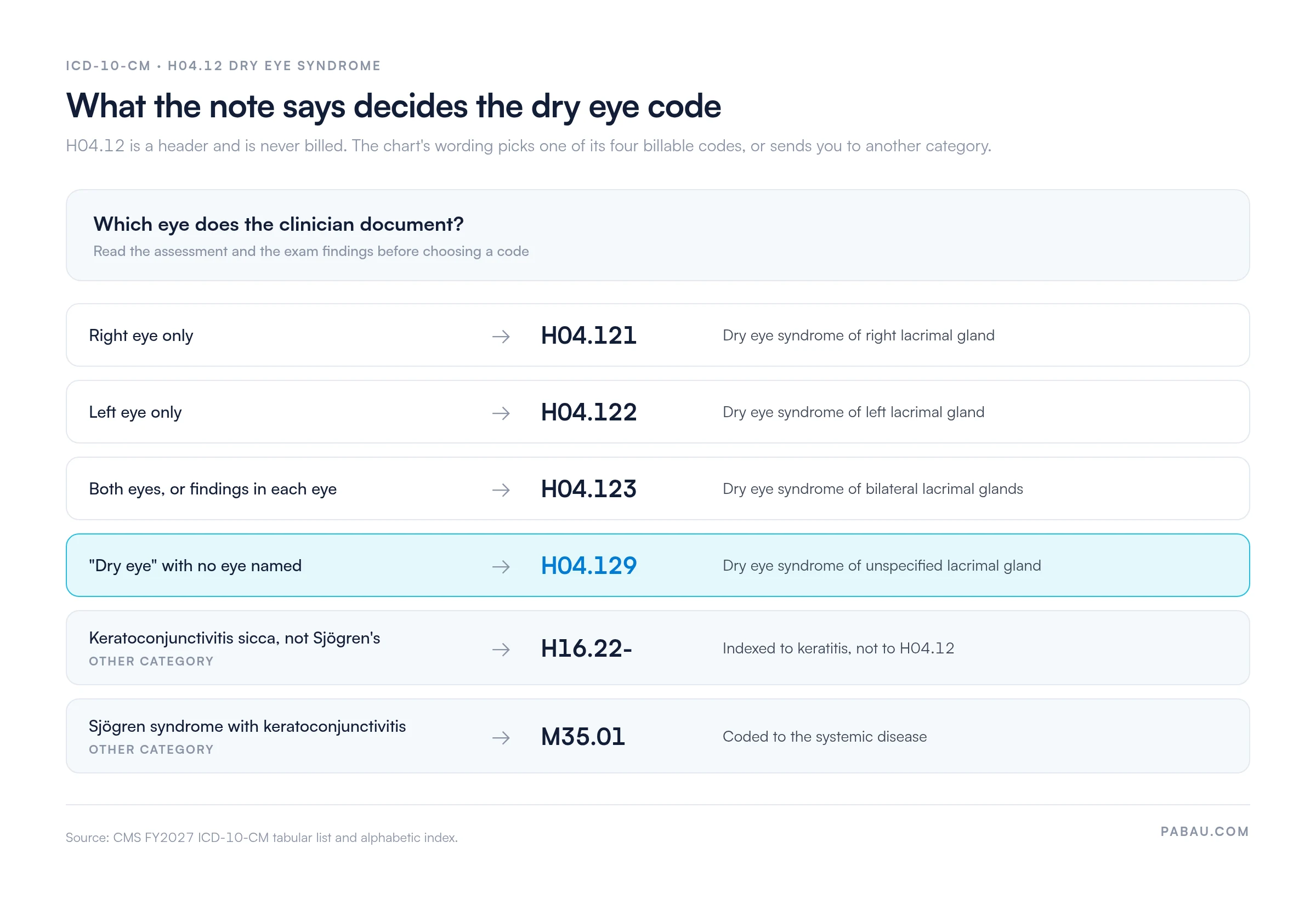
The H04 category carries one Excludes1 note: congenital malformations of the lacrimal system (Q10.4-Q10.6) are coded elsewhere. H04.1 and H04.12 carry no Excludes notes of their own, so the adjacent codes below are a matter of documentation, not of a tabular conflict.
Coders working with ophthalmology and optometry claims should also be aware of frequently confused adjacent codes:
Check the current-year Excludes1 and Excludes2 notes in the ICD-10-CM tabular list each October, because note placement can change with annual updates.
Accurate ICD-10 Code H04.129 coding starts with the SOAP note. Payers check dry eye claims for specific documentation elements, and a thin record is a common reason a paid claim is later recouped.
A compliant note supporting H04.129 should include:
ICD-10 Code H04.129 is a diagnosis code, so it supports the procedure codes on a claim rather than billing on its own. The table below lists the CPT codes most often linked to dry eye visits, from 92002 for a new-patient visit to 92012 for established-patient follow-up.
Medical necessity linkage is mandatory. Each CPT code must be supported by the H04.129 diagnosis in a way that the payer’s LCD or coverage policy recognizes. For 92071, many payers require documented failure of conservative treatment, such as artificial tears for a minimum period, before authorizing therapeutic lens fitting.
Before submitting 0330T with H04.129, verify that your Medicare Administrative Contractor (MAC) has issued a Local Coverage Determination supporting tear film imaging for dry eye. Category III codes lack a national coverage policy, and MAC policies vary. Submitting without checking costs a full adjudication cycle.
Medicare coverage for dry eye treatments billed under H04.129 is governed by Local Coverage Determinations (LCDs) issued by each Medicare Administrative Contractor. Because MACs operate regionally, the specific LCD number and its clinical criteria will differ depending on where your practice is located.
Across most LCD policies, common payer requirements include:
The unspecified laterality of H04.129 can itself slow an authorization request. Some payer portals require a laterality designation before releasing prior authorization for unilateral procedures. When this occurs, returning to the clinician to confirm laterality and upgrading to H04.121, H04.122, or H04.123 is faster than contesting the denial after submission.
Ophthalmology practices billing dry eye encounters face predictable denial patterns. Each has a specific fix.
The medical billing denial codes reference covers CO-4 and CO-11, the codes most often attached to ophthalmology rejections.
H04.129 is a valid, billable ICD-10-CM code. It is not a header or category code. It is a complete six-character code, so it needs no seventh character to be billable.
By contrast, H04.12 is a non-billable header. Claims submitted with H04.12 alone will be returned with a code-invalid rejection before adjudication even begins. Some electronic health records and older superbill templates still list H04.12 as a selectable item without flagging its non-billable status.
ICD-10-CM codes update annually on October 1, the start of each US federal fiscal year. CMS publishes the updated code files in advance. The WHO ICD-10 reference browser shows the international classification the clinical modification is built on.
Verify H04.129’s status each year against the current CMS release before the October effective date. A code that was valid in one fiscal year can be revised, split, or retired in the next. H04.129 has stayed stable since ICD-10-CM was adopted.
A grounding in medical billing fundamentals helps staff confirm code validity against the CMS files. A superbill template can lag behind the annual update.
Once the clinician has documented laterality and the coder has chosen the code, the claim still has to reach the payer and come back paid. Dry eye claims tend to stall at that stage, on a lapsed authorization, a coverage change, or a rejection nobody follows up.
Pabau’s eye care claims software submits US claims through Claim.MD and tracks each one to its remittance. Real-time eligibility checks confirm the patient’s coverage before the claim is submitted. Prior authorization codes, dates and sessions sit on the patient’s case, with a warning when one is missing.
Practices can also set up a recall in Workflows, Pabau’s automation feature, to bring dry eye patients back on a 90-day or 6-month cycle. That return visit is the natural moment for the clinician to confirm laterality and move the patient off H04.129.

Pabau submits and tracks claims through Claim.MD and checks the patient’s eligibility before submission. Ophthalmology and optometry teams see each claim’s status and remittance in one place.

Choose H04.129 only when the chart is silent on laterality, and treat each use as a reason to ask the clinician one question. A query sent before submission costs minutes, while a recouped claim costs the whole visit.
When the note says keratoconjunctivitis sicca or ties the dry eye to Sjögren syndrome, look outside H04.12 before you code. And keep H04.12 itself off every claim.
Book a demo to see how Pabau tracks each dry eye claim from the eligibility check to the remittance.

Need a systematic approach to clearinghouse claim submission? Pabau’s Claim.MD clearinghouse guide explains how real-time eligibility checks and payer-rule validation reduce rejections before they happen.
Seeing recurring CO-4 or CO-11 denials on eye care claims? Clean claim submission best practices outlines the data elements payers require on first pass to avoid code-based rejections.
Want to understand how electronic remittance works after a claim adjudicates? Electronic remittance advice (ERA) explained covers how 835 transaction files communicate payer decisions and denial reason codes back to your billing team.
ICD-10 Code H04.129 is the billable diagnosis code for dry eye syndrome of unspecified lacrimal gland. It is used when the medical record documents dry eye but does not identify which eye is affected. It is the fourth laterality variant under the H04.12 subcategory, chosen only when the chart cannot support a more specific right, left, or bilateral code.
Use H04.123 when the clinician has documented that both eyes are affected (bilateral). Use H04.129 when the documentation is silent on which eye is involved and laterality genuinely cannot be determined from the chart. If the note says “bilateral dry eye” or records findings in both eyes, H04.123 is correct. H04.129 is not an acceptable default when bilateral involvement is evident.
The CPT codes most often submitted with H04.129 are 92002 and 92012 for new and established patient ophthalmological services. Others include 92014 for comprehensive exams, 92025 for corneal topography, and 92071 for therapeutic contact lens fitting. Category III code 0330T (tear film imaging) may also be paired, but requires MAC-level prior authorization verification before submission.
H04.129 has remained stable since ICD-10-CM implementation, but all codes should be verified against the CMS release effective each October 1. If a code is split, retired, or revised, payers will return claims with an invalid-code rejection. Check the CMS ICD-10-CM tabular list file each September before the new fiscal year begins.