

ICD-10 code S61.201A: Open wound of left index finger without nail damage
ICD-10 code S61.201A covers a left index finger wound of unstated type ICD-10 co...

Last Updated: Oct 16, 2026
Billable Code Specific Code
V92.16XD is the billable ICD-10-CM code for drowning and submersion due to being thrown overboard by motion of (nonpowered) inflatable craft, subsequent encounter. It describes a patient thrown overboard by the motion of a nonpowered inflatable craft (no accident to the craft itself). You report it at follow-up visits, once emergency care is over.
As an external cause code, it always follows the injury code, usually T75.1XXD. Two details need the most care: the D seventh character and the mechanism. A fall off the same raft is V92.06XD, and a raft that overturns moves to V90. Below, you'll see how to tell them apart, sequence the claim and document it.
Let Pabau's smart automation suggest the right codes, reduce claim denials, and keep your practice compliant—effortlessly.
Automate repetitive tasks and focus on what matters most—your patients.
Reduce coding errors and ensure compliance with the latest regulations.
Clean claims, fewer denials, and faster reimbursements.
Powerful insights and reporting to help your practice thrive.
HIPAA compliant SOC 2 certified GDPR-compliant Trusted by 4,000+ clinics worldwide

V92.16XD is a billable external cause code for drowning after a patient is thrown overboard by the motion of a nonpowered inflatable craft.
A fall off the same craft is V92.06XD, and a craft that overturns or sinks moves the case to V90.
The seventh character D applies once active treatment is over and the patient returns for routine healing or recovery care.
It is never the principal or first-listed diagnosis. List it after the injury code it explains, usually T75.1XXD.
Pabau’s claims management software pre-fills claims from the patient record and checks required fields before a claim goes to Claim.MD.
ICD-10 code V92.16XD is the billable external cause code for drowning after a patient is thrown overboard by a nonpowered inflatable craft’s motion. It applies at a subsequent encounter, once emergency care is over and the patient returns for follow-up.
The code sits in the water transport accidents block (V90-V94). Within that block, V92 covers drowning on board a watercraft when the craft itself had no accident. The table traces the full path from chapter to billable code.
The seventh character D tells the payer this is a subsequent encounter. The patient has finished active treatment and now receives routine care while healing or recovering.
The patient may still be unwell. D simply records that the emergency phase is over. V92.16 takes one of three seventh characters, with an X holding the sixth position:
The provider’s notes decide which character applies. Never infer the encounter type from the visit date alone. If the record doesn’t show where the patient is in treatment, query the provider.
Picture a teenager sitting on a rubber dinghy on a lake. A sudden wave lurches the dinghy, and she’s thrown into the water. The dinghy stays upright and undamaged.
She’s pulled out after a short submersion and treated in the emergency department. That visit is coded V92.16XA. Two weeks later, she sees a pulmonologist for a cough that lingered after aspiration. That follow-up is where V92.16XD belongs.
For the code to fit, the record has to show three elements:
If she were still in active emergency or inpatient care, V92.16XA would apply. If the visit is for a late effect, such as hypoxic brain injury, consider V92.16XS instead.
Two choices cause most mix-ups here: the mechanism and the craft. Start with the craft’s condition, then look at how the patient left it. The decision path below maps each route from an inflatable craft into the water.
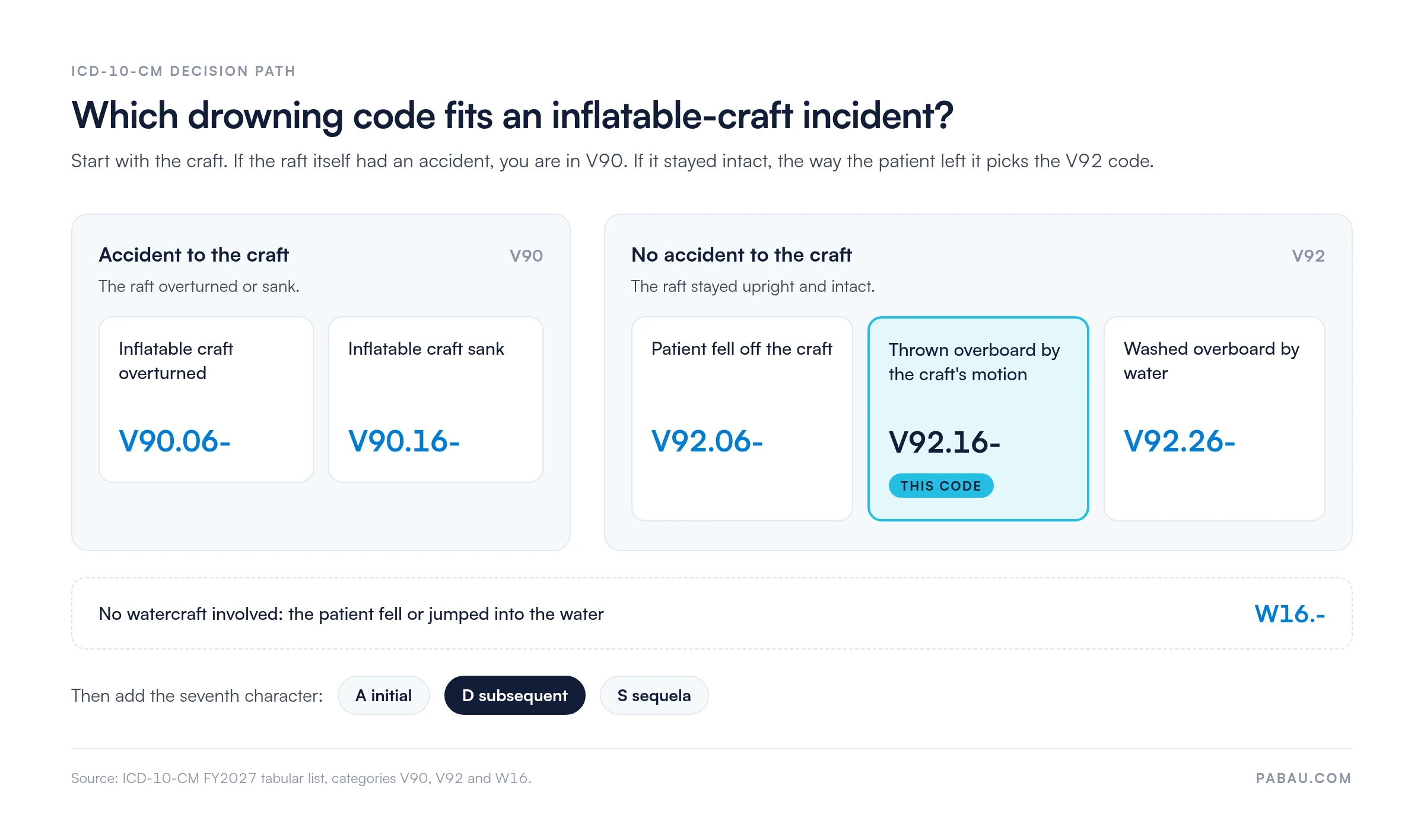
On the other side of the wall, V90.00XA shows how a V90 code reads when the vessel itself overturns. The table below lists the codes most often confused with V92.16XD, and what separates each one.
V92.16 covers inflatable watercraft with no motor, where the craft itself had no accident. Confirm the craft type early, because the wrong craft sends the case to a different subcategory.
V92.16XD is an external cause code. These codes explain how an injury happened, so they are never the principal or first-listed diagnosis.
The CMS ICD-10-CM coding guidelines place external cause codes after the injury or condition code that explains the visit. Here is the order for a V92.16XD claim:
New to how a claim travels from note to payer? Our overview of the medical billing process covers the basics.
V92.16XD is never reported alone. The principal code depends on what brought the patient in for this visit.
Injury codes such as T75.1XXD carry their own seventh character, and it should match the D on V92.16XD. Codes like J69.8 and G93.1 have no seventh character, so there’s nothing to match.
Check every injury code on the claim against the seventh character on V92.16XD. A T75.1XXA principal code beside V92.16XD tells the payer two different encounter stories, and payer edits can reject it.
A clean claim starts in the clinical note. The record must show all three of these elements:
Payer rules matter too. There is no national requirement to report external cause codes unless a payer or state mandates it. Check each payer’s rules.
Record each payer’s rule in your billing policy, so every coder handles V92.16XD the same way. That policy belongs in your wider medical billing compliance program.
The path is short. The provider documents the visit, and the coder assigns the injury code and V92.16XD. Then the claim goes to the payer, whose edits check code order, seventh characters and required fields.
Most rejections at that stage are avoidable. A steady denial management routine catches the patterns below before they repeat.
When a denial does land, our denial codes guide explains what each remittance code means.
Work through the list and the claim has its best chance of passing as a clean claim.
V92.16XD is a billable ICD-10-CM code, valid for FY2027 from October 1, 2026. CMS and the National Center for Health Statistics (NCHS) update the code set every October 1.
Confirm the code each year in the CDC/NCHS ICD-10-CM web tool or the AAPC Codify lookup. A change to a parent category, V92 or V92.1, flows down to every child code. Log the date you verify each code, because that record shows due diligence in an audit.
Set a reminder each September to review the CMS ICD-10-CM update files before the October 1 effective date. Changes to the V90-V94 block are rare, but a parent-level change flows down to V92.16XD.
In many practices, a follow-up like this is coded by hand. A coder reads the note, types the codes into the claim and checks the payer’s fields from memory. One missing field means a rejection and a second submission.
Pabau, the practice management platform we build, takes some of that manual work off the desk. Its claims management software pre-fills the claim from the patient record. Coders can search ICD-10-CM codes like V92.16XD and T75.1XXD in a built-in lookup library.
Before a claim can be sent, Pabau checks that required fields, such as member numbers, are complete. US claims then go through Claim.MD, with eligibility checks and electronic remittance (ERA) posting in the same place. The coding choices stay with your coder, and the claim leaves complete.
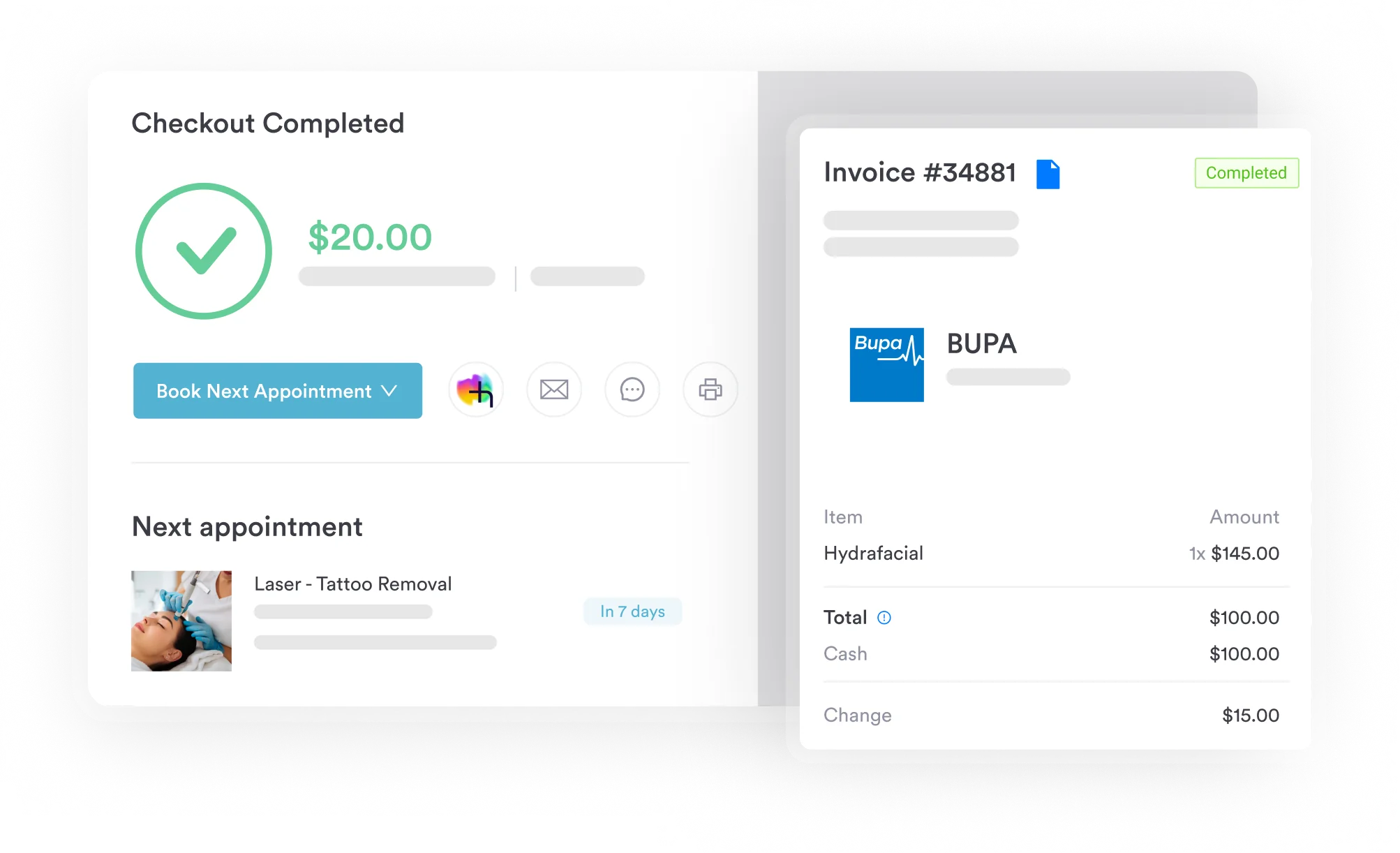

Pabau pre-fills claims from the patient record, gives coders an ICD-10-CM lookup library, and checks required fields before submission through Claim.MD. See how it fits your billing workflow.

Getting V92.16XD right comes down to three decisions. Confirm an intact, nonpowered inflatable craft threw the patient overboard. Use D only for follow-up care, and sequence the code after the injury diagnosis. These are among the most common causes of avoidable denials.
Of the three, the mechanism deserves the most care. If the note is vague about how the patient left the craft, query the provider before you code. A two-minute question costs far less than a resubmission.
Want claims that leave your practice complete and in the right order? Book a demo to see how Pabau handles external cause code claims from note to payment.

Want to understand how medical billing compliance protects claims? Medical billing compliance standards outlines the documentation and coding practices that keep external cause codes audit-ready.
Coding a drowning where the vessel itself had an accident? ICD-10 code V90.21XS covers drowning after falling or jumping from a burning passenger ship, at the sequela stage.
Was there no watercraft involved at all? ICD-10 code W16.821A covers drowning after a fall or jump into other water, at the initial encounter.
Curious what happens to a claim after you press send? The 837 file explained walks through the electronic claim format that payers receive.
V92.16 has only five characters, but the encounter letter must sit in position seven. The X is a placeholder that fills position six. Without it, V92.16D is an invalid code.
No. ICD-10-CM has no stand-alone near-drowning code. Nonfatal drowning goes to T75.1-, unspecified effects of drowning and nonfatal submersion. When the provider documents a specific effect, such as aspiration pneumonitis, code that effect instead.
Drowning with no watercraft falls outside V90-V94. Drowning in a lake or the sea is W69, accidental drowning while in natural water. A swimming pool is W67, and a fall or jump into water is W16.-.
No. V92.16XD belongs to ICD-10-CM, the US clinical modification. Countries that use the WHO ICD-10, such as the UK, code to V92 with a shorter structure and no seventh character.
Usually not. ICD-10-CM guidelines report place of occurrence (Y92) and activity (Y93) codes only once, at the initial encounter. A follow-up claim with V92.16XD normally leaves them off.



