

ICD-10 Code S42.444P: Medial epicondyle fracture, right humerus
ICD-10 Code S42.444P: full descriptor and code validity ICD-10 Code S42.444P car...

Last Updated: Oct 13, 2026
Billable Code Specific Code
W16.821A is the billable ICD-10-CM code for jumping or diving into other water striking bottom causing drowning and submersion, initial encounter.
Let Pabau's smart automation suggest the right codes, reduce claim denials, and keep your practice compliant—effortlessly.
Automate repetitive tasks and focus on what matters most—your patients.
Reduce coding errors and ensure compliance with the latest regulations.
Clean claims, fewer denials, and faster reimbursements.
Powerful insights and reporting to help your practice thrive.
HIPAA compliant SOC 2 certified GDPR-compliant Trusted by 4,000+ clinics worldwide

W16.821A covers drowning and submersion after jumping or diving into other water and striking the bottom. It is billable and valid for FY2026.
The sibling code W16.822A covers any other injury from the same bottom strike. Confusing the two is the most common error in this code family.
This is an external cause code, so it is never the principal diagnosis. For a nonfatal drowning the injury code is usually T75.1XXA.
The 7th character A means initial encounter, D means subsequent encounter, and S means sequela. The wrong character is a leading cause of rejection.
Practice management software like Pabau keeps the clinical note and the codes your team enters on one record, then submits US claims through Claim.MD.
ICD-10 Code W16.821A describes drowning and submersion caused by jumping or diving into other water and striking the bottom. The A suffix marks the initial encounter, so the patient is still under active treatment.
Other water means a body of water that is neither a swimming pool nor a natural body of water classified elsewhere in the chapter. For example, decorative fountains, ornamental ponds, industrial water tanks, and irrigation channels all fall into this group.
W16.821A is billable and specific, so it can go on a claim exactly as written. The CDC/NCHS ICD-10-CM tool confirms the code is valid for fiscal year 2026, effective October 1, 2025.
The distinction that decides this code is the outcome, not the mechanism. W16.821A is the drowning and submersion code. By contrast, W16.822A covers any other injury produced by the same bottom strike, such as a cervical fracture or a laceration.
The parent code W16.821 is not billable on its own, because it needs a 7th character before it can be submitted. Specifically, W16.821A is one of its three billable children, alongside W16.821D and W16.821S.
The 7th character is what turns the non-billable parent W16.821 into one of three claimable codes. As a result, picking the wrong character is one of the most common causes of rejection on external cause claims. In turn, each character carries a precise meaning defined in the CMS ICD-10-CM guidelines.
Key distinction for coders: initial encounter does not mean the patient’s first visit to any provider. Instead, it means active treatment is still underway. For example, a near-drowning patient stabilized in the ED and then admitted to intensive care is still in an initial encounter on admission. Once active treatment ends and the visit becomes routine monitoring, the subsequent encounter character D applies.
The sequela character S applies when a new condition arises from the original drowning after the acute phase has resolved. For instance, hypoxic brain damage diagnosed months after a near-drowning is the textbook example. Overall, the same 7th character logic runs across the whole trauma chapter.
W16.821A sits on a clearly defined path through ICD-10-CM. Indeed, walking the hierarchy is the quickest way to confirm you have landed on the most specific billable code rather than a non-billable parent.
Category W16 is built on four decisions rather than one, which is why so many of its codes look alike. In fact, each code fixes a value for all four, and changing any single value moves you to a different code:
W16.821A is the jump-or-dive, other-water, struck-the-bottom, drowning combination. Meanwhile, each of its nearest neighbors differs on one axis, or on two, and the grid below shows which. For further detail, you can look up any of them in our ICD-10-CM code library.
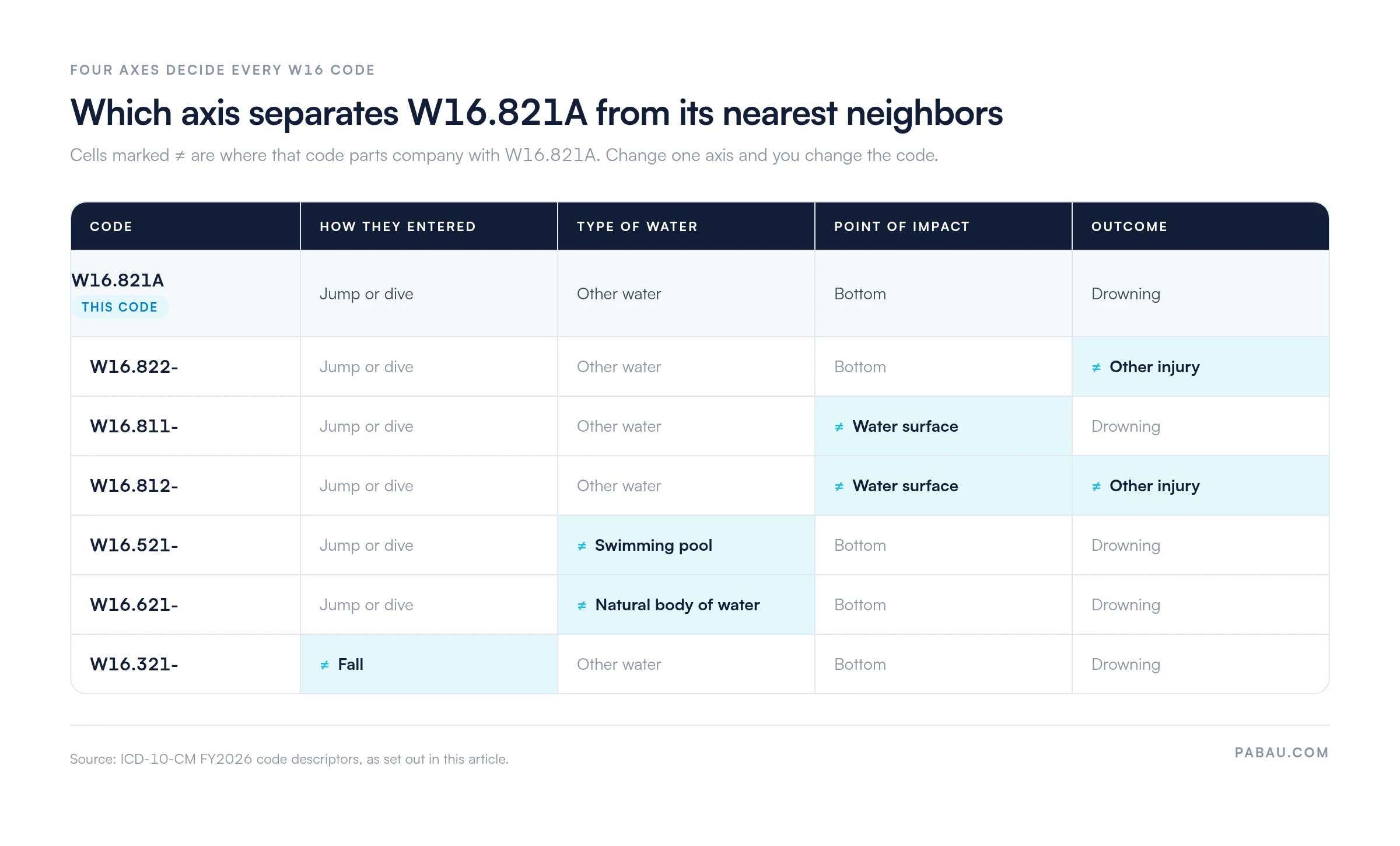
Precision matters here because the three neighboring codes differ from W16.821A on a single axis each. As a result, getting one axis wrong sends the claim to a code that reads almost identically but describes a different event.
What other water means: water that is neither a swimming pool nor a natural body of water. By contrast, jumps and dives into a pool use the W16.5 series. Similarly, rivers, lakes, and the sea use W16.6. Finally, fountains, garden ponds, industrial tanks, and similar manmade water features are what remains.
What striking bottom captures: the patient made contact with the floor of the water body after the jump or dive. In a drowning case, that impact is usually the reason the patient could not resurface. For example, loss of consciousness or a cervical injury removes the ability to swim.
What drowning and submersion means: respiratory impairment caused by immersion in liquid. Indeed, the code covers the nonfatal event that reaches a clinician, whatever its severity. In practice, that spans a brief submersion with a full recovery through to cardiac arrest. A fatal drowning is recorded on the death certificate rather than a claim, so W16.821A almost always describes a survivor.
W16.821A is always a secondary code. Codes from the V00-Y99 chapter explain the circumstances of an injury under the WHO ICD-10 classification framework and the official ICD-10-CM guidelines. In addition, CMS and NCHS maintain the US guidelines jointly. These codes never describe the injury itself, so they cannot carry a claim on their own.
Sequencing on a drowning claim runs in a specific order. First, code the effects of the drowning, which for a nonfatal submersion is usually T75.1XXA. Next, add codes for any documented consequence the provider treated, such as anoxic brain injury or aspiration pneumonitis. Then add W16.821A to explain how the drowning happened.
That order is where a reversed reading of this code does the most damage. Specifically, a coder who believes W16.821A means other injury will sequence a fracture code first and never report the submersion. The claim then describes an event the record does not support.
External cause codes rarely travel alone. For instance, alongside W16.821A you can report a place of occurrence code from Y92, an activity code from Y93, and an external cause status code from Y99. However, place of occurrence, activity, and status are each reported once, at the initial encounter, and are not repeated on follow-up visits.
Submitting a clean claim with external cause codes means checking four things before it leaves the practice:
HIPAA requires ICD-10-CM on every covered entity claim. That means the current fiscal year’s version of the code set, never last year’s.
Check your payer’s claim submission requirements before adding external cause codes. Most payers accept them on professional (CMS-1500) and institutional (UB-04) claims. Some Medicaid programs and workers’ compensation payers cap how many external cause codes a single claim can carry. When in doubt, lead with the injury code and confirm payer policy on the supplementary codes.
An external cause code is only as good as the note behind it. Specifically, W16.821A carries five documentation requirements, and each one has to be present in the record for the code to survive an audit. As a result, this is where most denial risk on this code originates.
When any of the five is missing, query the treating provider before you assign W16.821A. Otherwise, guessing at the water type or the outcome to fit a code raises audit risk on a claim that is already unusual. For instance, practices that run software for billing teams can review the documentation attached to a claim before it goes out.
ICD-9-CM organized aquatic injuries around the outcome and the activity, not the water body. Instead, accidental drownings sat in the E910 series, subdivided by what the patient was doing rather than where. No exact equivalent to W16.821A exists, so every mapping below is approximate.
Two ICD-9 codes get cited on this crosswalk by mistake, and both describe something else entirely. Indeed, neither one belongs in a W16.821A mapping:
Coders handling legacy data for research, appeals, or payer correspondence on pre-2015 claims should remember that the E910 series ignored water body type altogether. By contrast, ICD-10-CM introduced the pool, natural water, and other water split that makes W16.821A possible. For crosswalk work, verify against the CMS General Equivalence Mappings files rather than an approximate table.
Choosing correctly inside W16 means confirming all four axes from the clinical record. Specifically, the table below lists the codes most often confused with W16.821A, and names the axis that separates each one from it.
Two more branches sit further out. For example, a jump or dive taken from a boat has its own subcategory at W16.7. Similarly, a dive into water the record never identifies falls to W16.9. The AAPC ICD-10-CM code reference gives you a searchable view of the full category when you need to cross-check a sibling.
Run the four axes in order before you commit to a W16 code. First, did the patient jump or dive, or fall? A fall into other water is W16.32-, not W16.82-. Second, what kind of water was it? Third, did the patient strike the surface or the bottom? Fourth, and most often missed, was the outcome drowning and submersion or another injury? Only the drowning answer gives you W16.821A. Another injury gives you W16.822A.
The external cause code usually gets assigned last, once the injury coding is settled. First, a coder reads the encounter note, picks a W16 code from a lookup tool, and the claim goes out. Often, a sequencing mistake surfaces weeks later as a denial, by which time the note is cold and the patient has moved on.
Practice management software like Pabau keeps the clinical note, the diagnosis codes your coders enter, and the claim on a single patient record. As a result, your team does not re-key codes between the chart and the claim form, so one common source of transcription error drops out.
Pabau submits and tracks US claims electronically through Claim.MD, our clearinghouse partner, including 837P submission and real-time eligibility checks. However, your coding team still decides which codes apply. Pabau then carries those codes through to the claim file and reports back what the payer did with it.
So when a drowning claim comes back denied, you can see the code set that was sent and the payer response. In addition, the encounter note behind it sits on the same record. Overall, preventing a denial at the documentation stage takes far less time than working it after the fact.
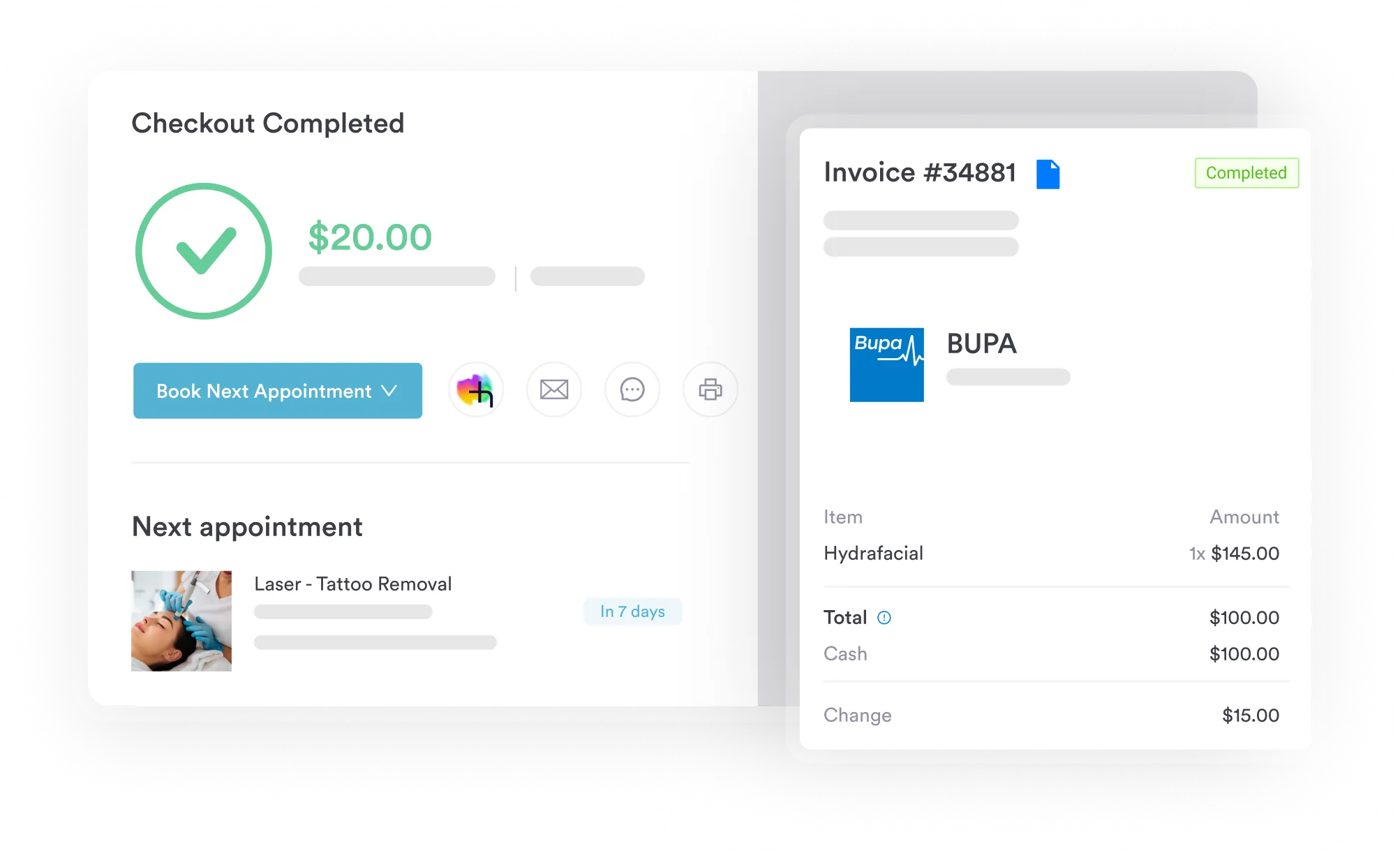

Pabau holds the encounter note, the codes your team enters, and the claim on one record. Claims go out through Claim.MD, so you can see what the payer received.

W16.821A turns on one word in its descriptor, and that word is drowning. If the record documents a bottom strike that produced a fracture and no submersion, the code you want is W16.822A instead.
Four checks keep the claim clean. First, confirm the patient jumped or dived rather than fell. Second, confirm the water was neither a pool nor a classified natural body. Third, confirm the impact was with the bottom. Finally, confirm the record documents drowning or submersion, then match the 7th character to the encounter.
Pabau’s claims management software keeps that documentation and the resulting claim on the same record, and submits through Claim.MD for US practices. To see how it handles injury-related claims in your practice, book a demo.

Need another external cause code that can never lead a claim? Assault ICD-10 codes: Y09 and the X92-Y09 range works through the same secondary-only sequencing rule outside category W16.
Working on denial prevention for injury claims? Denial management in healthcare outlines the most common causes of claim rejection and how to address them systematically.
Want to understand the clearinghouse submission process? 837 file submission guide explains how electronic claims are structured for payer transmission, including external cause code placement.
Reporting the companion codes alongside a W16 code? ICD-10 Code Y90.9 covers the blood alcohol code that often accompanies a diving or drowning event.
W16.821A is the billable external cause code for drowning and submersion after jumping or diving into other water and striking the bottom. Other water means a body of water that is neither a swimming pool nor a natural body of water classified elsewhere. The A marks an initial encounter.
Yes. W16.821A is billable and specific, and it is valid for FY2026 from October 1, 2025. It still has to be sequenced after the injury code, because an external cause code cannot stand as a principal diagnosis.
Both codes describe the same event, a jump or dive into other water that ends with the patient striking the bottom. W16.821A applies when the outcome is drowning and submersion. W16.822A applies when the outcome is any other injury, such as a cervical fracture or a laceration.
No. W16.821A is an external cause of morbidity code from the V00-Y99 chapter, so it is always secondary. For a nonfatal drowning the principal diagnosis is usually T75.1XXA, unspecified effects of drowning and nonfatal submersion, initial encounter.
Category W16 covers falls, jumps, and dives into water. Its codes are split on four axes. Those are how the patient entered the water, the type of water, the point of impact, and the outcome.




