ICD-10 Code T32.63: Corrosions involving 60-69% body surface
ICD-10 Code T32.63: Full description and billable status ICD-10 Code T32.63 is a...

Last Updated: Nov 2, 2026
Billable Code Specific Code
V92.00XS is the billable ICD-10-CM code for drowning and submersion due to fall off merchant ship, sequela. It is an external cause code, used when a patient is treated for a lasting effect of a past fall overboard from a merchant ship.
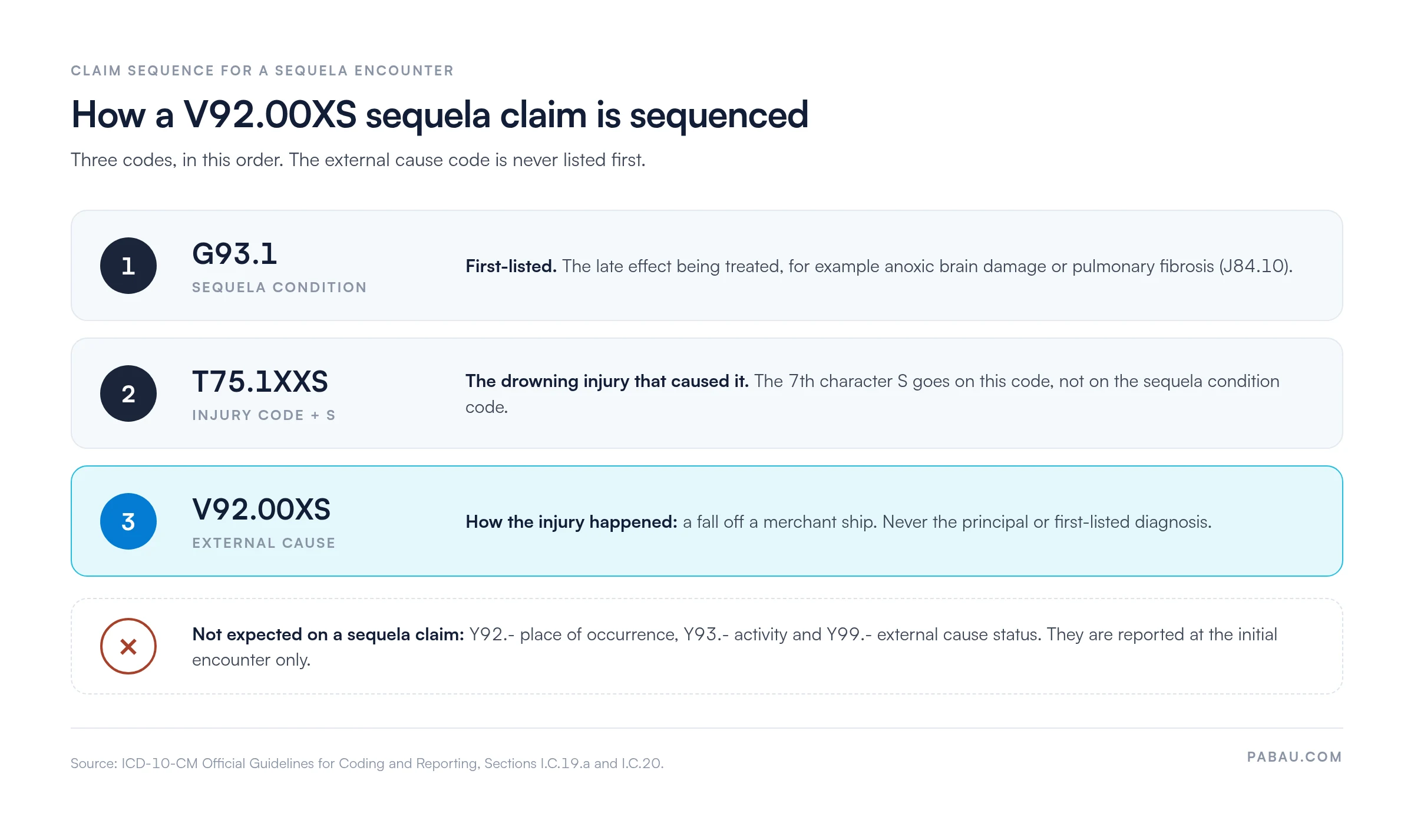
V92.00XS is never the principal diagnosis. The sequela condition is listed first, then the drowning injury code with S, then V92.00XS. The 7th character S applies only once the original injury has resolved.
Let Pabau's smart automation suggest the right codes, reduce claim denials, and keep your practice compliant—effortlessly.
Automate repetitive tasks and focus on what matters most—your patients.
Reduce coding errors and ensure compliance with the latest regulations.
Clean claims, fewer denials, and faster reimbursements.
Powerful insights and reporting to help your practice thrive.
HIPAA compliant SOC 2 certified GDPR-compliant Trusted by 4,000+ clinics worldwide

V92.00XS is a sequela external cause code, so it always follows the sequela condition code and is never listed first.
A sequela claim also carries the drowning injury code with S, such as T75.1XXS, sequenced after the sequela condition.
The 7th character S marks a late-effect encounter, while A covers initial active treatment and D covers subsequent active treatment.
The fifth character sets the vessel: merchant ship (V92.00), passenger ship (V92.01), fishing boat (V92.02) or other powered watercraft (V92.03).
Pabau’s billing software scrubs each claim for missing or invalid details, then submits it through the Claim.MD clearinghouse.
The ICD-10-CM Tabular List defines ICD-10 Code V92.00XS as drowning and submersion due to fall off merchant ship, sequela.
It is a secondary external cause code, reported after the late-effect condition it explains. Each character in the code carries a specific meaning:
The placeholder X in position 6 is required by the CMS ICD-10-CM Official Guidelines. V92.00 has only five characters, so X holds position 6 and lets S sit in position 7. Leaving it out creates an invalid code that claim edits reject.
V92.00XS belongs to Chapter 20 of the ICD-10-CM Tabular List, the chapter dedicated entirely to external causes of morbidity. Its position also explains why it never stands alone. Chapter 20 codes describe causes, so they always pair with injury or condition codes from other chapters.
External cause codes in the V00-Y99 range are supplementary by definition under ICD-10-CM Official Guidelines Section I.C.20. They describe the how and where of an injury, never the injury itself. Their sequencing rules differ from those for principal diagnoses, so they need their own check in your medical billing workflows.
The three valid 7th characters for V92.00 describe three different encounters. All three are active, billable codes in the ICD-10-CM Tabular List, but they are not interchangeable. The right one depends on where the patient is in their care.
A sequela is a late effect. It is a condition that develops as a direct result of a prior injury, once the original injury has resolved. For V92.00XS, the sequela is the chronic or permanent complication of the drowning or near-drowning, not the drowning itself.
Common sequela conditions after drowning and submersion include anoxic brain damage (G93.1), pulmonary fibrosis from aspiration-related lung damage, cognitive impairment and neurological deficits. Under ICD-10-CM Official Guidelines Section I.C.19.a, the late-effect condition is coded first. The injury code that caused it follows, with S as its 7th character. For drowning, that is T75.1XXS, and V92.00XS comes after both.
The switch from D to S follows the documentation. Once the physician records that the original injury has resolved and the patient is managed for its permanent effects, the encounter becomes a sequela encounter. The ICD-10-CM guidelines reserve S for that point, so XD no longer applies after it.
The table below sets out which scenarios V92.00XS covers and which need a different code.
V92 covers drowning without an accident to the watercraft. If the ship capsized, sank or was otherwise damaged, the code moves to category V90, drowning and submersion due to accident to watercraft.
Subcategory V92.0 breaks down by vessel type in the fifth character. The record must name the vessel behind whichever code is billed, and a mismatch is something auditors flag.
Watch for V92.09XS on charts that name the vessel in the operative report or clinical notes. Per the CDC/NCHS ICD-10-CM guidelines, coders should assign the most specific code the documentation supports. An unspecified code on a chart that supports a specific one is a known audit trigger.
Check the clinical record for the exact vessel description before selecting a V92.0 subcode. Documentation that says ‘cargo vessel,’ ‘freighter,’ or ‘commercial ship’ supports V92.00. If the note says ‘ferry’ or ‘cruise ship,’ V92.01 is correct. Flag charts where the vessel type is unclear and query the provider before submitting. A query now costs less than reworking a denial later.
Coding V92.00XS takes six steps, and the order of the codes matters as much as the codes themselves. A sequela claim lines up three codes in a fixed sequence:
No. V92.00XS cannot be used as a principal diagnosis under any circumstances. Per ICD-10-CM Official Guidelines Section I.C.20, external cause codes from the V00-Y99 range are supplementary codes only. They are never permitted as the first-listed or principal diagnosis on a claim.
A claim with V92.00XS in the principal diagnosis position is likely to be rejected. The sequela condition code belongs in that position, with V92.00XS in a secondary position to explain the external cause.
A defensible V92.00XS claim rests on the record. Coders cannot assign specificity the record does not support. If a denial is appealed, auditors will ask for the source documentation. Strong medical billing compliance also needs the record to link the original event to the current sequela.
The clinical record must contain all of the following to support V92.00XS:
The ICD-10-CM guidelines set no national requirement to report external cause codes. Some payers and states require them, so confirm the payer’s policy before you submit. When V92.00XS is reported, it never stands alone. It follows the sequela condition code it explains.
Check these points before submitting a V92.00XS claim:
Each of the five errors below can get a V92.00XS claim denied, and each can be caught before submission. Denial management workflows treat them as preventable, because a check before the claim goes out costs less than working a remittance. Knowing the payer denial codes helps billing teams read rejection messages and route corrections faster.
Run a pre-submission edit on every V92.- claim for the five denial triggers above. Check for an external cause code in the principal position and XS on an active treatment encounter. Also check for V92.09 on a chart that names the vessel, a missing placeholder X and a missing sequela condition code. Fixing any one before transmission costs less than a single denial rework cycle.
Without a check before submission, a missing or invalid detail on a V92.00XS claim surfaces only when the claim comes back. By then, the rework and the payment delay have already started.
Pabau’s claims software for practices scrubs every claim for missing or invalid details before it leaves the system. A claim with errors is flagged “Needs action,” and Fix shows what went wrong and links to the field to correct.
Clean claims go to payers through the Claim.MD clearinghouse. If a payer rejects one, Pabau shows the reason, so your team can correct the claim and resubmit it. Code order stays your coders’ call, and the field-level checks around it run on every claim.

Pabau’s claim validation checks every claim for missing or invalid details before it goes out through the Claim.MD clearinghouse. Your billing team fixes V92.00XS claim errors before submission, not after a denial.

Treat V92.00XS as the last code in a three-code chain. When the record names a merchant ship, confirms the fall and documents a resolved injury with a lasting effect, the code is safe to bill.
If any of those three is missing, query the provider before you code. A query takes minutes, while a denied claim restarts the billing cycle.
Book a demo to see how Pabau’s claim validation catches missing or invalid details before your V92.00XS claims reach the payer.

Need to understand how claim denials are categorised? Denial codes in medical billing explains the CARC/RARC system and how to read payer rejection messages.
Want a broader view of the clearinghouse submission process? Medical claims clearinghouse guide covers how electronic claims move from practice to payer and where external cause code errors are caught.
Looking for ERA and remittance advice workflows? Electronic remittance advice explains how to read 835 transaction sets and match denials back to specific claim lines.
ICD-10 Code V92.00XS is the billable ICD-10-CM code for drowning and submersion due to fall off a merchant ship, sequela encounter. It is an external cause code used to document the mechanism of a prior injury whose late effects are now being treated. It cannot be used as a principal diagnosis and must always be paired with the sequela condition code.
V92.00XA is used for the initial active-treatment encounter (the emergency or acute care visit when the drowning occurred). V92.00XD covers subsequent encounters during ongoing active treatment while the condition is still healing. V92.00XS applies only after the original injury has resolved. The patient is then treated for a permanent late effect, such as anoxic brain injury or pulmonary fibrosis.
Use a sequela encounter code once the physician has documented that the original injury is fully resolved. The patient is now presenting for a permanent or chronic complication that directly resulted from that injury. If active treatment for the injury is still occurring, use the subsequent encounter suffix (D) instead.
V92.00XS needs the sequela condition code as the first-listed diagnosis, for example G93.1 (anoxic brain damage) or J84.10 (pulmonary fibrosis). The drowning injury code with S, T75.1XXS, follows it. Place of occurrence (Y92.-), activity (Y93.-) and external cause status (Y99.-) codes are reported only at the initial encounter. They are not expected on a sequela claim.
No. Under ICD-10-CM Official Guidelines Section I.C.20, external cause codes in the V00-Y99 range, including V92.00XS, are never sequenced first-listed or principal. A claim that lists V92.00XS first is likely to be rejected. The sequela condition code belongs in the principal diagnosis slot.
Requirements vary by payer and state. The ICD-10-CM guidelines set no national requirement for reporting external cause codes, but some payers and state programs require them. Workers’ compensation carriers often expect detailed external cause documentation for maritime workplace injuries. Confirm requirements in the payer’s provider manual before submitting.