ICD-10 Code V91.84XS: Other burn due to burning watercraft
ICD-10 Code V91.84XS: overview and key facts ICD-10 Code V91.84XS identifies the...

Last Updated: Oct 30, 2026
Billable Code Specific Code
V90.32XD is the billable ICD-10-CM code for drowning and submersion due to falling or jumping from crushed fishing boat, subsequent encounter. It is an external cause code, reported after the condition treated at a follow-up visit.
The code sits in Chapter 20 (External causes of morbidity, V00–Y99), under category V90 in block V90–V94. It applies once active treatment for the drowning has ended. Its closest neighbor, V93.32XD, covers a fall on board a fishing boat with no submersion.
Let Pabau's smart automation suggest the right codes, reduce claim denials, and keep your practice compliant—effortlessly.
Automate repetitive tasks and focus on what matters most—your patients.
Reduce coding errors and ensure compliance with the latest regulations.
Clean claims, fewer denials, and faster reimbursements.
Powerful insights and reporting to help your practice thrive.
HIPAA compliant SOC 2 certified GDPR-compliant Trusted by 4,000+ clinics worldwide

V90.32XD is a billable external cause code for drowning or submersion after falling or jumping from a crushed fishing boat, subsequent encounter.
It is always sequenced after the principal diagnosis and is never the first-listed code on a claim.
The 7th character D marks a subsequent encounter, for routine care after active treatment ends. A marks the initial encounter, and S marks a sequela.
The placeholder X in the 6th position is mandatory, and a code string without it is rejected as an invalid format.
Pabau’s claims management software keeps notes, codes and invoices together and sends electronic CMS-1500 claims to US payers through Claim.MD.
ICD-10 Code V90.32XD is the valid, billable ICD-10-CM code for “Drowning and submersion due to falling or jumping from crushed fishing boat, subsequent encounter.” It is a Chapter 20 external cause code.
It records how the injury happened, while a separate code carries the condition being treated. The code is valid in the current tabular list, per the CDC/NCHS ICD-10-CM web tool.
Check the Excludes1 notes at category V90 before you assign it. They send other scenarios to V92.-, V94.81- and W16.-, and military watercraft accidents to Y36 and Y37.
The code hierarchy starts at Chapter 20 (V00-Y99) and Block V90-V94 (water transport accidents). It then runs Category V90 → Subcategory V90.3 (crushed watercraft) → Code V90.32 (fishing boat) → V90.32XD (subsequent encounter).
That specificity ladder is why vessel documentation matters. Without “fishing boat” in the note, a coder cannot use V90.32 over V90.39 (crushed unspecified watercraft). You can check the neighboring codes on that ladder in our ICD-10-CM code index.
Each segment of the descriptor needs its own support in the provider note. Matching the note to each segment prevents the specificity errors behind downcoded or denied claims.
The “crushed” qualifier is where coding most often outruns the documentation. The provider note must state that the vessel was crushed, beyond the fact that the patient fell overboard from a fishing boat.
A fire on board points to V90.22- instead, and a simple fall overboard with no damage to the boat points to V92.02-. Coding from assumed circumstances rather than documented ones is a claim risk under CMS ICD-10-CM coding guidance.
V90.32 has only five base characters, so ICD-10-CM requires a placeholder X in the 6th position before the episode-of-care character can occupy the 7th. The three valid extensions for this code are XA, XD and XS. Picking the wrong one is a frequent error on watercraft external cause codes.
Decision rule: Is active treatment still ongoing? Use XA. Has care shifted to routine management, rehabilitation, or monitoring? Use XD. Is the patient presenting only because of a long-term consequence of the drowning, with no acute management of the original injury? Use XS. XD fits most follow-up visits after a drowning event.
The placeholder X is mandatory. V90.32D, without the X, is an invalid code. A payer rejects that string as a format error before any clinical review takes place.
The watercraft injury codes in Chapter 20 trip up coders who search by keyword instead of reading the full descriptor. V90, V91, V92 and V93 share terms like drowning, watercraft and fishing boat, yet they describe different circumstances. Within V90 itself, the fourth character names the accident to the vessel: overturning, sinking, burning, crushing, or another accident.
The V90 vs V92 vs V93 split is the highest-risk confusion point. All three categories reference fishing boats, use the same episode-of-care characters and sit in the same block.
The split follows the circumstances. V90 codes describe drowning after an accident to the watercraft: it overturns, sinks, burns or is crushed. V92 codes describe drowning with no accident to the boat, such as a fall overboard.
V93 codes describe injuries on board when the patient never entered the water. The four questions below settle the choice from the provider note.
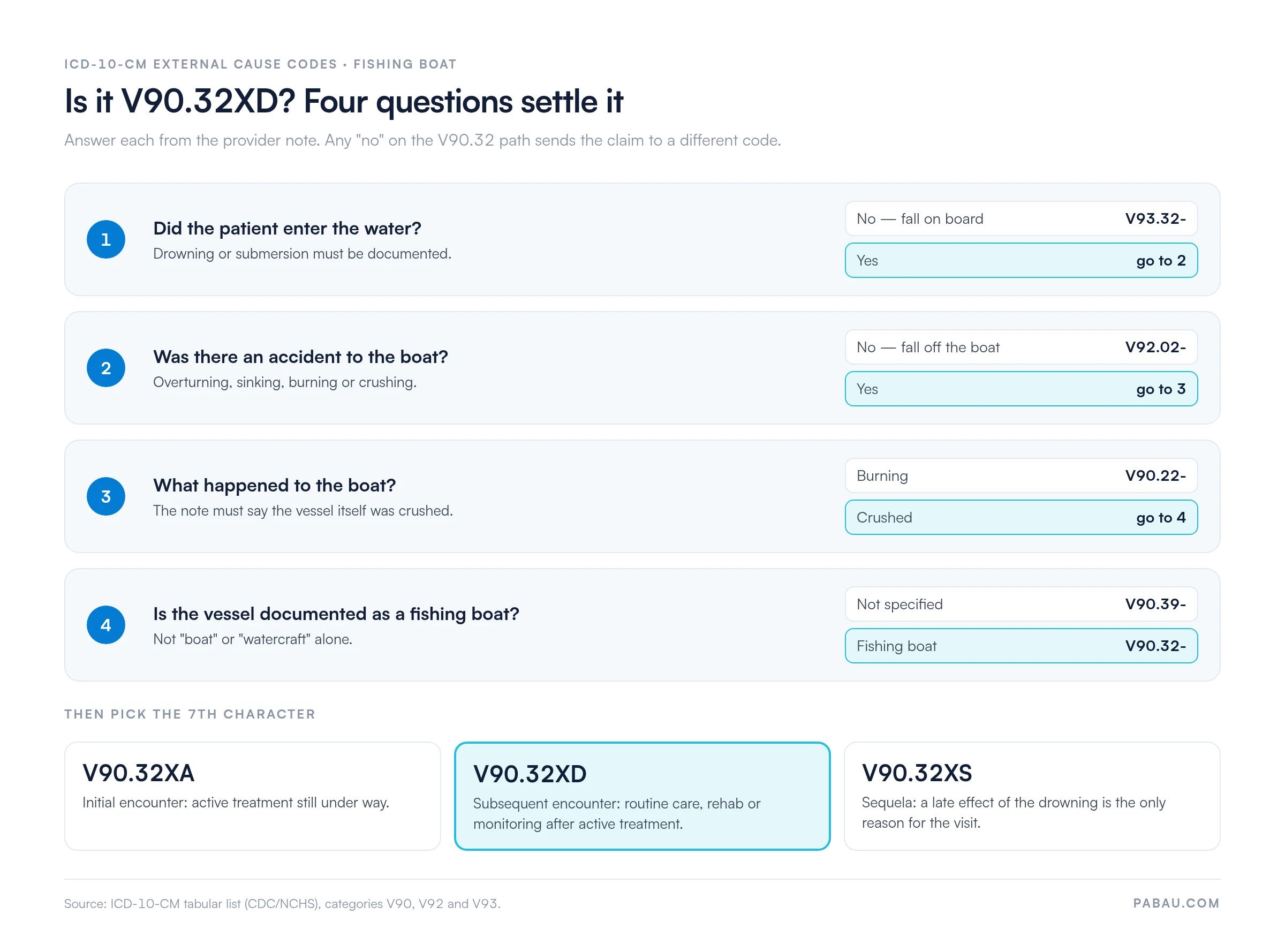
V90.32XD always follows a principal diagnosis code, and at the initial encounter it travels with place, activity and status codes. Per ICD-10-CM Official Guidelines Section I.C.20, external cause codes are always secondary. They supplement the injury or condition code that drove the encounter. A claim with V90.32XD as the first-listed code will be rejected.
The full coding picture for this event typically covers four code categories:
Place of occurrence, activity and status codes are not reported again at subsequent encounters, because they went on the initial claim. For a follow-up visit coded V90.32XD, the coder’s focus is on the principal diagnosis and confirming the correct episode-of-care character.
Four documentation elements must be present to support V90.32XD specifically. Missing any one of them means the coder must default to a less-specific code or query the provider before coding.
When documentation is ambiguous on any of these points, the ICD-10-CM guidelines require the coder to query the provider rather than assume. Structured medical billing compliance workflows prompt providers to record mechanism, vessel type and episode of care at each visit. That cuts the number of pre-submission queries.
V90.32XD is billable but drives no direct reimbursement on its own, because payment attaches to the principal diagnosis code. The external cause code gives the payer mechanism context for subrogation and injury reporting. It does not generate a separate line-item payment.
Payer requirements for external cause codes vary. CMS does not mandate them for Medicare Part B claims, though many state Medicaid programs do. Commercial payers increasingly require them on injury claims to support subrogation and coordination of benefits.
Because requirements shift from year to year, confirm each payer’s expectations before you submit. Reporting V90.32XD to a payer that does not require it causes no harm. Leaving it off for a payer that does may trigger an edit that delays payment.
In inpatient settings, the principal diagnosis and secondary conditions drive MS-DRG grouping. V90.32XD carries no CC or MCC status, so it does not change the DRG. Its role there is the same as on an outpatient claim: mechanism context for subrogation and injury reporting.
External cause codes for watercraft drowning events produce a predictable set of denial patterns. Each one maps to a specific documentation or coding mistake, and each has a fix.
Repeated denials on injury claims call for structured denial management workflows that track reason codes (CARCs) and route each correction to the right person. A clean claim checklist confirms the principal diagnosis, code format and sequencing before the first submission. That check alone catches three of the six patterns above.
Run a monthly audit of all V90-series external cause codes submitted in the prior 30 days. Look for any code string missing the placeholder X and any code sequenced as principal diagnosis. Also flag XA codes on encounters more than 30 days after the documented injury. These three checks target the most common external cause code denial patterns before they age into unpaid claims.
Without a structured note, the coder hunts through free text for the vessel type, the crushed-hull detail and the episode of care. Each missing detail becomes a query or a denial.
Pabau, the practice management and billing platform we build, keeps the clinical note, the diagnosis codes and the invoice in one patient record. Its claims management without rework lets the coder read the note and set the codes in the same place.
For US payers, Pabau connects to the Claim.MD clearinghouse. Claim.MD turns Pabau invoices into electronic CMS-1500 claims and tracks each claim’s status. It then returns the ERA to Pabau, so payments and denials post against the original visit.

Pabau keeps clinical notes, ICD-10-CM codes and invoices in one record. It then sends electronic CMS-1500 claims to US payers through Claim.MD and tracks their status.

Code V90.32XD only when the note says three things: the vessel was a fishing boat, the boat was crushed, and active treatment has ended. If one is missing, query the provider before the claim goes out.
The trade-off is specificity against speed. V90.39XD is always available when the vessel type is unclear, and it is safer than a fishing-boat code the note cannot support.
To see how Pabau carries the note, the code and the CMS-1500 claim through one record, book a demo.

Need to understand how claim denials are tracked and resolved? Denial management in healthcare covers workflows for routing, appealing, and preventing recurring denial patterns.
Want a checklist for submitting clean claims the first time? Clean claim best practices outlines the pre-submission checks that prevent the most common external cause code errors.
Looking for guidance on electronic remittance and ERA reconciliation? Electronic remittance advice (ERA) explains how 835 files map denial reason codes back to specific claim lines.
ICD-10 Code V90.32XD is the billable ICD-10-CM external cause code for “Drowning and submersion due to falling or jumping from crushed fishing boat, subsequent encounter.” It describes the mechanism of a drowning event at a follow-up visit after active treatment has ended. It is always sequenced after a principal diagnosis code.
Yes, V90.32XD is a valid, billable ICD-10-CM code. Check the Excludes1 notes at category V90 before you assign it. It generates no line-item payment on its own and must accompany the principal diagnosis code that drives reimbursement. A claim that lists it alone or first is denied.
V90.32XA marks an initial encounter, while active treatment is still under way, such as emergency care or an acute admission. V90.32XD marks a subsequent encounter, after care has shifted to routine management, rehabilitation or monitoring. XA on a post-acute follow-up visit is an episode-of-care mismatch that triggers a payer edit.
V90.32XD needs a principal diagnosis code for the condition managed at the visit, such as a respiratory or neurological effect of the drowning. At the initial encounter, place of occurrence (Y92), activity (Y93) and external cause status (Y99) codes are also reported. They are generally not repeated at subsequent encounters.
V90.32XD describes drowning after the patient fell or jumped from a crushed fishing boat into the water. V93.32XD describes a fall on board a fishing boat, on the deck or structure, without entering the water. Submersion is the dividing line, because V90 codes involve drowning and V93 codes cover on-board injuries only.
Yes. Per ICD-10-CM Official Guidelines Section I.C.20, external cause codes such as V90.32XD are always secondary and must follow a principal diagnosis code. A claim with V90.32XD listed first is noncompliant and will be rejected. The principal diagnosis is the condition treated at this encounter, typically an effect of the original drowning.
ICD-10-CM treats a fishing boat as a commercial or recreational vessel used for fishing, distinct from merchant, passenger, sail or inflatable craft. The provider must document the vessel type explicitly. A coder cannot infer “fishing boat” from the patient’s job or a generic mention of “a boat.” When the vessel type is not specified, the code is V90.39XD.