ICD-10 Code S42.444P: Medial epicondyle fracture, right humerus
ICD-10 Code S42.444P: full descriptor and code validity ICD-10 Code S42.444P car...

Last Updated: Oct 13, 2026
Billable Code Specific Code
V90.00XA is the billable ICD-10-CM code for drowning and submersion due to merchant ship overturning, initial encounter. It covers a commercial cargo or freight vessel capsizing and causing a person on board or in the water to drown. The code is valid for fiscal year 2026, effective October 1, 2025.
V90.00XA is an external cause code, so it is never the principal diagnosis. It follows a primary injury code such as T75.1XXA on the claim, and its 7th character has to match the encounter.
Let Pabau's smart automation suggest the right codes, reduce claim denials, and keep your practice compliant—effortlessly.
Automate repetitive tasks and focus on what matters most—your patients.
Reduce coding errors and ensure compliance with the latest regulations.
Clean claims, fewer denials, and faster reimbursements.
Powerful insights and reporting to help your practice thrive.
HIPAA compliant SOC 2 certified GDPR-compliant Trusted by 4,000+ clinics worldwide

V90.00XA identifies drowning and submersion from a merchant vessel overturning during the initial encounter. It never stands alone as the principal diagnosis.
It is a billable ICD-10-CM external cause code valid for FY2026 HIPAA-covered claim submissions effective October 1, 2025.
The 7th character separates initial encounter (XA), subsequent encounter (XD), and sequela (XS). Picking the wrong one is a leading denial trigger.
Pabau’s claims management software links ICD-10 code assignment directly to claim generation, so coders stop re-typing codes between a lookup tool and a billing screen.
ICD-10 code V90.00XA is a billable, specific ICD-10-CM diagnosis code valid for the submission of HIPAA-covered transactions in fiscal year 2026. The Centers for Medicare and Medicaid Services (CMS) confirms it as an active code effective October 1, 2025. That date falls under the 2026 edition of the ICD-10-CM tabular list.
The official descriptor reads Drowning and submersion due to merchant vessel overturning, initial encounter. It sits within the V00-Y99 chapter (External causes of morbidity), under block V90-V94 (Water transport accidents). Its category is V90, drowning and submersion due to accident to watercraft.
Verify the current-year validity of this code and any adjacent V90 codes using the CDC/NCHS official ICD-10-CM web tool. It reflects the live CMS tabular list and is updated each fiscal year.
The 7th character on V90.00XA signals the encounter type. Applying the wrong character is one of the most common denial triggers on water-transport injury claims. Payers validate it against the clinical documentation submitted with the encounter.
One practical rule covers most encounters. If the clinical note says “initial evaluation,” “admitted for,” or “acute treatment of,” use XA. Switch to XD once the provider documents “follow-up,” “wound check,” or “rehabilitation.” Reserve XS for encounters where the documented condition is explicitly a late effect of the original submersion event.
A merchant vessel, in ICD-10-CM tabular context, is a commercial cargo or freight ship used to transport goods. That separates it from a passenger ship (V90.01XA), a fishing boat (V90.02XA), and the other watercraft subtypes. The overturning event describes a capsizing incident where the vessel rolls or tips, sending occupants into the water.
V90.00XA applies when the mechanism of the drowning or submersion injury is specifically the capsizing of a merchant vessel. It appears most often in emergency departments and acute care facilities that treat maritime injury patients, including dock workers, cargo crew, and harbor employees.
The same vessel class appears outside the V90 category. A burn from a localized fire on board a merchant vessel takes V93.00XD at a follow-up visit. That code sits in V93, which covers injuries on board the watercraft rather than drownings caused by an accident to it.
V90.00XA is an external cause code. According to the ICD-10-CM Official Guidelines for Coding and Reporting (FY2026), all V00-Y99 codes identify the cause, intent, place, and circumstances of an injury. They are never submitted as the principal or first-listed diagnosis, and that is the rule most often violated on water-transport injury claims.
The correct claim structure pairs a primary injury or condition code with V90.00XA as a secondary diagnosis. A patient admitted with acute drowning and anoxia after a merchant vessel capsizing takes T75.1XXA first. V90.00XA follows it as the external cause. The two-line structure below is what a payer expects to see.
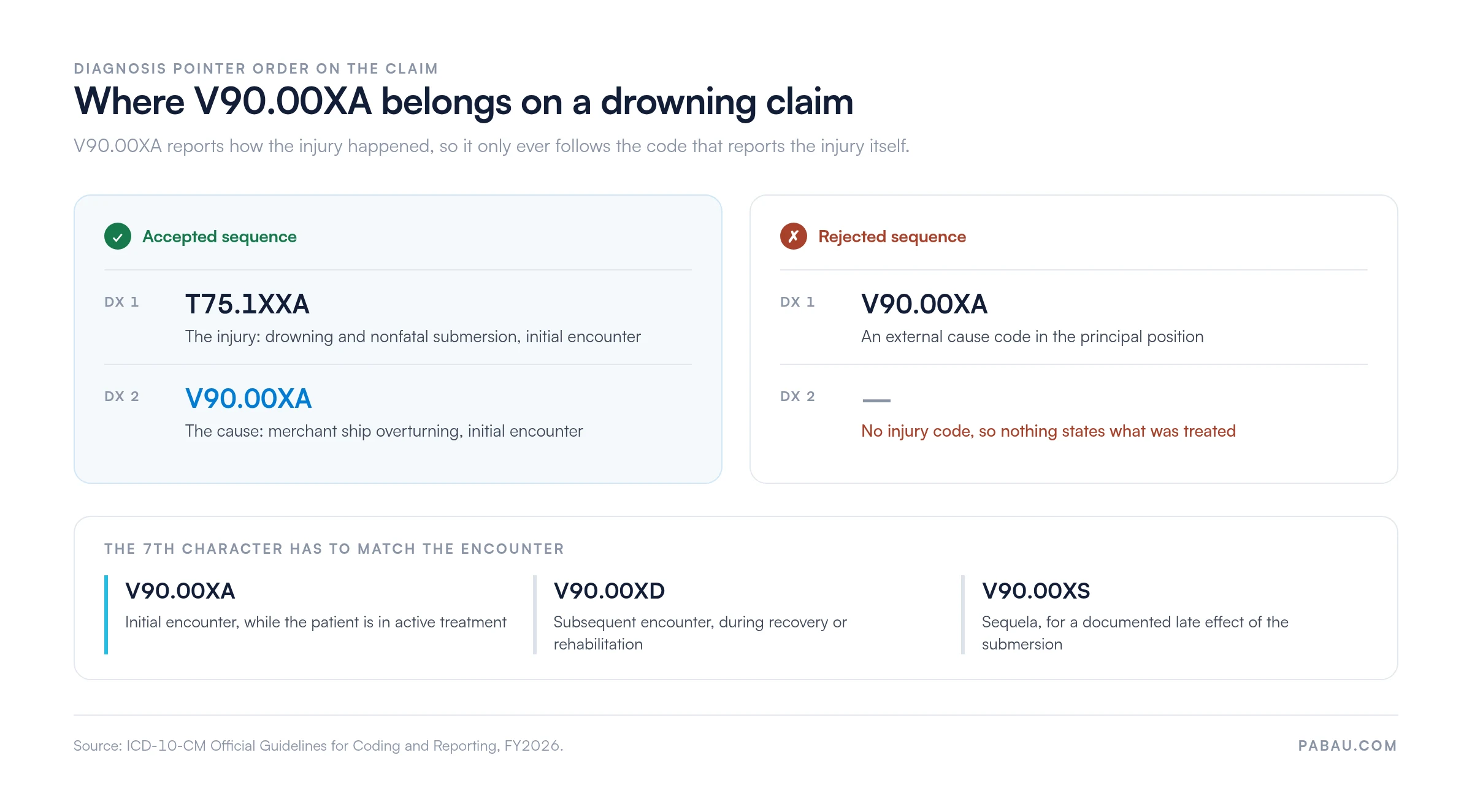
Practices submitting maritime injury claims through Pabau, our practice management software, route them electronically via Claim.MD, our integrated US clearinghouse partner. Claim.MD supports CMS-1500 and 837P submissions across thousands of US payers. The 837 claim file carries multiple diagnosis code fields, so V90.00XA drops cleanly into the secondary position without manual re-entry in a separate billing tool.
The V90 category is organized by watercraft type across its subcategory structure. Selecting the correct subcategory depends on what type of vessel was involved. The table below covers the overturning subcategories most relevant to coding staff, and the full set sits in the ICD-10-CM code index.
Use the unspecified code V90.09XA only when documentation genuinely does not identify the vessel type. Specificity matters here. Payers reviewing maritime injury claims may query an unspecified code when the vessel type was reasonably determinable. A commercial port or a freight yard is one such setting.
Vessel type is only half of the selection. The mechanism of the accident moves the code as well. A patient who fell from a burning fishing boat and later presents with a late effect is coded V90.22XS, not an overturning subcategory code.
The ICD-10-CM index lists several terms that map to V90.00XA. Recognizing these in clinical documentation helps coders move straight to the correct code instead of working backward from a broad search.
When clinical notes use terms like “commercial vessel,” “cargo ship,” or “freight ship” in the context of a capsize, V90.00XA is the appropriate code. The AAPC ICD-10-CM code database lists the index entry under “Drowning (accidental) W65-W74,” with subterms directing to V90 for watercraft-related events. Confirm against the alphabetic index in the CDC tabular list for the most current cross-references.
The V90 category carries Excludes notes that control which conditions may be reported together. Misapplying an Excludes1 is an immediate denial trigger. Sound denial management in healthcare starts with reading these notes before coding, not after a claim rejects.
Sequencing is the compliance point on any V90 external cause code. The primary injury code must appear first on the claim, and the external cause code second. Reversing that order is a sequencing error payers audit for during post-payment review.
Billing staff at acute care facilities and emergency departments handling maritime injury cases need more than the descriptor. Water transport injury claims tend to reject for two recurring reasons. Either the documentation never names the vessel type, or the code sequence is reversed.
Run a monthly audit of all V90 code submissions in your practice management system. Filter for claims where the only ICD-10 code sits in the V00-Y99 range. Any that appear as a standalone principal diagnosis are sequencing errors. Fixing them before a post-payment audit lowers recoupment risk and protects your clean claim rate.
V90.00XA has been a valid billable code in the ICD-10-CM system since the initial US implementation in 2015. The WHO ICD-10 framework that underpins ICD-10-CM places drowning and submersion due to watercraft accidents within the external causes of morbidity chapter. That structure has stayed stable across fiscal year updates.
For FY2026, no revisions were made to the V90.00XA descriptor, billable status, or coding guidelines. The code remains unchanged from FY2025. Coders working from older reference materials should confirm validity against the CDC’s ICD-10-CM lookup tool. Payer remittance responses also flag invalid code year references, which makes them a reliable secondary check.
Most coding teams look a code up in one browser tab, then type it into a billing screen in another. Every hop is a chance to drop the primary injury code, or to seat V90.00XA ahead of it. The error only surfaces weeks later, on a remittance.
Pabau ties ICD-10 assignment to claim generation inside one patient record. Our claims software for coders carries the codes from the encounter note straight into the claim. They arrive in the order they were entered, so the pairing a payer wants is built before anyone opens a billing screen. Electronic remittance advice and real-time eligibility checks sit in the same place.
For a maritime injury claim, that means the coder confirms the sequence once, in the record. Nobody proofreads it a second time in a separate billing tool, and nobody re-types a 7th character.

Pabau’s claims management software links ICD-10 code assignment directly to claim generation. Billing staff spend less time switching between a code lookup tool and a billing screen. Electronic remittance advice and real-time eligibility checks are built in.

V90.00XA is easy to apply correctly once three rules are settled. It always follows a primary injury code, its 7th character matches the encounter type, and the documentation names the merchant vessel. Denials on this code almost always trace back to one of those three.
The practical move is to check the sequence before the claim leaves the practice, rather than after the remittance comes back. Book a demo to see how Pabau keeps the injury code and the external cause code paired from note to claim file.

Need to understand how clearinghouse submissions work for ICD-10 claims? Our Claim.MD clearinghouse guide explains how electronic claims move from practice software to payer and back.
Want to reduce claim denials from coding errors? Denial codes in medical billing covers the most common denial reason codes and how to respond to each.
Working through another external cause code? ICD-10 code Y09 applies the same sequencing rule to assault-related injuries across the X92-Y09 range.
ICD-10 code V90.00XA is a billable ICD-10-CM external cause code that identifies drowning and submersion due to merchant vessel overturning, initial encounter. It is used as a secondary code alongside a primary injury or condition code – never as a standalone principal diagnosis. It is valid for FY2026 HIPAA-covered claim submissions, effective October 1, 2025.
Yes, V90.00XA is a billable, specific ICD-10-CM code valid for submission on HIPAA-covered transactions in fiscal year 2026. The CMS tabular list confirms it as an active code with an effective date of October 1, 2025. It must be submitted as a secondary diagnosis code, not the principal diagnosis.
The 7th character XA designates an initial encounter, meaning the patient is receiving active treatment for the drowning or submersion injury. Use XD for subsequent encounters once active treatment has concluded. Use XS for a sequela encounter documenting a late effect, such as anoxic brain injury.
All three codes describe the same causative event – drowning and submersion from a merchant vessel overturning – but differ by encounter type. V90.00XA is the initial encounter, during active treatment. V90.00XD is the subsequent encounter, during follow-up or rehabilitation. V90.00XS documents a sequela, where the condition is a late effect of the original injury. Use only the character that matches the documented phase of care.
V90.00XA is never used as a primary or principal diagnosis. As a V00-Y99 external cause code, ICD-10-CM guidelines require it to appear as a secondary code. It follows the primary injury or condition code, such as T75.1XXA for drowning and nonfatal submersion. Submitting it in the principal position is a sequencing error that typically results in a claim denial or audit flag.
No changes were made to V90.00XA for FY2026. The descriptor, billable status, and coding guidelines remain identical to FY2025. The code became effective October 1, 2025, as part of the 2026 ICD-10-CM edition update. Coders should confirm annually against the CDC’s official ICD-10-CM tabular list, as adjacent V90 subcategory codes may be updated in future fiscal years.