ICD-10 Code S42.444P: Medial epicondyle fracture, right humerus
ICD-10 Code S42.444P: full descriptor and code validity ICD-10 Code S42.444P car...

Last Updated: Oct 13, 2026
Billable Code Specific Code
W44.B0XA is the billable ICD-10-CM code for plastic object unspecified, entering into or through a natural orifice, initial encounter. Coders use it when the note confirms plastic but doesn't name the object. Think of an unidentified piece of plastic pulled from a child's ear.
It's an external cause code, so it never goes first on the claim. A T-code for the object's location leads, and W44.B0XA follows. The 7th character "A" stays on every visit while active treatment continues. The sections below cover choosing the right plastic subcode, pairing it with a T-code, and keeping the claim clean.
Let Pabau's smart automation suggest the right codes, reduce claim denials, and keep your practice compliant—effortlessly.
Automate repetitive tasks and focus on what matters most—your patients.
Reduce coding errors and ensure compliance with the latest regulations.
Clean claims, fewer denials, and faster reimbursements.
Powerful insights and reporting to help your practice thrive.
HIPAA compliant SOC 2 certified GDPR-compliant Trusted by 4,000+ clinics worldwide

W44.B0XA is a billable ICD-10-CM external cause code for an unspecified plastic object entering a natural orifice, initial encounter.
It can never be the principal diagnosis, so a T-code for the object’s location always goes first on the claim.
Use it only when the note says plastic but names no object type, such as a bead, coin, toy or toy part, jewelry, or bottle.
The 7th character stays “A” for every visit during active treatment, not just the first one.
Pabau, the practice management platform we build, pre-fills claims and checks required fields before submission.
ICD-10 code W44.B0XA reports a plastic object of unspecified type entering into or through a natural orifice, at the initial encounter. It’s a supplementary external cause code. That means it explains how the injury happened, while another code describes the injury itself.
The table below holds the core facts. Confirm the fiscal year in your encoder before you submit, because the ICD-10-CM code set updates every October 1.
So when does the code fit? Use W44.B0XA when the record confirms the object is plastic but doesn’t say what it is. If the provider documents a plastic bead, coin, toy or toy part, jewelry, or bottle, a more specific sibling code applies.
The code covers objects that enter through an opening the body already has. Surgical openings and wounds don’t count. An object left behind during a procedure is a complication coded from T81.5-, and an object pushed through skin belongs to W45.
To confirm the code is valid for the current year, search it in the CDC/NCHS ICD-10-CM web tool. It publishes the official tabular list.
Next comes the character coders trip over most. The 7th character in W44.B0XA tells the payer what kind of encounter this is, and misapplying it is a common error on foreign body claims. The rules mirror the ones for injury codes.
Here’s how it plays out. A four-year-old arrives at urgent care with plastic in her left ear. Removal fails, so she’s referred to ENT two days later. Both visits carry W44.B0XA, because the object is still being treated.
The ENT’s later check of a healed canal is different. Treatment has ended, so that visit is the first one that takes W44.B0XD.
Knowing the code tree helps you find the right sibling quickly. Here’s the path from chapter to billable code:
The “X” is a placeholder. W44.B0 doesn’t use a 6th character, yet every W44 code needs seven, so the X fills the slot. Leave it out and the code string is invalid. You’ll see the same placeholder pattern across Chapter 20.
Category W44 carries no Excludes1 notes. Instead, its Excludes2 notes flag three neighboring categories that describe a different mechanism. Excludes2 means that condition isn’t part of W44, though both codes may appear together when both happened.
Sharp glass has its own category, so a cut from a broken bottle at a follow-up visit codes to W25.XXXD instead.
Swallowed objects still use W44. An ingested piece of plastic entered through the mouth, so W44.B0XA can report the mechanism. The T18 code for its location goes first. The two codes describe different facts, so they sit on the same claim.
ICD-10-CM asks for the highest specificity the documentation supports. When the note names the object type, use that sibling code rather than W44.B0XA. The AAPC ICD-10-CM code lookup lists the full W44.B subcategory.
When W44.B0XA is correct: the note says “plastic foreign body” or “piece of plastic” and nothing more. If removal shows a bead but the note doesn’t say so, query the provider first. Don’t code from imaging or the removal tray alone.
The decision path below runs from the first question, is it plastic, down to the billable code.
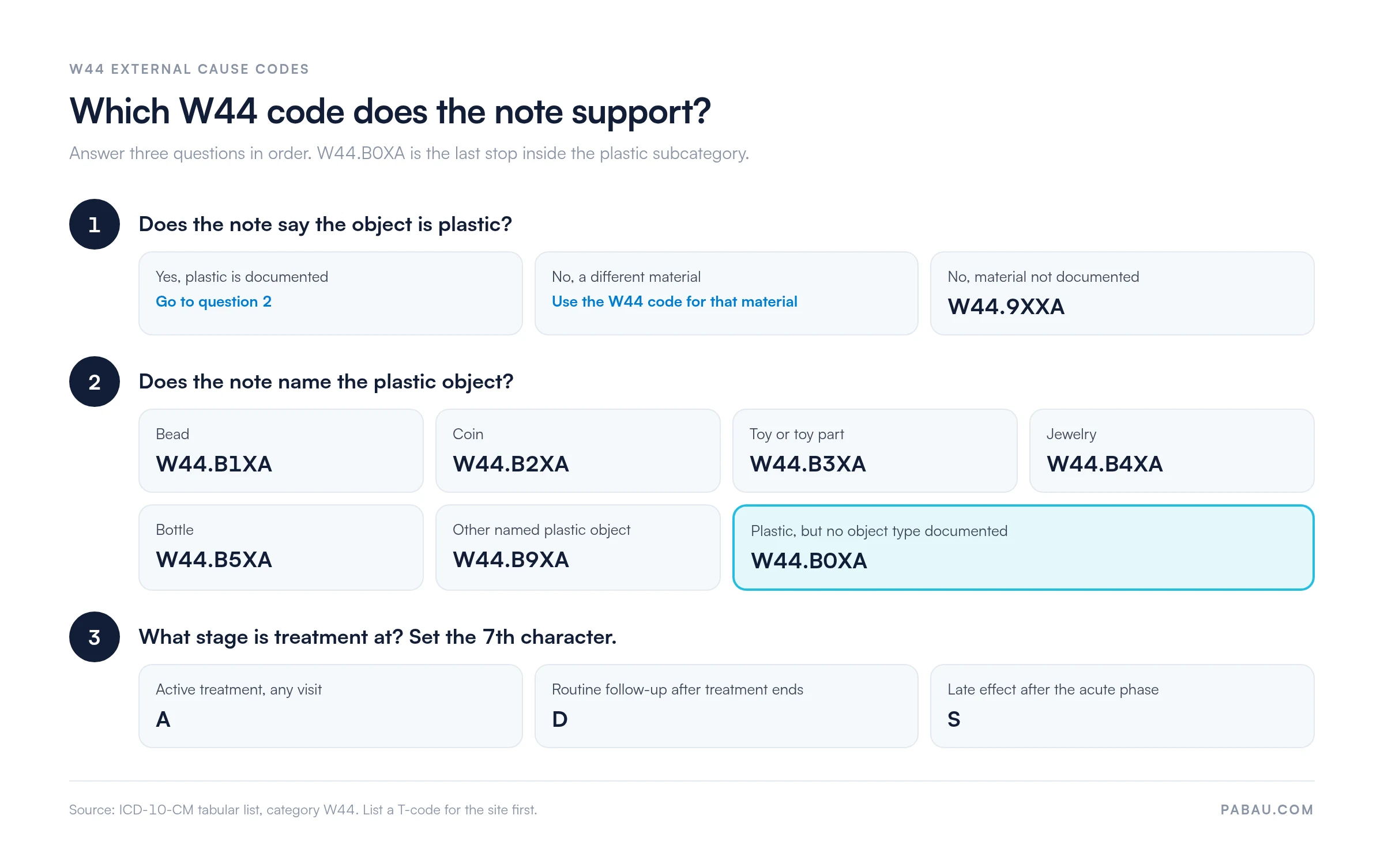
W44.B0XA can’t be the principal or first-listed diagnosis. Chapter 20 codes describe how an injury happened, not the injury itself, and the ICD-10-CM Official Guidelines keep them out of first position.
A code from another chapter goes first to describe the condition. Typical companion codes by site:
Picture the claim for a piece of plastic removed from a right ear. T16.1XXA sits on line one, and W44.B0XA follows as a secondary code. The removal procedure, CPT 69200 without general anesthesia, then points to T16.1XXA.
The nose works the same way. For an object removed under general anesthesia, the procedure code shifts to 30310, while T17.1XXA and W44.B0XA stay put.
Thin documentation sits behind many W44.B0XA denials. The record needs four details for the code to hold up on audit. Good medical billing compliance starts with teaching providers what belongs in the note before a coder sees it.
Good clean claim submission habits catch a missing detail before the claim leaves the practice. One practical step is adding material type and orifice site as required prompts in your foreign body note template.
External cause codes fail in their own ways. The table maps each denial to its cause and the fix. Strong denial management workflows track these by reason code, so patterns surface quickly.
When a remittance comes back, match its reason code against this guide to medical billing denial codes. It maps each CARC to the right resubmission path.
Run a quarterly audit of W44 claims. Filter for W44.B0XD and check that each date of service falls after documented treatment ended. A ‘D’ billed during active treatment can be corrected and resubmitted, but only inside the payer’s timely filing window.
External cause codes sit in an odd spot in US billing. Most payers accept them, but not all require them. They never carry a claim alone, yet reported correctly they add context that supports the principal diagnosis.
If you bill several payer types, a clearinghouse with real-time eligibility checks flags missing fields before submission. The CMS ICD-10 codes page posts each year’s code files and guidelines.
The code turns up in emergency departments, urgent care centers, and ENT or pediatric practices. Young children account for many ear and nose cases. If you’re newer to the claims side, these medical billing fundamentals explain how an encounter becomes a claim.
The ICD List code lookup tool cross-references W44.B0XA with the T-codes for each site. That helps when you confirm the principal diagnosis pairing.
Without claims software, a coder re-keys the site code from the note and looks up the external cause code separately. Payer fields then get checked by eye. Each manual step is another chance for a blank field.
Pabau offers claims software for practices that pre-fills the claim from the patient record. Its ICD-10-CM lookup library sits inside the claim form, so coders can search W44.B0XA without leaving the screen.
Before you send, Pabau checks that required fields, like membership and authorization numbers, are complete. US claims then go out through Claim.MD. As a result, fewer claims bounce back for missing data, and your team spends less time on rework.

Pabau pre-fills claims from the patient record, offers an ICD-10-CM code lookup library, and checks required claim fields before you send.

Treat W44.B0XA as the last stop inside the plastic subcategory. If the provider can name the object, get that detail into the note before you code. When nobody can, report W44.B0XA with confidence, behind the T-code, with “A” until treatment ends.
The bigger win sits upstream, in the note itself. A template that asks for material, object type, and orifice saves more claims than any audit after the fact. Book a demo to see how Pabau pre-fills foreign body claims and checks required fields before they go out.

Need to understand how clearinghouse submission works for injury-related claims? Claim.MD clearinghouse overview explains how electronic claim routing and real-time eligibility checks cut avoidable rejections.
Want a complete guide to managing denied claims by reason code? Revenue cycle management fundamentals covers how denial tracking fits into your RCM workflow end to end.
Removing a foreign body from the urethra or bladder? CPT 52310 covers the cystourethroscopy removal code that can pair with T19.0XXA and W44.B0XA.
Add them when your payer or state asks for them. Place of occurrence (Y92) and activity (Y93) codes are reported once, at the initial encounter. An external cause status code (Y99) follows the same rule.
The CPT code depends on the removal. For the ear canal, use 69200 without general anesthesia or 69205 with it. For the nose, 30300 covers office removal and 30310 applies under general anesthesia.
Yes. Swallowing is entry through the mouth, so W44 applies. Code the object’s location first from T18, such as T18.1- for the esophagus or T18.2XXA for the stomach. W44.B0XA then follows as the external cause.
Report the airway site with a T17 code, such as T17.1XXA for the nostril or a T17.2- code for the pharynx. W44.B0XA still describes the mechanism when the plastic entered through the nose or mouth.