ICD-10 Code V32.1XXD: Passenger three-wheeled vehicle collision
ICD-10 Code V32.1XXD: definition and billable status ICD-10 Code V32.1XXD is a b...

Last Updated: Oct 8, 2026
Billable Code Specific Code
V47.6XXD is the billable ICD-10-CM code for car passenger injured in collision with fixed or stationary object in traffic accident, subsequent encounter. It is an external cause code, so it is reported after the code for the injury itself.
Common errors on this code are using the wrong episode-of-care character and omitting the placeholder X characters in positions 5 and 6.
Let Pabau's smart automation suggest the right codes, reduce claim denials, and keep your practice compliant—effortlessly.
Automate repetitive tasks and focus on what matters most—your patients.
Reduce coding errors and ensure compliance with the latest regulations.
Clean claims, fewer denials, and faster reimbursements.
Powerful insights and reporting to help your practice thrive.
HIPAA compliant SOC 2 certified GDPR-compliant Trusted by 4,000+ clinics worldwide

V47.6XXD is billable for a car passenger’s follow-up care after a traffic collision with a fixed object, but it always needs a paired injury code.
The 7th character D means active treatment is complete; using A (initial encounter) at a follow-up visit is a coding error with audit implications.
Positions 5 and 6 must hold placeholder X characters: omitting them makes the code invalid and triggers automatic claim rejection.
V47.6XXD is an external cause code and can never be sequenced as the principal or first-listed diagnosis.
ICD-10 Code V47.6XXD reports a car passenger hurt in a traffic collision with a fixed or stationary object. It applies once active treatment has ended. It is a secondary code, always listed after the code for the injury itself.
Use the table below to confirm the code’s key attributes before building your claim. Every field reflects the ICD-10-CM tabular list. The CDC’s National Center for Health Statistics (NCHS) maintains it and publishes it with the Centers for Medicare and Medicaid Services.
Each character in V47.6XXD carries one piece of information about the accident or the visit.
Read together, the characters say a car passenger was hurt when the car hit a non-moving object in a traffic accident. This visit is a follow-up after the acute phase of treatment ended.
A frequent error on V47.6XXD is keeping the A character long after the patient’s active treatment ended. The choice turns on treatment status, not on the visit number.
A practical checkpoint: if the provider note refers to “follow-up,” “monitoring,” or “continued care” for injuries from the original accident, use D for the visit. Treatment for a new condition the accident caused later, such as chronic pain or post-traumatic arthritis, takes S, coded V47.6XXS. Per the CDC/NCHS ICD-10-CM official guidelines, the character choice follows treatment status, not calendar days since the accident.
The ICD-10-CM tabular list requires codes to occupy specific character positions. When a code does not use positions 5 and 6 for clinical detail, the guidelines mandate placeholder X characters to hold those slots. V47.6 is one such subcategory: positions 5 and 6 carry no occupant or event detail, so both must be X.
Coders who build claims from memory sometimes write V47.6D instead of V47.6XXD. That five-character string is invalid and will fail front-end payer edits before a human reviewer ever sees it. The correct structure is always seven characters.
The structure also matters when documentation changes. V47.6 already specifies a passenger in a traffic accident. If a chart addendum shows the patient was driving, the code becomes V47.5XXD. If the note never states the patient’s role, the correct code is V47.9XXD, unspecified occupant in a traffic accident.
Knowing the code’s position in the hierarchy helps coders navigate related codes and understand why V47.6XXD can never stand alone on a claim.
The entire Chapter 20 block consists of external cause codes. By definition, these codes describe the circumstances of an injury, not the injury itself. For medical billing workflows, this means V47.6XXD always appears on the claim as a secondary code. It sits alongside the diagnosis code for the physical injury sustained in the accident.
To look up that paired injury code or a sibling V-code, browse the ICD-10-CM code library, which follows the same chapter and block structure.
V47.6 means the patient was a passenger. When the note describes the crash but never says whether the patient was driving or riding, use V47.9XXD rather than assuming a role. The traffic driver code is V47.5XXD. Query the provider when the role affects liability or reimbursement.
The codes below are the ones most easily mistaken for V47.6XXD. Each differs by the patient’s role in the car, by traffic versus nontraffic setting, or by the 7th character. The grid that follows maps every V47 subcategory on those two axes.
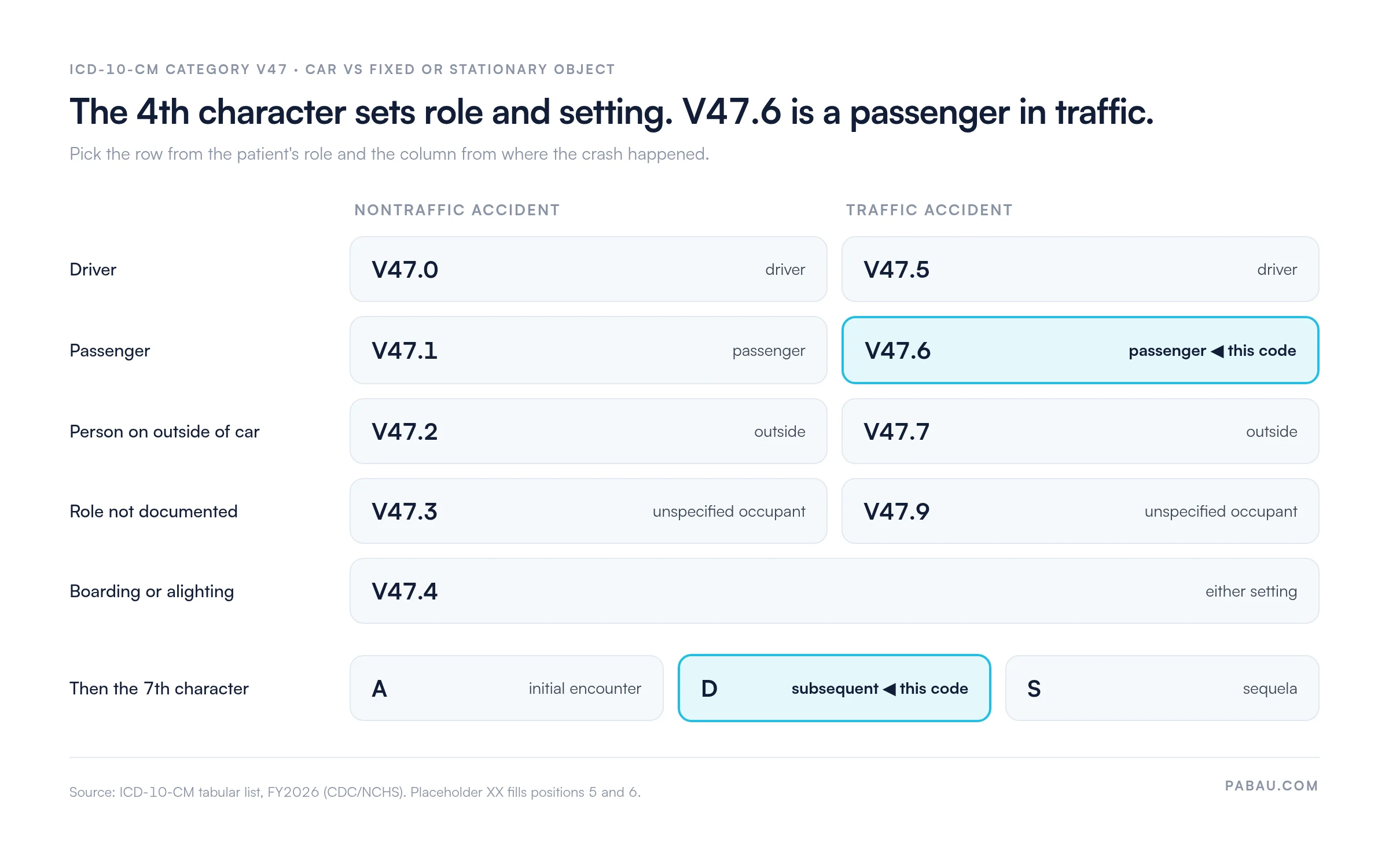
The .6 subcategory applies only to traffic accidents. Nontraffic collisions with fixed objects, such as a car rolling into a wall in a private driveway, use V47.0-V47.3. A nontraffic passenger is coded under V47.1, with V47.1XXA at the initial encounter and V47.1XXD at follow-up. When in doubt, the provider note should specify “traffic accident” or “nontraffic” to settle the assignment.
External cause codes supplement the claim; they do not anchor it. The provider note must support both the injury code and the external cause code independently.
Section I.C.20 of the ICD-10-CM Official Guidelines covers this. It says to assign the external cause code, with the right 7th character, at each encounter where the injury is treated. When your practice reports external cause codes, each follow-up visit for the original accident injuries carries V47.6XXD, not just the first.
Follow these six steps at each follow-up visit for accident-related injuries. Most of them take seconds once the note is open.
Not every payer treats external cause codes the same way. Knowing how Medicare, Medicaid, and commercial carriers handle V47.6XXD prevents avoidable rejections.
The table below lists common denial triggers on V47.6XXD and the fix for each.
Effective denial management in healthcare starts at the point of coding, well before a claim needs an appeal. Each of the five triggers above can be prevented with front-end workflow controls. Pair follow-up note templates that capture the accident context with a coder check of code structure and sequencing before submission. For the wider checklist across visit types, see what submitting a clean claim requires.
Run a quarterly audit of all V47.x claims at your practice. Filter by 7th character and check that A only appears at initial visits and D appears at all subsequent visits. Repeated A characters for the same accident and patient point to a coding pattern error, and that pattern can attract payer audits.
A car accident often brings a run of follow-up visits, and each one produces a claim carrying the injury code and V47.6XXD. Tracking those claims by hand across a clearinghouse portal and a spreadsheet makes a rejected one easy to miss.
Pabau, the practice management and billing platform we build, sends claims to the Claim.MD clearinghouse from the data already in the patient record. Its claims management software then tracks each claim’s status, so your team sees a rejection without logging in to a separate portal.
Pabau doesn’t choose or check codes for you. Your coders still confirm the 7th character, the placeholder X characters, and the sequencing before each claim goes out. The time saved on chasing claim status gives them room for that check.

Pabau’s claims management submits claims through Claim.MD and tracks each one’s status, so your team spots a rejected follow-up claim quickly. See how it fits your billing workflow.

V47.6XXD fits only when the note shows three facts. The patient was a passenger, the crash was a traffic accident, and active treatment has ended. If one of those is missing, the code changes to V47.5XXD, V47.9XXD, V47.1XXD, or V47.6XXA.
So build those three facts into your follow-up note template, and check the placeholder X characters and the sequencing before each claim goes out. A check at the coding stage takes far less work than reworking a denied claim.
Book a demo to see how Pabau keeps your accident follow-up claims submitted and tracked in one place.

Coding a late effect from the same crash? ICD-10 code V47.6XXS covers the sequela version of this passenger code.
Want a step-by-step guide to what makes claims pay first time? Clean claim requirements in medical billing covers every element payers check before processing a claim.
Looking for a deeper look at how to recover denied claims? Denial management in healthcare walks through the appeal workflow for coding-related rejections.
Was the passenger hurt off the public road? ICD-10 code V47.1XXA covers a car passenger in a nontraffic collision, initial encounter.
Decoding a denial on a follow-up claim? Denial codes in medical billing explains what each payer reason code means.
ICD-10 Code V47.6XXD is the billable code for a car passenger injured in a traffic collision with a fixed or stationary object, subsequent encounter. The code indicates the patient is in the follow-up phase after active treatment for the accident injuries has concluded.
Use the 7th character D when active treatment for the original injury is complete. The patient is attending a follow-up visit for monitoring, recovery management, or continued care related to that injury. If the patient is still receiving definitive treatment, use A (initial encounter) instead.
V47.6XXA is used for the initial encounter when active treatment is underway; V47.6XXD is used for subsequent encounters when active treatment has ended. The clinical event (car passenger in a traffic collision with a fixed object) is identical; only the episode of care differs.
Yes, V47.6XXD is a valid billable ICD-10-CM code at 7-character specificity. However, it cannot be submitted as a standalone diagnosis. It must accompany an injury diagnosis code that is sequenced as the principal or first-listed diagnosis.
The V47 category covers car occupant injuries in collisions with fixed or stationary objects. V47.0-V47.3 cover nontraffic accidents (driver, passenger, person on outside, unspecified occupant). V47.4 covers boarding or alighting, and V47.5-V47.9 cover traffic accidents (driver, passenger, person on outside, unspecified). Each subcategory then takes the A, D, or S 7th character for episode of care.
V47.6XXD applies when the patient is still receiving care directly related to the original accident injuries. V47.6XXS applies when the visit treats a late effect that developed after the accident injuries resolved, such as chronic pain or post-traumatic arthritis. Use S with the sequela condition code as the principal diagnosis, not the original injury code.