ICD-10 Code R34: Anuria and oliguria
ICD-10 Code R34 is the billable ICD-10-CM diagnosis code for anuria and oliguria...

Last Updated: Oct 6, 2026
Billable Code Specific Code
V54.4XXD codes a person injured while boarding or alighting a pick-up truck or van in a collision with a heavy transport vehicle or bus. It is a billable ICD-10-CM external cause code, and the seventh character D marks a subsequent encounter.
The code explains how the injury happened, so it is always listed after the injury code and never as the first-listed diagnosis.
Let Pabau's smart automation suggest the right codes, reduce claim denials, and keep your practice compliant—effortlessly.
Automate repetitive tasks and focus on what matters most—your patients.
Reduce coding errors and ensure compliance with the latest regulations.
Clean claims, fewer denials, and faster reimbursements.
Powerful insights and reporting to help your practice thrive.
HIPAA compliant SOC 2 certified GDPR-compliant Trusted by 4,000+ clinics worldwide

V54.4XXD covers a person injured while boarding or alighting a pick-up truck or van in a collision with a heavy transport vehicle or bus. The D marks a subsequent encounter.
The code is a supplementary external cause code, so it must never appear as the principal or first-listed diagnosis.
Both placeholder X characters are mandatory. Omitting either one produces an invalid code that payers reject automatically.
Pabau’s claims management software runs validation checks each time you send a claim, so required details are in place before it reaches the payer.
ICD-10 Code V54.4XXD covers a person injured while boarding or alighting a pick-up truck or van, at a subsequent encounter.
The injury happened in a collision between that pick-up truck or van and a heavy transport vehicle or bus. Its official descriptor reads “Person boarding or alighting a pick-up truck or van injured in collision with heavy transport vehicle or bus, subsequent encounter.”
It is a billable, valid code in the CMS ICD-10-CM code set. It sits in Chapter 20, External causes of morbidity (V00-Y99), within the transport accidents block (V00-V99). Its category, V54, covers occupants of a pick-up truck or van injured in collision with a heavy transport vehicle or bus.
As an external cause code, V54.4XXD describes the mechanism and circumstances of an injury. It does not describe the nature of the injury itself. Every claim that includes this code must also carry a nature-of-injury code (such as a fracture, laceration, or contusion code) as the principal diagnosis. According to the ICD-10-CM Official Guidelines for Coding and Reporting, Section I.C.20, external cause codes are always supplementary.
Effective date: the V54 category has been part of ICD-10-CM since the US implementation in fiscal year 2016. The code set is updated each October 1. Before coding, check the tabular list for the current fiscal year in the CDC/NCHS ICD-10-CM web tool.
V54.4XXD is a seven-character code. Each position has a fixed meaning in ICD-10-CM’s external cause classification. The table below maps every character to its clinical significance.
Both X characters at positions 5 and 6 are structural placeholders required by ICD-10-CM’s code-length rules. They carry no clinical information but are mandatory for the code to be technically valid. Submitting V54.4XD (one placeholder missing) or V54.4D (both missing) triggers an invalid-code edit, and the claim is rejected before anyone reviews it.
The seventh character D designates a subsequent encounter. The patient is receiving routine care or aftercare once active treatment of the original injury has ended. Per ICD-10-CM Official Guidelines Section I.C.19, “subsequent encounter” applies once the injury is no longer being actively treated. The patient still receives care related to it, such as cast checks, wound monitoring, physical therapy, or medication management.
A frequent coding mistake is using D during a visit when the patient is still receiving active treatment. Active treatment includes surgical repair, initial fracture management, debridement, or the first emergency department encounter. Those visits require the seventh character A (initial encounter), not D.
A plain-language rule of thumb helps here. If today’s visit is “checking on” the original injury rather than “actively treating” it, D is correct. If a new complication or late effect has emerged as its own clinical condition, S applies instead.
V54.4XXD applies to a specific occupant position and encounter type. Getting either element wrong produces a valid-but-incorrect code that may not be audited until a payer review.
The V54 subcategories, V54.0 through V54.9, separate the patient’s position: driver, passenger, person on outside, person boarding or alighting, or unspecified. Most positions also split into nontraffic and traffic codes. V54.4 is the only subcategory with no traffic split, so one code covers boarding or alighting on a road or off it.
The V54.4XX series differs only in the seventh character. Coders regularly confuse the three variants, and the error does not always trigger a payer edit because all three are technically valid codes.
Also watch for confusion with adjacent position codes. V54.0XXD and V54.5XXD cover the driver of the pick-up truck or van, and V54.1XXD and V54.6XXD cover a passenger. If the note does not say the patient was getting in or out at the time of the collision, query the provider. Do not default to V54.4XXD.
To look up any of those siblings, start from our ICD-10-CM codes index. The decision path below puts both questions, position first and care phase second, in the order a coder answers them.
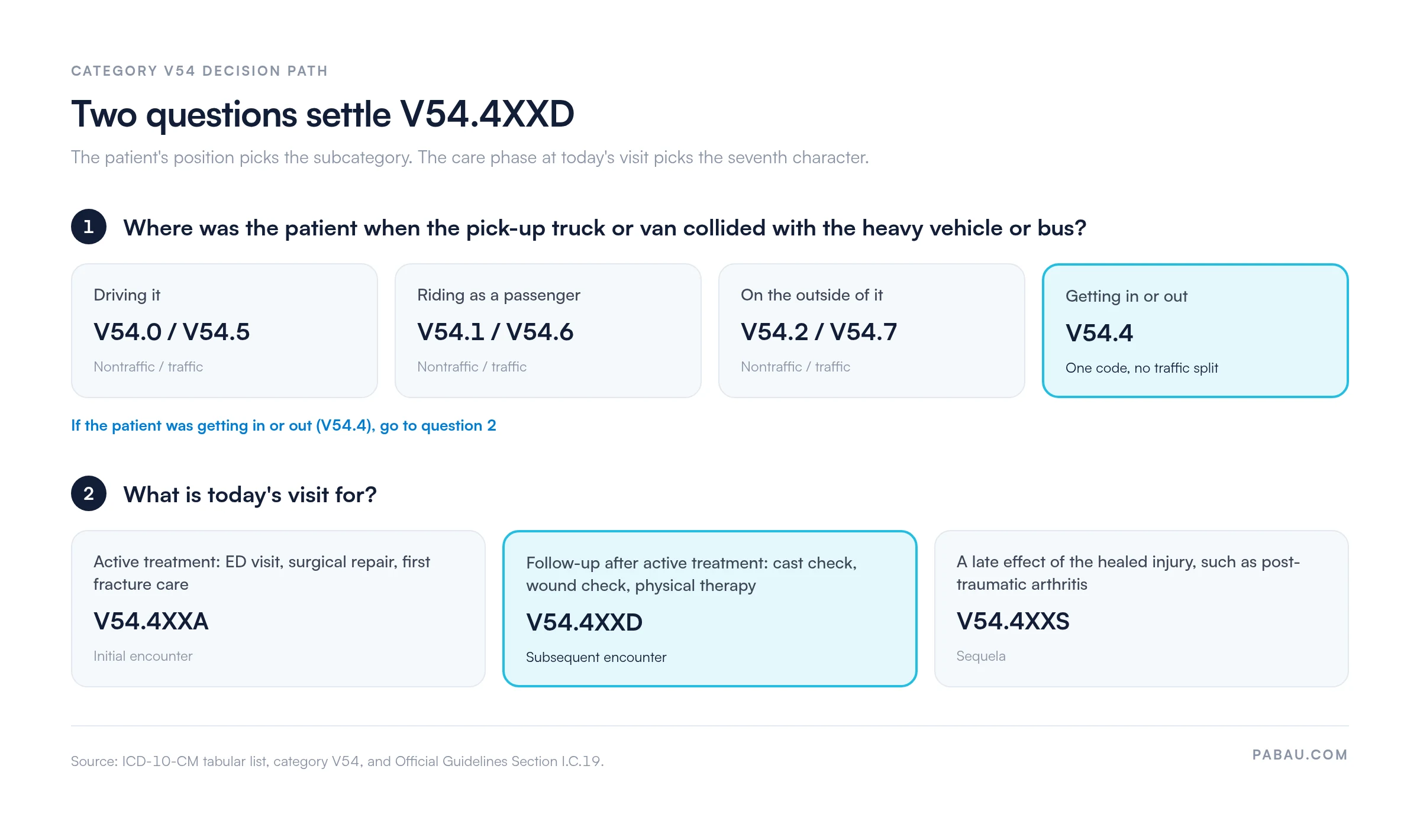
A V54.4XXD claim holds up only when the record covers each point below. Missing even one can invalidate the code or trigger a denial on audit.
Query the provider whenever the patient’s position at the time of the collision is ambiguous. ‘Vehicle occupant’ alone does not distinguish driver (V54.0/V54.5), passenger (V54.1/V54.6), person on outside (V54.2/V54.7), or person boarding or alighting (V54.4). A single clarifying question at coding prevents a potential audit finding months later.
Section I.C.20 of the ICD-10-CM Official Guidelines sets three rules for external cause codes that decide how V54.4XXD is reported.
Decision logic for V54.4XXD: Was the patient boarding or alighting a pick-up truck or van? Did that vehicle collide with a heavy transport vehicle or bus? Is today’s visit follow-up care rather than active treatment? If all three answers are yes, V54.4XXD is the correct external cause code for this encounter. Confirming them before submission is part of sending a clean claim the first time.
Payers handle external cause codes differently, and traditional Medicare sits apart from most of them. Knowing which payer requires the code prevents avoidable claim holds and secondary billing delays. Our guide to the Claim.MD clearinghouse explains how clearinghouse edits screen claims before they reach the payer.
The Medicare distinction is frequently misapplied. Traditional Medicare Part B fee-for-service does not mandate external cause codes, but many Medicare Advantage plan contracts do. Practices seeing a mix of traditional Medicare and MA patients should not assume a single submission standard applies across the board. Always verify individual payer requirements through the payer’s provider manual or billing guidelines, as state workers’ compensation regulations and carrier requirements vary by jurisdiction.
Denials involving V54.4XXD follow predictable patterns. Each one has a straightforward correction, but identifying them after the fact takes longer than preventing them upfront. Practices with strong denial management workflows catch these at the pre-submission stage.
The invalid-code denial caused by a missing placeholder X is the most preventable. It fails at the clearinghouse level before a human reviewer ever sees the claim. Screening each code against the current ICD-10-CM tabular list is a routine clearinghouse step in medical billing. When in doubt, confirm the code in the CDC/NCHS web tool before you resubmit.
Audit your V54 external cause codes periodically by filtering your remittance reports for two reason codes. CARC 16 means the claim lacks information or has submission or billing errors. CARC 146 means the diagnosis was invalid for the date of service reported. Trace each hit back to its source and fix the template in your EHR to prevent recurrence.
On many billing teams, the V54 checks live in one coder’s memory. That coder knows V54.4XXD needs an injury code ahead of it and that both X placeholders are mandatory. They also know to ask whether the patient was getting into the vehicle or already seated inside it.
Pabau, the practice management platform we build, takes the claim-side checks off that coder’s plate. It runs validation checks in the background each time you send a claim. Required details, such as membership and authorization numbers, are confirmed before the claim leaves.
Claims then go to US payers through the Claim.MD clearinghouse, with real-time eligibility checks built in. Each claim is tracked from pending to paid or error, so a rejected follow-up claim surfaces quickly. Every Pabau subscription includes the full billing workflow, so a small practice runs the same checks as a multi-site group.

Pabau runs validation checks every time you send a claim, so required details are in place before it leaves the practice. Claim.MD submission and eligibility checks come built in.

V54.4XXD rests on three facts. The patient was boarding or alighting a pick-up truck or van. That vehicle collided with a heavy transport vehicle or bus. Today’s visit is follow-up care rather than active treatment. Confirm all three, sequence the code after the injury code, and keep both placeholder X characters. When the note is vague about position, a provider query costs far less than an audit finding.
Pabau’s claims management software handles the submission side, with validation checks on every claim and Claim.MD built in. Book a demo to see how it carries your follow-up injury claims from coding to payment.

Need to understand how denial codes are structured? Denial codes in medical billing explains the CARC and RARC system used by payers to communicate rejection reasons.
Want to verify claim accuracy before submission? Claim.MD clearinghouse overview covers how electronic clearinghouse validation catches format and coding errors before they reach the payer.
Coding another boarding or alighting injury? ICD-10 code V86.49XD covers boarding and alighting injuries involving golf carts and other off-road vehicles, at a subsequent encounter.
V54.4XXD is the ICD-10-CM external cause code for a person injured while boarding or alighting a pick-up truck or van. The injury happened in a collision with a heavy transport vehicle or bus, and the D marks a subsequent (follow-up) encounter. It is a supplementary code that must accompany a nature-of-injury code as the principal diagnosis.
The seventh character D designates a subsequent encounter. The patient is receiving routine or follow-up care after the active treatment phase for the original injury. It applies to visits such as wound checks, cast checks, physical therapy, and medication management once the initial acute treatment is complete.
A subsequent encounter (seventh character D) covers follow-up care for an injury that is still resolving. A sequela (seventh character S) covers a new condition that developed as a direct late effect of an injury that has already resolved. Post-traumatic arthritis following a healed fracture is one example. Under S, the injury itself is no longer the focus of treatment. A downstream complication of it is.
Use V54.4XXA when the patient is still receiving active treatment for the collision injury, such as at an emergency department visit or during surgical repair. Switch to V54.4XXD once active treatment is complete and the patient is returning for routine follow-up care, monitoring, or rehabilitation related to the same injury.
No. V54.4XXD is an external cause supplementary code and may never be the principal or first-listed diagnosis. Per ICD-10-CM Official Guidelines Section I.C.20, all external cause codes must be reported secondary to the nature-of-injury code, which must occupy the principal diagnosis position.
Workers’ compensation and auto liability carriers routinely require external cause codes to establish the accident context for claim processing. Many Medicare Advantage Organizations and commercial payers also require them per contract terms. Traditional Medicare Part B fee-for-service does not mandate external cause codes, but requirements vary by payer and state jurisdiction. Always verify with the individual payer’s provider manual before omitting the code.