ICD-10 Code S00.04XD: External constriction of part of scalp
ICD-10 code S00.04XD: Definition and billable status ICD-10 Code S00.04XD is a v...

Last Updated: Oct 7, 2026
Billable Code Specific Code
V43.42XS is the billable ICD-10-CM code for person boarding or alighting a car injured in collision with other type car, sequela. It applies when a patient hurt while getting into or out of a car is treated for a late effect of that injury.
V43.42XS belongs to the V40-V49 block for car occupants injured in transport accidents. As an external cause code, it is never the principal diagnosis and follows the code for the residual condition. A common error is assigning seventh character D when the visit treats a sequela, which calls for S.
Let Pabau's smart automation suggest the right codes, reduce claim denials, and keep your practice compliant—effortlessly.
Automate repetitive tasks and focus on what matters most—your patients.
Reduce coding errors and ensure compliance with the latest regulations.
Clean claims, fewer denials, and faster reimbursements.
Powerful insights and reporting to help your practice thrive.
HIPAA compliant SOC 2 certified GDPR-compliant Trusted by 4,000+ clinics worldwide

V43.42XS reports a person boarding or alighting a car who was hurt in a collision with another car, at a sequela encounter.
Pick-up trucks, vans and sport utility vehicles have their own V43.4 codes, so confirm the other vehicle before you assign V43.42XS.
Seventh character S fits a visit for a late effect of the injury, while A covers active treatment and D covers routine healing care.
List the sequela condition first and the injury code with S next, then V43.42XS, which can never be the first-listed diagnosis.
No national rule requires external cause codes, so report V43.42XS when your payer or state mandates it, and voluntarily otherwise.
ICD-10 code V43.42XS is a billable ICD-10-CM external cause code. Its official descriptor is Person boarding or alighting a car injured in collision with other type car, sequela. Use it when a patient was hurt getting into or out of a car during a crash with another car. Today’s visit then treats a late effect of that injury.
“Other type car” means a passenger car that isn’t a sport utility vehicle, pick-up truck or van. Those vehicles have their own codes. V43.42XS never stands first on a claim, because it explains how the injury happened rather than what is being treated. You can check the current descriptor in the CDC/NCHS ICD-10-CM web tool.
Each level of the code narrows the event, from any external cause down to one occupant position and one vehicle type. Reading the chain top to bottom is the quickest way to confirm you have the right endpoint.
The fourth character tracks where the patient was. The .4 subcategory covers someone in the act of getting into or out of the car. A driver in a traffic accident falls under V43.5-, and a passenger in a traffic accident falls under V43.6-.
The fifth character then names the other vehicle. That is why V43.42 only fits a collision with another passenger car. If you’re newer to how these codes reach a payer, our guide to how medical billing works covers the basics.
The seventh character tells the payer what stage of care the visit belongs to. It follows the type of care, not the time since the crash. The external cause code takes the same seventh character as the injury code it accompanies.
Section I.C.19.a of the ICD-10-CM Official Guidelines sets these definitions, and Section I.B.10 covers sequela. A patient back for a cast check is a D patient. That same patient returning six months later with joint stiffness from the healed fracture is an S patient.
The panel below pairs each seventh character with the claim order a sequela visit needs.
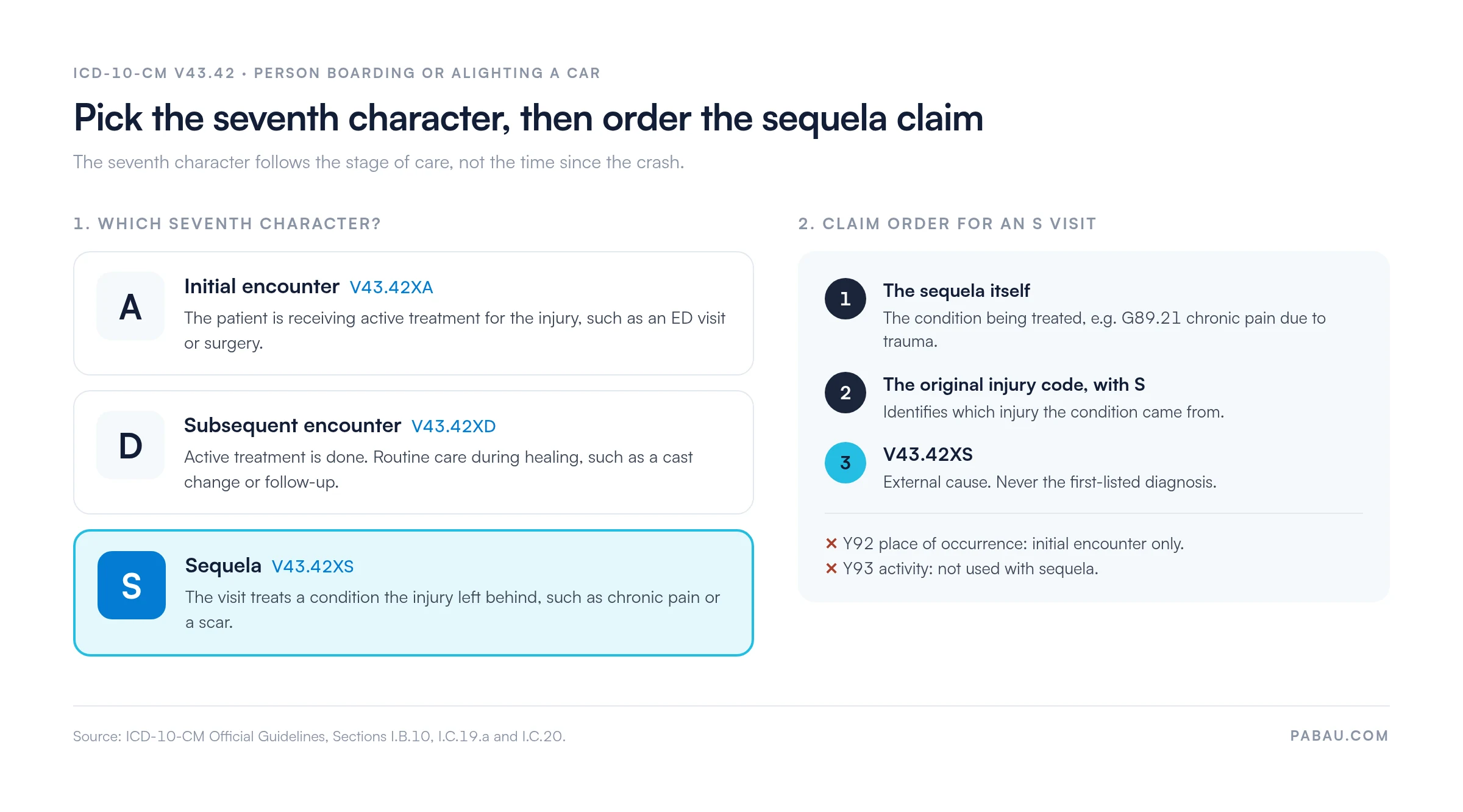
V43.42XS fits when three conditions hold. The injury happened while the patient was boarding or alighting a car hit by another car. Active care for that injury has ended. And today’s visit is for a condition the injury caused.
Ask what the visit is treating. Routine care for the injury while it heals takes D. Once the injury has healed and you’re treating what it left behind, S is correct.
A sequela claim reverses the usual injury pattern, because the condition being treated goes first. Section I.B.10 of the Official Guidelines sets that order. Section I.C.20.i covers external cause codes for sequela.
V43.42XS adds context to the clinical codes on the claim but never replaces them. Here is how each code type behaves at a sequela visit.
The tabular list sets the scope of V43 and points other collision types to their own categories. These are the points that matter when you assign V43.42XS.
Before you assign V43.42XS, read the block notes at V40-V49 in the tabular list. Then confirm the note names both the occupant position and the other vehicle, because those two details decide the code.
Most mix-ups come from the wrong seventh character, the wrong occupant position or the wrong vehicle type. The table shows when each neighbor applies. When in doubt, check the descriptor in the AAPC ICD-10-CM lookup.
Most V43.42XS rejections trace back to a handful of avoidable coding choices. Here are the ones to watch for.
A steady denial management process catches these patterns before they repeat. When a claim does come back, the remittance names the reason with an adjustment code. Our guide to denial reason codes explains how to read them.
Run through these five checks before a V43.42XS claim goes out.
Sequela claims from a motor vehicle crash need more than a diagnosis list. Medicare, Medicaid and auto-liability insurers all want the record to show how the crash led to today’s condition.
With auto-liability cases, run insurance eligibility verification upfront to confirm which payer is primary. Then you’ll know what documentation each one expects.
Submitting a clean claim means the documentation, sequencing and payer rules are all met before the first submission. Setting up electronic remittance advice also helps, because payers use it to explain each denial.
Sequela has no time limit under Section I.B.10, so a late effect can surface years after the crash. Some practices set their own rule, such as a second review when the crash was more than 12 months ago. For long gaps, document how symptoms continued, since auto-liability payers may request records that link the two.
V43.42XS is a valid, billable code in the current ICD-10-CM code set. The FY2027 release took effect on October 1, 2026, so confirm the code in the CDC/NCHS web tool for that release.
ICD-10-CM updates run on the federal fiscal year, with new, revised and deleted codes taking effect each October 1. Check the CMS ICD-10-CM codes page each summer to see what is changing before the new year starts.
In many practices, a biller retypes diagnosis codes from the clinical note into a claim form. Every retyped code is a chance to drop the external cause code or swap a seventh character.
Pabau, the practice management and billing platform we build, pre-fills the claim from the patient record. Coders pick codes from built-in ICD-10-CM and CPT lookup libraries. Pabau checks that required claim fields are complete, then submits through the Claim.MD clearinghouse. Its claims tools for practices also run eligibility checks, post electronic remittances and track each claim.
The coder still decides the seventh character and the code order. What changes is the busywork around those decisions, so fewer claims bounce back for missing data.
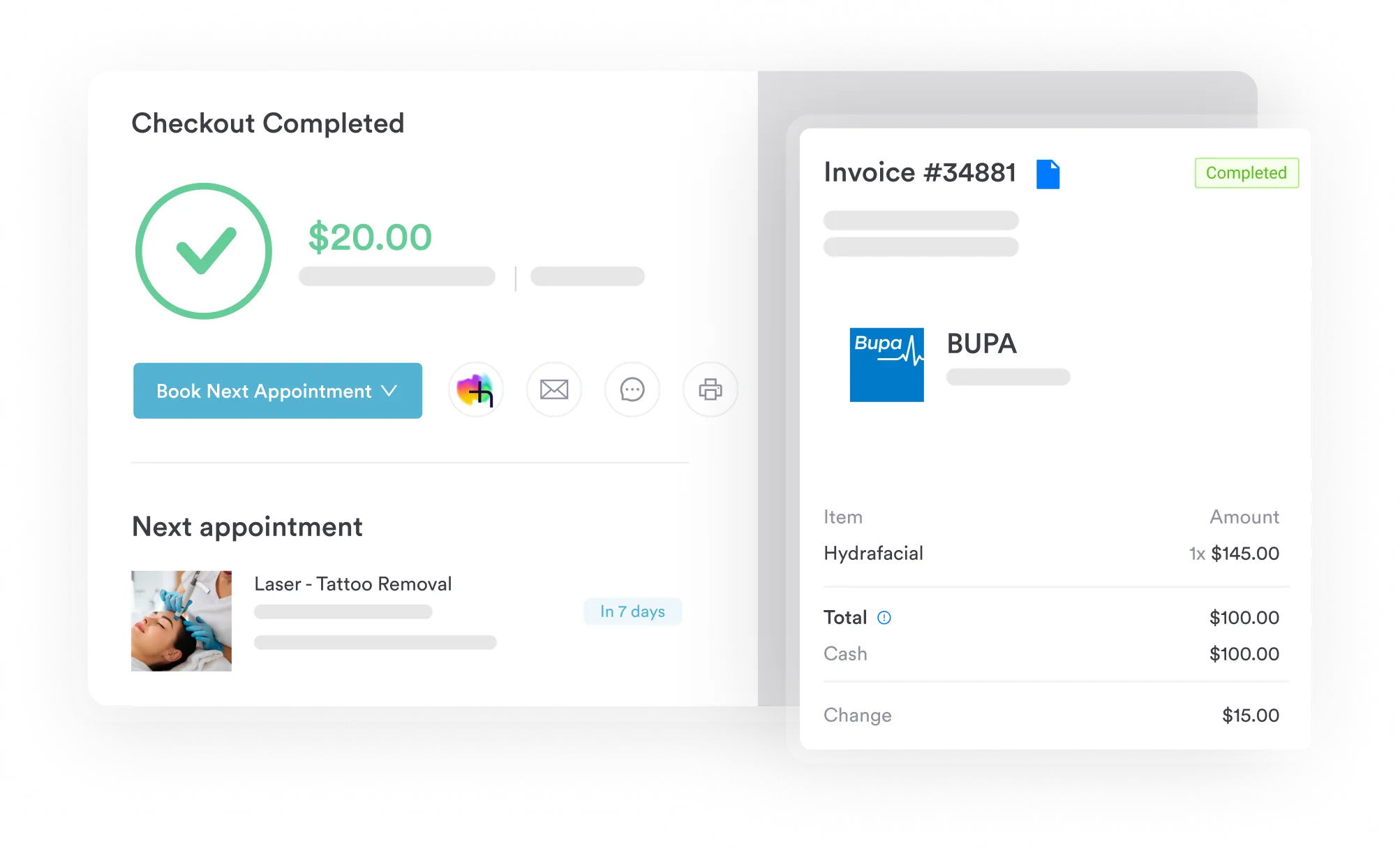

Pabau pre-fills claims from the patient record, checks required fields and submits through Claim.MD. Your team spends less time fixing claims that bounced for missing data.

With V43.42XS, the expensive mistakes happen before the claim leaves the building. Confirm the patient was boarding or alighting, and that the other vehicle was a car. Then ask whether today’s visit treats a late effect. If it does, S is right and the sequela condition leads the claim.
Build those checks into intake and coding, and sequela claims stop coming back for avoidable reasons. They’re one small piece of revenue cycle management, but they recur for months after a crash.
Book a demo to see how Pabau pre-fills and tracks your injury claims from the patient record.

Need to read a denial after a V43.42XS rejection? Denial codes in medical billing explains CARC and RARC reason codes for faster claim resolution.
Want a closer look at the clearinghouse step? Medical claims clearinghouse explains how claims travel from your practice to the payer.
Billing injury claims and checking your compliance? Medical billing compliance covers the documentation and regulatory basics.
No. Section I.C.20.a.6 of the ICD-10-CM guidelines says an external cause code can never be the first-listed diagnosis. List the sequela condition first, then the injury code with S, then V43.42XS.
There is no time limit. Section I.B.10 lets you code a sequela whenever the condition results from the injury, whether that’s months or years later. Document how the symptoms continued since the crash.
Yes, where you report external cause codes. Section I.C.20.a.2 says to assign the external cause code, with the matching seventh character, for each encounter where the condition is treated.
Use V43.41XS for a person boarding or alighting a car hit by a sport utility vehicle, at a sequela visit. A pick-up truck takes V43.43XS and a van takes V43.44XS.
No. A Y92 place-of-occurrence code is reported once, at the initial encounter (Section I.C.20.b). Y93 activity codes don’t apply to sequela (Section I.C.20.c).
Yes. It is a billable code in the current ICD-10-CM code set. The FY2027 release took effect on October 1, 2026, so confirm it in the CDC/NCHS ICD-10-CM web tool.