ICD-10 Code T30.4: Corrosion of unspecified body region
ICD-10 Code T30.4: Definition and official descriptor ICD-10 Code T30.4 is the b...

Last Updated: Nov 5, 2026
Billable Code Specific Code
T31.77 is the billable ICD-10-CM code for burns involving 70-79% of body surface with 70-79% third degree burns. It classifies a burn by extent, not site, so it is reported alongside the T20-T25 site codes.
Both thresholds must be met at once. Total body surface area (TBSA) burned must fall in the 70-79% range. The percentage of total body surface that is third-degree must also fall in the 70-79% range. Third-degree burns cannot exceed the burned total, so T31.77 is the highest code in the T31.7 subcategory.
Let Pabau's smart automation suggest the right codes, reduce claim denials, and keep your practice compliant—effortlessly.
Automate repetitive tasks and focus on what matters most—your patients.
Reduce coding errors and ensure compliance with the latest regulations.
Clean claims, fewer denials, and faster reimbursements.
Powerful insights and reporting to help your practice thrive.
HIPAA compliant SOC 2 certified GDPR-compliant Trusted by 4,000+ clinics worldwide

T31.77 is a billable ICD-10-CM code for burns covering 70-79% of body surface with 70-79% of body surface third-degree. Both percentages must be documented as numbers.
The T31 category works on two axes. The first digit after the decimal gives the total body surface burned, and the second gives the share of body surface that is third-degree.
T31.77 is complete as written and takes no seventh character — A, D or S goes on the T20-T25 site-specific burn codes reported alongside it.
Missing or inconsistent TBSA and third-degree percentages in the medical record are the first thing to check when a T31.77 claim is denied.
Pabau, the practice management and billing platform we build, files electronic CMS-1500 claims through Claim.MD for the physician side of burn care.
ICD-10 code T31.77 is the billable ICD-10-CM code for burns covering 70-79% of body surface, with 70-79% of body surface third-degree.
It is valid for fiscal year 2026 under the CMS ICD-10-CM tabular list.
The code sits in Chapter 19 of the full ICD-10-CM code set, in category T31. That category classifies burns by the extent of body surface involved rather than by anatomical site.
The T31 category sorts burn codes along two axes at once. The first axis is the total body surface burned, in 10% bands from under 10% (T31.0) to 90% or more (T31.9). The second axis is the percentage of total body surface that is third-degree, or full-thickness, in the same 10% bands.
Third-degree burns are part of the burned total, so their share can never exceed it. Each subcategory therefore stops at the band that matches its own total, and T31.7 ends at T31.77.
T31.77 sits where both axes reach 70-79%. The first digit after the decimal (7) is the burned total: 70-79% of body surface. The second digit (7) is the third-degree share: 70-79% of body surface is full-thickness. Both must be true at once, and both must be stated in the medical record. The chart shows the whole T31.7 subcategory on one scale.
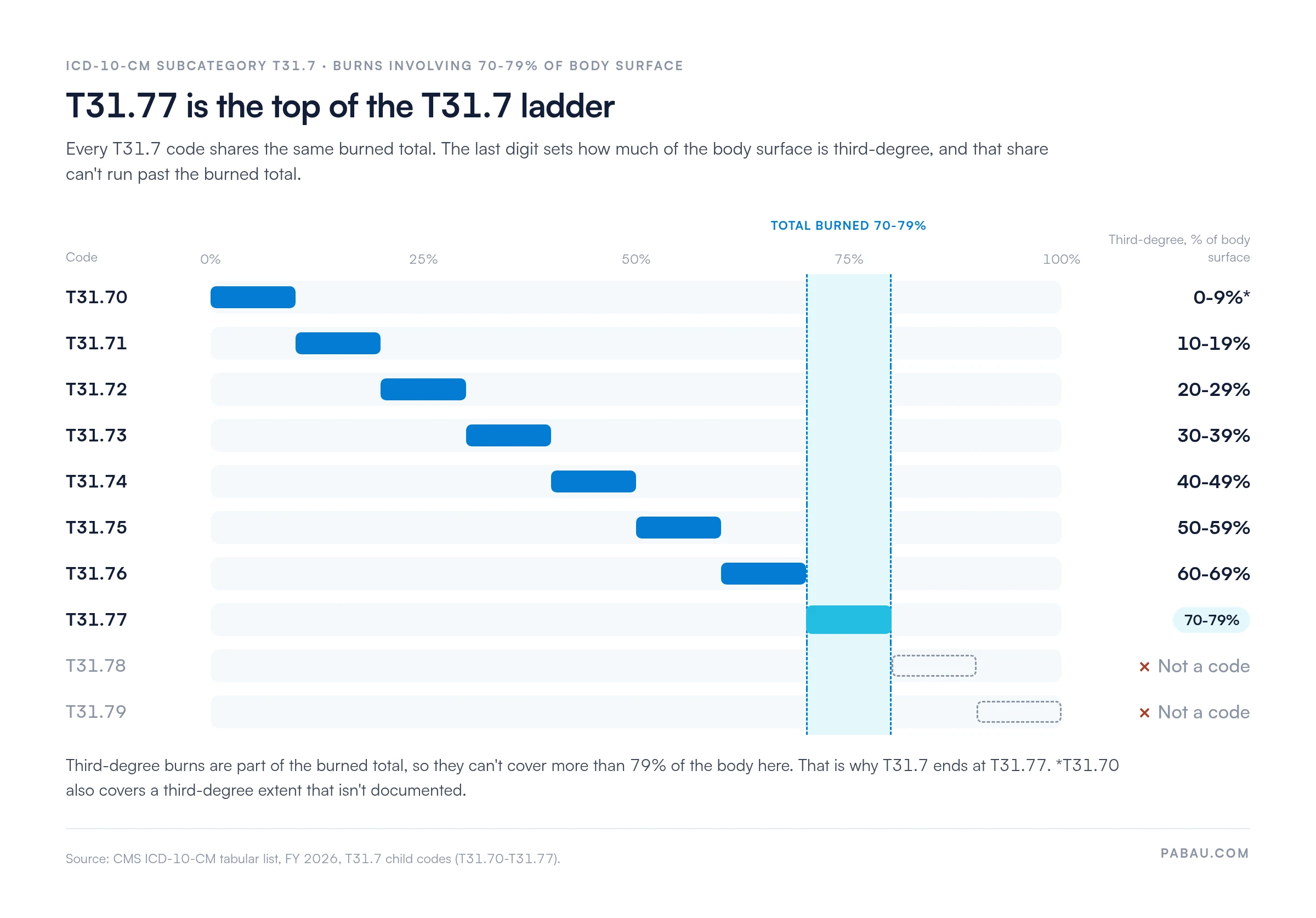
The table lists each T31.7 code with the clinical picture it describes.
The most common error in this subcategory is assigning T31.70 when the physician documents extensive third-degree burns without a separate percentage. Without that figure, query the physician rather than default to T31.70. Defaulting understates injury severity and may suppress the appropriate DRG. The band also has to match exactly: 55% of body surface third-degree is T31.75, not T31.77.
T31.77 is a complete code as written. Category T31 has no seventh-character extension, so T31.77A, T31.77D and T31.77S do not exist and are rejected as invalid codes.
The encounter type lives on the site-specific burn codes from categories T20-T25 instead. Each burned region gets its own code for site and depth, and each of those codes takes a seventh character.
Under the ICD-10-CM burn guidelines, sequence first the site code that reflects the highest degree of burn. Report T31.77 as an additional code to show the extent of body surface involved. A T31 code stands alone only when the burn site is not specified.
A common error is keeping the A character on the site codes after the acute phase ends. Once the patient moves to routine wound care or outpatient follow-up, the site codes switch to the D character. T31.77 itself never changes and never takes a seventh character.
Check the site codes against the TBSA before you submit. A T31.77 claim should carry T20-T25 codes for the burned regions, each with its own seventh character. If T31.77 arrives with no site codes, query the physician for site and depth by region.
Accurate TBSA calculation determines which T31 code applies. Two common clinical methods are used, and the American Burn Association (ABA) recognizes both: the Rule of Nines and the Lund-Browder chart.
The Rule of Nines divides the adult body into regions worth 9% of total body surface area, or a multiple of 9%:
This method is fast and adequate for initial triage. It can misjudge burns in pediatric patients, whose heads are larger relative to body surface area. In a T31.77 case, the Rule of Nines will usually show burns across most of the trunk, both legs and both arms.
The Lund-Browder chart provides a more precise TBSA estimate by adjusting body region percentages based on patient age. It is the preferred method for pediatric burn patients. It also suits any case where the TBSA estimate drives major decisions, such as burn center transfer and fluid resuscitation.
For ICD-10-CM coding purposes, the method used to calculate TBSA is less important than what appears in the medical record. The physician must document both the total TBSA burned and the percentage of total body surface that is third-degree, each as a number. A notation that reads “extensive burns” or “major burns to trunk and extremities” is not sufficient for T31.77.
External cause codes are covered in Section I.C.20 of the ICD-10-CM Official Guidelines. There is no national mandate to report them, but they are recommended for burn injuries. Report them wherever a payer or state reporting rule requires them. A full set for a T31.77 case covers four categories.
Sequencing follows the ICD-10-CM burn guidelines. List the T20-T25 site codes first, starting with the highest degree of burn, then T31.77, then the external cause codes. External cause codes never serve as the principal diagnosis.
Burns covering 70-79% TBSA with extensive third-degree involvement almost always produce a complex, multi-code claim. These conditions and procedures are routinely coded alongside ICD-10 code T31.77 in burn center admissions.
Inhalation injury accompanies a significant proportion of major flame burns. For smoke inhalation, report T59.811A (toxic effect of smoke, accidental, initial encounter). T59.891A (toxic effect of other specified gases, fumes and vapors, accidental, initial encounter) applies when a different gas is documented. Burns of the respiratory tract itself take a code from T27.-.
Per AHA Coding Clinic guidance, inhalation injury codes sequence after the burn code when both are present.
Surgical debridement and skin grafting are standard treatments for third-degree burns at this scale. Circumferential burns may need an escharotomy to relieve compartment pressure, coded in ICD-10-PCS as an incision of skin. Split-thickness skin grafts (STSG) are coded using ICD-10-PCS replacement codes specifying the body region, graft type, and qualifier. Each graft site requires its own procedure code, which affects DRG grouping and reimbursement significantly.
T31.77 cases typically map to burn DRGs 927-935 under the CMS MS-DRG system. The exact DRG depends on whether an operating room procedure was performed and whether complications or comorbidities (CC/MCC) are present. DRG groupings change every year, so check the current fiscal year grouper before estimating reimbursement.
Payers reviewing T31.77 claims look for specific numbers in the medical record. Narrative descriptions of burn severity are not enough, because coders assign T31 codes only from the percentages the physician states. A clean claim for this code starts with complete documentation at the point of care.
Clinical Documentation Improvement (CDI) specialists should query the physician whenever a TBSA diagram is present but the note gives no numeric percentages. The diagram alone is not enough. The percentages must be stated in the note or the query response.
T31.77 is a high-value code that draws close payer review. Burn center revenue cycle teams need a denial management in healthcare process that catches these triggers before submission.
Burns covering 70-79% TBSA are almost universally inpatient admissions, typically to a verified burn center. Emergency admissions do not require prior authorization from Medicare, but transfer authorizations may apply when the patient is being moved between facilities. Document the clinical justification for transfer in the medical record, including the referring facility’s assessment and the burn center’s acceptance criteria.
Commercial payers vary in their authorization requirements for extended burn center stays and reconstructive procedures. When initial authorization is obtained for the admission, confirm whether staged reconstructive procedures scheduled during the same inpatient stay require separate authorization. Some payers treat skin grafting as a separate authorized service even within an authorized admission.
Two claim types come out of one admission. The burn center bills the stay on the UB-04 (837I), which groups to an MS-DRG. Physicians bill their excision, grafting and follow-up work on the CMS-1500 (837P). Knowing how medical billing workflows split that work helps when a case involves multiple payers, coordination of benefits or workers’ compensation.
When a patient returns to treat a condition caused by a healed burn, the sequela is coded on the site-specific burn code, not on T31.77. The seventh character S goes on the T20-T25 code for the region that scarred, such as T21.31XS for the chest wall.
Common late effects at this scale include hypertrophic scarring and keloid (L91.0) and scar conditions or fibrosis of skin (L90.5). Joint contractures take an M24.5- code for the affected joint. Reconstructive procedures such as scar revision or contracture release are reported against these sequela codes.
Sequela coding follows a two-code order. List the sequela condition first, because it is what the provider is treating. Then list the T20-T25 burn code with the S character to show the cause. Reversing this order is a claim error.
CDI query tip: When a patient is readmitted for contracture release after T31.77-level burns, check the operative report. It should name the burned region and link it to the original injury. Then sequence the contracture code first and add the site code with S, such as T24.311S for the right thigh. This pairing supports medical necessity for the reconstruction.
A physician claim for T31.77 burn care carries a long code set. It holds the T20-T25 site codes with their seventh characters, plus T31.77 itself. It may add external cause codes and a procedure code for each graft site. One wrong character can stall payment for the whole claim.
Pabau, the practice management and billing platform we build, handles that professional side. Its claims software for practices files electronic CMS-1500 claims through the Claim.MD clearinghouse. Eligibility checks and claim validation run before submission, and ERA remittance data comes back so denials can be tracked by code.
Pabau does not bill the facility side. The burn center’s inpatient claim on the UB-04 (837I), and the MS-DRG it groups to, stay with the hospital’s own billing system.

Pabau files professional claims through Claim.MD, with eligibility checks, pre-submission validation and ERA processing for multi-code burn care claims.

Code T31.77 from two numbers only: total TBSA burned and the percentage of body surface that is third-degree. If either is missing or the notes disagree, query the physician before you code. A guessed band lands the claim on the wrong T31.7 code, and the payer will notice before you do.
The other errors are mechanical, and a pre-submission check catches them. Keep the seventh character on the site codes and off T31.77, and add external cause codes wherever the payer asks for them. Do that, and a claim this severe gets paid at the level its documentation supports.
Pabau handles that check for the professional claim. Book a demo to see how it validates physician burn-care claims before they reach the payer.

Need to understand the broader clearinghouse billing process? Claim.MD clearinghouse overview explains how electronic claim routing works for US healthcare billers.
Want to reduce claim rejection rates across your practice? Medical billing compliance guidance covers the documentation and submission standards that support cleaner claims.
Need to itemize physician services for a burn patient? How superbills work in medical billing walks through how a physician visit becomes an itemized claim.
ICD-10 code T31.77 is a billable ICD-10-CM code for burns covering 70-79% of body surface, with 70-79% of body surface third-degree (full-thickness). Both percentages must be documented as numbers and must fall in those ranges at the same time.
Yes, T31.77 is a valid, billable ICD-10-CM code for fiscal year 2026. It is complete as written and needs no seventh character to be submission-ready.
No. Category T31 has no seventh-character extension, so T31.77A, T31.77D and T31.77S are not valid codes. The encounter type goes on the T20-T25 site-specific burn codes reported with T31.77, such as T21.31XA for an initial encounter or T21.31XS for a sequela.
T31.70 applies when 70-79% of body surface is burned and 0-9% of body surface is third-degree, or the third-degree extent is unspecified. T31.77 applies when 70-79% of body surface is third-degree. Using T31.70 when the record supports T31.77 understates injury severity and reduces reimbursement.
The physician must document that 70-79% of total body surface is third-degree. That figure must appear as a number in the medical record, not as a narrative description. Coders cannot estimate the band upward or downward from vague documentation.
Section I.C.20 of the ICD-10-CM guidelines recommends external cause codes with T31.77. They are required only where a payer or state rule asks for them. A full set covers cause of burn (X00-X19), place (Y92), activity (Y93) and patient status (Y99). They never serve as the principal diagnosis.
TBSA sets both digits after the decimal in a T31 code. The first is the total body surface burned, and the second is the share of total body surface that is third-degree. An error in either figure changes the code, so code only from the percentages the physician documents.