ICD-10 code S12.591B: Nondisplaced C6 fracture, open
ICD-10 code S12.591B: Definition and billable status ICD-10 code S12.591B is the...

Last Updated: Nov 2, 2026
Billable Code Specific Code
V49.9XXS is the billable ICD-10-CM code for car occupant (driver) (passenger) injured in unspecified traffic accident, sequela. It is reported as a secondary external cause code once the original injury has healed. It follows the late-effect condition code and the injury code ending in S.
The code sits in category V49 of the V40–V49 car occupant block, within the external causes chapter. When the record names a nontraffic setting or how the accident happened, a more specific V40–V49 code replaces it. The driver or passenger role alone does not.
Let Pabau's smart automation suggest the right codes, reduce claim denials, and keep your practice compliant—effortlessly.
Automate repetitive tasks and focus on what matters most—your patients.
Reduce coding errors and ensure compliance with the latest regulations.
Clean claims, fewer denials, and faster reimbursements.
Powerful insights and reporting to help your practice thrive.
HIPAA compliant SOC 2 certified GDPR-compliant Trusted by 4,000+ clinics worldwide

V49.9XXS codes the sequela of an unspecified traffic accident for a car occupant, once the acute injury phase is over.
The seventh character S means the condition being treated stems from the accident and the original injury has already healed.
V49.9XXS is an external cause code, so it is never sequenced as the primary diagnosis. A condition code, such as chronic pain or post-traumatic arthropathy, comes first on the claim.
Documenting whether the patient was the driver or a passenger does not move coding off V49.9XXS. A documented collision, object or nontraffic setting does.
Pabau, the practice management software we build, integrates with Claim.MD to submit electronic claims to thousands of US payers and track ERAs.
ICD-10 code V49.9XXS is a billable external cause code for a car occupant injured in an unspecified traffic accident, at the sequela stage.
The seventh character S marks the sequela. The code sits in the ICD-10-CM External Causes of Morbidity chapter (V00-Y99). The Centers for Medicare and Medicaid Services (CMS) and the National Center for Health Statistics (NCHS) maintain the code set.
The hierarchy runs from category to specific code in four steps:
The two X placeholders are structural. They hold the fifth and sixth character positions so the seventh character S can be applied.
The seventh character S designates sequela. A sequela is a condition that directly results from an injury that has already healed or reached maximum medical improvement.
Per ICD-10-CM Official Guidelines Section I.C.19.a, sequela coding starts when the acute injury phase is over. No fixed calendar point applies. Provider documentation must show that the original injury has resolved and the patient is now treated for a residual condition it caused.
Three seventh-character options apply to V49.9. Each governs a distinct episode of care and cannot be interchanged without triggering denials or audit flags.
The ICD-10-CM guidelines set no minimum number of days or weeks before the sequela character applies. Provider attestation in the medical record controls the determination. Say the note records that the original cervical sprain has healed and the patient now has persistent neck stiffness. That documentation supports S, however much time has passed.
V49.9XXS covers sequela for a car occupant — driver or passenger — injured in an unspecified traffic accident. The tabular list places “car accident NOS” here. It applies when the record confirms a road accident but not how it happened. An accident with no place stated counts as traffic under the tabular list’s transport note.
The occupant’s role does not change the code, because the official descriptor already names both driver and passenger. What moves coding off V49.9XXS is a documented mechanism or setting. That means a collision with another motor vehicle, a named object or person, a noncollision event such as a rollover, or a nontraffic location.
Sequela conditions commonly coded alongside V49.9XXS include:
The condition code drives medical necessity and reimbursement. V49.9XXS supplements it by telling the payer why the patient has this condition. It answers “how did this happen?”, while the condition code answers “what are we treating?”
V49.9XXS has a defined scope that excludes several situations coders meet in MVA billing. Using it when an exclusion applies produces a technically incorrect claim, which payer edits may catch.
The V49 block contains several closely related codes that coders often confuse. The key differentiators are episode of care, traffic versus nontraffic setting, and how the accident happened. Occupant role only matters once the record documents a collision. Run the four checks below against the record in this order, and stop at the first one the documentation answers.
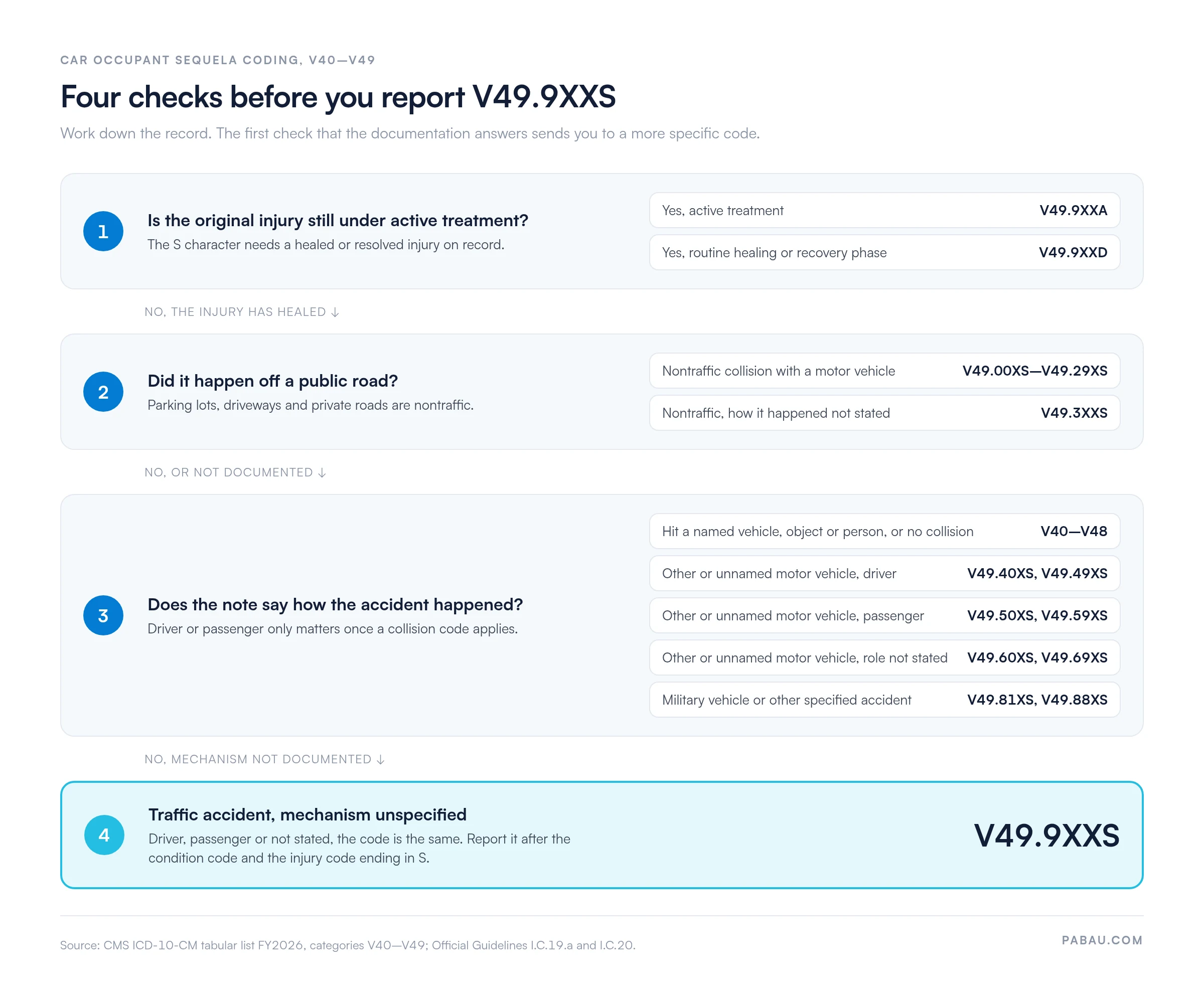
The table below sets out the codes that cause the most confusion in sequela billing for car occupant injuries.
Verify against the official NCHS ICD-10-CM tabular list for the active fiscal year before billing V49.9XXS or any adjacent V49 code. Code descriptions and valid ranges change in annual updates, and using a retired or restructured code is an audit trigger.
V49.9XXS is an external cause code. Per ICD-10-CM Official Guidelines Section I.C.20, external cause codes are never sequenced as the principal diagnosis on a claim. A condition code describing the sequela being treated must appear first. Practices billing US insurers through Pabau can then submit electronic claims to thousands of US payers and track ERAs through its Claim.MD integration.
The correct coding sequence for a V49.9XXS encounter:
Worked example claim: A patient presents 14 months post-MVA for evaluation of persistent post-traumatic headaches. The provider’s note documents that the original whiplash injury has healed and links the headaches directly to the accident. Correct sequencing: G44.309 (post-traumatic headache, unspecified, not intractable) → S13.4XXS (sprain of ligaments of cervical spine, sequela) → V49.9XXS.
Sequela coding is documentation-intensive. The medical record must establish two points that routine office notes often leave implicit. The original injury has resolved, and the current condition traces causally to that injury. Missing either element creates audit exposure. Structured medical billing compliance workflows catch these omissions before claims reach adjudication.
The minimum documentation set for a defensible V49.9XXS claim includes:
Sequela external cause codes generate a predictable set of denials. Most stem from sequencing errors or missing documentation rather than an invalid code. The correction path differs by root cause, so the specific denial pattern matters. Practices with structured denial management workflows resolve these faster. They route each denial reason to the right team: coding, billing, or clinical documentation.
For a fuller reference, the CARC denial codes guide covers the most common adjustment reason codes and the recommended response to each.
External cause codes behave differently across payer types. Report external cause codes where state or payer rules require them. No national Medicare or Medicaid mandate exists, and neither program uses V49.9XXS to determine reimbursement. Where you do report it, the CMS ICD-10-CM coding guidelines govern how it is sequenced.
Auto insurance carriers often require the original accident date and a police report number linked to the claim. That makes the external cause code more central to their adjudication.
Workers’ compensation payers typically have state-specific sequela rules. Some require prior authorization before treating late-effect conditions, particularly when the original injury claim has been closed. The causal-link documentation requirement is usually stricter in workers’ comp. Many programs require an independent medical examination (IME) to confirm the sequela condition is work-related before approving continued treatment.
Auto insurers may not recognize sequela codes for reimbursement the way health insurers do. They still commonly request them during audits as evidence that treatment relates to the covered accident. MVA personal injury billing layers these payer rules on top of standard medical billing workflows. The safest approach has three parts:
Check pre-authorization requirements with each payer before the first sequela visit. Auto insurers frequently require formal notice that the patient is moving from acute treatment to sequela management. Treating without prior approval can lead to whole-episode denials rather than single-claim rejections.
Sequela claims usually fail on paperwork rather than on the code. Coders chase providers for a healing statement, rebuild the accident history from old notes, and re-key the claim after a rejection.
In Pabau, the accident date, resolution statement and causal link sit in the patient’s clinical notes. The coder can check them before billing. Pabau’s claims management software then sends the claim through its Claim.MD integration to thousands of US payers. ERA tracking shows which claims were paid and which came back.
The result is fewer resubmissions for missing documentation, and a clear view of where each sequela claim stands.

Pabau connects to Claim.MD, so your practice can submit electronic claims to thousands of US payers and track ERAs. See how Pabau handles sequela claims from clinical notes to payment.

V49.9XXS is the right code when the record confirms a traffic accident but not how it happened. The driver or passenger detail does not change that. The provider must still document two facts: the original injury is resolved, and the current condition traces directly to the accident.
Before billing, read the note for a healing statement and a causal link. If either is missing, request an addendum before submission rather than after the denial arrives.
Then sequence the condition code first and V49.9XXS second on every sequela encounter. Book a demo to see how Pabau keeps clinical notes and electronic claims together for MVA sequela billing.

Need a reference for denial adjustment reason codes? CARC denial codes in medical billing covers the most common adjustment reason codes with recommended response steps.
Unsure how clearinghouse claim validation works? Medical claims clearinghouse explained covers how electronic claim scrubbing catches sequencing errors before payer adjudication.
Want to understand the full revenue cycle around sequela claims? Revenue cycle management fundamentals explains how each step from coding through payment posting connects.
ICD-10 code V49.9XXS is the billable external cause code for a car occupant injured in an unspecified traffic accident, sequela. It is used when treating a late-effect condition caused by a prior motor vehicle accident, after the original injury has healed. It never stands as the primary diagnosis. A condition code describing the sequela must be listed first on the claim.
Use the seventh character S once provider documentation shows the original injury has healed or reached maximum medical improvement. The patient must now be treated for a condition that directly resulted from that injury. The guidelines set no minimum healing period. Provider attestation in the medical record governs the determination.
V49.9XXA designates the initial encounter, the first visit where the car occupant injury itself receives active treatment. V49.9XXS designates the sequela phase, when a late-effect condition caused by the accident is treated after the injury has resolved. Using A once healing is complete, or S before it is, are both coding errors that trigger denials.
No. The official descriptor covers both: car occupant (driver) (passenger) injured in unspecified traffic accident. A documented mechanism is what moves coding off V49.9XXS. Examples are a collision with another motor vehicle (V49.4–V49.6) or with a named object or person (V40–V48). A documented nontraffic setting moves it too.
No. External cause codes, including V49.9XXS, are never sequenced as the principal or primary diagnosis under ICD-10-CM Official Guidelines Section I.C.20. A condition code describing the sequela being treated must appear first on every claim using V49.9XXS.
The most common sequela conditions coded alongside V49.9XXS are chronic cervical or lumbar pain (M54.2, M54.50) and post-traumatic headaches (G44.309). Post-traumatic arthropathy (M12.5x) and neuropathic pain from nerve injury are also frequent. So are psychological sequelae such as PTSD (F43.10) or anxiety disorder (F41.1) linked to the accident.
The most common reason is sequencing V49.9XXS as the primary diagnosis instead of a supplementary code. Payers also deny claims that use S before the original injury has healed, when A or D is correct. Others leave out the paired condition code that describes what is being treated. The last frequent cause is a record that never documents the causal link to the original MVA. Each denial reason needs a different correction path.