ICD-10 Code T31.77: Burns involving 70-79% of body surface
ICD-10 code T31.77: Quick reference and code details ICD-10 code T31.77 is the b...

Last Updated: Nov 5, 2026
Billable Code Specific Code
T30.4 is the billable ICD-10-CM code for corrosion of unspecified body region, unspecified degree. It covers a chemical injury, such as an acid or alkali burn, when the chart documents neither the site nor the degree.
Coders most often meet it in emergency department charts, where the chemical exposure is confirmed but the wound assessment is pending. Where a documented site and degree support another code, T30.4 should not be used. Coding a chemical injury with a burn code contradicts the rest of the claim and can trigger a denial.
Let Pabau's smart automation suggest the right codes, reduce claim denials, and keep your practice compliant—effortlessly.
Automate repetitive tasks and focus on what matters most—your patients.
Reduce coding errors and ensure compliance with the latest regulations.
Clean claims, fewer denials, and faster reimbursements.
Powerful insights and reporting to help your practice thrive.
HIPAA compliant SOC 2 certified GDPR-compliant Trusted by 4,000+ clinics worldwide

T30.4 is the corrosion code for chemical injuries, and selecting the thermal burn code T30.0 for a chemical exposure is a coding error.
T30.4 is a complete, billable code as written, with no placeholder X and no 7th character for encounter type.
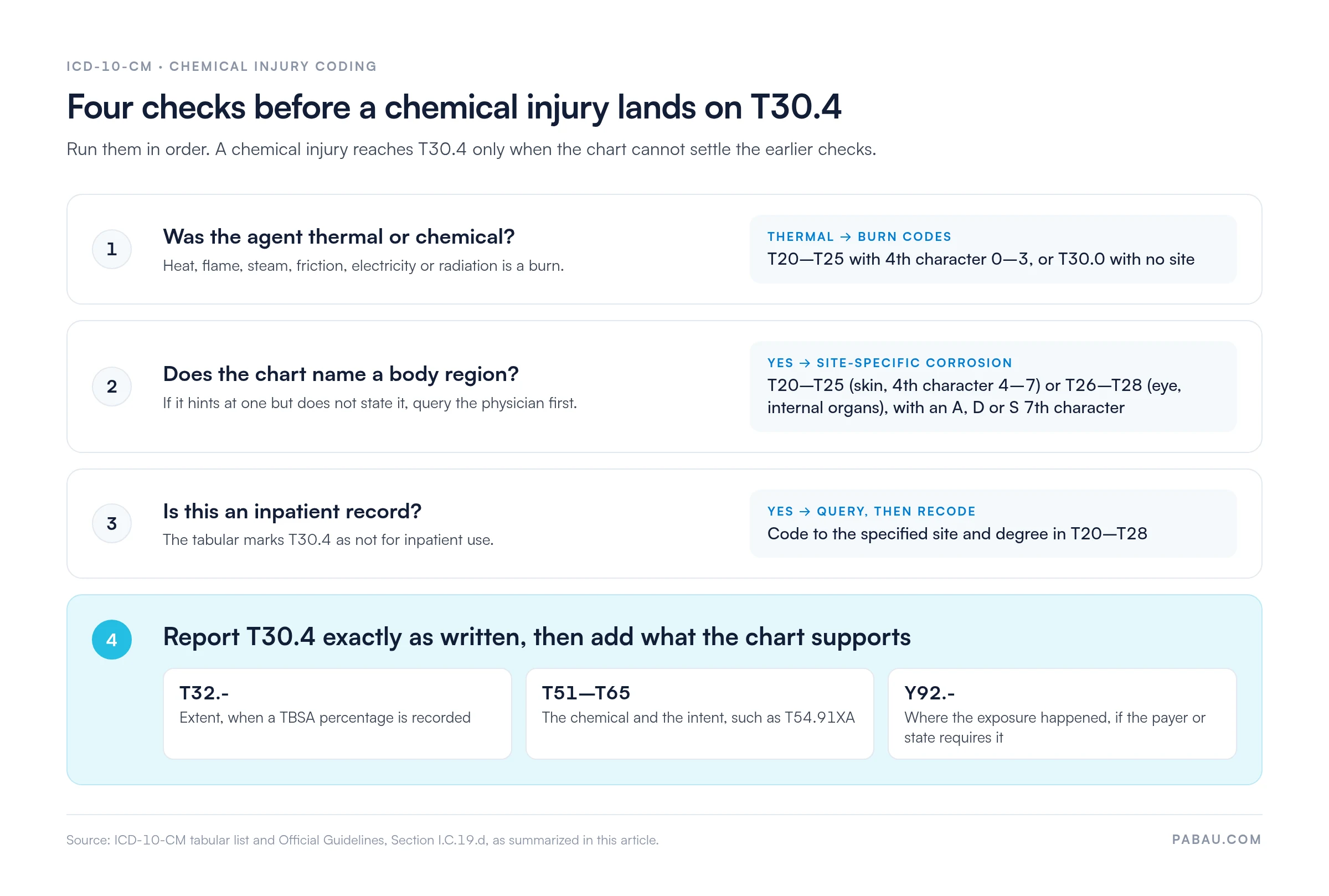
The tabular marks T30.4 as not for inpatient use, and the official guidelines say category T30 should rarely be used.
Where the chart supports it, report the chemical and intent with a T51-T65 code and the place of injury with a Y92 code.
Pabau’s claims management software works with the Claim.MD clearinghouse to check ICD-10 coding before submission, reducing corrosion-code denials.
ICD-10 Code T30.4 is the billable diagnosis code for corrosion of unspecified body region, unspecified degree, under the ICD-10-CM classification system. It is a complete code as written, valid for the current fiscal year and accepted on HIPAA-covered claims.
The CDC/NCHS ICD-10-CM web tool lists T30.4 in its current annual release. Category T30 covers only injuries where the body region is not specified. When the chart hints at a site or degree but does not state it, coders should query the physician before settling on T30.4.
A burn results from a thermal source such as heat, flame, steam, friction, electricity or radiation. A corrosion results from a chemical agent, such as an acid, alkali or other caustic substance. ICD-10-CM codes them separately under Section I.C.19.d of the ICD-10-CM Official Guidelines for Coding and Reporting.
Why it matters for claims: Payers read the injury code against the rest of the claim. A thermal burn code such as T30.0 next to a corrosive toxic-effect code, such as T54.91XA, contradicts itself. That conflict is a preventable denial trigger, and it starts at the documentation stage.
The ICD-10-CM tabular attaches a short set of notes to T30.4 and to the burn and corrosion block it sits in. Each one shapes when the code is valid.
The T20-T32 block carries an Excludes2 note. These conditions are not part of T30.4, but they can be coded alongside it when both are present.
No. T30.4 is a complete, billable code, and you report it exactly as written. Category T30 carries no 7th-character note, so it takes no placeholder X and no A, D or S extension. Appending one creates a code that does not exist in ICD-10-CM, and claim edits reject it.
That also means T30.4 does not capture the encounter type. Initial care, follow-up wound care and scar treatment all report as T30.4. When the encounter type needs to show on the claim, the chart has to support a site-specific code.
Categories T20-T28 do carry a 7th character: A for initial encounter, D for subsequent encounter and S for sequela. For example, T20.40XA reports corrosion of unspecified degree of the head, face and neck at the initial encounter. Guideline I.C.19.d.7 codes late-effect care, such as scar or contracture treatment, with the 7th character S, so that work needs a site-specific code.
Several codes in the T20-T32 range look similar to T30.4 but carry different clinical meanings. Using the wrong one changes how the payer adjudicates the claim.
The AAPC ICD-10-CM code lookup and the ICD List reference tool both display the full T30 hierarchy and its sibling codes.
Guideline I.C.19.d.9 says an external cause code should be used with burns and corrosions to identify the source, the intent and the place. For a corrosion, the chemical and intent are reported with a toxic-effect code from T51-T65. The site-specific corrosion codes in T20-T25 state this as a “code first” note. T30.4 carries no such note, but the same logic applies when the chart names the substance.
The T51-T65 codes carry their own A, D or S 7th character; that belongs to the toxic-effect code, never to T30.4. The guidelines set no national mandate for external cause reporting. State reporting rules and individual payer policies can still require it, so check the payer before you treat it as optional.
T30.4 is appropriate only when documentation genuinely cannot support a more specific code. The chart must still contain the minimum elements that justify this code over a site-specific alternative.
Underdocumentation that forces T30.4 when a specific code was clinically available is a documentation deficiency for the physician to correct. Coders should query the physician whenever the injury description is incomplete.
Before assigning T30.4, run a documentation checklist: causative agent documented? Body region determinable? Degree assessable? If a physician query can complete any of those fields, send the query. Reserve T30.4 for charts that still lack those details after the query.
T30.4 is appropriate when the chart contains no determinable body region and no assessable degree, even after a physician query. These are the situations where the unspecified code is clinically justified.
When T30.4 is not appropriate: If the chart documents a body region, use a site-specific corrosion code. That means T20-T25 for skin surfaces such as the face, hand, trunk or lower limb, and T26-T28 for the eye and internal organs. Inpatient records should not carry T30.4, because the tabular marks it as not for inpatient use. Using T30.4 when the chart supports specificity is a coding convention violation and an audit risk. The decision path below runs those checks in the order a coder meets them.
Guideline I.C.19.d.6 assigns a T32 code for acute corrosions when the site is not specified or when extra data is needed. The tabular note on T32 allows it as the primary code only when the site of the corrosion is unspecified. A chart with a TBSA figure and no site is exactly that case.
T32 codes use a 5th character to capture the percentage of TBSA that involves 3rd degree corrosion. If the physician documents 25% TBSA with no 3rd degree component, the code is T32.20. If total TBSA is 25% and 15% of it is 3rd degree, the code is T32.21. T30.4 carries no equivalent digit, because its degree is unspecified. Neither code takes a 7th character, and T32 is not used for sequelae.
A clean T30.4 claim depends on the code going out exactly as written, with the companion codes the chart supports. These are the elements payers check most often.
T30.4 claims fail for a consistent set of preventable reasons. Each denial maps to a specific corrective action.
Structured denial management workflows give billing teams a systematic way to catch these patterns before claims age. A clean claim submission checklist for corrosion codes catches the same errors before the claim leaves the practice.
When a T30.4 claim does come back, the remittance carries a reason code. The reference on denial codes explains what each one means and which fix it calls for.
Audit T30.4 claims quarterly. Pull every claim that carries T30.4 and check three things. Nothing is appended to the code, the setting is not inpatient, and a named chemical has its code. Building those checks into charge entry removes this category of denial.
Without a check before submission, a T30.4 error surfaces on the remittance, weeks after the visit. By then the chart is cold, and the fix means a corrected claim and a second wait for payment.
Pabau, the practice management and billing platform we build, moves that check to the point of charge entry. It sends claims electronically through Claim.MD, the US clearinghouse partner that checks ICD-10 coding against payer rules before submission. Its claims management software keeps the injury code, the chemical code and the place code together on one claim.
The outcome is fewer rejected corrosion claims and a clear trail when one does fail. Pairing that with electronic remittance advice workflows shows billing teams which code element triggered a denial. The guide to the Claim.MD clearinghouse integration walks through how it fits a billing workflow.

Pabau’s integration with Claim.MD checks ICD-10 coding against payer edits before submission. Invalid code formats and missing companion codes are caught before they turn into denials.

T30.4 is a last-resort code. The guidelines call category T30 extremely vague, and the tabular keeps it off inpatient records. Use it only when a physician query cannot recover the site or the degree.
The fix that saves the most claims is also the simplest. Report T30.4 exactly as written, with nothing appended. Add the chemical and place codes the chart supports, and move to a T20-T28 code once the wound is assessed.
Book a demo to see how Pabau catches corrosion-code errors before your claims reach the payer.

Want the bigger billing picture? Understanding revenue cycle management explains how coding accuracy feeds into the full claim payment lifecycle.
Getting denials on ICD-10 submissions? Medical claims clearinghouse guide covers how clearinghouse edits catch code errors before they reach the payer.
Want to validate codes before submission? Superbill documentation guide details how to build a superbill that captures the injury code, external cause code, and TBSA add-on together.
ICD-10 Code T30.4 is the billable diagnosis code for corrosion of unspecified body region, unspecified degree. It is used when a chemical agent caused the injury and the chart does not specify the degree of tissue damage or the body site. It sits in category T30, which groups burns and corrosions where the body region is unspecified.
Burns come from thermal sources such as heat, flame, steam, friction, electricity or radiation. Corrosions are burns caused by chemicals such as acids and alkalis. On skin sites, codes T20-T25 separate them by the 4th character: 0-3 for burns and 4-7 for corrosions. Where no site is documented, T30.0 is the burn code and T30.4 is the corrosion code.
Use T30.4 only when the chart contains no determinable body region and no assessable degree, even after a physician query. Typical cases are ED triage before wound assessment, a chemical splash across regions too diffuse to separate, and coding from incomplete transfer records. The tabular marks T30.4 as not for inpatient use, so code to site and degree on inpatient records.
The official guidelines say an external cause code should be used with burns and corrosions to show source, intent and place. There is no national mandate, though some payers and states require one. For a chemical injury, the chemical and intent are usually reported with a T51-T65 code, and the place with a Y92 code.
No. T30.4 is a complete, billable code and is reported exactly as written. Category T30 has no placeholder X and no A, D or S 7th character, so appending one creates an invalid code. The 7th characters for encounter type apply to the site-specific burn and corrosion codes in T20-T28.
Section I.C.19.d of the ICD-10-CM Official Guidelines governs burns and corrosions. Key rules: sequence the highest-degree burn first and code each site separately. Category T30 is extremely vague and should rarely be used. Assign T31 or T32 when the site is not specified or extra data is needed. An external cause code should show source, intent and place.