ICD-10 Code T31.77: Burns involving 70-79% of body surface
ICD-10 code T31.77: Quick reference and code details ICD-10 code T31.77 is the b...

Last Updated: Nov 5, 2026
Billable Code Specific Code
T81.533S is the billable ICD-10-CM code for perforation due to foreign body accidentally left in body following injection or immunization, sequela. It applies when a fragment from an injection, such as a broken needle tip, caused a perforation and the visit treats a resulting condition.
Coders commonly confuse it with T81.530S (surgical operation), T81.538S (other procedure) and T81.539S (unspecified procedure). The other frequent error is the 7th character: A or D on a visit that treats a late effect.
Let Pabau's smart automation suggest the right codes, reduce claim denials, and keep your practice compliant—effortlessly.
Automate repetitive tasks and focus on what matters most—your patients.
Reduce coding errors and ensure compliance with the latest regulations.
Clean claims, fewer denials, and faster reimbursements.
Powerful insights and reporting to help your practice thrive.
HIPAA compliant SOC 2 certified GDPR-compliant Trusted by 4,000+ clinics worldwide

T81.533S codes a later visit for a condition caused by a perforation from a foreign body left after an injection or immunization.
The 6th character names the procedure that left the object behind, so 3 means injection or immunization, never a body site.
A sponge left during surgery is T81.530-, and a fragment left after catheter removal is T81.537-, so code the procedure in the record.
Per Guideline I.B.10, list the resulting condition first and T81.533S second, then add a Z18.- code when the retained material is documented.
CMS lists retained foreign objects as HAC 01, but that payment rule targets the original inpatient stay, not the later sequela claim.
ICD-10 Code T81.533S is the billable code for perforation due to foreign body accidentally left in body following injection or immunization, sequela.
A fragment from an injection, such as a broken needle tip, perforated tissue. The current visit treats a late effect of that perforation.
It is a valid, fully specified code, so a claim needs no further character.
Subcategory T81.5 groups complications caused by a foreign body accidentally left in the body after a procedure. The 5th character names the complication, and T81.53- is the perforation group. The 6th character then records which procedure left the object behind.
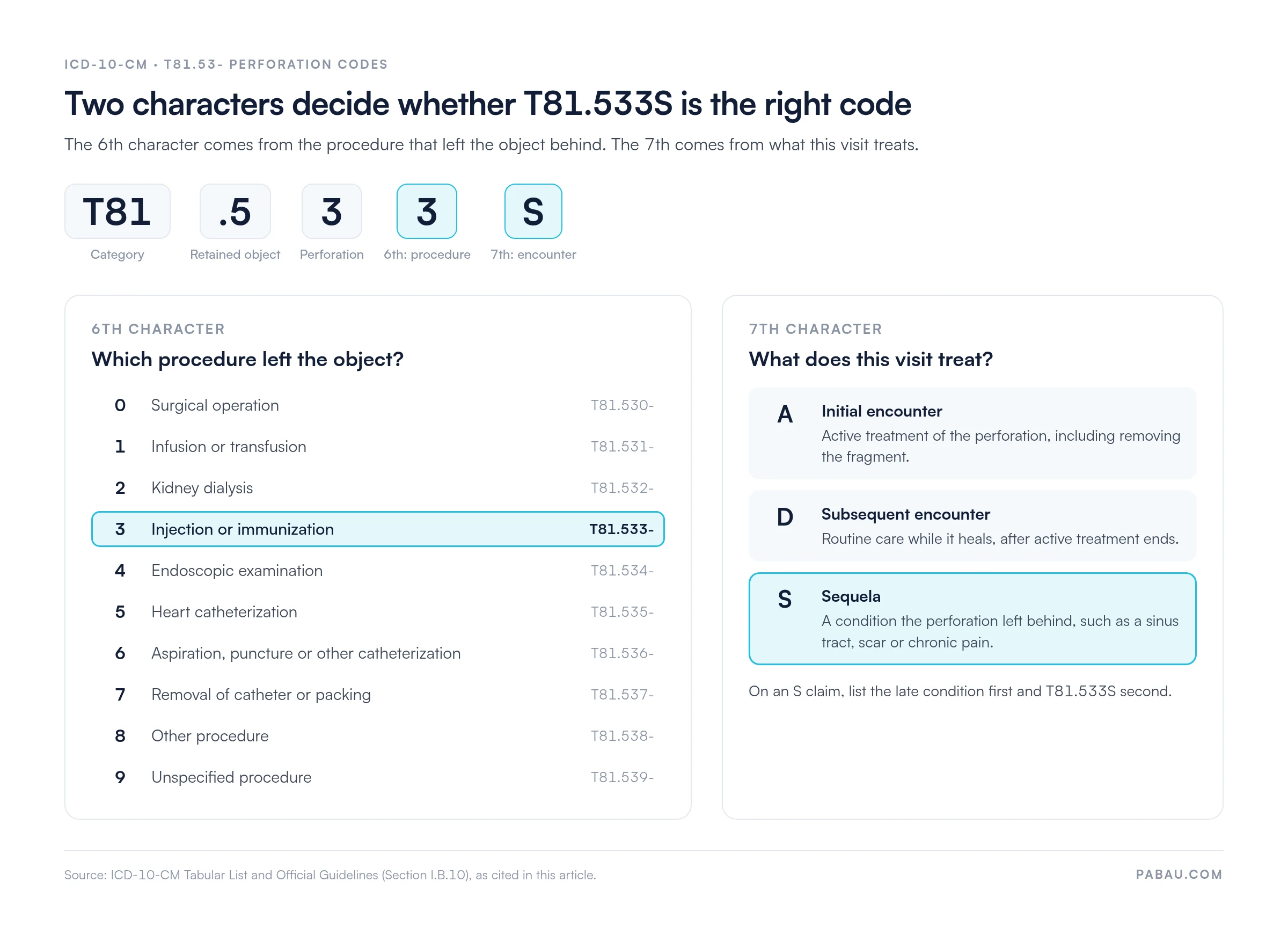
Read T81.533S character by character and two decisions stand out: the procedure at the 6th position and the encounter type at the 7th.
Per the ICD-10-CM Official Guidelines for Coding and Reporting, the 7th character S marks a condition that arises directly from an earlier one. For T81.533S, that is a late effect of the perforation, coded once active treatment has ended.
The tabular also instructs coders to use an additional Z18.- code to identify any retained foreign body, if applicable.
The three encounter options for this code family are:
The 7th character tracks the stage of treatment, whoever provides it. A new specialist who removes the fragment still reports T81.533A, because that visit is active treatment.
A needle can break during an injection or vaccination and leave its tip in soft tissue. Over weeks or months, the retained tip can migrate and perforate nearby tissue.
The perforation is treated first, often by removing the fragment, and that visit carries T81.533A. T81.533S applies later, when the patient returns for a condition the perforation left behind.
Common clinical features that prompt coding of T81.533S:
Objects left during an operation belong to a different code. A retained surgical sponge (gossypiboma) that perforates the bowel is T81.530-, because the procedure was a surgical operation. A catheter fragment left during an infusion is T81.531-, and one left when a catheter was removed is T81.537-.
The key documentation point is a provider statement that links the late condition to the perforation, and the perforation to the injection fragment.
Flag T81.533S cases for review before coding. The record should name the injection that left the fragment and link it to the perforation. If the provider hasn’t connected the two, query before assigning this code.
Every T81.53- code describes perforation due to a retained foreign body, and the 6th character names the procedure. Choosing the wrong procedure is a frequent denial trigger in this family.
The codes not shown cover endoscopic examination (T81.534-), heart catheterization (T81.535-), aspiration, puncture or other catheterization (T81.536-), and removal of catheter or packing (T81.537-).
Code from the procedure named in the record, whatever the body site. A perforated bowel from a retained surgical sponge is T81.530S. A soft-tissue perforation from a broken vaccine needle is T81.533S. If the record doesn’t name the procedure, query before falling back to T81.539S.
Read the code as two separate choices, as the diagram below lays out: the procedure sets the 6th character, and the visit sets the 7th.
Several codes sit close to T81.533S, and each one describes a different event. Check the record against these before you settle on the code.
Key related codes:
The CDC/NCHS ICD-10-CM web tool is the authoritative source for verifying current Excludes1 and Excludes2 notes before coding. These notes can change with annual FY updates, so always check the current tabular rather than relying on prior-year references.
Before T81.533S is assigned, the record should establish four things:
Physician query is appropriate when any of these four elements is missing or ambiguous. Facility query policy governs when and how the query is initiated. Coding guidelines don’t require a query in every case.
CMS lists retained foreign objects on its hospital-acquired conditions list as HAC 01 (Foreign Object Retained After Surgery). Under the HAC payment provision, a qualifying condition not present on admission can’t raise the inpatient MS-DRG payment.
That provision is separate from the Hospital-Acquired Condition Reduction Program (HACRP). The HACRP reduces Medicare payments by 1% for hospitals in the worst-performing quartile on its quality measures.
The Joint Commission also treats unintended retention of a foreign object after an invasive procedure as a sentinel event.
The HAC payment provision applies to the inpatient stay where the condition arose. T81.533S describes a later sequela encounter, billed on its own claim. Check each payer’s rules for that encounter:
Don’t assume a sequela claim will be denied, because the HAC rule doesn’t extend automatically to later encounters. Running an eligibility check through your claims management software before the sequela visit prevents authorization-related denials. Pabau, the practice management and billing platform we build, runs that check through the Claim.MD clearinghouse.
T81.533S denials cluster around five predictable errors. Each has a direct fix. When a claim comes back, the medical billing denial codes on the remittance show which error caused it.
A clean-claim submission workflow catches these errors before the claim leaves the practice. Build edits that flag a T81.533S claim listed first, or one with no Z18.- code when the material is documented.
ICD-10-CM Official Guidelines Section I.B.10 governs sequela sequencing. The condition or nature of the sequela is listed first, and the sequela code is listed second.
For a T81.533S encounter, that means:
Take a patient who returns with a sinus tract that formed after a retained needle tip perforated soft tissue. Code the sinus tract first, then T81.533S.
Two further rules apply. When the Tabular List pairs the sequela code with a manifestation code, follow that instruction instead. And never report T81.533A alongside T81.533S, because the acute-phase code is never used with its late effect.
Audit T81.533S claims quarterly. A claim with T81.533S listed first, or as the only code, usually means the sequela sequencing rule was missed. Catching the pattern early prevents repeat denials.
Many practices still check sequela claims by hand, often after a payer has already rejected one. A missing Z18.- code or a reversed sequence then surfaces weeks later as a denial.
Pabau’s claims management scrubs each claim for missing or invalid details before it leaves the system. Eligibility checks and CMS-1500 submission run through Claim.MD, so coverage is confirmed before the follow-up visit.
When a payer rejects a claim, Pabau flags it as “Needs action” and shows what went wrong. Your billing team fixes and resubmits it from the same record, without rebuilding the claim.

Pabau scrubs each claim for missing or invalid details and submits it through Claim.MD, so T81.533S claims reach the payer complete.

T81.533S turns on one question: which procedure left the object behind? If the record says injection or immunization, the 6th character is 3, whatever the body site.
Settle that before the 7th character or the sequencing. A record that can’t answer the procedure question needs a query, not a guess. The wrong procedure code fails however well the rest is built.
Teams that build these checks into their revenue cycle workflow stop reworking the same denials. Book a demo to see how Pabau checks sequela claims before they reach the payer.

Need to understand how clearinghouse submission works for complication codes? Our Claim.MD clearinghouse guide explains how 837P claims are validated and transmitted to thousands of US payers.
Looking for guidance on denial management workflows for postprocedural codes? Denial codes in medical billing covers CARC reason codes and appeals processes for rejected claims.
Want to understand electronic remittance and ERA processing for sequela claims? Electronic remittance advice explains how 835 ERA files report payer payment decisions for ICD-10-coded claims.
ICD-10 Code T81.533S means perforation due to foreign body accidentally left in body following injection or immunization, sequela. It codes a later visit for a condition that perforation caused, such as a scar after a broken needle tip.
Yes, T81.533S is a valid, fully specified ICD-10-CM code that needs no further characters. On a CMS-1500 claim it usually sits second, after the code for the condition the sequela caused.
Use S when the visit treats a condition that arose as a direct result of the perforation, such as scarring or a sinus tract. Use A for each encounter with active treatment of the perforation. Use D for routine care during healing after active treatment ends.
CMS lists it as HAC 01 (Foreign Object Retained After Surgery) on its hospital-acquired conditions list. Under that payment provision, a qualifying condition not present on admission can’t raise the inpatient MS-DRG payment. The HACRP is a separate program, and neither rule automatically applies to a later sequela claim.
The difference is the procedure that left the object behind, not the body site. T81.530S covers perforation from an object left during a surgical operation, such as a sponge. T81.533S covers perforation from a fragment left by an injection or immunization.
There is no direct ICD-9-CM equivalent for T81.533S. The closest code was 998.4 (Foreign body accidentally left during a procedure). It did not separate the complication type, the procedure or the encounter the way ICD-10-CM does.