

ICD-10 code S61.201A: Open wound of left index finger without nail damage
ICD-10 code S61.201A covers a left index finger wound of unstated type ICD-10 co...

Last Updated: Oct 16, 2026
Billable Code Specific Code
V86.42XD is the billable ICD-10-CM code for person injured while boarding or alighting from snowmobile, subsequent encounter. Picture a rider who slips climbing onto a snowmobile, breaks a wrist, and returns weeks later for a cast check. That follow-up visit is where this code belongs.
It is an external cause code from Chapter 20, so it records how the injury happened. The injury itself gets its own code, which always comes first on the claim. The D in the seventh position means active treatment is over and the patient is healing. Get the vehicle and that seventh character right, and the claim keeps moving.
Let Pabau's smart automation suggest the right codes, reduce claim denials, and keep your practice compliant—effortlessly.
Automate repetitive tasks and focus on what matters most—your patients.
Reduce coding errors and ensure compliance with the latest regulations.
Clean claims, fewer denials, and faster reimbursements.
Powerful insights and reporting to help your practice thrive.
HIPAA compliant SOC 2 certified GDPR-compliant Trusted by 4,000+ clinics worldwide

V86.42XD reports an injury sustained while getting on or off a snowmobile, coded at a subsequent encounter.
The 7th character D marks healing-phase care, such as a cast change, a wound check or physical therapy.
It is an external cause code, so it never takes the principal diagnosis position on a claim.
Boarding and alighting codes skip the traffic versus nontraffic split that applies to drivers and passengers.
An ATV, a dune buggy or a dirt bike each has its own V86.4 sibling, so the vehicle must be named in the note.
ICD-10 code V86.42XD reports an injury that happened while a person was getting on or off a snowmobile. You use it at a subsequent encounter, once active treatment is over and the patient is healing. Typical visits include a wound check, a cast change, a follow-up X-ray or a physical therapy session.
The code sits in Chapter 20 of the ICD-10-CM code set, External causes of morbidity (V00-Y99). Like every code in that chapter, it explains how an injury happened. The injury itself, such as a fracture or a sprain, gets its own code, and that code goes first.
Read the code left to right and it tells the payer who was hurt, on what, and at which stage of care.
Watch the fourth character closely. In V86, values 0 to 3 cover drivers, passengers, people on the outside and unspecified occupants in traffic accidents. Value 4 covers boarding or alighting. Values 5, 6, 7 and 9 repeat the occupant roles for nontraffic accidents.
V86.42 has only five characters, so the X fills the sixth slot. Without it, the D lands in the wrong position. The result is an invalid code, and the claim is rejected before anyone reviews it.
The D tracks the phase of care, whatever the visit count. It marks an injury that has moved out of active treatment and into healing.
Take a patient who slips while climbing onto a snowmobile and fractures an ankle. The emergency visit, the orthopedic consult and the surgical repair all take A, the initial encounter character. The wound check a week later and each physical therapy session take D.
Now suppose the fracture heals but post-traumatic arthritis develops in the joint. That visit treats a late effect, so it takes the sequela character, S.
V86.42XD sits in a family of boarding and alighting codes. Each fifth character names a different vehicle, and two nearby codes cover snowmobile riders instead.
V86.4 has no code for an unspecified vehicle. When the note only says “off-road vehicle,” query the provider before you choose between siblings.
V86.42XD applies to snowmobiles only. It also ignores a question that drives most other V86 codes, which is whether the accident happened on a public road. A patient hurt climbing onto a snowmobile on a trail or on a street takes the same code.
The timing matters more. Once the patient is seated and the snowmobile is moving, the occupant codes take over. A driver uses V86.02- or V86.52-, and a passenger uses V86.12- or V86.62-.
The chart below maps each mechanism to its code family, then to the 7th character.
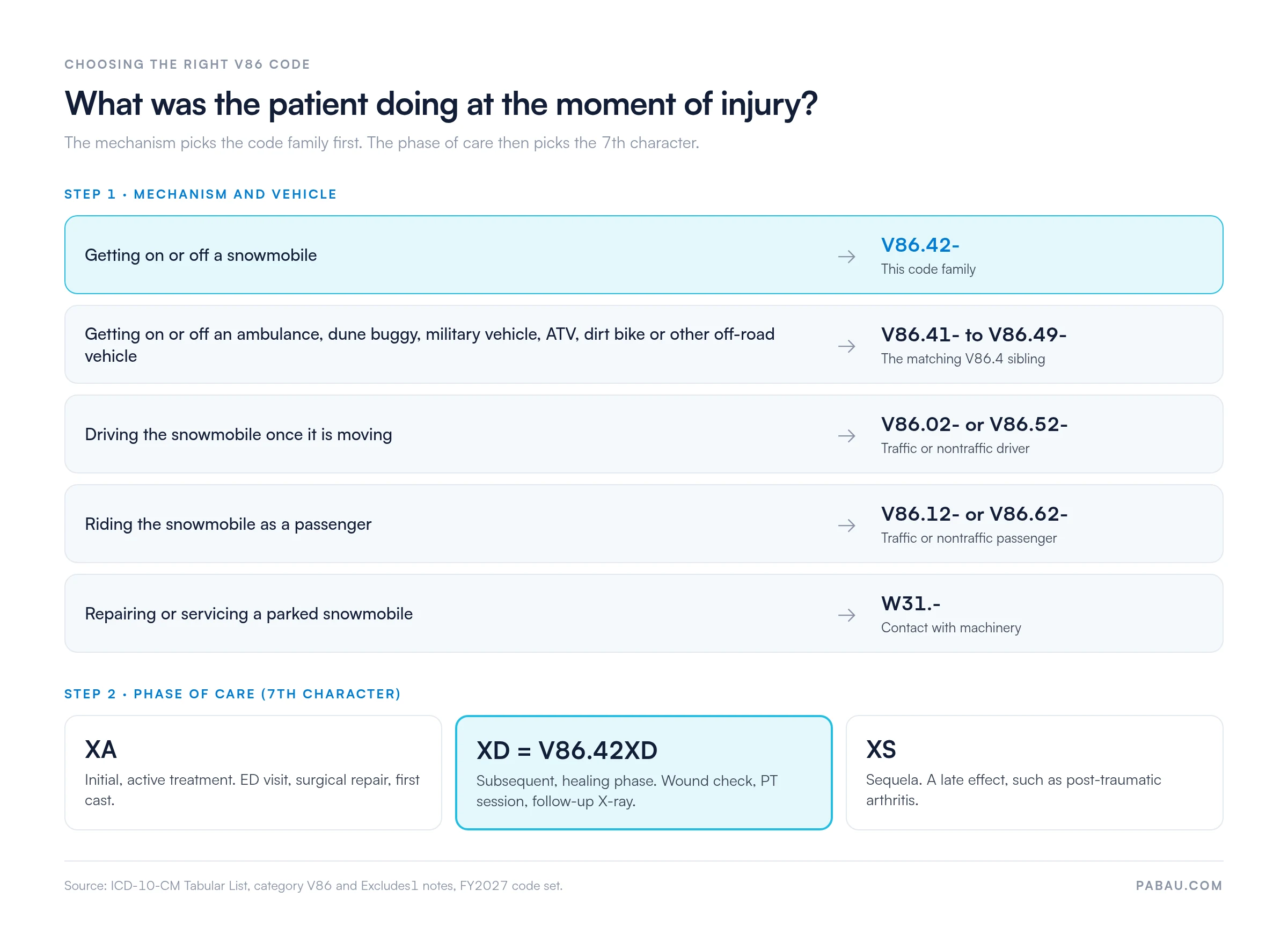
The V86 category also carries Excludes1 notes that send some cases elsewhere:
Ask what the patient was doing at the moment of injury. Climbing on or stepping off points to V86.42-. Riding points to the driver or passenger codes. Repairing or servicing a parked snowmobile points to W31.-.
The CMS ICD-10-CM Official Guidelines for Coding and Reporting treat Chapter 20 codes as supplementary. Five rules shape how V86.42XD is used.
The AAPC ICD-10-CM code reference is a handy companion for checking inclusion notes at the point of coding.
A follow-up claim for this injury carries at least two diagnosis codes. Build it in this order.
Once the codes are in order, the claim goes out electronically through your clearinghouse.
If your team is tightening its process, our guide to submitting a clean claim covers the basics.
An auditor reading a claim with V86.42XD expects the record to support each part of the code.
Practices facing payer audits should review their medical billing compliance policies against these points. A missing element can be enough for a retrospective adjustment.
Most problems with this code come from the same handful of errors. Each one is easy to catch before submission.
A denial management workflow that reviews external cause codes before submission stops most of these from turning into rework.
Two minutes with this list saves a resubmission.
The same code can matter a little or a lot, depending on who pays.
If injury cases move between payers, record the payer type at the first visit. Claims management software keeps that detail with the claim, not in a coder’s memory.
Flag snowmobile injury cases for payer type at intake. Knowing whether a commercial insurer, a workers’ compensation carrier or a liability policy pays first saves a rework cycle later.
Follow-up injury claims are often typed by hand from the visit note. That retyping is where a wrong 7th character or a missing injury code slips in.
Pabau, the practice management platform we build, pre-fills the claim from the invoice details. Background checks then confirm required fields are filled in before the claim can be sent.
US practices then send the claim electronically through Claim.MD. Your coder still chooses the code and the 7th character. Pabau simply takes the retyping out of that step.

Pabau pre-fills claims from invoice details, checks required fields and sends them electronically through Claim.MD. See how it fits your billing workflow.

V86.42XD is a narrow code, and that is its strength. When the note says the patient was getting on or off a snowmobile and the visit is healing-phase care, the choice is simple.
When the note only says “off-road vehicle accident,” stop and query the provider. A short question costs far less than a corrected claim. Treat the vehicle, the mechanism and the 7th character as one decision, made from the record.
Fewer retyped fields means fewer chances to slip on that decision. To see how Pabau handles medical billing workflows from invoice to submission, book a demo.

Need to understand how electronic claim submission works? Claim.MD clearinghouse overview explains how Pabau sends US claims electronically through the clearinghouse.
Want to reduce denial rework across your billing team? Denial codes in medical billing explains the most common CARC denial reason codes and how to address each one systematically.
Want the bigger picture on getting paid? Revenue cycle management fundamentals walks through the end-to-end process from eligibility verification to payment posting.
Was the vehicle something other than a snowmobile? ICD-10 code V86.49XD covers boarding or alighting from other off-road vehicles at a follow-up visit.
Yes. V86.42XD is exempt from present-on-admission reporting. Leave the POA indicator blank or use the exempt value your payer specifies on inpatient claims.
No. The code has been valid since ICD-10-CM took effect in October 2015. The FY2027 update, effective October 1, 2026, made no change to it.
Yes. A therapist treating the healing injury codes the injury with a D first, then V86.42XD. The same applies to a telehealth follow-up, since the phase of care sets the code.
There is no national requirement to report external cause codes. Report it when a state mandate or payer policy calls for it, and consider it best practice otherwise. It records how the injury happened for audits and injury data.



