ICD-10 Code V47.6XXD: Passenger Collision Injury
ICD-10 Code V47.6XXD: quick reference ICD-10 Code V47.6XXD reports a car passeng...

Last Updated: Oct 8, 2026
Billable Code Specific Code
V32.1XXD is a billable ICD-10-CM code. Its official descriptor reads: passenger in three-wheeled motor vehicle injured in collision with two- or three-wheeled motor vehicle in nontraffic accident, subsequent encounter.
In plain terms, a motorized tricycle passenger was hurt off a public highway when the vehicle hit another two- or three-wheeled vehicle. The code applies at follow-up visits after active treatment. Coders most often confuse it with V32.0XXD (driver, not passenger) and V32.6XXD (passenger, traffic accident).
Let Pabau's smart automation suggest the right codes, reduce claim denials, and keep your practice compliant—effortlessly.
Automate repetitive tasks and focus on what matters most—your patients.
Reduce coding errors and ensure compliance with the latest regulations.
Clean claims, fewer denials, and faster reimbursements.
Powerful insights and reporting to help your practice thrive.
HIPAA compliant SOC 2 certified GDPR-compliant Trusted by 4,000+ clinics worldwide

V32.1XXD is a billable ICD-10-CM code for passengers, not drivers, in three-wheeled motor vehicles injured in non-traffic collisions, at a subsequent encounter.
The seventh character D means active treatment is complete and the patient is receiving routine follow-up care, rehabilitation or aftercare.
External cause codes like V32.1XXD are never first-listed. The injury diagnosis code always leads the claim.
Y92, Y93 and Y99 are recommended companion codes, required by some payers (e.g. some Medicaid and workers’ compensation plans). Report them once, at the initial encounter.
ICD-10 Code V32.1XXD is a billable ICD-10-CM code, valid for claims in FY2025 through FY2027 (verify each October 1 update). In addition, it sits in Chapter 20 (External Causes of Morbidity, V00-Y99). Moreover, the classification is maintained by the Centers for Medicare and Medicaid Services (CMS) and the National Center for Health Statistics (NCHS).
The full official descriptor is: Passenger in three-wheeled motor vehicle injured in collision with two- or three-wheeled motor vehicle in nontraffic accident, subsequent encounter. Because it is an external cause code, it cannot stand alone as the primary diagnosis. The injury diagnosis code always appears first.
Every character in V32.1XXD carries a specific coding meaning. Read left to right, the string gives the vehicle type, the occupant role and accident setting, and the encounter phase. Therefore, each one needs its own support in the record.
In fact, the two placeholder X characters are not optional. The ICD-10-CM tabular list requires them to fill positions 5 and 6 so the seventh character D lands in the correct position. Therefore, the code string is invalid without them, and most billing software rejects it at scrubbing.
The seventh character in V32.1XX_ identifies where the patient is in their treatment continuum. In addition, the external cause code takes the same seventh character as the injury code it accompanies. Thus, both must match the encounter the note describes.
Common coder error: Reporting V32.1XXA (initial) for a physical therapy visit that follows ED discharge. If the progress note says “follow-up for rib contusions sustained last month,” the seventh character is D, not A.
Four axes determine which V32._ _ _ code applies: vehicle type, occupant role, accident setting (traffic vs non-traffic), and encounter phase. The table further down covers the codes most often confused with V32.1XXD.
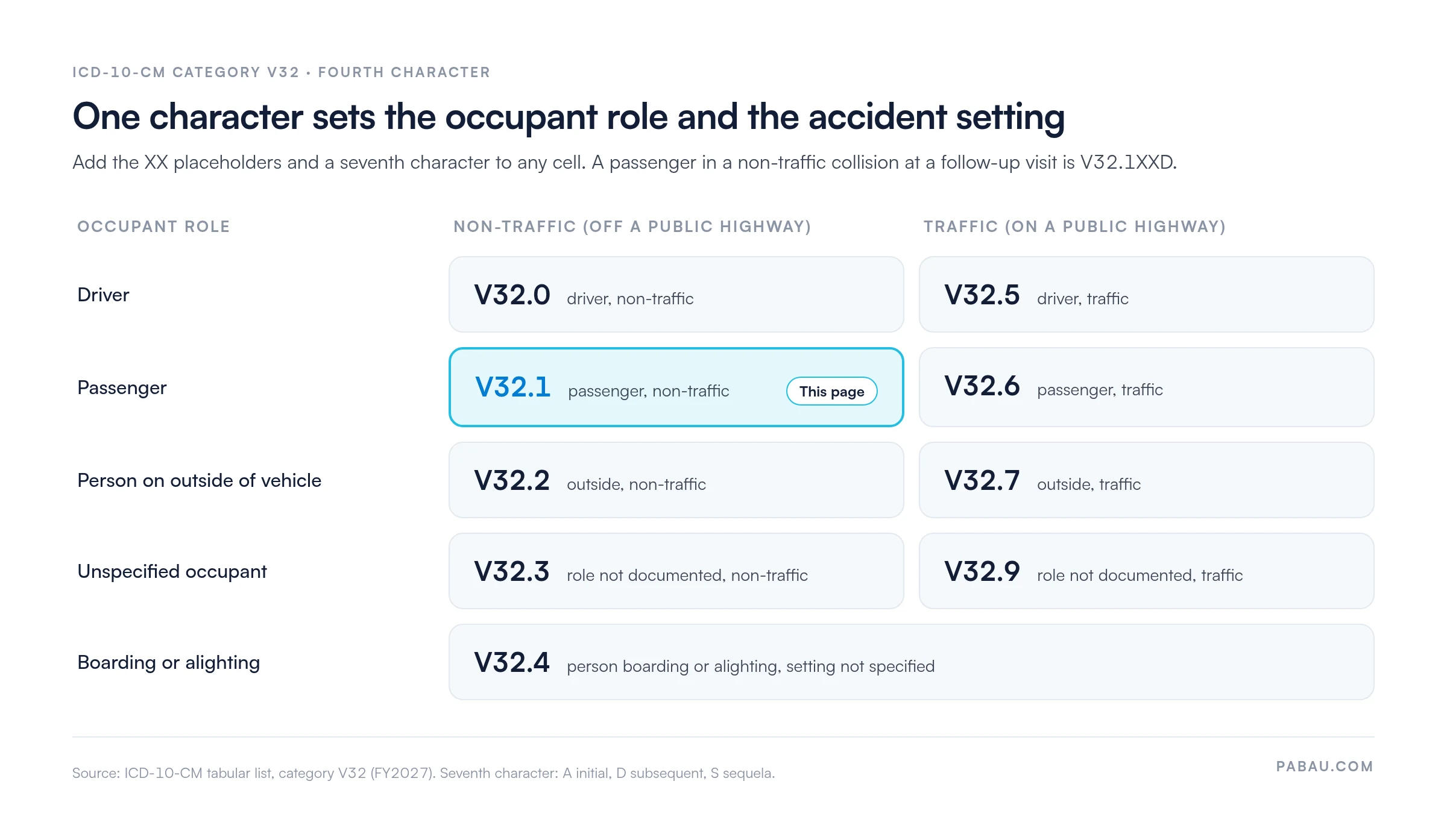
Also, the fourth character carries both the occupant role and the accident setting, as the map below shows. For example, off a public highway, the driver, passenger, person on the outside and unspecified occupant take .0 to .3. By contrast, on a public highway they take .5, .6, .7 and .9, and .4 covers a person boarding or alighting.
First, the vehicle split that matters most is V32 (three-wheeled motor vehicle) against V20-V29 (two-wheeled motorcycle). If the accident report says “motorcycle” without a wheel count, query the clinician before assigning V32.1XXD.
Second, V33 is the collision counterpart. The patient still rode a three-wheeled vehicle, but the other vehicle was a car, pick-up truck or van. Codes such as V33.3XXA follow that branch, so confirm what the vehicle hit as well as what the patient rode in.
For example, the ICD-10-CM tabular list includes motorized tricycles, motorized rickshaws and three-wheeled motor cars in the V30-V39 block. However, it excludes all-terrain vehicles and other vehicles designed primarily for off-road use (V86.-), and motorcycles with a sidecar (V20-V29). As a result, not every three-wheeled vehicle qualifies.
Also, per the AAPC Codify ICD-10-CM lookup, category V32 sits within the V30-V39 block for three-wheeled motor vehicle occupants. Furthermore, that block is separate from the V20-V29 motorcycle block and the V40-V49 car block. When the vehicle type is ambiguous, query the provider rather than guess.
A non-traffic accident, per the ICD-10-CM Official Guidelines, is any transport accident that does not occur on a public highway. Also, traffic and non-traffic accidents take different fourth characters, and accident location can affect coordination-of-benefits review.
Non-traffic examples (V32.1XXD applies):
Traffic examples (V32.6XXD applies for passengers):
When the accident report is silent on location, coders should query the provider or review any police report attached to the record. If the record still names no place, ICD-10-CM assumes the accident happened on a public highway, which moves a passenger to V32.6XXD.
V32.1XXD is an external cause code. It answers “how did the injury happen” but never “what is wrong with the patient.” The ICD-10-CM Official Guidelines, Chapter 20, require or recommend several companion codes alongside it. Submitting a clean claim with external cause codes depends on assembling the full code set correctly before submission.
Meanwhile, Y92, Y93, and Y99 are reported at the initial encounter only – do not repeat them at subsequent visits. Instead, the injury diagnosis code retains its seventh character D across all follow-up visits, confirming the ongoing treatment phase.
Furthermore, each component of the code string has a corresponding documentation element that must appear in the medical record. In fact, missing even one makes the claim vulnerable. The same principle holds for every ICD-10-CM injury code, because the record must justify each character chosen.
External cause codes generate a predictable set of denials, and most can be prevented by checking the code set against the note before submission. Pabau, the practice management platform we build, submits and tracks claims through Claim.MD from the diagnoses already recorded, while your coders still choose the codes.
A strong denial management workflow tracks which denial codes keep recurring on external cause claims. Those patterns can then be corrected at the documentation level.
However, external cause code requirements are not uniform across payers. Therefore, understanding which payers require V32.1XXD and its companion codes, versus which treat them as optional, prevents both over-documentation and under-documentation denials. Good medical billing compliance means checking payer policy every year, not just once at implementation. Pabau’s claims management and tracking sends claims to Claim.MD from the diagnoses already on the record. A coder still checks the payer’s rules first.
When V32.1XXD is present on a claim, auto insurers and liability carriers may assert primary payer status over the patient’s health plan. Practices should verify primary payer before billing and document any coordination of benefits arrangement in the patient record. Electronic remittance advice from the payer will typically include a CARC denial reason if COB was not established correctly.
In contrast, ICD-9-CM did not carry the same level of specificity as ICD-10-CM for vehicle occupant role or traffic status. Also, the approximate crosswalk below is for reference and legacy system queries only – never use ICD-9 codes for active billing. In fact, the jump in external cause detail was one of the larger structural changes to medical billing fundamentals at the ICD-10 transition.
Per ResDAC guidance on ICD codes in Medicare files, ICD-9 to ICD-10 crosswalk mappings are approximate and unsuitable for retrospective billing corrections. Likewise, historical claims coded in ICD-9 cannot be amended to ICD-10 codes retroactively.
When reviewing legacy records for quality audits, map ICD-9 E822.x codes to the appropriate V30-V39 ICD-10-CM block rather than a single code. The specificity difference between systems means one ICD-9 code can map to dozens of ICD-10-CM codes depending on occupant role, vehicle subtype, and encounter phase. Flag any ambiguous crosswalk for clinical review before using it in research datasets.
For example, a V32.1XXD claim usually belongs to a long run of follow-up visits, from physical therapy to wound checks. Moreover, each one carries the injury code, the external cause code and often a coordination-of-benefits question. Meanwhile, many practices track that run across a billing spreadsheet, the clearinghouse portal and the chart.
Instead, in Pabau, the visit note, the diagnoses your coder selects and the claim live in the same patient record. Then, claims go out through Claim.MD built from those recorded diagnoses, and their status comes back to the same place. Pabau does not choose or validate the codes, so the documentation checks above still apply.
Overall, the result is one view of every follow-up claim for the accident. As a result, a payer query or a COB hold is spotted on the day it arrives, not at month-end.

Pabau’s claims management submits and tracks claims through Claim.MD from the diagnoses your team has already recorded. Your coders still choose the codes, and every claim’s status stays in one place.

In short, assign V32.1XXD only when the record names three facts. The patient was a passenger, the collision happened off a public road, and this visit is follow-up care. If one is missing, a query to the provider takes minutes, while correcting a paid or denied claim takes far longer.
Above all, location deserves the most care. A record that names no place defaults to traffic, so the same passenger is coded V32.6XXD unless the note says otherwise.
Pabau’s claims management, via Claim.MD, submits and tracks claims from the diagnoses already recorded, while your coders still choose the codes. Book a demo to see how it keeps every external cause follow-up claim visible from submission to payment.

Need to understand how claims move from coding to payment? What is revenue cycle management covers the end-to-end billing workflow from code assignment through ERA posting.
Unsure how to verify insurance before an external cause claim? Insurance eligibility verification explains how to confirm active coverage and coordination of benefits before submitting accident-related claims.
Looking for a quick guide to denial codes on external cause claims? Denial codes in medical billing lists the CARC codes most frequently returned on external cause and accident claims.
ICD-10 Code V32.1XXD is a billable ICD-10-CM diagnosis code for a passenger in a three-wheeled motor vehicle injured in a non-traffic (off-highway) collision. It applies at a subsequent (follow-up) encounter. It belongs to Chapter 20 (External Causes of Morbidity) and is valid for FY2025 through FY2027 (verify each October 1 update). It cannot be the first-listed diagnosis on any claim.
V32.0XXD applies to the driver of the three-wheeled motor vehicle, and V32.1XXD applies to a passenger. Their official descriptors differ only by occupant role. Traffic status (non-traffic) and encounter (subsequent) are the same, so the record must state the patient’s role explicitly to support either code.
Always pair V32.1XXD with a principal injury diagnosis code, which is listed first. The ICD-10-CM Official Guidelines also recommend Y92 (place of occurrence), Y93 (activity) and Y99 (external cause status) where documented. Some Medicaid, workers’ compensation and liability payers require them. Y92, Y93 and Y99 are reported at the initial encounter only and do not repeat at subsequent visits.
V32.1XXS uses the seventh character S for sequela, meaning a late effect that arises after the original injury has healed. V32.1XXD uses D for subsequent encounter, meaning follow-up care for an injury still in the healing phase. V32.1XXS is reported alongside the specific sequela condition, while V32.1XXD accompanies the original injury code with a matching D seventh character.