ICD-10 Code T31.77: Burns involving 70-79% of body surface
ICD-10 code T31.77: Quick reference and code details ICD-10 code T31.77 is the b...

Last Updated: Nov 5, 2026
Billable Code Specific Code
V39.10XS is the billable ICD-10-CM code for passenger in three-wheeled motor vehicle injured in collision with unspecified motor vehicles in nontraffic accident, sequela. It's reported as a secondary external cause code. It applies when a passenger hurt away from a public highway is treated for a lasting effect of the collision.
The 7th character S marks a sequela: a residual condition, such as chronic pain, that remains after the injury has healed. Encounters during healing take A or D instead. This reference covers the code breakdown, the V39 code grid, companion codes, and the denial reasons that affect sequela claims.
Let Pabau's smart automation suggest the right codes, reduce claim denials, and keep your practice compliant—effortlessly.
Automate repetitive tasks and focus on what matters most—your patients.
Reduce coding errors and ensure compliance with the latest regulations.
Clean claims, fewer denials, and faster reimbursements.
Powerful insights and reporting to help your practice thrive.
HIPAA compliant SOC 2 certified GDPR-compliant Trusted by 4,000+ clinics worldwide

V39.10XS covers a passenger in a three-wheeled motor vehicle injured in a nontraffic collision with an unspecified motor vehicle, at a sequela encounter.
The 7th character S applies only after the acute injury phase has ended and a residual condition remains. Using S during active healing is a coding error.
V39.10XS is never sequenced as the principal diagnosis. The sequela condition, such as chronic pain, is coded first, followed by V39.10XS as the external cause.
A driver is coded V39.00XS, an occupant with no documented role V39.20XS, and a passenger in a traffic accident V39.5-.
Sequela claims need the accident date, the original injuries, and a documented causal link to today’s condition.
ICD-10 Code V39.10XS carries the official full descriptor “Passenger in three-wheeled motor vehicle injured in collision with unspecified motor vehicles in nontraffic accident, sequela.”
It belongs to Chapter 20 of the ICD-10-CM tabular list (External Causes of Morbidity). Within that chapter, it sits in the V30-V39 block (Occupant of three-wheeled motor vehicle injured in transport accident) and category V39.
The code applies only to nontraffic accidents, meaning collisions that happened entirely away from a public highway. A passenger hurt on a public road is coded in the V39.5- traffic range instead.
Each segment of V39.10XS carries a distinct meaning:
V39.10XS is the passenger code for a nontraffic collision with unspecified motor vehicles. The patient rode in a three-wheeled motor vehicle that collided with a vehicle of unknown or undocumented type, away from a public highway. They now present with a residual condition after the acute injury phase has ended.
The code’s scope hinges on five definitions that coders frequently misread.
Three-wheeled vehicles in the scope of V39.10XS are not motorcycles. Coders who default to motorcycle codes (V20-V29) for a three-wheeled vehicle land in the wrong code family entirely.
The 7th character S means the condition treated today is a sequela. That’s a new, distinct condition that developed as a direct result of a previous injury. Telling it apart from ongoing injury care is the most important call when you assign V39.10XS.
The critical test is whether the acute injury is still healing. If yes, use D for a subsequent encounter. If the acute phase is complete and a new, persistent condition resulted from it, use S for sequela. Per ICD-10-CM Official Guidelines Section I.C.19.a, a sequela results from a prior injury or illness. It isn’t the healing phase of that injury.
Submitting V39.10XS while the patient is still in active treatment puts two conflicting statements in the record. The claim says the acute phase is over, while the treatment notes document ongoing injury management. Payers and auditors look for exactly that mismatch.
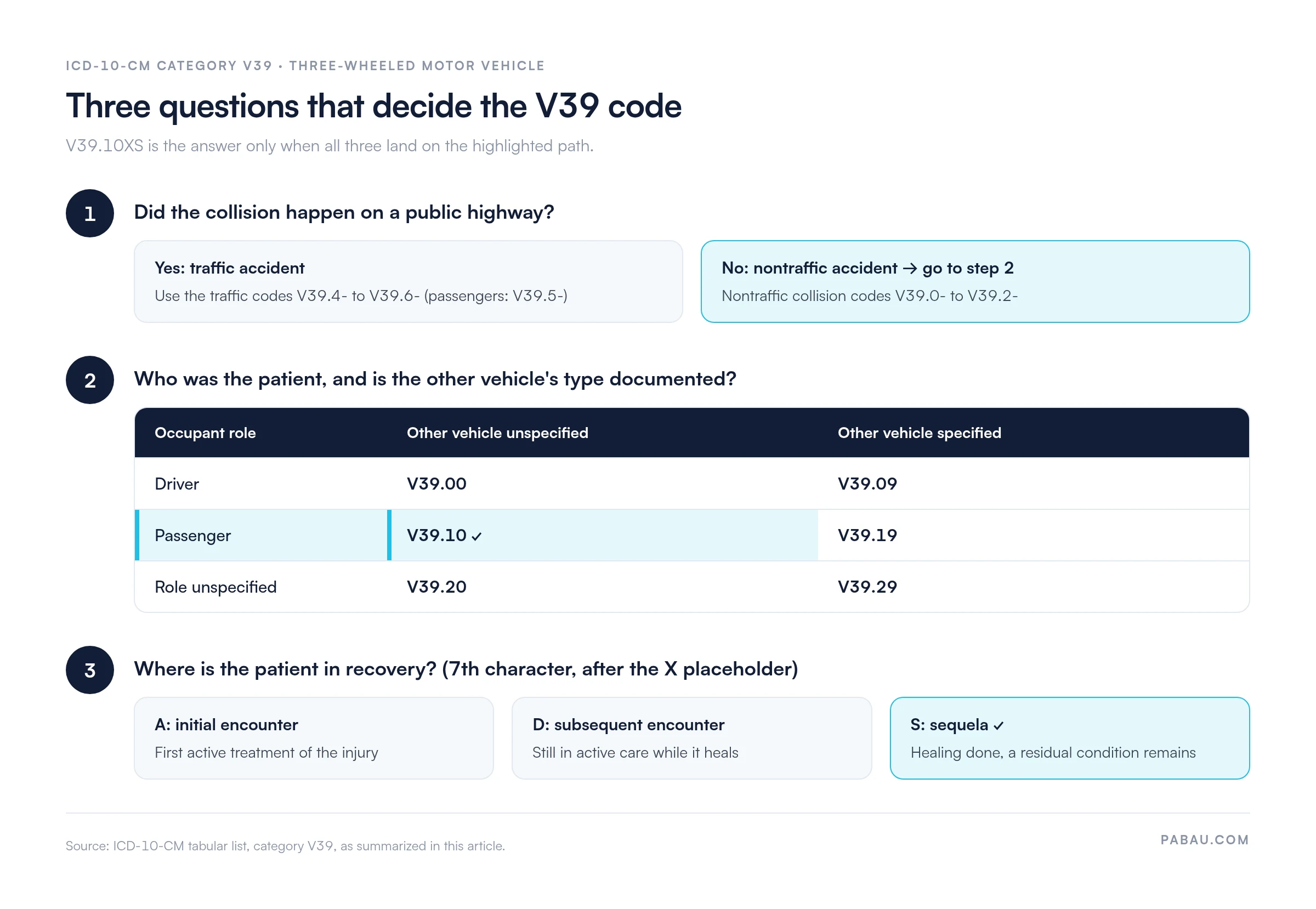
V39 covers three-wheeled motor vehicle occupants injured in other and unspecified transport accidents. The grid below covers the nontraffic collision codes only, for accidents away from a public highway. V39.4- to V39.6- are the traffic equivalents. Codes split by occupant role, opposing vehicle type, and encounter type. A wrong pick within V39 is a specificity error that payers may deny or audit.
All codes above carry the sequela 7th character (S). The same grid applies with “A” for initial and “D” for subsequent encounters. V39.10XS is the correct code only for a passenger in a nontraffic collision with an unspecified motor vehicle. Use V39.19XS if the other vehicle is specified, or V39.00XS or V39.20XS if the person was the driver or their role is unspecified. The three questions below settle the choice in order.
The V30-V39 block in the ICD-10-CM tabular list carries inclusion and exclusion notes that govern every code in it, including V39.10XS. Review these at the block level, not just at the individual code level.
When a clinical scenario triggers an exclusion, code from the applicable alternative block. Inclusion and exclusion language is revised annually, so verify current-year notes in the CDC/NCHS ICD-10-CM web tool.
V39.10XS is an external cause code for a nontraffic accident. Per ICD-10-CM Official Guidelines Section I.C.20.a, external cause codes are never assigned as the principal or first-listed diagnosis. Every claim using V39.10XS must carry a principal diagnosis code that reflects the sequela condition itself.
The correct sequencing for a V39.10XS claim is 1. the sequela condition code (for example, chronic pain from the original collision injury), then 2. V39.10XS as the external cause sequela code. Section I.C.20.a of the ICD-10-CM Official Guidelines governs this order. Listing V39.10XS first is a sequencing error that generates claim edits and denials.
Pabau, the practice management platform we build, includes claims software for practices that checks each claim for missing or invalid details before it’s submitted.
Before submitting a sequela motor vehicle claim, confirm the clinical notes document three facts. They are the original accident date, the nature of the initial injuries, and a clear causal link to the current residual condition. Missing any one of them gives payers grounds to deny the sequela external cause code outright.
A sequela claim supported by V39.10XS is only as strong as the documentation behind it. Payer auditors look for a clear, traceable narrative connecting the original accident to the current residual condition. Good medical billing fundamentals for sequela encounters start with getting the clinical record right before the claim is built.
Four documentation elements are non-negotiable for sequela motor vehicle claims.
Missing or vague documentation on any of these four points is a common reason sequela external cause code claims are audited or denied. A clean claim submission for V39.10XS begins in the clinical note, not at the billing desk.
External cause codes like V39.10XS are supplemental codes. They don’t drive reimbursement directly, because the principal diagnosis and the associated procedure or evaluation code determine payment. Payer requirements for external cause code reporting still vary significantly across payer types.
Third-party liability and no-fault payers pay particular attention to external cause codes on motor vehicle accident sequela claims. They use the code to confirm the injury mechanism matches the claimed sequela condition. In the US, Pabau submits claims through Claim.MD, its clearinghouse partner, and can check a patient’s eligibility before the visit.
V39.10XS claims are denied for a predictable set of reasons, and each one can be caught before submission. For external cause sequela codes, that coding-stage check is where denial management in healthcare starts.
The specificity error deserves special attention. Coders often default to V39.10XS without confirming three facts: the person was a passenger, the accident was nontraffic, and the other vehicle was unspecified. A driver, a traffic accident, or a documented vehicle type each points to a different V39 code. When a V39 claim does come back, the medical billing denial codes on the remittance show which error the payer flagged.
The three encounter-type variants of V39.10 are the most frequently confused codes in this family. Each applies to a distinct clinical moment, and selecting the wrong one creates a documentation mismatch that payers flag.
Beyond the three encounter-type variants, confirm you’re in the correct occupant-role code. Check the occupant role in the clinical record before selecting between V39.00 (driver), V39.10 (passenger), and V39.20 (unspecified occupant). The AAPC Codify ICD-10-CM lookup lists the full V39 range with descriptors for cross-reference.
When reviewing a V39 claim for sequela coding accuracy, ask two questions. Is there a signed provider statement that the acute phase of the collision injury has resolved? Does the current encounter note name a specific residual condition and link it causally to the accident? Both answers must be yes before you apply the S character.
Without claim validation, a coding error on a sequela claim surfaces only when the denial arrives. By then, the biller has to reopen the note, correct the code, and resubmit weeks after the visit.
In Pabau, each claim is pre-filled from the invoice you already raised at checkout. Claim validation then checks it for missing or invalid details before it leaves. US practices submit through Claim.MD and can verify a patient’s insurance eligibility before the visit.
If a claim is still denied, Pabau shows the reason and links straight to the field that needs correcting. Your biller fixes the V39.10XS claim and resubmits it, so a sequela payment isn’t left waiting on a phone call.

Pabau pre-fills each claim from the invoice, checks eligibility through Claim.MD, and flags missing or invalid details before submission. Denied claims come back with the reason attached, so external cause codes like V39.10XS get fixed fast.

Before you assign V39.10XS, check four facts in the note. The patient was a passenger, the collision was nontraffic, the other vehicle’s type is unknown, and the acute phase is over. If any one of them fails, a sibling code fits, and the claim is safer for it.
The trade-off is a minute at the coding stage against weeks of rework later. A sequela claim that’s denied for a wrong role or 7th character has to be reopened, recoded, and resubmitted while the payment waits.
Pabau’s claim validation catches missing or invalid details before submission, and denials come back with the reason attached. Book a demo to see how Pabau takes sequela and injury claims from invoice to payment.

Need a framework for managing claim denials on transport codes? Denial management in healthcare covers the full workflow for identifying, appealing, and preventing payer rejections on injury-related claims.
Want to understand how external cause codes interact with clean claim requirements? Clean claim submission explains the structural and documentation requirements that keep external cause code claims out of the denial queue.
Looking for the ERA and remittance workflow behind sequela claim payments? Electronic remittance advice covers how 835 ERAs communicate denial reasons and payment decisions for injury and transport accident codes.
Want a quick reference for code structure and 7th characters? Medical coding cheat sheet puts the coding rules your team checks most often on one printable page.
V39.10XS is the billable code for a passenger in a three-wheeled motor vehicle injured in a nontraffic collision with an unspecified motor vehicle, sequela. It belongs to ICD-10-CM Chapter 20 (External Causes of Morbidity). It’s used when the patient presents with a residual condition from that collision after the acute injury phase has resolved.
Yes, V39.10XS is a billable and valid ICD-10-CM code for HIPAA-covered transactions. As an external cause code, it’s never reported as the principal diagnosis. It always accompanies a code identifying the sequela condition being treated. Verify billability against the current fiscal year tabular list, as codes are updated annually.
Use S (sequela) when the acute phase of the collision injury has fully resolved and a persistent residual condition remains. Use D (subsequent encounter) when the patient is still receiving active treatment and healing is ongoing. Applying S while active treatment continues is a compliance error that creates audit liability.
No. V39.10XS is an external cause code and is never sequenced as the principal or first-listed diagnosis. Per ICD-10-CM Official Guidelines Section I.C.20.a, external cause codes are always supplemental. The sequela condition itself, such as chronic pain or post-traumatic arthritis, is coded first, with V39.10XS listed after it.
Generally, no. Per ICD-10-CM Official Guidelines Section I.C.20.b, Y92 place-of-occurrence codes are reported at the initial encounter only. For sequela encounters using V39.10XS, Y92 is typically not required. Check individual payer contracts and state Medicaid billing guides, as some payers deviate from the official guideline on this point.
The most common denial reasons are five coding and documentation errors. The first is the wrong 7th character, such as S while the injury is still healing. The second is a missing principal sequela diagnosis, and the third is listing the external cause code first. The fourth is using V39.10XS without confirming a passenger, a nontraffic accident, and an unspecified other vehicle. The fifth is missing documentation linking the accident to the current condition.