ICD-10 code S61.201A: Open wound of left index finger without nail damage
ICD-10 code S61.201A covers a left index finger wound of unstated type ICD-10 co...

Last Updated: Oct 16, 2026
Billable Code Specific Code
V33.3XXA is the billable ICD-10-CM code for an unspecified occupant of a three-wheeled motor vehicle. The full descriptor covers a collision with a car, pick-up truck or van in a nontraffic accident, initial encounter.
The parent code V33.3 carries no 7th character, so a claim built on it gets rejected. The "A" extension is what makes V33.3XXA reportable. Choosing between "A", "D" and "S" turns on how far along the patient's treatment has moved.
Let Pabau's smart automation suggest the right codes, reduce claim denials, and keep your practice compliant—effortlessly.
Automate repetitive tasks and focus on what matters most—your patients.
Reduce coding errors and ensure compliance with the latest regulations.
Clean claims, fewer denials, and faster reimbursements.
Powerful insights and reporting to help your practice thrive.
HIPAA compliant SOC 2 certified GDPR-compliant Trusted by 4,000+ clinics worldwide

V33.3XXA is a billable ICD-10-CM code valid for fiscal year 2026, while parent code V33.3 is non-billable and cannot go on a claim.
The 7th character A designates the initial encounter, so use it only while the patient is still in active treatment.
V33.3XXA, V33.3XXD and V33.3XXS share the same parent, and picking the wrong one is a top denial trigger.
External cause codes are always secondary, so the injury itself carries the primary diagnosis on the claim.
Pabau submits claims through the Claim.MD clearinghouse, runs real-time eligibility checks, and tracks each claim status in one place.
ICD-10 code V33.3XXA is the billable ICD-10-CM code for an unspecified occupant of a three-wheeled motor vehicle. It covers a collision with a car, pick-up truck, or van in a nontraffic accident, initial encounter.
The collision counterpart decides the category. A crash with another two- or three-wheeled vehicle codes to V32 instead, where a passenger’s follow-up visit takes V32.1XXD. A heavy transport vehicle or bus sends the claim to V34, and boarding or alighting there takes V34.4XXA.
The code sits in the V30-V39 block of external cause codes, which covers occupants of three-wheeled motor vehicles injured in transport accidents. The CDC/NCHS ICD-10-CM web tool lists V33.3XXA as an active, billable code for fiscal year 2026, effective October 1, 2025.
The word nontraffic in the descriptor carries weight. ICD-10-CM treats a transport accident as nontraffic when it happens entirely somewhere other than a public highway. A collision in a parking lot, a yard, or on private land qualifies. The same crash on a public road does not.
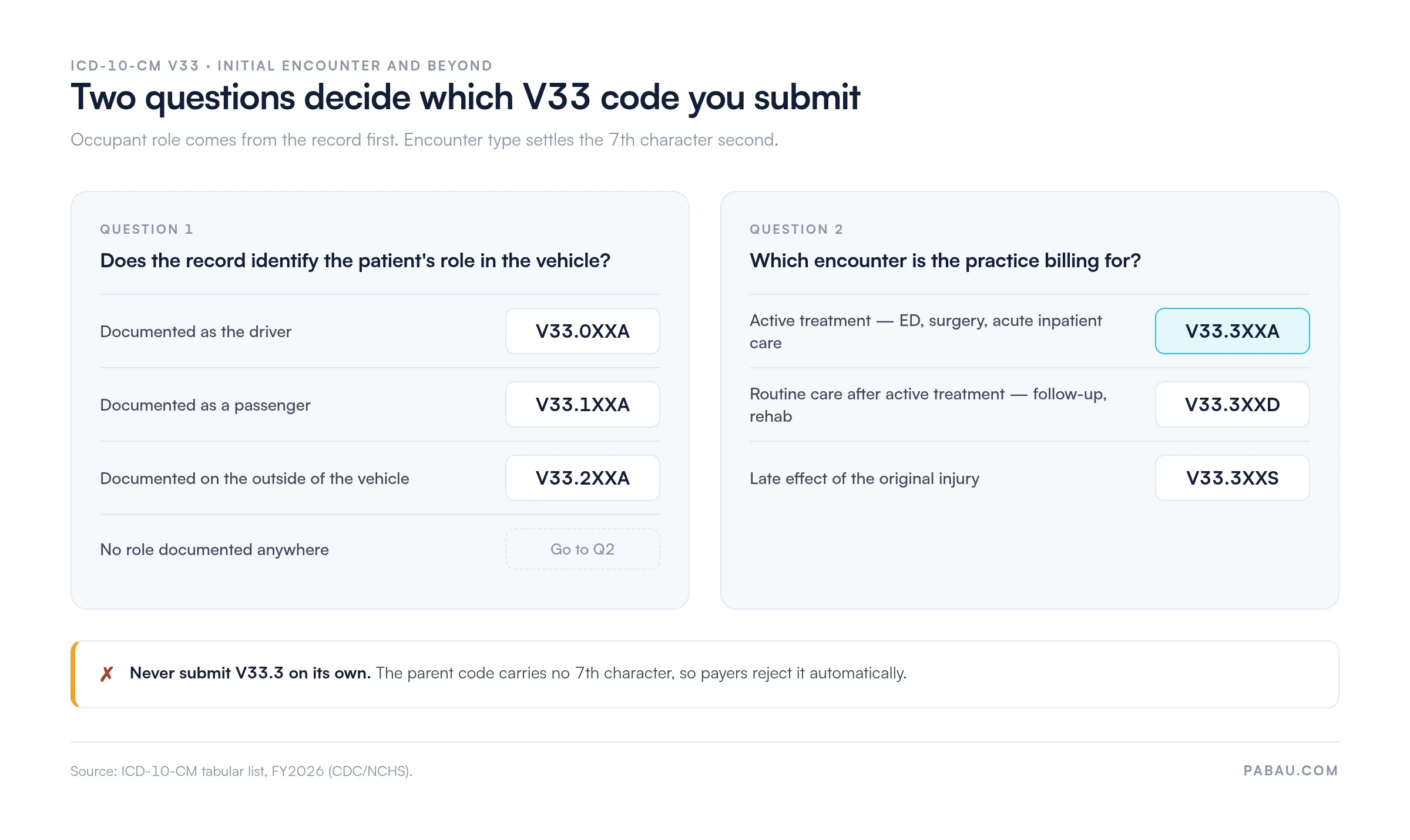
The unspecified occupant designation applies when the medical record does not identify whether the injured person was the driver, a passenger, or another occupant. If that detail is documented, a more specific sibling code in the V33 family is correct instead.
The table below captures the structural attributes coders verify before submitting a claim. Check the fiscal year validity row. CMS updates ICD-10-CM codes every October 1, so a code billable in FY2026 needs re-checking for earlier dates of service.
According to the CMS ICD-10 codes page, external cause codes in Chapter 20 are assigned as secondary codes. They identify the circumstances of an injury, while the primary diagnosis describes the injury itself.
The 7th character extension sets the encounter type for V33.3XX codes. Picking the wrong character is one of the most common reasons external cause claims are rejected on audit.
The ICD-10-CM Official Guidelines for Coding and Reporting define each encounter type precisely. Initial encounter does not simply mean the first visit to any provider.
Here is a practical way to tell A from D. If the clinician is still deciding how to manage the injury, character A applies. Once the treatment plan is set and the patient is recovering or rehabilitating, character D is correct.
Sequela (S) applies when a new condition develops as a direct consequence of the collision injury, such as chronic pain documented months later.
V33.3 is the non-billable parent code for unspecified occupant collisions in the V33 category. Submitting V33.3 on a claim results in a rejection. Coders select one of its child codes, each carrying the XX placeholder followed by an encounter suffix.
The unspecified occupant code is a last resort rather than a default. When the record contains any indication of the patient’s role, even a phrase like the driver was treated, the specific code is required. The AAPC Codify ICD-10-CM lookup shows the full V33 hierarchy with applicable-to notes.
Two facts decide the code, and the record has to settle both. The chart below runs them in order.
Run a query on your denied V33.3XXA claims over the past 12 months. If specificity denials keep showing up, check whether the occupant role was documented but overlooked at coding. A short clarification query to the treating provider can often turn an unspecified code into a specific one.
Practices processing legacy claims may need to map V33.3XXA back to its approximate ICD-9-CM equivalent. Translations between the two systems are approximate rather than exact, because they carry different levels of clinical specificity. No ICD-9-CM code captures the 7th character encounter detail that V33.3XXA carries.
The E822.9 mapping comes from the final general equivalence mappings published by CMS and CDC. It is approximate. ICD-9-CM had no way to record vehicle type, occupant role, or encounter phase the way ICD-10-CM does. Label every V33.3XXA crosswalk as approximate in your own documentation.
A clean claim built on V33.3XXA needs the medical record to support each element of the descriptor. Miss one of the anchors below and a payer can deny on specificity grounds.
Practices handling high volumes of motor vehicle claims benefit from intake documentation that captures the anchors above at first presentation. Capturing them once beats reconstructing them from a chart six weeks later. Our guide to clean claim requirements covers the wider checks a payer applies before it pays a line.
V33.3XXA coding errors cluster into five patterns. Each one is preventable with a single documentation review before the claim goes out.
A run of denials on external cause codes usually points at the intake note rather than the coder. The rules on this code family are short. Once the record captures the collision properly, the code almost picks itself.
Accident detail often lands in a free-text note, then has to be hunted down weeks later when a denial arrives. Vehicle type, occupant role, and the encounter phase are all in the chart somewhere. Finding them again costs more than recording them properly did.
Practice management software like Pabau keeps that detail on the patient record, in structured intake and treatment notes your team completes at the first visit. Coders read the same record the clinician wrote, so occupant role and encounter phase are settled before the claim is built.
Pabau also connects to the Claim.MD clearinghouse. You can submit claims from the same system and run real-time eligibility checks before the appointment. Claim status comes back into Pabau, so nobody logs into a payer portal to chase it. Pabau flags missing details on a claim, such as an absent membership or authorization, before you send it.
Structured records are what make cleaner claims management possible, because the coder never has to guess what the clinician saw. On a code like V33.3XXA, that is the difference between a clean submission and a rework queue.

Pabau connects to the Claim.MD clearinghouse, so you can submit claims, run real-time eligibility checks, and track each claim status in one place. See how it fits your coding workflow in a live demo.

The denials on this code come from three places, and all three are decided before the claim is built. Submitting the parent V33.3, picking the wrong 7th character, and defaulting to unspecified occupant account for most rejections here.
So the work belongs at intake rather than in the appeals queue. Ask for vehicle type, occupant role, and the nontraffic setting while the patient is still in front of you. A coder holding those three facts can select the code in seconds.
Pabau keeps that detail on the patient record and sends the finished claim through Claim.MD. Book a demo to see how your team could cut rework on external cause claims.

Need the foundations behind external cause coding? Medical billing fundamentals covers how primary and secondary diagnosis codes are structured for clean claim submission.
Seeing denials you can’t immediately explain? Denial management in healthcare breaks down how to read CARC and RARC codes and build an appeal workflow.
Working through a remittance file? Electronic remittance advice explains how ERA 835 files report the reason a payer cut or denied a line.
ICD-10 code V33.3XXA is the billable ICD-10-CM diagnosis code for an unspecified occupant of a three-wheeled motor vehicle. It covers a collision with a car, pick-up truck, or van in a nontraffic accident, initial encounter. The code sits in the V30-V39 block of Chapter 20 and is valid for fiscal year 2026.
Yes, V33.3XXA is a billable ICD-10-CM code. Its parent code V33.3 is not billable. Select V33.3XXA for an initial encounter, V33.3XXD for a subsequent one, or V33.3XXS for a sequela. Submitting the parent triggers an automatic rejection.
V33.3XXA covers the initial encounter, while the patient is in active treatment. V33.3XXD covers subsequent encounters during recovery or rehabilitation. V33.3XXS covers sequela, meaning conditions that arise as a late effect of the original injury. Choosing the wrong 7th character for the visit type is a common audit finding.
V33.3XXA applies only when the medical record does not identify the patient’s role in the vehicle. If the record names the patient as the driver, a passenger, or a person on the outside, use V33.0XXA, V33.1XXA, or V33.2XXA instead. Unspecified occupant is not a default.
V33.3XXA maps approximately to ICD-9-CM code E822.9, other motor vehicle nontraffic accident involving collision with moving object, unspecified person. The mapping comes from the final general equivalence mappings and is approximate rather than exact. ICD-9-CM could not record vehicle type, occupant role, or encounter phase the way ICD-10-CM does. Label every conversion as approximate in your documentation.
V33.3XXA is an external cause code and is always reported as a secondary code. The primary diagnosis describes the injury itself. Report secondary codes for place of occurrence (Y92), activity (Y93), and external cause status (Y99) when the record carries that information.