ICD-10 Code Z86.73: Personal history of TIA
ICD-10 Code Z86.73: Definition, descriptor, and code hierarchy ICD-10 Code Z86.7...

Last Updated: Nov 20, 2026
Billable Code Specific Code
V33.1XXD is the ICD-10-CM code for passenger in three-wheeled motor vehicle injured in collision with car, pick-up truck or van in nontraffic accident, subsequent encounter.
It identifies a passenger in a three-wheeled motor vehicle injured in a collision with a car, pick-up truck or van in a nontraffic accident. The D character marks a follow-up visit while the injury heals. Nontraffic means the crash happened entirely off a public road, such as in a parking lot or on a private driveway. The code sits in Chapter 20, External causes of morbidity (V00-Y99), and is always reported after the injury diagnosis.
Let Pabau's smart automation suggest the right codes, reduce claim denials, and keep your practice compliant—effortlessly.
Automate repetitive tasks and focus on what matters most—your patients.
Reduce coding errors and ensure compliance with the latest regulations.
Clean claims, fewer denials, and faster reimbursements.
Powerful insights and reporting to help your practice thrive.
HIPAA compliant SOC 2 certified GDPR-compliant Trusted by 4,000+ clinics worldwide

V33.1XXD codes a passenger in a three-wheeled motor vehicle injured in a collision with a car, pick-up truck or van in a nontraffic accident. It applies at subsequent encounters only.
A crash counts as traffic unless the record places it off a public road. Without that detail, the traffic passenger code V33.6XXD applies instead.
The 7th character D marks the healing or routine follow-up phase. Use A for active treatment and S for a late effect after the injury has healed.
V33.1XXD is never the principal diagnosis. The injury code, such as a fracture or contusion, comes first and carries the same 7th character.
Pabau’s claims management software builds US claims and sends them through the Claim.MD clearinghouse, from the same record that holds the follow-up note.
ICD-10 code V33.1XXD is the billable external cause code for a passenger in a three-wheeled motor vehicle at a subsequent encounter. The passenger was injured in a collision with a car, pick-up truck or van in a nontraffic accident. The code is listed in CMS’s FY 2027 ICD-10-CM files, which apply to encounters from October 1, 2026.
The code is used when a provider documents a follow-up or aftercare visit for injuries from that specific collision. Active-treatment visits use the same descriptor with 7th character A. Per the ICD-10-CM Official Guidelines, an external cause code supplements the injury diagnosis. It never serves as the reason for the encounter on its own.
Each segment of V33.1XXD carries a distinct coding meaning. Misreading any one segment produces a code that is either invalid or clinically incorrect.
The placeholder Xs are mandatory. Submitting V33.1D without them produces an invalid code that most clearinghouses reject before the claim reaches the payer. Per ICD-10-CM Official Guidelines Section I.A.4, placeholders must occupy every position between the subcategory and the 7th character.
ICD-10-CM defines a three-wheeled motor vehicle as a motorized tricycle designed primarily for on-road use. Applying V33.1XXD to the wrong vehicle type is a common audit trigger.
Vehicles that qualify under V33:
Vehicles that do NOT qualify (use a different V-code category):
When the clinical record describes the vehicle as a “motorcycle” without further detail, verify before defaulting to V33. If the treating provider’s notes confirm it was two-wheeled, V23.1XXD (motorcycle passenger) is the correct code.
The subcategory digit records two facts at once, the patient’s role in the vehicle and whether the crash was traffic or nontraffic. Using the wrong one produces a claim that does not match the documented occupant position, which payers flag during medical record review.
Reserve V33.3XXD for records that cannot establish the role. A police report or first-responder note that names the patient as a passenger rules out “unspecified.” Defaulting to it anyway exposes the claim to audit. Two other subcategories sit in the same family. V33.2XXD covers a person riding on the outside of the vehicle, and V33.4XXD covers a person hurt while boarding or alighting.
Traffic status is the fact coders most often take for granted. ICD-10-CM assumes a vehicle accident happened on a public highway unless the record names another place. A follow-up note that never says where the crash happened therefore points to V33.6XXD, not V33.1XXD. The five facts below decide the code, and a missing one moves the claim to a neighboring code.
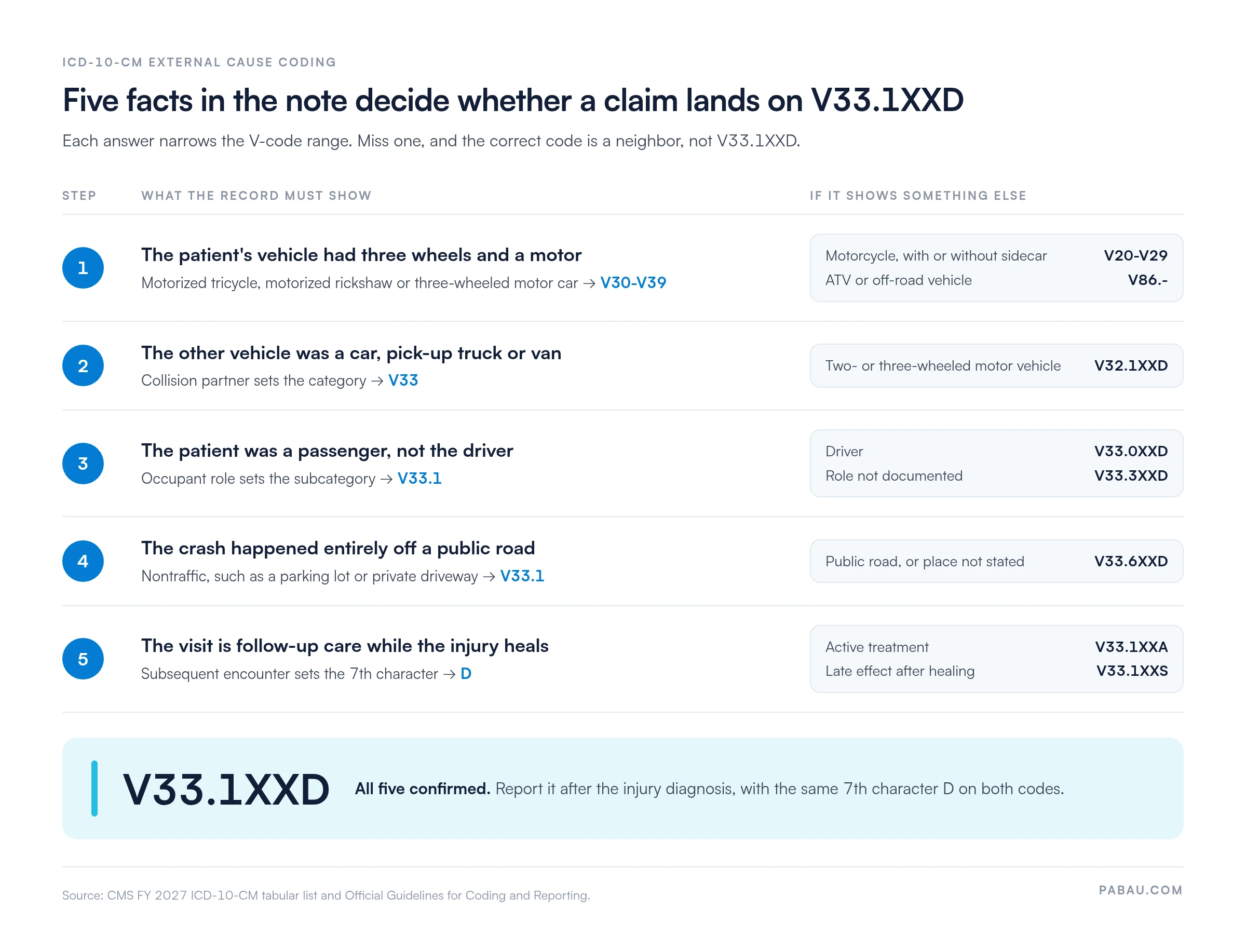
The phase of care at the visit being coded sets the 7th character. The number of visits and the time since the injury do not. This is the most common coding error on motor vehicle injury claims.
Take a patient who broke a tibia in the collision and returns three weeks later for a cast check. That visit gets D, even if it is their fourth encounter. The ICD-10-CM Official Guidelines define subsequent encounter by treatment phase, not visit count.
Check the clinical note’s stated purpose before assigning the 7th character. ‘Wound check,’ ‘follow-up,’ and ‘physical therapy’ are D. ‘Surgical repair,’ ‘fracture reduction,’ and ‘initial evaluation’ are A. New active treatment of the same injury after a break in care may take A again.
V33.1XXD is a supplementary external cause code. Per ICD-10-CM Official Guidelines Chapter 20, it is always reported alongside an injury diagnosis, never as the principal or first-listed code. Thorough medical billing compliance practice requires every needed code to be present before submission.
Routing claims through a US medical claims clearinghouse that runs claim edits before payer submission catches missing or mis-sequenced codes before they cause denials. The CDC/NCHS ICD-10-CM web tool confirms the valid date range and any excludes notes for V33.1XXD at the point of coding.
Several codes share structural similarities with V33.1XXD. A wrong pick is easy to audit. The occupant role, vehicle type, traffic status and encounter phase each leave a clear paper trail in the clinical record.
The closest neighbor is V32.1XXD, which keeps the passenger role and the nontraffic setting but changes the other vehicle. See the AAPC Codify ICD-10-CM lookup to cross-reference sibling codes in the V33 family and confirm excludes notes before submitting.
Payers that require external cause codes will audit the supporting record when a motor vehicle injury claim is reviewed. The clinical note must contain all five of the following elements to support V33.1XXD specifically.
A record missing any of these five facts cannot support V33.1XXD when a payer asks for it. Query the provider before the claim goes out, rather than after a record request arrives.
External cause codes sit outside the principal diagnosis sequencing rules, which creates denial patterns that differ from standard injury-code rejections. When a payer denies one of these claims, the remittance carries denial codes that name the reason, so the fix starts there.
Common denial reasons for V33.1XXD claims:
The ICD-10-CM Official Guidelines set no national requirement to report external cause codes. Some states and payers do require them, and the requirement varies by contract. Denial management workflows that track external cause code rejections by payer show which contracts enforce the requirement. Reviewing your clean claim standards against each payer’s rules is the most reliable way to prevent external cause code denials at scale.
Run a quarterly audit of your V33.x claims. Pull every claim where the external cause code is listed first. Add every nontraffic code whose note does not say where the crash happened. One instance often points to a template or workflow default, so fix the source as well as the claim.
In many practices the external cause code is typed onto the claim days after the visit, from a note the biller has to reread. That is where a crash with no stated location gets coded as nontraffic, or a follow-up visit goes out with A instead of D.
Pabau, the practice management platform we build, keeps the treatment note and the claim in the same patient record. For US practices, its claims management software builds CMS-1500 claims and sends them through the Claim.MD clearinghouse. Eligibility checks run before the visit, and electronic remittances come back to the same record afterward.
Your coder assigns V33.1XXD with the follow-up note in view. The place of the crash and the phase of care are checked against the source. When a payer does deny the claim, the remittance and the note sit side by side for the correction. See how Pabau handles V-code claims by booking a demo.

Pabau keeps the follow-up note and the claim in one patient record and sends US claims through Claim.MD. Your coder checks V33.1XXD against the note before the claim goes out.

V33.1XXD is a narrow code, and each part of it has to be earned in the note. The record must name the patient as a passenger, the vehicle as a three-wheeler and the other vehicle as a car, pick-up truck or van. It must also place the crash off a public road, or ICD-10-CM treats it as traffic.
Before you assign the code, read the follow-up note for those facts and the phase of care. If one is missing, query the provider rather than reaching for the nearest neighbor code. A query before submission is quicker to settle than a payer’s record request after it.
Book a demo to see how Pabau keeps the follow-up note and the claim in one record for your billing team.

Need a clearinghouse that checks claims before submission? Medical claims clearinghouse guide explains how clearinghouse edits catch coding errors before a claim reaches the payer.
Seeing recurring denials on external cause codes? Denial codes in medical billing breaks down the most common payer denial codes and how to address them systematically.
Can the record not say who was in the driver’s seat? ICD-10 code V33.3XXA covers the unspecified occupant of a three-wheeled vehicle in the same nontraffic collision, at the initial encounter.
Coding the status that goes with the crash? ICD-10 code Y99.8 explains when to report other external cause status, such as leisure activity.
Want to understand how ICD-10 coding fits into the broader billing cycle? Revenue cycle management guide covers the end-to-end process from encounter to paid claim.
ICD-10 code V33.1XXD is the billable external cause code for a passenger in a three-wheeled motor vehicle at a subsequent encounter. The passenger was injured in a collision with a car, pick-up truck or van in a nontraffic accident. It belongs to Chapter 20 (External causes of morbidity) and supplements the injury diagnosis on follow-up and aftercare claims.
Yes, V33.1XXD is a valid billable ICD-10-CM code. It is a fully specified 7-character code that meets the character requirement for claim submission. It cannot be submitted as the only code on a claim, however. It must accompany a principal injury diagnosis code.
The only difference is the 7th character. A marks an initial encounter, meaning active treatment of the collision injury. D marks a subsequent encounter during healing-phase follow-up, and S marks a sequela, a residual condition after the injury has healed. The vehicle type, occupant role and collision details are identical across all three.
V33.0XXD applies to the driver of the three-wheeled motor vehicle, while V33.1XXD applies to the passenger, both in nontraffic accidents. The subcategory digit distinguishes the two, with .0 for the driver and .1 for the passenger. The clinical documentation must identify the patient’s role in the vehicle at the time of the collision.
V33.1XXD is for nontraffic accidents only, meaning the crash happened entirely off a public road. A passenger hurt in a traffic accident with a car, pick-up truck or van takes V33.6XXD instead. If the record does not say where the crash happened, ICD-10-CM assumes a public highway, so the traffic code applies.
V33.1XXD must accompany the injury diagnosis, which is listed first and carries the same D as its 7th character. Place of occurrence (Y92) and activity (Y93) codes are reported only once, at the initial encounter, so they usually stay off a follow-up claim. An external cause status code (Y99) goes with it whenever external cause codes are reported.