ICD-10 Code S53.013D: Anterior subluxation of unspecified radial head
ICD-10 Code S53.013D: Quick reference summary Use the table below as your first ...

Last Updated: Nov 6, 2026
Billable Code Specific Code
V29.408D is the billable ICD-10-CM code for other motorcycle driver injured in collision with unspecified motor vehicles in traffic accident, subsequent encounter. It covers the driver of a motorcycle, moped or scooter hit by a motor vehicle of undocumented type on a public road.
Use it at follow-up visits such as physical therapy, wound checks or cast removal, once active treatment of the collision injuries has ended. As an external cause code, it always follows the injury code on the claim.
Let Pabau's smart automation suggest the right codes, reduce claim denials, and keep your practice compliant—effortlessly.
Automate repetitive tasks and focus on what matters most—your patients.
Reduce coding errors and ensure compliance with the latest regulations.
Clean claims, fewer denials, and faster reimbursements.
Powerful insights and reporting to help your practice thrive.
HIPAA compliant SOC 2 certified GDPR-compliant Trusted by 4,000+ clinics worldwide

V29.408D covers a motorcycle, moped or scooter driver (not a passenger) injured in a traffic collision with unspecified motor vehicles, subsequent encounter.
The 7th character D applies to healing or recovery care after active treatment has ended, and phase of care sets it, not visit count.
V29.408D is an external cause code and must never be sequenced as the principal or first-listed diagnosis.
The injury code goes first, while place (Y92), activity (Y93) and status (Y99) codes belong on the initial encounter, and payers vary on repeating them.
ICD-10 Code V29.408D records a motorcycle, moped or scooter driver hurt in a traffic collision with an unidentified motor vehicle, at a follow-up visit.
It is a secondary, external cause code that explains how the injury happened. The table below sums up the facts to check before coding, taken from the ICD-10-CM tabular list as published by CMS and CDC/NCHS.
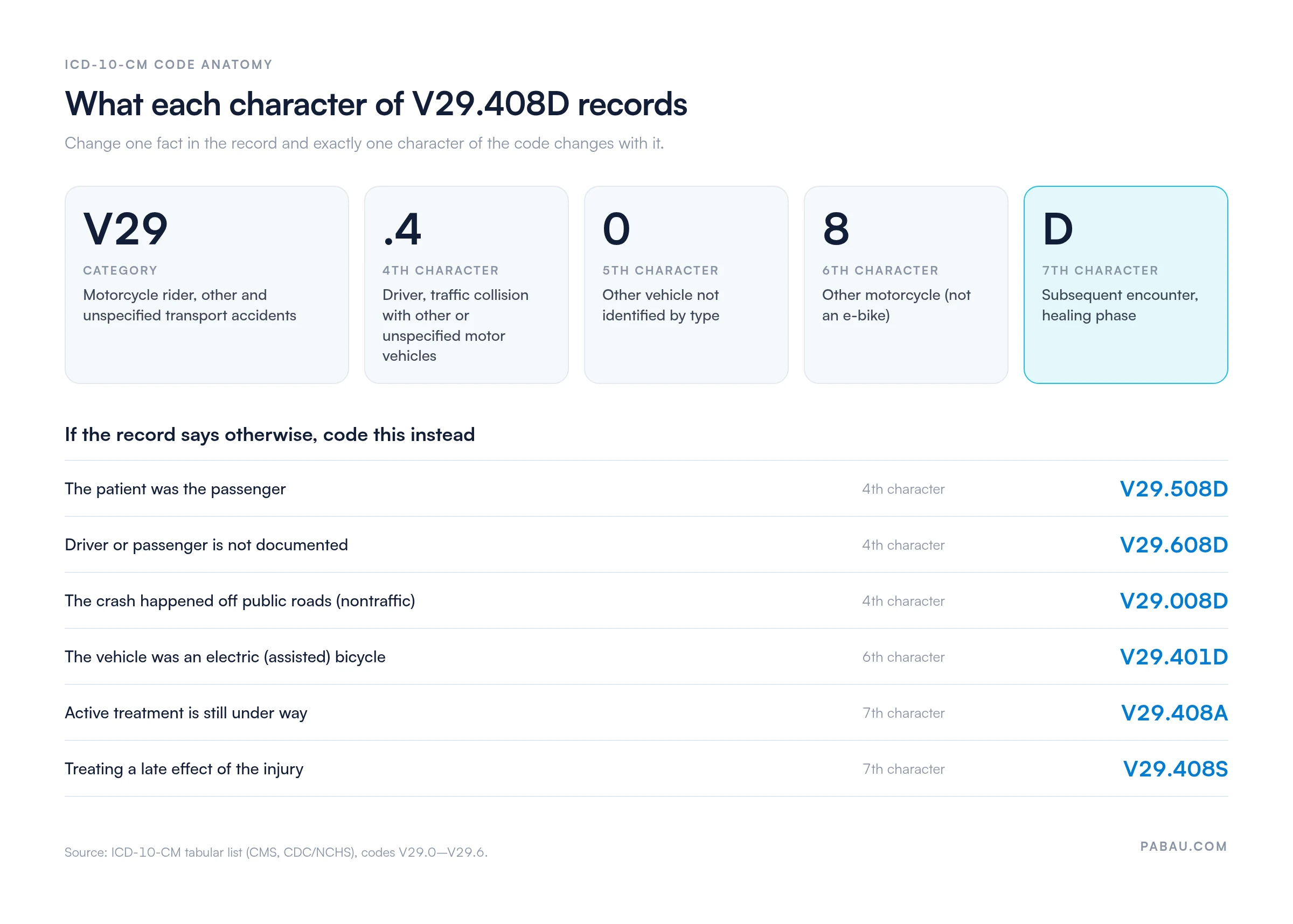
V29.408D means other motorcycle driver injured in collision with unspecified motor vehicles in traffic accident, subsequent encounter. Each character of the code narrows the scenario:
“Unspecified motor vehicle” in ICD-10-CM means the other vehicle involved in the collision is not identified by type in the medical record. If documentation clearly names the vehicle (a pickup truck, a bus, a passenger car), a more specific code from the V20-V28 range may be appropriate. Use V29.408D when the collision partner is documented only as “another vehicle” or remains unspecified.
Because every character records one fact, a single change in the record swaps the code for a sibling. The diagram below maps each character and the code that takes over.
The 7th character decides whether V29.408D fits the visit. Per the ICD-10-CM Official Coding Guidelines (Section I.C.19.a), three values apply across transport accident codes:
“Subsequent encounter” does not mean the patient’s second visit to a provider. It describes the phase of care. A patient seeing the same provider for the fourth time is still at an initial encounter while active surgical or procedural treatment continues.
Equally, a patient can move to D at the second visit if active treatment ended at the first. Document the phase of care clearly so the coder can assign the correct character.
Understanding the hierarchy helps coders locate V29.408D in the ICD-10-CM tabular list and select the most specific valid code.
The V20-V29 block covers motorcycle riders as the ICD-10-CM tabular list defines them. Its includes note names mopeds, motor scooters, motorized bicycles and motorcycles with a sidecar. Know what falls outside this code before assigning it.
When documentation is ambiguous about whether the patient was the driver or a passenger, query the physician before coding. Driver and passenger codes sit in different subcategories and affect coordination-of-benefits analysis for auto insurance payers.
The near-neighbor codes below share most of their descriptor text with V29.408D. Getting one character wrong changes the clinical picture entirely.
The driver-versus-passenger distinction (V29.4 vs V29.5) is a common specificity error on motorcycle accident claims. Auto insurance payers and workers’ compensation carriers can flag mismatches between the stated role in the clinical notes and the code billed.
V29.408D is an external cause code. Per ICD-10-CM Official Coding Guidelines Section I.C.20.a, it must never be sequenced as the principal or first-listed diagnosis. Understanding medical billing fundamentals makes this sequencing logic clear. The injury code drives medical necessity and reimbursement, while the external cause code explains how the injury occurred.
Use this sequencing order for every claim that includes V29.408D:
Under the place, activity and status guidelines (Sections I.C.20.b, I.C.20.c and I.C.20.k), these three codes are reported once, at initial treatment. They are not required on a subsequent-encounter claim like V29.408D, though payers vary on repeating them. A rider hurt on a weekend leisure trip, for example, takes Y99.8 on that first claim.
Check payer-specific requirements before you submit companion codes. Medicare does not require external cause codes for reimbursement. Some auto insurance and workers’ compensation payers still ask for place and activity codes on follow-up claims, so confirm before you leave them off.
Supporting V29.408D on a claim requires the medical record to clearly establish three things. When any of these is absent, coders should query the treating provider before coding. Per medical billing compliance standards, underdocumented external cause codes are a frequent audit target.
When documentation is unclear about driver versus passenger, or about the phase of care, a written query to the physician is the correct path. Coding without sufficient documentation to support the specificity of V29.408D risks a payer audit and potential recoupment.
V29.408D does not drive reimbursement on its own. The injury code (the principal diagnosis) determines medical necessity and payment. That said, payer policies on external cause codes vary significantly, and knowing those differences prevents avoidable denials.
Practices using claims management software that integrates with a clearinghouse can run pre-submission edits. Those edits catch missing or misordered external cause codes before the claim reaches the payer.
External cause transport codes like ICD-10 Code V29.408D carry a predictable set of denial triggers. Understanding denial management workflows for these scenarios helps billing teams resolve rejections faster and prevent recurring patterns.
When a claim for V29.408D is denied, start with the list of medical billing denial codes to identify the CARC reason code. Then map it to the sequencing, specificity, or documentation issue above. Many V29.408D denials can be corrected on appeal when the documentation supports the original coding. Use clean claim standards as a pre-submission checklist to catch these issues before they reach the payer.
Run a quarterly audit of claims where a V00-Y99 code sits in the first-listed position. One staff member’s habit with 7th characters or sequencing can repeat across hundreds of claims. A short audit catches the pattern before a payer does.
In many practices, a coder builds each follow-up claim by hand. They read the note, pick the injury code, add V29.408D and check the order before submitting. A wrong 7th character or a reversed sequence then surfaces weeks later as a denial.
Pabau, the practice management platform we build, ties the claim to the visit itself. Codes sit inside the invoice, which is raised at checkout. Claims then go out through our Claim.MD clearinghouse integration, with real-time eligibility checks and diagnosis-code validation before submission.
The aim is to catch coding slips before submission, so less time goes on rework after the payer responds.

Pabau integrates with Claim.MD to validate diagnosis codes, run real-time eligibility checks and track claim status before and after claims leave your practice. See how it works for injury and accident billing.

Coding V29.408D cleanly depends on four facts in the record. The coder needs the rider’s role, the road setting, the vehicle type and the phase of care. Each fact controls one character, and a sibling code takes over when the answer differs.
Remember that this code never earns payment on its own. Put the effort into the injury code and the claim order, and treat V29.408D as the explanation that follows them.
Revenue cycle management tools that check sequencing and 7th characters before submission stop these errors at the source. Book a demo to see how Pabau keeps accident follow-up claims coded and sequenced correctly.

Need a clearinghouse that validates ICD-10 sequencing before claims reach the payer? Claim.MD clearinghouse overview explains how Pabau’s US clearinghouse integration handles 837P claim validation and real-time eligibility checks.
Seeing recurring denials on accident-related claims? Electronic remittance advice explained walks through how to read ERAs and 835 remittances to identify CARC denial patterns across your V-code claims.
Was the collision off public roads? ICD-10 code V29.008S covers the nontraffic branch of the same driver scenario, coded for sequela.
Coding the status of the activity on the first claim? ICD-10 code Y99.8 explains when other external cause status applies, including leisure riding.
ICD-10 Code V29.408D is the billable code for an other motorcycle driver injured in collision with unspecified motor vehicles in a traffic accident, subsequent encounter. It applies once active treatment has ended and the patient is in healing-phase or follow-up care. It is a Chapter 20 external cause code and is always sequenced after the injury diagnosis code.
Yes, V29.408D is a billable ICD-10-CM code. Its parent codes (V29.4, V29.40 and V29.408) are non-billable headers, and the 7th character D completes the code so it can go on a claim. Confirm validity against the current fiscal year release at cms.gov before each claim cycle, as annual updates occasionally affect code status.
V29.408A applies during active treatment of the collision injuries (emergency department visit, initial surgery, first evaluation). V29.408D applies once active treatment has concluded and the patient is in a healing, recovery, or follow-up care phase (physical therapy, wound check, cast removal). The distinction is based on the phase of care, not the number of visits the patient has made.
V29.408D needs a principal injury code, such as a fracture or contusion coded to its highest specificity with the matching 7th character. The injury code goes first, and V29.408D follows it. Place of occurrence (Y92.xx), activity (Y93.xx) and external cause status (Y99.x) codes are reported once, at the initial encounter. Payers vary on whether they want them repeated on a follow-up claim.
Three errors can trigger denials. The first two are sequencing V29.408D as the principal diagnosis and using 7th character A instead of D on a follow-up visit. The third is leaving off place or activity codes a payer expects. A less obvious trigger is an injury code too vague to establish medical necessity.
Yes, for the driver. The V20-V29 includes note covers mopeds, motor scooters, motorized bicycles and motorcycles with a sidecar. All of them take the sixth character 8, the “other motorcycle” slot. The one exception is an electric (assisted) bicycle, which has its own code, V29.401D.