ICD-10 Code Z86.73: Personal history of TIA
ICD-10 Code Z86.73: Definition, descriptor, and code hierarchy ICD-10 Code Z86.7...

Last Updated: Nov 20, 2026
Billable Code Specific Code
V99.XXXA is the billable ICD-10-CM code for unspecified transport accident, initial encounter. It records how an injury happened when the chart confirms a transport accident but names no vehicle, role or circumstances.
The three Xs are placeholders that carry the code to its 7th character, and A marks a visit for active treatment. As an external cause code, it always follows the injury code and is never the principal diagnosis.
Let Pabau's smart automation suggest the right codes, reduce claim denials, and keep your practice compliant—effortlessly.
Automate repetitive tasks and focus on what matters most—your patients.
Reduce coding errors and ensure compliance with the latest regulations.
Clean claims, fewer denials, and faster reimbursements.
Powerful insights and reporting to help your practice thrive.
HIPAA compliant SOC 2 certified GDPR-compliant Trusted by 4,000+ clinics worldwide

V99.XXXA is the billable ICD-10-CM external cause code for a transport accident whose vehicle and circumstances the record doesn’t identify, at the initial encounter.
The XXX placeholders carry the code to its 7th character, and that character should match the injury code’s encounter type: A, D or S.
An external cause code is never the principal diagnosis, so V99.XXXA always follows the injury code it explains.
Records that say MVA, road traffic accident or collision without a vehicle type code to V89, which the V98-V99 block excludes.
Pabau, the practice management platform we build, sends US claims through Claim.MD, and ERA remittances come back for staff to work denials.
ICD-10 code V99.XXXA is the billable ICD-10-CM code for an unspecified transport accident, initial encounter. The FY2027 ICD-10-CM Tabular List from CDC places it in category V99, inside block V98-V99 of Chapter 20, External causes of morbidity.
It tells the payer how the injury happened, while the injury code beside it says what was treated. It is valid for claim submission in the code files the Centers for Medicare and Medicaid Services publishes.
The fit is narrow, because most records name at least a vehicle. The quick reference below collects the facts billing staff check most often.
The 7th character in V99.XXXA records the phase of care. A marks the initial encounter, D a subsequent encounter, and S a sequela, which is a late effect of the original injury.
The three Xs are placeholders. Category V99 has no subdivisions, so ICD-10-CM fills positions four to six with X to reach the required 7th character. Leave them out, and the code is invalid.
The Official Guidelines add one rule that settles most arguments. The external cause’s 7th character should match the 7th character on the injury code for that encounter. A new provider seeing the patient later doesn’t reset it.
So base the choice on the purpose of the visit, never the date of the accident. For a patient back three months later for continued active treatment, A still applies. Switching to D while treatment is ongoing puts the external cause out of step with the injury code.
“Unspecified transport accident” means the record confirms a transport accident but not the vehicle, the patient’s role or the circumstances. Every other transport category names at least one of those.
Work down the ladder below and stop at the first rung the record supports.
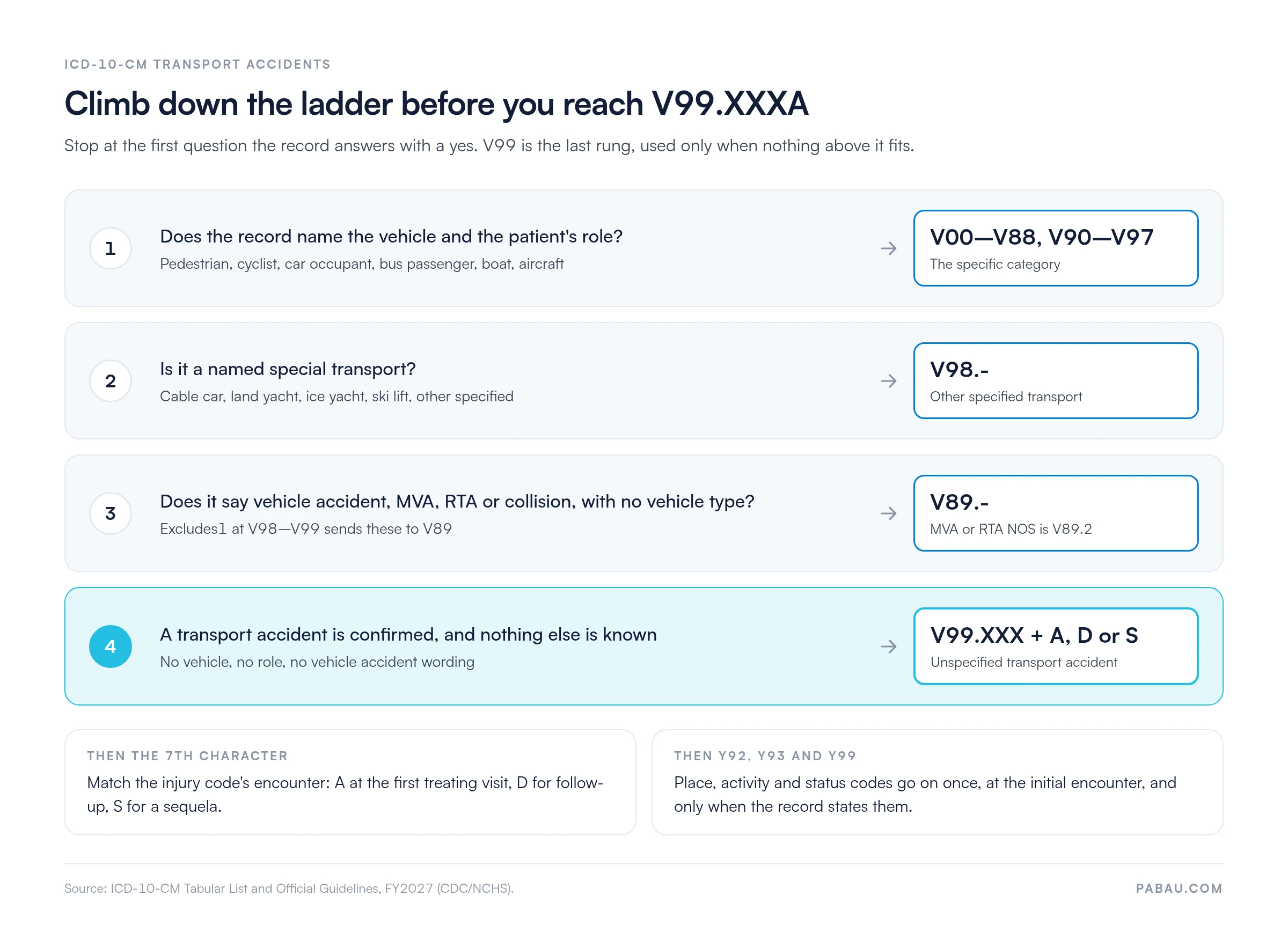
Records that can legitimately land on the bottom rung include:
Watch the wording. “MVA”, “motor vehicle accident” and “road traffic accident” without more detail index to V89.2, and “collision NOS” goes to V89.9. If the documentation supports a specific code, such as V06.90XA for a pedestrian hit by a nonmotor vehicle, use it. A missing accident report is no reason to stop at V99.
No Excludes notes sit on V99.XXXA itself. The V98-V99 block above it carries an Excludes1 for vehicle accident, type of vehicle unspecified (V89.-). Excludes1 means “not coded here”, so V89 and V99 never describe the same event.
That note draws the V89 boundary. V89 covers a vehicle accident with an unknown vehicle type, split by motor or nonmotor and by traffic or nontraffic. V99 is left for a transport accident where even the word “vehicle” is missing. Confirm the current notes in the CDC/NCHS ICD-10-CM coding tool before you code.
The comparison below lines up the codes coders most often confuse with V99.XXXA.
Chapter 20 codes follow the documentation, so the record needs a few specific facts before V99.XXXA reaches a claim. The FY2027 Official Guidelines steer code selection through the Alphabetic Index and the Tabular List’s inclusion and exclusion notes.
External cause codes are supplementary and can never be the principal or first-listed diagnosis. Follow these steps on every claim:
A status code such as Y99.8, other external cause status, covers events outside paid work and military duty. No intent code is needed, because every transport accident category assumes accidental intent. A deliberate crash moves to X82 for self-harm or Y03 for assault.
EMS brings in a sedated patient with a deformed left forearm. The handover says “transport accident” and nothing else, and imaging shows a fracture nobody can classify further yet.
The first claim lists S52.92XA, unspecified fracture of left forearm, initial encounter for closed fracture. V99.XXXA follows it. Place, activity and status codes stay off, since the record states none of them.
Two weeks later she returns for a cast check, and the chart now says a car hit her while she was cycling. That visit takes a code from V13, pedal cycle rider injured in collision with a car, with a D. It doesn’t take V99.XXXD. The first claim matched what the record said that day, so it usually stands.
Transport accident external cause codes trip claims in predictable ways. Most come down to documentation or sequencing rather than coverage. The denial management process for them follows the same appeal pathway as other claim types.
Reading denial codes in medical billing alongside each claim’s CARC helps map every rejection to its fix. Most of the fixes above take minutes once the remittance names the problem.
The Official Guidelines set no national mandate to report external cause codes. Reporting is driven by state or payer requirements, and the CMS Claims Processing Manual is not the source for it. Check your state’s rules and each payer contract before treating V99.XXXA as optional.
Workers’ compensation works differently. If the accident happened during work travel, the claim may belong with the employer’s workers’ comp carrier rather than health insurance. Expect extra forms and a separate injury report.
V99.XXXA can appear on those claims, but the carrier’s coding and documentation rules take precedence. Your medical billing compliance procedures should route each claim to the right payer before anyone assigns a code.
Medicare Part B doesn’t require external cause codes. Some Medicare Advantage (Part C) plans ask for them, especially where a third party may be liable. Check the plan’s billing guide before you leave V99.XXXA off a claim.
The approximate ICD-9-CM equivalent of V99.XXXA is E848, Accidents involving other vehicles, not elsewhere classifiable. That match comes from the CMS General Equivalence Mappings (GEMs), which bridge the two systems for data analysis and legacy research.
Caveat: GEMs matches are approximate. ICD-9-CM grouped vehicle accidents differently, and E848 has no encounter suffix to carry initial, subsequent or sequela detail. Note that difference in any trend comparison. ResDAC’s guide to ICD codes in Medicare files explains how the GEMs files are structured and where they fall short.
On a busy front desk, V99.XXXA claims stall in familiar places. A code gets keyed by hand, the injury code lands in the wrong slot, and denials sit unread until someone notices.
Pabau pre-fills the claim form from the patient record. Its claims management software includes a searchable ICD-10-CM code library and checks that required claim fields are complete before you send.
Pabau sends US claims through Claim.MD, and ERA remittances come back for staff to work denials. Your team works each denial from the remittance instead of waiting on a letter.

Pabau pre-fills claims from the patient record and sends US claims through Claim.MD. ERA remittances come back for staff to work denials.

V99.XXXA earns its place only when the record confirms a transport accident and says nothing more. Before you use it, look for vehicle wording, query the provider when details are probably known, and match the injury code’s 7th character.
The trade-off is speed against precision. A quick provider query costs minutes, while a specificity denial costs a full resubmission cycle.
Clean medical billing starts with the record, and the claim follows it. Book a demo to see how Pabau pre-fills injury claims and brings US remittances back for your team to work.

Want to see how US claims move after submission? Claim.MD clearinghouse guide walks through submission, eligibility checks and remittances.
Building a denial prevention workflow? What makes a clean claim covers the coding and documentation checks that keep claims from bouncing.
Adding the status code beside V99.XXXA? ICD-10 code Y99.8: Other external cause status explains when the other-status code applies.
Once the record names the vehicle? ICD-10 code V06.90XA: Pedestrian injured by nonmotor vehicle shows a specific transport code at the initial encounter.
Only when the vehicle is unknown. The falls block, W00-W19, excludes falls in or from a transport vehicle, so they code to V01-V99. Use the vehicle’s own category when the record names it.
No. V99.XXXA is on the FY2027 list of codes exempt from POA reporting, so report it as exempt under your payer’s POA rules.
No. Every transport accident category assumes accidental intent. Code a deliberate crash to X82 for intentional self-harm or Y03 for assault, both by crashing of motor vehicle.
Code later encounters from the updated record, using the specific category with a D or S 7th character. Whether to correct the first claim depends on the payer’s rules.
No national rule requires external cause codes. State mandates and payer contracts decide, and the guidelines encourage voluntary reporting for injury research.
The approximate GEMs match is E848, Accidents involving other vehicles, not elsewhere classifiable. Use it for historical data comparisons only, never on a current claim.