ICD-10 Code V91.84XS: Other burn due to burning watercraft
ICD-10 Code V91.84XS: overview and key facts ICD-10 Code V91.84XS identifies the...

Last Updated: Oct 30, 2026
Billable Code Specific Code
V29.408A is the billable ICD-10-CM code for other motorcycle driver injured in collision with unspecified motor vehicles in traffic accident, initial encounter.
It is an external cause code, so the injury code (a fracture, brain injury or laceration) goes first and V29.408A explains how the injury happened. It is most often confused with V29.9XXA, an unspecified traffic accident, and with V29.408D, used once active treatment ends. The patient's role and whether the other vehicle is named decide which V29 code applies.
Let Pabau's smart automation suggest the right codes, reduce claim denials, and keep your practice compliant—effortlessly.
Automate repetitive tasks and focus on what matters most—your patients.
Reduce coding errors and ensure compliance with the latest regulations.
Clean claims, fewer denials, and faster reimbursements.
Powerful insights and reporting to help your practice thrive.
HIPAA compliant SOC 2 certified GDPR-compliant Trusted by 4,000+ clinics worldwide

V29.408A is a billable ICD-10-CM external cause code, always sequenced after the principal injury diagnosis.
The 7th character A marks the initial encounter, used while active treatment for the injury is still ongoing.
Use V29.408A only when the patient was the driver and the other vehicle’s type is undocumented or unknown.
A missing companion injury code and V29.408A sequenced as the principal diagnosis are both common denial triggers.
ICD-10 code V29.408A is the billable external cause code for a motorcycle driver hurt in a traffic collision with an unidentified motor vehicle. The 7th character A marks the initial encounter, and the code always follows the injury code on the claim.
The CDC/NCHS ICD-10-CM web tool confirms V29.408A as valid and billable. Verify the active fiscal year before submission, as CMS releases annual code updates each October 1.
V29.408A is an external cause code describing a specific collision scenario. Each element of the descriptor restricts its scope, and misreading any one element leads to the wrong code.
Taken together, the patient drove a motorcycle and collided with another motorized vehicle on a public road. The note doesn’t record that vehicle’s type, and the patient is presenting for active-phase care. All five conditions must be true at once for V29.408A to be correct.
The 7th character on an external cause code records the phase of care for the injury. All three V29.408 variants describe the same crash, and only the encounter type changes.
The ICD-10-CM Official Guidelines for Coding and Reporting (Section I.C.19.a) state that the 7th character reflects the phase of treatment, not the number of visits. A patient can have multiple initial-encounter visits if active treatment continues across several appointments before healing begins.
Document the treatment phase in every clinical note where V29.408A, V29.408D or V29.408S will be reported. Take a note that says ‘follow-up for motorcycle collision injuries’ and nothing more. It doesn’t say whether active treatment continues, so the coder has no basis for picking the 7th character. Payers can check this distinction in post-payment reviews, and a wrong 7th character can lead to recoupment.
External cause codes carry specific inclusion and exclusion notes that determine when they apply and when a different code is required. These are part of the ICD-10-CM tabular list, as published by CMS’s ICD-10 codes page, and they are mandatory coding guidance.
The V29 series contains several codes that look alike at first glance. The table below maps the key neighbors and the one factor that separates each from V29.408A. ICD-10-CM guidelines require coding to the highest level of specificity the record supports, and the AAPC ICD-10-CM code search helps confirm a narrower code. The same crash off a public road moves to the nontraffic family, whose sequela code is V29.008S. For any other code in the series, the ICD-10-CM code library lists each one with its own guide.
V29.408A is always an additional code and never stands alone on a claim. The six steps below apply to any encounter where a motorcycle driver is injured in a traffic collision with an unidentified vehicle. The flow below runs the code-selection checks in order and shows where each failed check sends you.
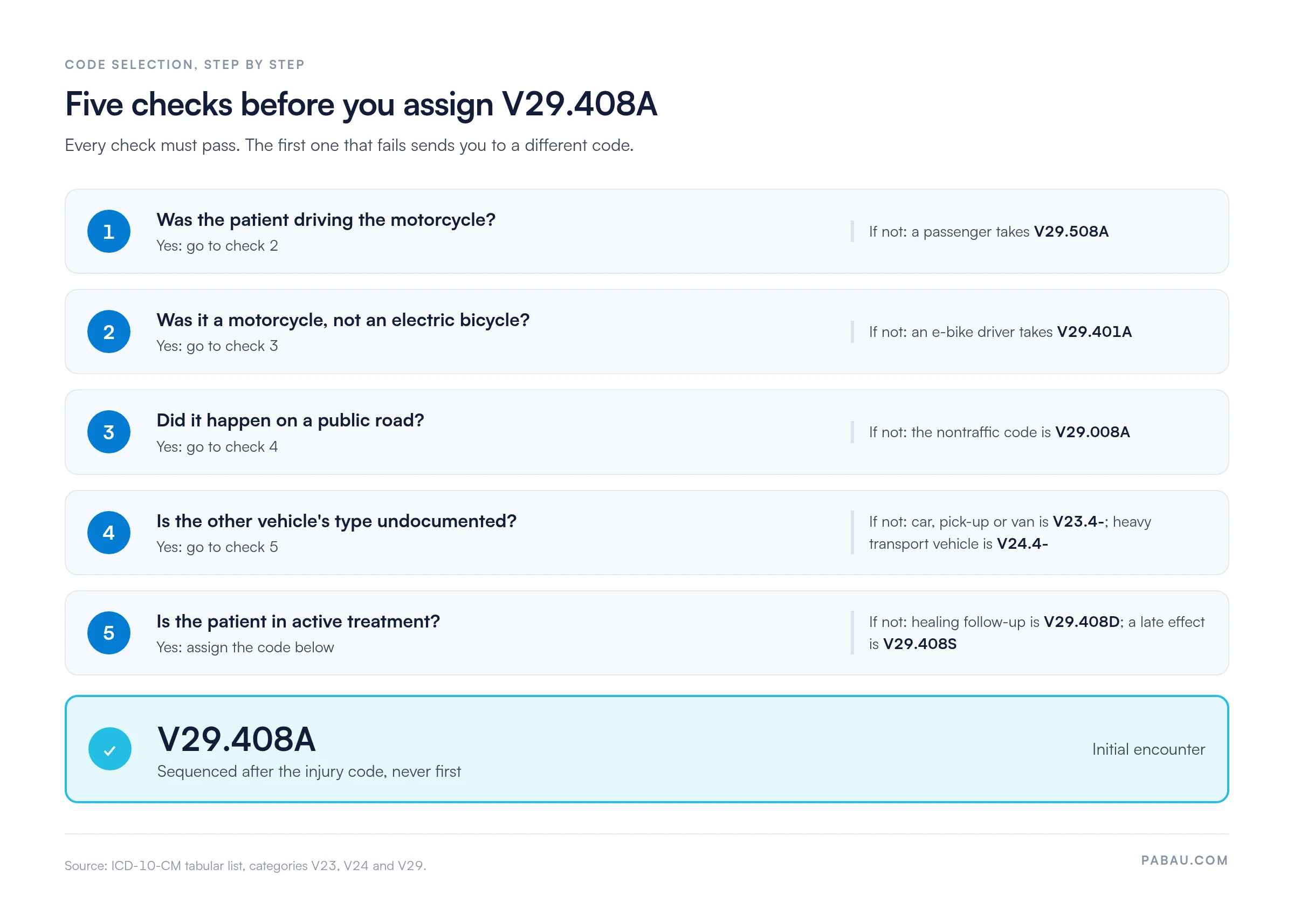
V29.408A is billable, but coders can’t assign it without specific supporting documentation. The clinical note must address four elements for the code to hold up in an audit. A standard trauma intake template prompts clinicians to record each one. Every clean claim starts with that documentation, long before it reaches the billing desk.
V29.408A is never the principal diagnosis. Section I.C.20 of the ICD-10-CM Official Guidelines for Coding and Reporting sets the rule. External cause codes explain how an injury happened, so they are reported after the injury code. Status codes such as Y99.8, which covers leisure activity, follow the same rule.
Correct sequencing on a claim looks like this:
Some payers, including Medicare Advantage plans and state Medicaid programs, run automated edits that reject a claim with a V-code in position 1. That denial usually takes a corrected claim to resolve.
Motorcycle accident claims often get extra scrutiny, because auto insurance or a tort claim may sit alongside health coverage. A consistent approach to denial management stops these patterns from repeating across a practice.
Traffic accident codes in the V20-V29 series can affect claim routing and payer behavior in ways that do not apply to most other ICD-10-CM codes. A grounding in medical billing basics helps front-desk and billing staff anticipate these effects before submission.
Traditional Medicare does not automatically deny traffic injury claims, but Medicare Advantage plans vary. Some MA plans run edits that flag external cause codes as the sole or first diagnosis on a claim. Submit V29.408A as an additional code only, with the injury diagnosis sequenced first, to avoid these edits. Medicare’s coordination of benefits rules also require a query about third-party liability at intake. If an at-fault driver’s auto insurance is responsible, Medicare pays second.
State Medicaid programs may have specific policies on injury-related claims. Some states require an accident report number or a statement of circumstances alongside the claim. Keep police reports and patient statements on file in case the payer asks for them.
Commercial health insurers routinely invoke coordination of benefits on traffic accident claims. V29.408A on a claim signals a traffic accident to the payer’s editing system. That signal may send the claim to a coordination-of-benefits queue automatically. Confirm at intake whether the patient has an active auto insurance claim and whether health or auto coverage is primary. Billing the wrong primary payer is a common cause of delays on motorcycle accident claims.
Without a connected billing system, a coder sequences injury codes by hand and staff check coverage by phone. Denials then surface weeks later on a paper remittance, long after the visit note was written.
Pabau, the practice management and billing platform we build, connects to the Claim.MD clearinghouse. It runs real-time 270/271 eligibility checks and submits CMS-1500 claims electronically to US payers. Claim status updates come back from the payer, and denied claims are flagged for rework.
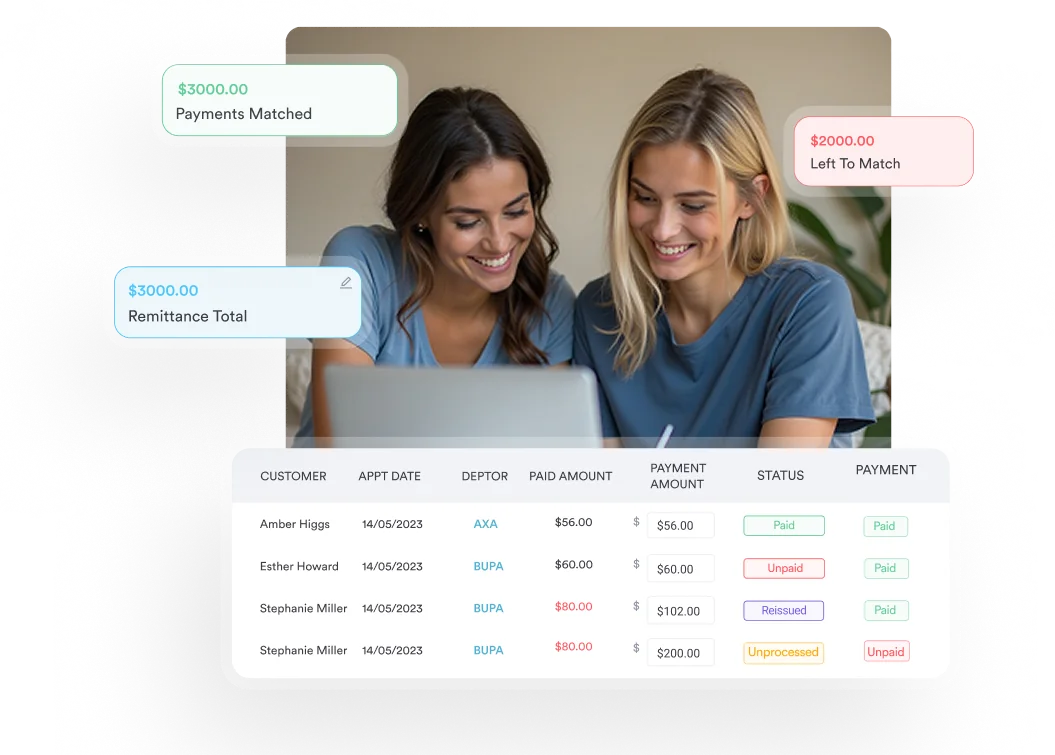
Before a claim leaves Pabau, its claims management workflows check it for missing or invalid details and link straight to the field that needs fixing. Electronic remittance advice files come back into Pabau and match to the claims they settle. Your billing team sees which claims are paid, pending or denied on one dashboard.

Pabau checks eligibility in real time, submits CMS-1500 claims through Claim.MD and flags denied claims for rework. Your team spends less time chasing motorcycle injury claims.

V29.408A rewards precise notes. It fits only when five conditions hold at once. The patient drove, the crash was a collision with another motor vehicle, and that vehicle’s type is undocumented. The crash happened on a public road, and treatment is still active.
So the fix for most V29.408A errors sits upstream of billing, in an intake note that records role, road and vehicle every time. Sequencing the code first and sending it without an injury code are both easy to catch before submission.
After submission, Pabau’s Claim.MD integration tracks each claim’s status and flags denied claims for rework. Electronic remittance advice then matches each payment back to its claim, so no denial sits unworked. Book a demo to see how Pabau tracks injury claims from the eligibility check to payment.

Need to understand how denials are classified and appealed? Denial codes in medical billing covers CARC and RARC codes used by payers to explain every rejection type.
Want the main code sets on one page? Medical coding cheat sheet summarizes CPT, ICD-10, HCPCS and E/M codes for quick reference.
Want a plain-English overview of how claims flow from code to payment? What is revenue cycle management maps each step from encounter to remittance.
ICD-10 Code V29.408A is the billable external cause code for other motorcycle driver injured in collision with unspecified motor vehicles in traffic accident, initial encounter. It records how the injury happened, during active treatment. It is always reported as an additional code alongside the principal injury diagnosis.
Yes, V29.408A is a billable ICD-10-CM code confirmed valid in the CMS annual tabular list. However, it cannot stand alone on a claim. At least one companion injury code must be sequenced ahead of it as the principal diagnosis.
All three codes describe the same collision scenario but at different phases of care. V29.408A applies during active treatment (initial encounter). V29.408D applies once the injury is healing and the patient is in routine follow-up. V29.408S applies when the visit is for a late effect or complication that developed after the original injury healed.
Use 7th character A when the patient is still receiving active treatment for the injury, regardless of how many visits have occurred. The A character reflects the phase of care, not the number of encounters. Once active treatment ends and the patient transitions to routine healing follow-up, switch to D.
No. V29.408A is an external cause code and is explicitly prohibited from being sequenced as the principal diagnosis under ICD-10-CM Official Guidelines Section I.C.20. It always follows the injury code. Placing it in position 1 on a claim is a common denial trigger and cannot be corrected without submitting a corrected claim.
V29.408A always follows one or more injury codes that describe the trauma. These include fracture codes (S-series), traumatic brain injury codes (S06-series), soft tissue injury codes, or laceration codes. Place-of-occurrence (Y92), activity (Y93), and patient status (Y99) codes may also be reported when documentation supports them. Payer requirements and the ICD-10-CM Official Guidelines govern their use.
Unspecified motor vehicle means the clinical documentation does not identify the type of other vehicle involved in the collision. If the record documents the other vehicle as a car, truck, bus, or other specific type, a more specific code from V20-V27 applies. V29.408A is appropriate only when the vehicle type is genuinely unknown or unrecorded, not when documentation was simply not queried.
Four denial reasons come up most often. The first two are V29.408A sequenced as the principal diagnosis and a claim with no companion injury code. The third is a 7th character that doesn’t match the visit, such as A on a healing follow-up. The fourth is a claim sent to health insurance when auto insurance is the primary payer.