ICD-10 code S31.30XD – Open wound of scrotum and testes
ICD-10 code S31.30XD covers a scrotal or testicular wound at follow-up ICD-10 co...

Last Updated: Nov 2, 2026
Billable Code Specific Code
V21.59XS is the billable ICD-10-CM code for other motorcycle passenger injured in collision with pedal cycle in traffic accident, sequela. It covers a passenger on a motorcycle other than an electric (assisted) bicycle, injured when the motorcycle collided with a bicycle in traffic.
The 7th character S marks a sequela encounter. The acute injury has healed, and the patient is now treated for a condition it left behind, such as chronic pain or nerve damage. That residual condition is coded first, and V21.59XS follows as the external cause.
Let Pabau's smart automation suggest the right codes, reduce claim denials, and keep your practice compliant—effortlessly.
Automate repetitive tasks and focus on what matters most—your patients.
Reduce coding errors and ensure compliance with the latest regulations.
Clean claims, fewer denials, and faster reimbursements.
Powerful insights and reporting to help your practice thrive.
HIPAA compliant SOC 2 certified GDPR-compliant Trusted by 4,000+ clinics worldwide

ICD-10 Code V21.59XS identifies a passenger on a non-e-bike motorcycle, injured in a traffic collision with a pedal cycle, at the sequela stage.
The 4th character .5 means a passenger in a traffic accident, and the 5th character 9 means a motorcycle other than an electric (assisted) bicycle.
The 7th character S means the original injury has healed. Only the residual or late-effect condition is treated and reported at this stage.
V21.59XS is always a secondary code: the residual condition is sequenced first, with V21.59XS added as the external cause of the late effect.
Missing the placeholder X in position 6, or using character A or D instead of S, are common reasons this code triggers a claim denial.
ICD-10 Code V21.59XS reports the external cause behind a late effect.
The patient rode as a passenger on a motorcycle other than an e-bike, and the motorcycle collided with a pedal cycle in a traffic accident.
Confirm the code against the current fiscal year’s CDC/NCHS ICD-10-CM web tool, which publishes the official tabular list annually.
ICD-10 Code V21.59XS carries six pieces of information, each held by a specific character position. Knowing what each one means prevents swaps with neighboring codes in category V21.
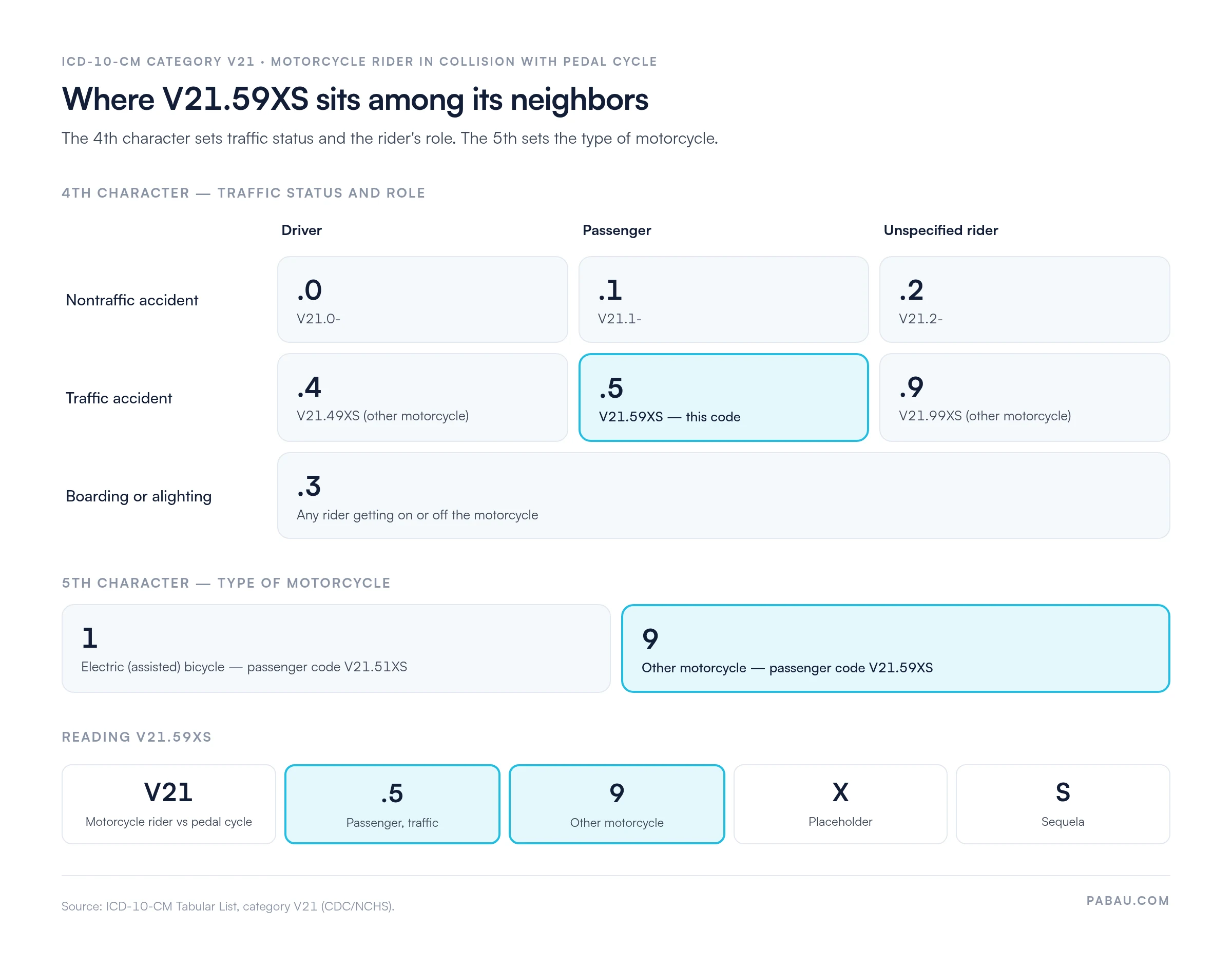
The 4th character sets two things at once in category V21: traffic status and the rider’s role. Characters .0, .1 and .2 cover a driver, passenger and unspecified rider in a nontraffic accident. Characters .4, .5 and .9 cover the same three roles in a traffic accident, and .3 covers anyone boarding or alighting.
The 5th character names the vehicle: 1 for an electric (assisted) bicycle and 9 for any other motorcycle. When a traffic-accident record doesn’t say whether the patient drove or rode as a passenger, the unspecified rider code is V21.99XS. The matrix below maps each combination.
Knowing the boundaries of V21.59XS prevents pairing it with incompatible injury codes or applying it to the wrong encounter type.
This code covers:
This code does not cover:
The 7th character S designates sequela: a late complication or residual condition that persists after the acute phase of an injury has ended. The ICD-10-CM Official Guidelines for Coding and Reporting define it in Section I.B.10 (Sequela, late effects).
Choosing between A, D and S is the key encounter decision for any V21 code, and the table below shows what separates them.
Sequela coding always takes two codes. The residual condition (for example, M79.622, pain in left upper arm) is sequenced first. V21.59XS follows as the external cause code, showing that the condition began with this motorcycle-bicycle collision.
Reporting V21.59XS alone, without the residual condition code leading, is a coding error that payers catch and deny.
Document the link between the current residual condition and the original accident in the clinical note. A phrase like ‘chronic left knee pain secondary to motorcycle-bicycle collision sustained [date]’ shows the coder and the payer why S applies. A note that only describes current symptoms won’t support V21.59XS.
Transport accident codes in Chapter 20 follow a set sequencing logic. These five steps apply the ICD-10-CM sequela guidelines and the external cause sequencing rules that govern V21.59XS.
Category V21 splits on three choices: traffic or nontraffic accident, the rider’s role, and the type of motorcycle. The table lists the traffic-accident sequela codes closest to V21.59XS.
The most common swap is reaching for V21.99XS when the note already confirms the patient rode as a passenger. An unspecified code applies only when the record doesn’t say.
Two other details change the code. An e-bike moves the 5th character to 1, and a crash off a public road moves the 4th character to the nontraffic range. Query the provider whenever the note leaves either point unclear.
External cause codes in ICD-10-CM are supplementary by definition. They explain the origin of a condition, not the condition itself. For V21.59XS, the clinical note must establish three things.
The note also has to settle two coding choices. Whether the crash happened in traffic sets the 4th character, and whether the motorcycle was an electric (assisted) bicycle sets the 5th. When either is missing, query the provider rather than guessing.
Most Medicare and Medicaid payers do not reimburse on external cause codes in isolation. V21.59XS must accompany a reimbursable diagnosis code, the residual condition, for the claim to generate payment. The external cause code supports medical necessity and supplies the injury origin for coordination of benefits.
Auto insurance subrogation is where V21.59XS carries particular weight. When a health insurer pays for sequela treatment after a motorcycle-bicycle collision, it can recover those costs from the at-fault party’s auto or liability insurer. Accurate coding of the mechanism, occupant role and encounter type gives the health plan the documentation trail it needs to pursue recovery.
Commercial payers vary in whether they require external cause codes as a condition of payment. Some make them mandatory for transport accident claims, while others treat them as informational. Review each payer’s policies annually, since requirements change with each contract cycle.
Our overview of medical billing fundamentals walks through how a coded claim moves from submission to payment.
Denials on V21.59XS claims follow predictable patterns. Each one has a correction path that avoids the most time-consuming outcome: resubmitting with inadequate changes and triggering a second denial.
Our guide to denial management covers how to systematize correction and resubmission. The reference on medical billing denial codes explains the CARC reason codes behind sequencing and coding errors.
Run a monthly audit of claims carrying V21 external cause codes. Filter for denials with CO-16, which flags missing information or a billing error. Fixing a batch of V21.59XS sequencing errors at month-end is far faster than chasing aged denials one at a time.
ICD-9-CM had no 7th character encounter extensions, so the crosswalk from V21.59XS is approximate. The nearest ICD-9 code for the accident itself is E813.3. The CMS ICD-10 General Equivalence Mappings (GEMs) provide the official translation files.
This mapping is approximate. ICD-9-CM E-codes did not split occupant role or motorcycle type as finely as ICD-10-CM does in category V21. For retrospective analysis or appeals on pre-2015 claims, verify the crosswalk against the official CMS GEM files.
The AAPC Codify ICD-10-CM lookup and ICD List both show crosswalk data alongside code descriptions, which helps when working through older records.
Sequela claims fail on small slips: a missing X, the wrong 7th character, or an external cause code sent as the principal diagnosis. Without a scrubbing step, those slips surface only when the denial arrives.
Pabau, the practice management platform we build, includes error-checking claims management software. Its claim validation scrubs every claim for missing or invalid details before it leaves Pabau. US claims then go out as electronic CMS-1500s to thousands of payers through the Claim.MD clearinghouse.

Remittance advice comes back into Pabau and ties each payer payment to the claim it settles. If a claim comes back rejected, Pabau flags it as Needs action, so your team corrects the code and resubmits from the same record.

Pabau’s claim validation scrubs every claim for missing or invalid details, then submits electronically to thousands of US payers through Claim.MD. See how it fits your practice’s billing workflow.

Coding V21.59XS correctly comes down to checks made before the claim leaves. The residual condition goes first. The note has to back up traffic status, passenger role and motorcycle type. And the code needs both its X placeholder and its S.
The trade-off is a little time at the front end. A minute spent reading the note against the V21 matrix costs less than a resubmission, and far less than a second denial.
A clean claim on the first pass is the goal. Book a demo to see how Pabau scrubs each claim before it reaches the payer.

Need to understand how clearinghouse validation catches ICD-10 code errors? Claim.MD clearinghouse overview covers how real-time code validation and ERA processing work in practice.
Working through a batch of transport accident denials? Revenue cycle management fundamentals covers the denial identification and resubmission workflow from initial rejection through paid status.
Want a reference for reading ERA denial reason codes? Electronic remittance advice explained breaks down CARC and RARC codes that appear on V21.59XS denials involving sequencing and documentation errors.
ICD-10 Code V21.59XS is the external cause code for an other motorcycle passenger in a traffic collision with a pedal cycle, at the sequela stage. “Other motorcycle” means any motorcycle except an electric (assisted) bicycle. It is reported after the residual condition code when the patient is treated for a late effect of that accident.
Use 7th character S once the original injury has fully healed and the patient is treated for a residual or late-effect condition. Use A for the first active-treatment encounter and D for subsequent encounters during the healing phase. If the injury is still healing in any form, S is not appropriate.
No. V21.59XS is an external cause code and is always reported as a secondary code. The residual condition code (for example, a chronic pain or neuropathy code) is sequenced first as the principal diagnosis. Submitting V21.59XS in the primary position is a coding error that results in claim denial.
The closest ICD-9-CM match for the accident is E813.3, a motor vehicle traffic accident involving collision with other vehicle, passenger on motorcycle injured. E813 includes collisions with a pedal cycle. ICD-9 had no 7th character, and late effects were reported with E929.0. Verify against the official CMS GEM files for retrospective claims.
At minimum, a code for the residual condition must be sequenced first. Some payers also request a place of occurrence code (Y92.x) or an activity code (Y93.x) alongside external cause codes for transport accident claims. Review the payer’s requirements before final claim submission.
Both codes report a passenger injured in a traffic collision with a pedal cycle, at the sequela stage. The 5th character is the difference: 9 means a motorcycle other than an e-bike, and 1 means an electric (assisted) bicycle. If the record doesn’t say whether the patient drove or rode as a passenger, query the provider. V21.99XS is the unspecified-rider code if the answer stays unclear.