ICD-10 Code R34: Anuria and oliguria
ICD-10 Code R34 is the billable ICD-10-CM diagnosis code for anuria and oliguria...

Last Updated: Oct 6, 2026
Billable Code Specific Code
V04.92XD is the billable ICD-10-CM code for a skateboarder hit by a bus or heavy transport vehicle, with traffic status unspecified, at a follow-up visit. It covers routine care while the injury heals, and it always follows the injury code it explains.
The catch is a silent record. ICD-10-CM assumes a public highway unless the record names another place, so a note with no location codes to V04.12XD. A named non-highway place codes to V04.02XD. V04.92XD is for cases where traffic status can't be determined. Getting it right keeps the claim clean and flags which insurer pays first.
Let Pabau's smart automation suggest the right codes, reduce claim denials, and keep your practice compliant—effortlessly.
Automate repetitive tasks and focus on what matters most—your patients.
Reduce coding errors and ensure compliance with the latest regulations.
Clean claims, fewer denials, and faster reimbursements.
Powerful insights and reporting to help your practice thrive.
HIPAA compliant SOC 2 certified GDPR-compliant Trusted by 4,000+ clinics worldwide

V04.92XD reports a follow-up visit for a skateboarder hit by a bus or heavy transport vehicle when traffic status can’t be determined.
A record that names no place defaults to traffic, V04.12XD, because ICD-10-CM assumes a public highway unless another place is specified.
Use V04.02XD only when the record names a non-highway place, such as a depot yard or a private parking lot.
The 7th character D covers routine care while the injury heals, not the first treatment visit or a late effect.
Sequence V04.92XD after the injury code, and keep the place, activity and status codes for the initial encounter claim.
ICD-10 code V04.92XD reports a follow-up visit for a skateboarder injured in a collision with a bus or heavy transport vehicle. It applies only when nobody can establish whether the collision was a traffic or nontraffic accident.
That makes it a narrow code. ICD-10-CM assumes a vehicle accident happened on the public highway unless the record names another place. So a note that never mentions the location usually codes to V04.12XD instead. Here are the attributes to confirm before V04.92XD goes on a claim.
Check the descriptor against the CDC/NCHS ICD-10-CM web tool each October. Annual updates can change valid character sets.
Read the code one character at a time and most assignment errors disappear. Here’s what each position tells the payer.
Put together, the code describes a skateboarder hit by a bus or heavy transport vehicle who is back for follow-up care. The one detail it leaves open is whether the collision counts as traffic.
Why a pedestrian code at all? ICD-10-CM treats a skateboard as a pedestrian conveyance. So a skateboarder struck by a vehicle is coded in the pedestrian categories, not with cyclists or vehicle occupants.
Four conditions have to hold at once. The patient was on a skateboard, and the other party was a bus or heavy transport vehicle. Traffic status can’t be determined from the record or the provider, and the visit is a follow-up.
Scenarios that fit this code include:
A record that simply names no place is a different case. The Chapter 20 definitions treat it as traffic, so it codes to V04.12XD.
The code also doesn’t apply when the patient was on foot, on roller-skates, or on a scooter. A car, pickup truck, or van moves the code to category V03. And the initial treatment visit takes 7th character A, not D.
The fourth character records where the collision happened. ICD-10-CM defines a traffic accident as a vehicle accident on a public highway, meaning any road or street open to the public for vehicle travel. A nontraffic accident happens anywhere else, such as a private lot or a depot yard.
The Chapter 20 definitions explain the fourth row. A vehicle accident is assumed to have occurred on the public highway unless another place is specified. The one exception covers accidents involving only off-road motor vehicles, which are nontraffic unless stated otherwise.
A bus or heavy transport vehicle isn’t an off-road vehicle, so that exception never reaches V04. In practice, a documented collision with no place recorded goes to V04.12XD. V04.92XD stays the residual code, and the decision path below shows where it sits.
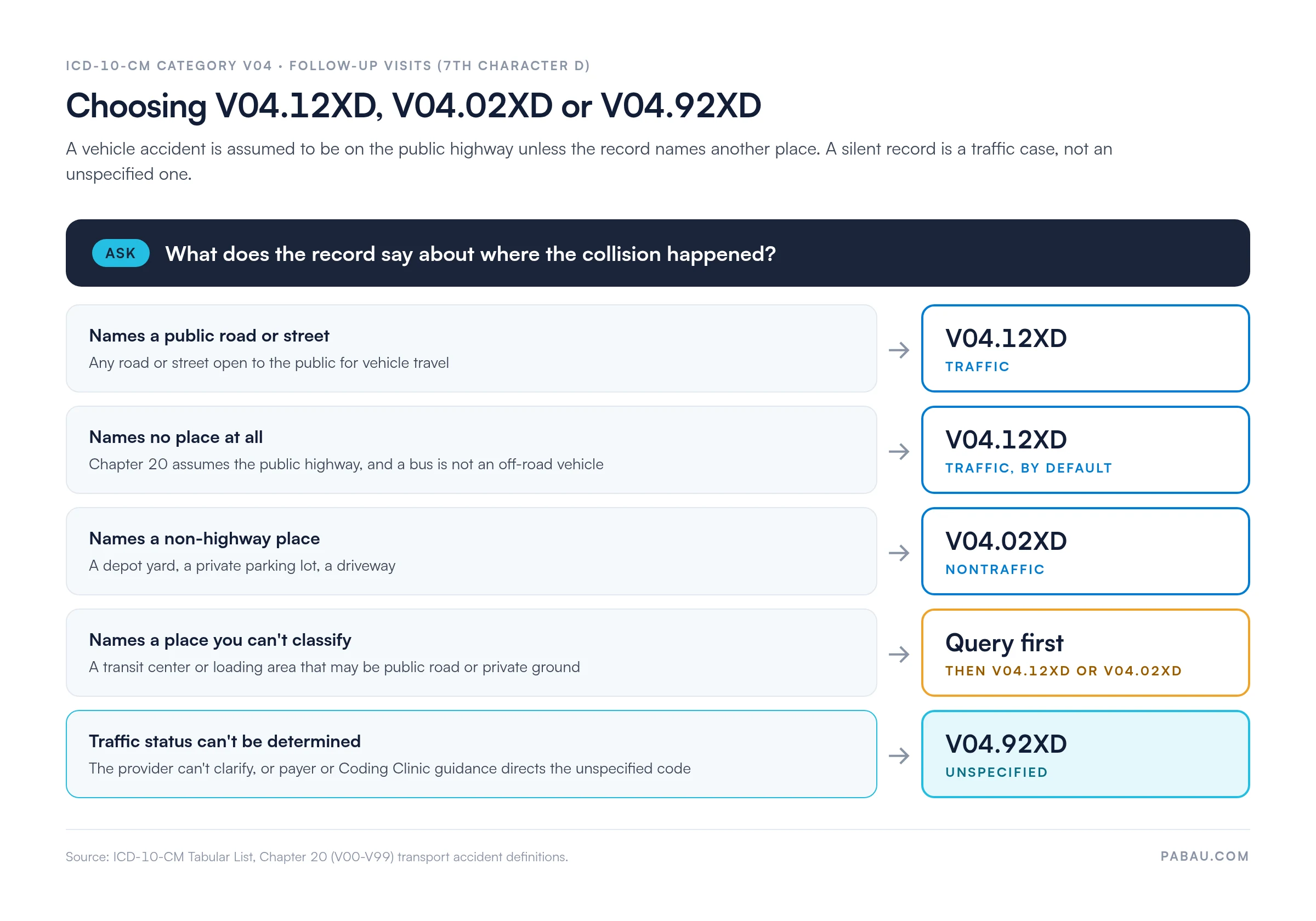
When the note names a place you can’t classify, query the provider. A one-line answer about the location usually unlocks the more specific code. On a workers’ compensation or liability claim, getting traffic status wrong can also cause coordination-of-benefits problems that outlast a single denial.
The 7th character D marks a subsequent encounter. That’s any visit after active treatment, while the injury is healing or recovering. V04.92X takes three 7th characters, and each maps to a different episode of care.
A simple rule works at the front desk. Use D while the provider is treating an injury that is still healing. Once it has resolved and left a residual condition, switch to S and code that condition first. Chronic wrist instability after the collision is one example.
The V04 category holds several codes that look almost identical in a lookup. The table shows the siblings most often confused with V04.92XD and the character that separates them.
Check the other party before you settle the conveyance. A skateboarder hit by a bicycle leaves category V04 entirely and codes to V01.92XD at follow-up. Confirm any sibling against the AAPC Codify ICD-10-CM lookup or the ICD List database.
V04.92XD is an external cause code, so it never leads the claim. Under ICD-10-CM Official Guidelines Section I.C.20, external cause codes can’t be the principal or first-listed diagnosis. They always follow the injury or condition code they explain.
Here’s how a follow-up fracture visit should read:
The injury code tells the payer what was treated, and the external cause code tells it how the injury happened. Payers use that pairing to coordinate benefits, especially when a bus operator’s or trucking company’s liability coverage may pay first. Meeting clean claim requirements means both codes are present and in the right order.
Leave the place of occurrence (Y92), activity (Y93) and external cause status (Y99) codes off this claim. Section I.C.20 reports each of them once, at the initial encounter. So Y93.51, the activity code for roller skating and skateboarding, belongs on the V04.92XA claim. The same goes for a status code such as Y99.8 for leisure skateboarding.
Sending V04.92XD without an injury code is a common audit finding. The external cause code alone doesn’t establish medical necessity for the service billed. The CMS ICD-10 coding guidance confirms that external cause codes supplement injury codes rather than replace them.
Run a sequencing audit on any claim pairing an external cause code with an E&M or procedure code. On a CMS-1500, field 21 position 1 holds the principal diagnosis. An external cause code in that slot will generate an edit at the clearinghouse or payer level. Build a scrubbing rule to catch this before transmission.
An auditor checks each element of V04.92XD against the note. If the conveyance, the vehicle, the traffic status, or the encounter type can’t be verified, the claim is open to a documentation-based denial.
Medicare doesn’t require external cause codes for payment. According to the ResDAC guidance on ICD codes in Medicare files, reporting them is encouraged for data completeness. It isn’t a condition of reimbursement under traditional Medicare fee-for-service.
Many commercial payers and state Medicaid programs take a different position. Check each payer contract and portal guidance before you treat V04.92XD as optional.
Collisions with a bus or commercial truck add another layer. The vehicle operator’s liability insurance, or no-fault auto coverage in some states, may be the primary payer.
A V04 code tells the health plan a vehicle accident occurred, which can trigger a lien or conditional payment review. Brush up on medical billing fundamentals around coordination of benefits before you bill the health plan.
Your remittance data shows which plans do this. Reviewing electronic remittance advice across your payer mix reveals which plans routinely hold accident-related claims. Your team can then gather the documentation before the request arrives.
Denials on V04.92XD claims follow predictable patterns. The table maps the six most common triggers to their fixes.
Sort V04 rejections by reason code and you’ll see whether a pattern is systemic or a one-off. A wrong 7th character across several coders points to a training issue. Denial management workflows help you track that, and the guide to billing denial codes maps CARC/RARC codes to the scenarios above.
Most of those denials can be caught at the desk. Before a V04.92XD follow-up claim leaves the practice, confirm each point below.
A follow-up visit after a transport injury usually carries at least two diagnosis codes, and each one has to land in the right slot. Pabau, the practice management platform we build, pre-fills the claim form from the patient record. The injury code and V04.92XD carry over from the recorded problem list instead of being retyped.
Coders can search Pabau’s ICD-10-CM and CPT lookup libraries, which hold more than 20,000 codes, to confirm the fourth and fifth characters. The claim can’t be sent until required fields, such as membership numbers and authorization codes, are complete.
In the US, claims go out electronically through Claim.MD, with real-time eligibility checks and remittance posting. Pabau’s claims management software keeps claim status in one place, so a rejected accident claim is spotted and corrected quickly.
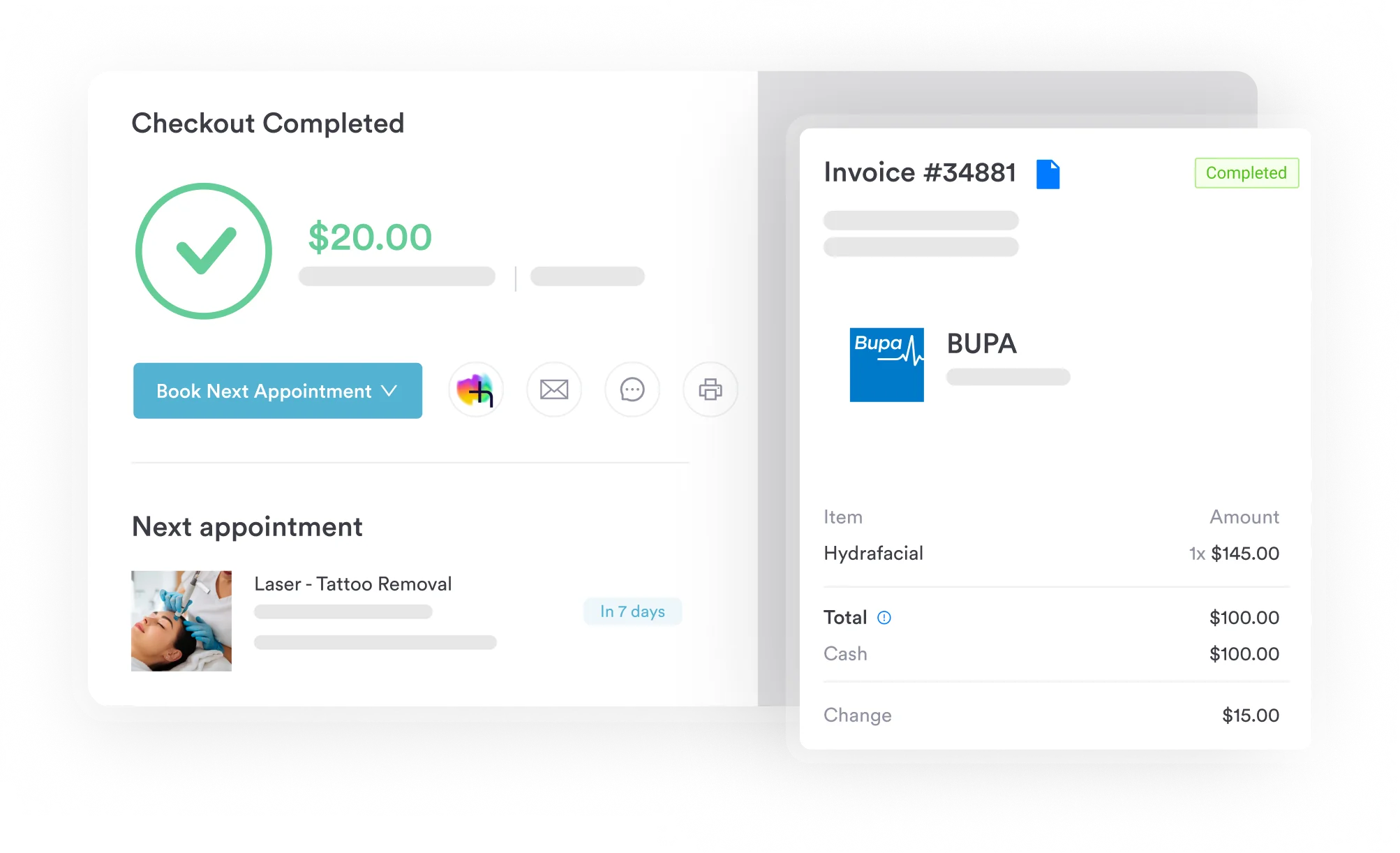

Pabau pre-fills claims from the patient record and checks required fields before you submit. US claims go through Claim.MD with eligibility checks and remittance posting built in.

V04.92XD is a residual code, and it should feel like one. Reach for it only when nobody can establish traffic status, or when payer or Coding Clinic guidance tells you to.
A silent record isn’t that case. ICD-10-CM assumes the public highway, so a collision with no place documented codes to V04.12XD. A named depot yard or private lot gives you V04.02XD. Settling that one question also tells you which insurer is likely to pay first.
If your team bills accident follow-ups regularly, the coding rules are only half the job. Book a demo to see how Pabau carries the injury and external cause codes from the record to a clean claim.

Need a structured approach to claim rejections? Denial management in healthcare covers how to build systematic workflows that catch V-code sequencing errors before they become remittance patterns.
Want to understand how clearinghouse validation works? How Claim.MD clearinghouse works explains real-time eligibility, 837P transmission, and ERA processing for ICD-10-coded claims.
Submitting accident-related claims to multiple payers? Medical billing compliance guidance outlines coordination-of-benefits rules and documentation requirements for motor vehicle accident claims.
Coding an e-scooter rider hit by a truck? ICD-10 code V04.131A covers the standing micro-mobility sibling in category V04 at the initial encounter.
Moving from follow-up to late effects? ICD-10 code V05.92XS shows how a skateboard collision is coded once the injury leaves a sequela.
Yes. V04.92XD is a billable, specific ICD-10-CM code, valid for HIPAA-covered transactions from FY 2026 onward. It’s never the principal diagnosis, so it only appears as a secondary code.
Use V04.92XD only when traffic status can’t be determined, or when payer or Coding Clinic guidance directs it. If the record names no place, ICD-10-CM assumes a public highway, so V04.12XD applies. A named non-highway place, such as a depot yard, means V04.02XD.
The Chapter 20 definitions describe a motor vehicle designed mainly to carry property and classed locally as a heavy goods vehicle. Its driver needs a special license. A bus is built to carry more than 10 passengers. Pickup trucks and vans belong in category V03.
Yes, for as long as the injury is being treated. Guideline I.C.20.a.2 assigns the external cause code, with the right 7th character, to each encounter for that injury. Place, activity and status codes are the exception, reported once at the initial encounter.
A fall from a skateboard with no other party codes to V00.131-, with the 7th character for the encounter. A follow-up visit uses V00.131D. A skateboarder colliding with a stationary object codes to V00.132- instead.