ICD-10 Code S02.602D: Fracture of mandible, subsequent encounter
ICD-10 Code S02.602D: Definition and billable status ICD-10 Code S02.602D is the...

Last Updated: Oct 8, 2026
Billable Code Specific Code
ICD-10 code V04.131A is the billable code for a pedestrian on a standing electric scooter, struck by a heavy transport vehicle or bus in traffic. The 7th character A marks the initial encounter, while active treatment is still being given.
V04.131A is an external cause code, so it never stands alone on a claim. Pair it with a primary injury code from the S00-T88 range that names the fracture, head injury or wound being treated.
The code took effect on October 1, 2020 in the FY2021 addenda. It remains current for FY2026, covering dates of service through September 30, 2026.
One distinction causes most of the errors on this code. V04.131A is the e-scooter code, while its neighbor V04.138A covers hoverboards, segways and other standing micro-mobility conveyances.
Let Pabau's smart automation suggest the right codes, reduce claim denials, and keep your practice compliant—effortlessly.
Automate repetitive tasks and focus on what matters most—your patients.
Reduce coding errors and ensure compliance with the latest regulations.
Clean claims, fewer denials, and faster reimbursements.
Powerful insights and reporting to help your practice thrive.
HIPAA compliant SOC 2 certified GDPR-compliant Trusted by 4,000+ clinics worldwide

V04.131A is the billable ICD-10-CM code for an e-scooter rider struck by a heavy transport vehicle or bus in traffic
The 7th character A means initial encounter, while V04.131D covers routine follow-up and V04.131S covers sequela
V04.131A needs a companion injury code from S00-T88, because external cause codes never stand alone on a claim
V04.138A belongs to hoverboards, segways and other standing micro-mobility conveyances, so an e-scooter case never goes there
Pabau’s claims management software flags missing companion codes before submission, which cuts external cause code denials
V04.131A sits inside the V00-V09 block, which covers pedestrians injured in transport accidents. Electric scooter riders land here rather than under V20-V29 (motorcycle riders) because ICD-10-CM treats a standing e-scooter as a pedestrian conveyance, not a motor vehicle. The quick-reference table below summarizes the code’s attributes.
For trauma patients, confirming billable status and companion-code requirements before submission prevents the most common denials on external cause codes.
Knowing where V04.131A sits in the hierarchy helps coders navigate to the right code when documentation is thin. It also identifies the parent codes that carry the Excludes notes and instructional notes.
The V04 category carries one Excludes1 note, for a pedestrian injured in collision with a military vehicle (V09.01, V09.21). A fall from a standing electric scooter with no collision belongs to V00.841 instead.
Coders working with trauma registry data should check the CDC/NCHS ICD-10-CM web tool against the current fiscal year before assigning V04.131A.
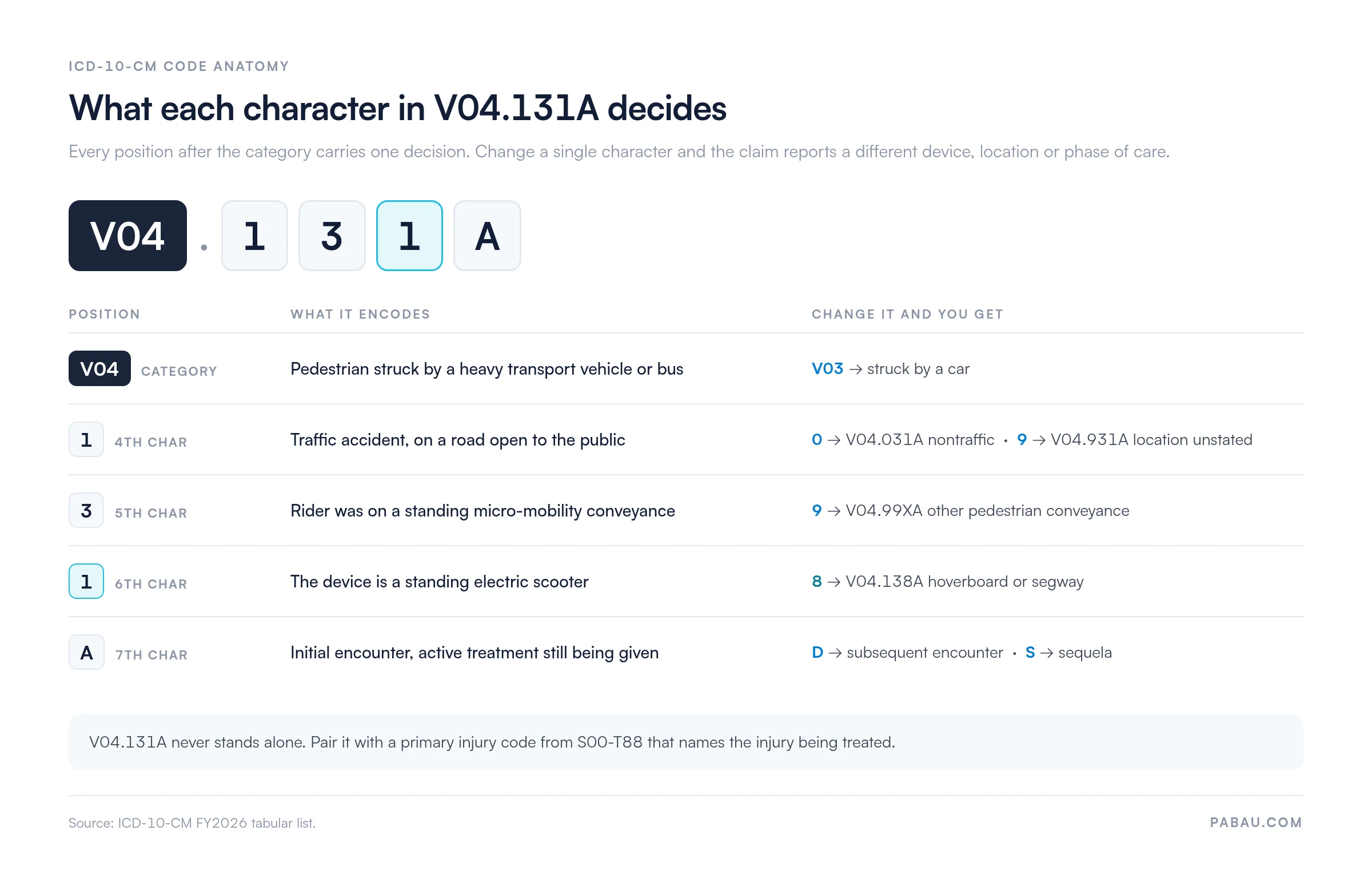
Each character position after V04 carries its own decision. The panel below reads the code one position at a time.
Clinicians rarely write the tabular descriptor into a chart. The phrases below are the ones that show up in an emergency note. Each maps to V04.131A when the collision happened in traffic with a bus or a truck.
Two phrases do not map here. A seated mobility scooter is a different device and belongs to V00.83 or its collision equivalents. A kick scooter without a motor is not a standing micro-mobility conveyance under ICD-10-CM, so it is coded as an other-conveyance pedestrian.
The 7th character in V04.131A tells payers which phase of treatment the claim covers. Getting it wrong is the second most common denial reason on this code group, after the missing companion injury code.
A common mistake is to keep reporting V04.131A through weeks of outpatient rehabilitation, because the patient was first seen in the ER.
Once active treatment has ended, the encounter type shifts to the letter D, and routine healing-phase follow-up belongs there. The CMS ICD-10-CM coding guidelines tie the suffix to the care given at that visit, not to the date of injury.
The traffic versus nontraffic distinction decides whether a coder uses V04.1xx or V04.0xx. It depends entirely on where the collision happened, not on the vehicles involved.
Under the ICD-10-CM official guidelines, a traffic accident takes place on a public highway or a road open to traffic. A nontraffic accident happens somewhere that is not built for public through-traffic. Examples include a private parking lot, a hospital campus, a loading bay, or a driveway.
When the documentation does not state where the accident happened, query the treating clinician rather than defaulting to the unspecified code.
Most payers accept a clinical addendum naming the location without a full note revision. Poor specificity here also feeds denial management work, since payers increasingly audit the V04.9xx codes.
The 6th character carries the device, and it is where most V04.13 errors start. A 1 in that position means a standing electric scooter. An 8 means any other standing micro-mobility conveyance.
The FY2026 tabular list gives two inclusion terms under V04.138: a pedestrian on a hoverboard and a pedestrian on a segway. Electric scooters are not among them, because they already have their own 6th character. Assigning V04.138A to an e-scooter case therefore reports the wrong device, even though both codes read almost identically at a glance.
The same 1-versus-8 pattern repeats across the whole micro-mobility family. V03.131A covers an e-scooter rider struck by a car, and V03.138A covers a hoverboard or segway rider in the same collision. Learn the pattern once and it holds for V02 through V06.
Choosing the most specific code inside the V04 block means reading three character positions: pedestrian type, traffic status, and encounter type. The table below covers the codes most often considered alongside V04.131A.
The AAPC ICD-10-CM code search lists the full sibling set for the V04.13 group. Always compare the 6th character against the current CMS tabular list rather than trusting a lookup tool alone, since lookup databases lag the annual updates.
Every V04 code describes the pedestrian, not the vehicle that struck them. A heavy transport vehicle’s driver or passenger takes V69.9XXA at the initial encounter, when traffic is confirmed but the accident type is not.
Our diagnostic code library covers the other ICD-10 codes trauma billers reach for alongside V04.131A.
Submitting V04.131A without adequate documentation is the fastest route to a medical records request or an outright denial. The clinical record has to answer five questions before the code is defensible.
Practices that capture this detail at the point of care spend less time writing addenda later. A defensible claim for an external cause code takes all five elements above, not the code alone.
Flag any emergency department note that says scooter accident without naming the device. Standing electric scooter, seated mobility scooter, kick scooter and hoverboard each route to a different code. A one-line addendum from the treating physician resolves the ambiguity and keeps V04.131A defensible at audit.
The scenarios below show how one collision produces different codes, depending on the visit type and on what the documentation contains. Each maps to V04.131A or one of its siblings.
Physical therapy practices that see patients in the sequela phase often report V04.131S correctly, then leave the companion code untouched. The external cause S code is right. The primary diagnosis should now describe the current condition, not the original fracture with an S appended.
Trauma registry work follows different rules from claim submission. Registrars capture the full injury narrative, while billers select the codes that support the services rendered at each encounter.
V04.131A is an external cause code, so it supplements the primary injury code and does not drive reimbursement on its own. Payers read it to understand the mechanism of injury for medical necessity and for population health reporting. Payment is calculated on the primary diagnosis and the procedures coded.
For US practices, complete external cause coding reduces the odds of a medical record request. Payers can verify the mechanism of injury without asking for chart notes.
Practices that submit claims through Claim.MD, Pabau’s integrated clearinghouse, get real-time eligibility checks before submission and automated ERA processing after. Claim.MD reaches thousands of US payers and handles 837P files and CMS-1500 forms, which covers the full submission path for these claims.
Sound revenue cycle management for injury claims means expecting V04.131A on both the facility and the professional side of an ER encounter. Coordination between the hospital coder and the physician practice coder prevents duplicate-code conflicts that trigger edits.
The clearinghouse layer catches formatting errors before the claim reaches the payer, but it cannot fix a wrong 7th character. That correction has to come from the clinical documentation upstream.
NCHS added the standing micro-mobility family, including V04.131, in the FY2021 addenda. Those codes took effect on October 1, 2020, following a documented rise in e-scooter emergency department visits across US cities.
Before that date, coders fell back on the other specified pedestrian conveyance codes, which made national e-scooter surveillance almost impossible.
Placing e-scooters in the pedestrian block came down to how the vehicles operate. They need no license, run at low speeds, and share space with people walking and cycling. ICD-10-CM therefore treats the rider as a pedestrian using a conveyance.
An e-bike or a moped with higher power output may instead belong in the motorcycle categories. That call needs verification against the CMS tabular list for the exact vehicle described.
The traumatic brain injury codes most often paired with V04.131A do not change based on the external cause code chosen. They do affect DRG assignment, which makes external cause accuracy indirectly relevant to facility payment.
Most e-scooter coding errors start in the clinical note. The device goes in as scooter. The location never makes it into the record. The companion injury code gets added days later, by someone who was not in the room.
Practice management software like Pabau closes that loop at the point of care. Structured injury templates ask for the device, the collision partner, and the location while the patient is still in front of the clinician. Visit type drives the encounter suffix, so a healing-phase follow-up does not inherit the A from the first visit.
Pabau then checks the claim before it leaves the practice. Missing companion codes and suffix mismatches surface while the note is still open, so the practice sends fewer rejected claims. Coders spend their time on genuine queries instead of chasing addenda weeks later.
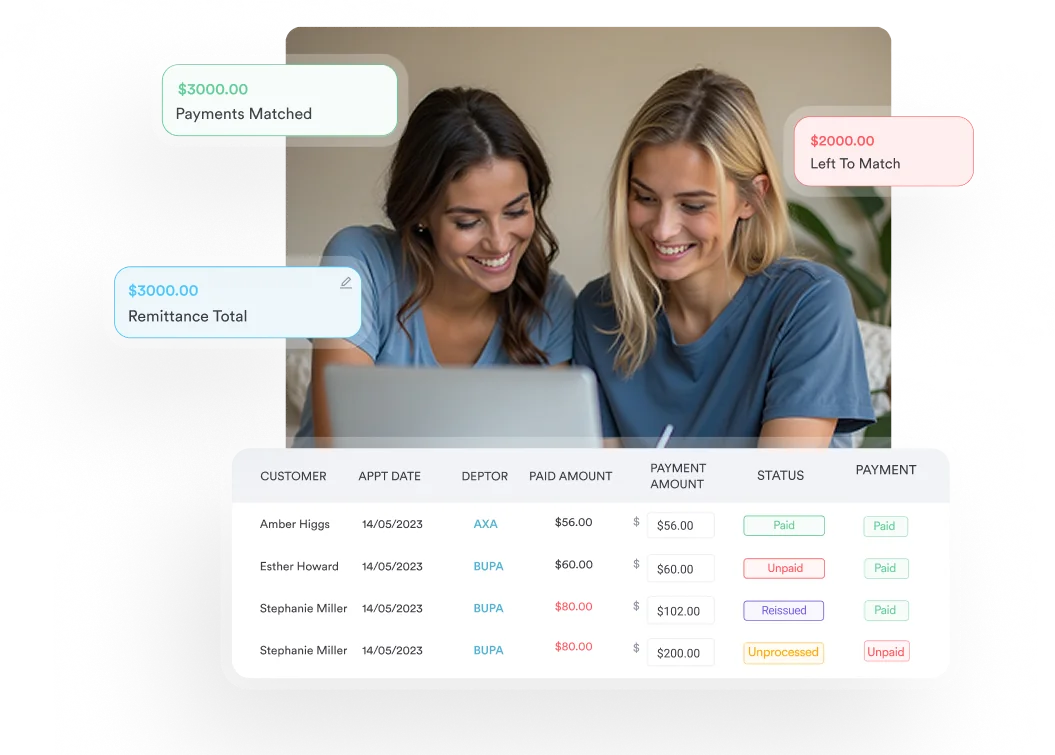

Pabau’s claims management tools help injury-focused practices code V04.131A and its companion codes accurately. Submit clean claims through Claim.MD and track denial patterns across external cause categories.

V04.131A is billable and specific, and it holds three conditions at once. The device has to be a standing electric scooter. The collision has to involve a heavy transport vehicle or bus on a public road. The visit has to be an initial treatment encounter. Miss one of the three and the code either drops to an unspecified variant or draws a denial.
The one trap worth remembering is the 6th character. V04.138A looks like the same code on a screen. It belongs to hoverboards and segways, so an e-scooter case coded there reports the wrong device.
Pabau’s claims management software catches missing companion codes and encounter-suffix mismatches before claims leave the practice. That ends the retrospective addendum cycle on external cause categories. To see how it handles injury documentation and clean claim submission end to end, book a demo with our team.

Need to understand how clean claims reduce external cause code denials? Clean claim requirements for injury billing walks through the documentation checklist that keeps V-codes defensible at audit.
Coding a follow-up visit after the initial e-scooter encounter? Revenue cycle management for injury claims explains how external cause codes interact with the full billing workflow across multiple encounter types.
Want to understand how clearinghouses process ICD-10 coded claims? How the Claim.MD clearinghouse works covers payer connectivity, ERA processing, and real-time eligibility checks for US practices.
V04.131A documents a pedestrian on a standing electric scooter, injured in a traffic collision with a heavy transport vehicle or bus. It applies at the initial treatment encounter. As an external cause code it accompanies a primary injury diagnosis from S00-T88, and cannot be billed on its own.
Yes. V04.131A is a billable, specific ICD-10-CM code. It took effect on October 1, 2020 in the FY2021 addenda and remains valid for FY2026, through September 30, 2026. Submit it alongside a primary injury diagnosis code from the S00-T88 range.
The 6th character names the device. V04.131A is the code for a standing electric scooter. V04.138A covers other standing micro-mobility conveyances, and the FY2026 tabular list gives hoverboard and segway as its inclusion terms. An e-scooter collision should never be coded to V04.138A.
The 7th character A means initial encounter, covering any visit where the patient is receiving active treatment for the collision injury. Once treatment ends and routine follow-up begins, the correct 7th character becomes D instead. The A does not mean the patient’s first-ever visit to the practice. It means active care is still being given.
Use V04.131D for any visit after the initial active treatment phase has ended. That includes wound checks, cast changes, outpatient physical therapy during healing, and routine fracture monitoring. The ICD-10-CM official guidelines define a subsequent encounter as routine care while the patient heals, not simply a return appointment.
Yes. V04.131A is an external cause code, so it must always be reported with a primary injury diagnosis from S00-T88. That companion code names the injury itself, such as a fracture, traumatic brain injury, or contusion. Submitting V04.131A alone will usually draw a denial or a request for records.
V04.031A, the nontraffic sibling of V04.131A. A private parking lot is not open to public through-traffic, so the V04.0 subcategory applies. If the record never states where the collision happened, query the clinician before falling back on V04.931A.