ICD-10 Code R34: Anuria and oliguria
ICD-10 Code R34 is the billable ICD-10-CM diagnosis code for anuria and oliguria...

Last Updated: Oct 6, 2026
Billable Code Specific Code
V01.92XD is the billable ICD-10-CM code for a pedestrian on a skateboard injured in a collision with a pedal cycle, at a subsequent encounter. The record doesn't say whether it was a traffic or nontraffic accident.
Use it at follow-up visits after active treatment ends. As an external cause code, it always follows the injury code on the claim. A crash on a public road takes V01.12XD, and one on a park path or driveway takes V01.02XD. A patient on foot takes V01.90XD.
Let Pabau's smart automation suggest the right codes, reduce claim denials, and keep your practice compliant—effortlessly.
Automate repetitive tasks and focus on what matters most—your patients.
Reduce coding errors and ensure compliance with the latest regulations.
Clean claims, fewer denials, and faster reimbursements.
Powerful insights and reporting to help your practice thrive.
HIPAA compliant SOC 2 certified GDPR-compliant Trusted by 4,000+ clinics worldwide

V01.92XD codes a skateboarder hit by a pedal cycle at a follow-up visit, when the record doesn’t say traffic or nontraffic.
It is an external cause code, so the injury code always goes first on the claim.
A named location changes the code: V01.02XD for a nontraffic accident, V01.12XD for a traffic accident.
The X in position 6 is a placeholder, and the code is invalid without it.
D fits routine care while the injury heals, and active treatment still takes A, even at a later visit.
ICD-10 code V01.92XD describes a pedestrian on a skateboard who was injured in a collision with a pedal cycle. The record doesn’t say whether it was a traffic or nontraffic accident. The final D marks a subsequent encounter, so you use it at follow-up visits while the injury heals.
In ICD-10-CM, a person on a skateboard counts as a pedestrian. That is why this code lives in category V01, with walkers and roller skaters, and not in the cyclist codes.
The code explains how the injury happened. It never explains what the injury is. You still need an injury code from Chapter 19, such as a contusion or a fracture, and that code goes first.
Read the code one character at a time and the logic gets easy. Change one character and you describe a different accident.
V01.92 has only five characters, but the category needs a 7th character. The placeholder X fills the empty sixth position. If you send V01.92D, the code is invalid, because the D lands in the wrong position.
Encoders usually add the X for you. Problems tend to start with hand-typed codes and copied templates, so check the full seven characters.
Category V01 splits three ways on location. V01.0 covers nontraffic accidents, and V01.1 covers traffic accidents. V01.9 is for records that don’t say which.
Within each split, the fifth character names how the pedestrian was moving. Here are the subsequent-encounter codes side by side.
So V01.91XD is not the traffic version of this code. It means a person on roller-skates, with traffic status unknown. That mix-up is easy to make when you scan the list fast.
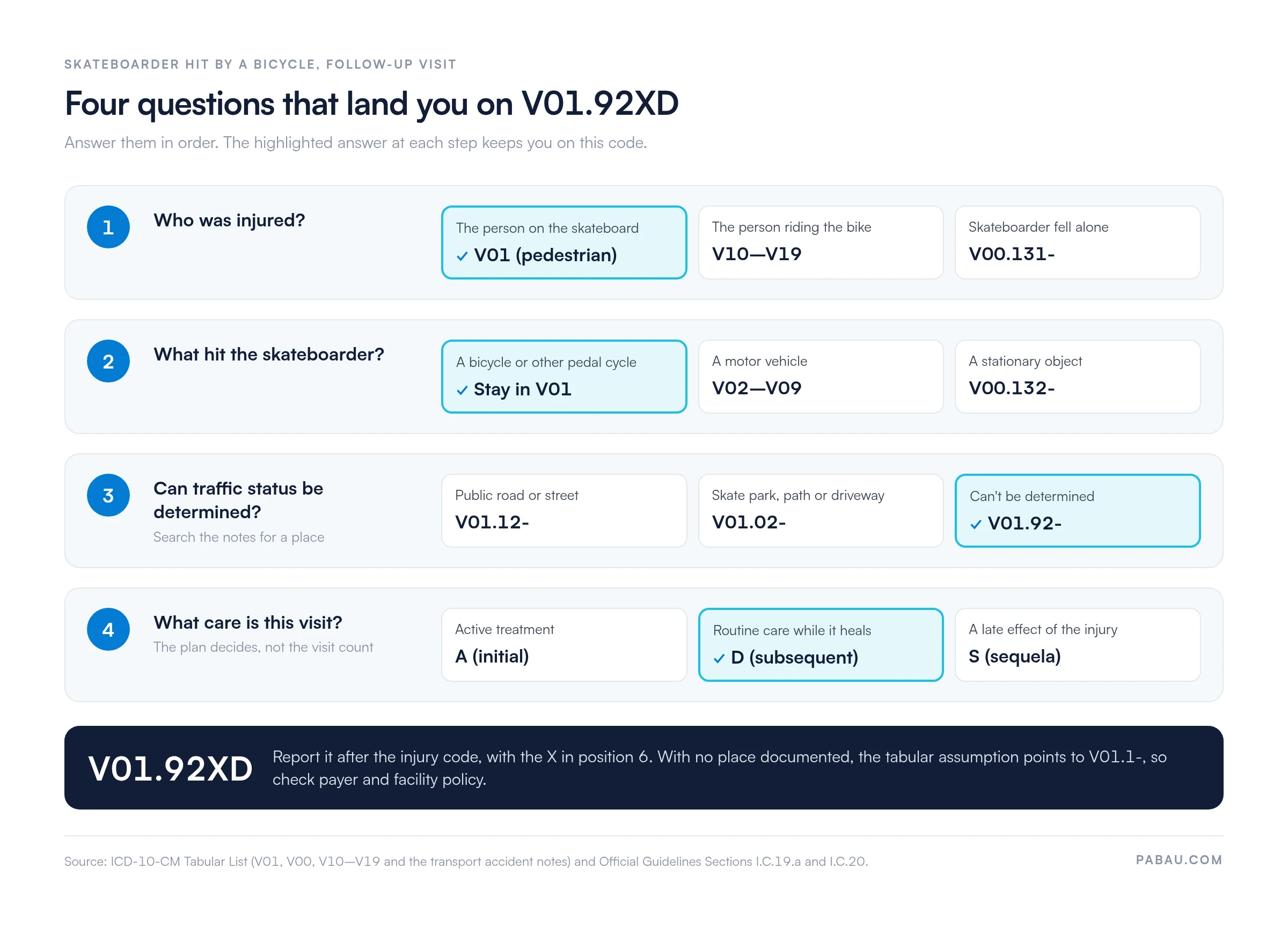
The ICD-10-CM transport notes define a traffic accident as one on a public highway. They also say a vehicle accident is assumed to be on the public highway unless another place is specified.
So look hard for a location first. A note like “hit by a cyclist on Main Street” points to V01.12XD. “Clipped by a bike at the skate park” points to V01.02XD.
Strictly, the tabular assumption points to a traffic code (V01.1-) when no place is given. V01.9- is for records where traffic status can’t be determined. Check your payer and facility policy.
The 7th character follows the type of care at this visit. It doesn’t count visits. The rules sit in the ICD-10-CM Official Guidelines, Section I.C.19.a.
A patient can have many D visits. A skateboarder seen for a cast check in week two and again in week six gets D both times.
The external cause code carries the same idea. Under Section I.C.20, you report it at each encounter where the injury is treated, with the matching 7th character.
Read the plan, not the visit count. If the provider is still making treatment decisions, such as resetting a fracture, use A for that visit. If the plan says the injury is healing as expected, use D for that visit.
Here is how the code plays out across two visits. The patient is a 15-year-old who was hit by a bike while skateboarding. The notes leave the traffic status undetermined.
The provider diagnoses a contusion of the right knee and treats it. The coder reports S80.01XA first, then V01.92XA. Any place of occurrence and activity codes also go on this first visit.
The knee is healing, and the provider checks progress. The coder reports S80.01XD first, then V01.92XD.
The place and activity codes don’t come back. Under Sections I.C.20.b and I.C.20.c, each one is reported once, at the initial encounter for treatment.
This code fits a narrow scene. Four questions about the record decide whether a visit lands on it.
Switch codes if the record shows any of the following.
A minute with the chart saves a resubmission later. Work through these points in order.
This kind of review is the core of medical billing compliance for injury coding.
These errors show up again and again on V01 claims. Each one is easy to catch once you know to look.
If one of these slips through, the remittance names the problem with a standard denial code. A clear denial management routine then helps you fix and resend the claim fast.
It helps to see where each check happens. A typical follow-up claim moves like this.
Most coding errors start at steps one and two. A clean claim depends on a clear note and a careful coder more than on any software.
Follow-up visits for injuries create a lot of small billing tasks. Each one needs the right codes, an invoice and often the next appointment.
Pabau, the billing and scheduling software we make for practices, keeps those steps in one place. Your team records the visit and adds the diagnosis codes to the claim. Then claims management sends it out.
In the US, claims go out electronically through our Claim.MD integration. So your billers spend less time re-keying claims and more time on the checks above.

See how Pabau records the visit, adds the diagnosis codes and sends the claim electronically through Claim.MD.

V01.92XD is a fallback for one narrow case. Use it when a skateboarder hit by a bike comes back for routine healing care, and the record can’t settle traffic status.
Most of the time, a closer read of the notes gives you a location. That moves you to V01.02XD or V01.12XD and makes the claim more precise. The trade-off is a few extra minutes per chart, and on injury follow-ups that time pays off.
Book a demo to see how Pabau helps your team code, bill and send injury follow-up claims in one workflow.

Need a process for denied injury claims? Denial management in healthcare walks through tracking, appealing and resolving denials.
Curious how a clearinghouse handles your claims? Pabau’s Claim.MD clearinghouse guide explains how claims travel from your system to the payer.
Want fewer front-end rejections? Clean claim submission covers the details that get a claim paid the first time.
Looking at the bigger billing picture? What is revenue cycle management shows how coding fits into getting paid.
Yes. V01.92XD is a valid, billable code in the current ICD-10-CM code set. You can confirm its status each year in the CDC ICD-10-CM browser tool.
The classification groups skateboards with other pedestrian conveyances, such as roller-skates and wheelchairs. So a skateboarder hit by a bike falls under V01, the pedestrian category. The cyclist in the same crash gets a code from V10-V19.
Not always. The Chapter 20 guidelines set no national requirement for external cause codes. You report them when a state mandate or a payer requires them. Many practices report them anyway, because they explain how the injury happened.
Those count as standing micro-mobility pedestrian conveyances. For a collision with a pedal cycle at a follow-up visit, with traffic status unknown, use V01.93XD.