ICD-10 Code T31.77: Burns involving 70-79% of body surface
ICD-10 code T31.77: Quick reference and code details ICD-10 code T31.77 is the b...

Last Updated: Nov 5, 2026
Billable Code Specific Code
V04.92XS is the billable ICD-10-CM code for a skateboarder injured by a heavy transport vehicle or bus, reported at a sequela encounter. Its full descriptor is pedestrian on skateboard injured in collision with heavy transport vehicle or bus, unspecified whether traffic or nontraffic accident, sequela.
Coders report it when a skateboarder struck by a truck or bus returns for a late effect of that injury. It fits records that name the vehicle and the skateboard but not whether the collision happened on a public road. List the sequela condition first and the injury code with 7th character S next, then V04.92XS. Routine follow-up while the injury still heals takes V04.92XD instead.
Let Pabau's smart automation suggest the right codes, reduce claim denials, and keep your practice compliant—effortlessly.
Automate repetitive tasks and focus on what matters most—your patients.
Reduce coding errors and ensure compliance with the latest regulations.
Clean claims, fewer denials, and faster reimbursements.
Powerful insights and reporting to help your practice thrive.
HIPAA compliant SOC 2 certified GDPR-compliant Trusted by 4,000+ clinics worldwide

V04.92XS reports a pedestrian on a skateboard hit by a heavy transport vehicle or bus, coded at a sequela encounter.
The 4th character 9 means the record does not say whether it was a traffic accident, and the 5th character 2 means skateboard.
When the chart places the collision, V04.12XS (traffic) or V04.02XS (nontraffic) replaces V04.92XS.
List the sequela condition first, then the injury code with 7th character S, then V04.92XS as an additional code.
Place, activity and status codes (Y92, Y93, Y99) belong to the initial encounter only, so they stay off a sequela claim.
ICD-10 Code V04.92XS reports the sequela of an injury to a pedestrian on a skateboard who collided with a heavy transport vehicle or bus. It applies when the record does not say whether the collision was a traffic or a nontraffic accident.
The code sits in Chapter 20 of ICD-10-CM, External causes of morbidity (V00-Y99), inside the pedestrian block V00-V09. ICD-10-CM counts a skateboarder as a pedestrian, so a skateboard collision never moves into the pedal cycle or motorcycle blocks.
Each character in V04.92XS narrows the event. The 4th and 5th characters cause most of the errors on this code, because they are easy to read the wrong way round.
Leave out the X and the code becomes V04.92S, which is not a valid code. Clearinghouse edits reject it before the payer sees the claim.
The S tells the payer the visit treats a late effect of the collision, not the injury itself. Category V04 offers three 7th characters, and each one matches a different kind of encounter.
The choice between D and S turns on what the visit treats. Routine follow-up of the healing injury takes the D character. A separate condition the injury caused takes the S character. The guidelines set no healing milestone that has to be documented first. Healing-phase visits for the same collision take V04.92XD instead.
V04.92XS covers a skateboarder struck by a heavy transport vehicle or a bus, with the traffic status of the collision left undocumented. ICD-10-CM defines a heavy transport vehicle as one built mainly to carry property that needs a special license, such as a tractor-trailer. A bus carries more than 10 passengers and also needs a special license.
Category V04 carries one Excludes1 note. A pedestrian injured in collision with a military vehicle is coded to V09.01 or V09.21, never to V04. The V00-V09 block adds three Excludes1 notes of its own. They cover falls caused by another person (W03), slips on ice and snow (W00.-), and being struck by another person (W51).
The traffic question deserves a check before V04.92XS goes on the claim. Definition (c) opens the transport accident section of the tabular list. It assumes a vehicle accident occurred on the public highway unless another place is specified. If the original record names a street, road or crosswalk, V04.12XS is the more specific code.
Keep V04.92XS for records that leave the setting open, such as a transferred summary that names only the vehicle and the skateboard.
Most coding errors on this code come from a wrong 4th or 5th character, or from the wrong vehicle category. The table lines up the codes that sit closest to V04.92XS.
Code to the highest specificity the documentation supports. If the original accident report is in the chart and places the collision on a road, query the provider and move to V04.12XS.
Three questions settle the choice, and they run in a fixed order. The vehicle sets the category, the conveyance sets the 5th character, and the setting sets the 4th.
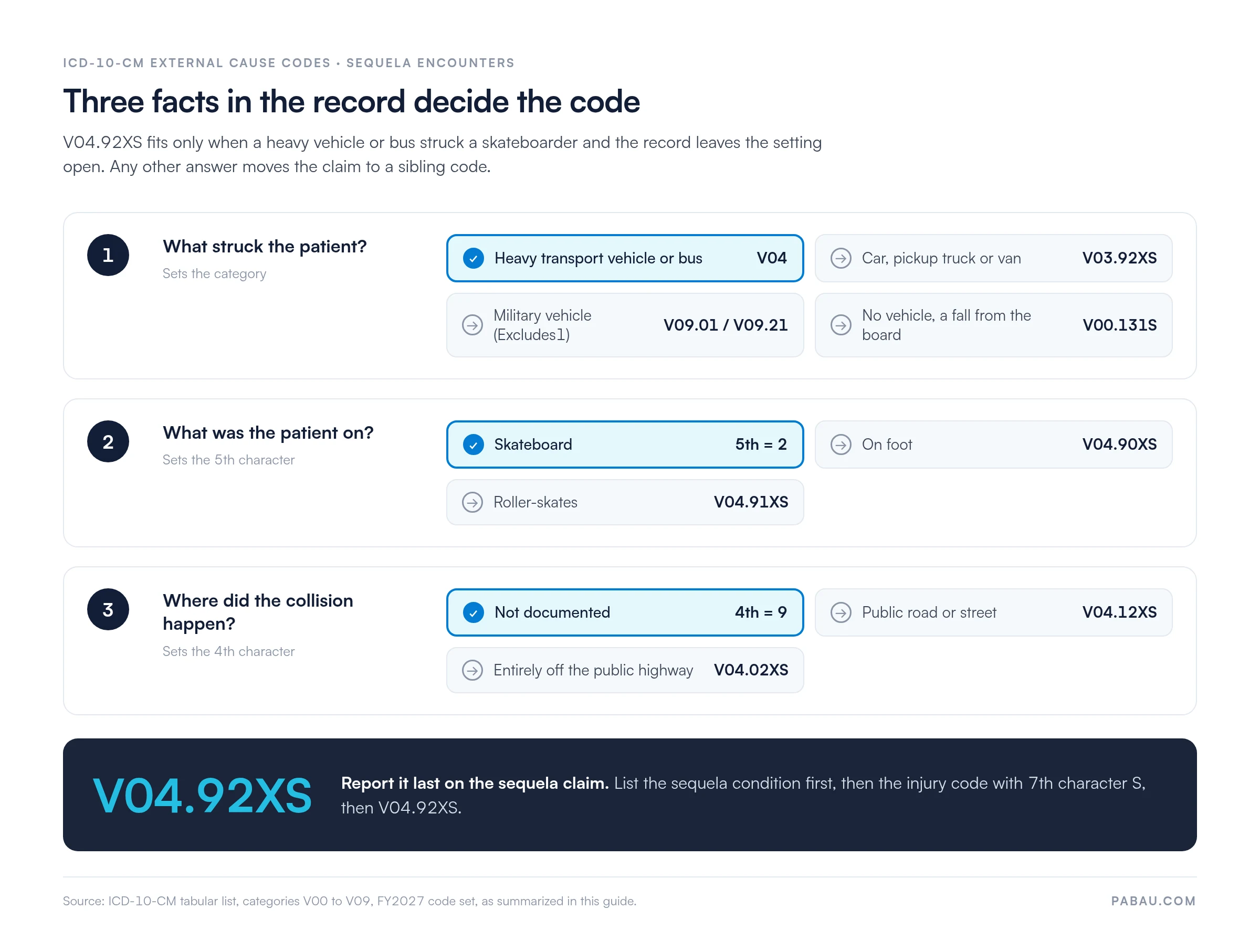
V04.92XS is never the first-listed diagnosis. ICD-10-CM Official Guidelines section I.C.19.a sets the order for a sequela claim, and it needs three codes.
The S goes on the injury code and the external cause code, not on the sequela condition. A claim with only the sequela condition and V04.92XS leaves out the link that explains the late effect.
Under guidelines section I.C.20, place of occurrence (Y92), activity (Y93) and external cause status (Y99) are reported once, at the initial encounter. They do not repeat on V04.92XS claims. Those details belong on the record of the original treatment.
Chapter 20 codes also have no national reporting mandate. They become required where a state reporting mandate or a payer contract asks for them. Check both before you drop external cause codes from a claim. Accurate external cause coding still supports clean claim submission and liability billing.
The record has to tie today’s condition to the original collision. Three elements carry that link, and the checklist below lists each one.
Payers process V04.92XS as supporting information. It explains how the sequela condition began and does not justify the service by itself. Liability, auto and workers’ compensation carriers read it most closely, because it documents the event behind the claim.
Rehabilitation for a sequela condition, such as physical therapy or pain management, often needs prior authorization. Put the sequela condition first on the request, not V04.92XS. Reviewers want the functional limitation and the treatment plan.
A collision during paid work, such as a courier on a skateboard, is usually billed to a workers’ compensation carrier. The work status code (Y99.0) went on the initial encounter, so sequela claims rely on the carrier’s claim number and the earlier records. Expect the adjuster to ask for notes that connect the current condition to the original collision.
Denials on V04.92XS come from a small set of repeat errors. Practices that see heavy-vehicle collision sequela cases can prevent most of them at the coding step. Denial management workflows that track errors by code show whether they are systemic. Our denial codes guide maps the CARC codes payers return.
Add two questions to the sequela visit template: where did the original collision happen, and what struck the patient. The first settles V04.92XS against V04.12XS or V04.02XS. The second settles V04 against V03.
These two cases show V04.92XS inside a complete sequela code set. Both follow the order in guidelines section I.C.19.a and leave the Y codes off. Our guide to the medical billing workflow shows where these codes enter the claim cycle.
Clinical scenario: A 34-year-old patient starts physical therapy for right knee pain. Three years ago a delivery truck struck them while they were skateboarding, causing a displaced bicondylar tibial plateau fracture. The fracture healed, and imaging now confirms post-traumatic osteoarthritis. The old records do not say whether the collision was on a public road.
Clinical scenario: A 19-year-old patient sees neurology for daily headaches. Two years ago a bus struck them while they were skateboarding, causing a concussion without loss of consciousness. The neurologist documents post-traumatic headache caused by that concussion. The referral gives no location for the collision.
If either record later shows the collision happened on a street, V04.12XS replaces V04.92XS. The rest of the code set stays the same.
Sequela claims fail when the original collision details sit in another provider’s file. Pabau, the practice management and billing platform we build, keeps intake answers, notes and diagnosis codes on one patient record.
Add the vehicle, conveyance and setting questions to your digital intake forms, and the answers sit beside the treatment notes. Pabau’s claims management software pulls the codes already on the record into a pre-filled claim. It then submits and tracks the claim through the Claim.MD clearinghouse.
Your billers see each claim’s status in one view. A rejected sequela claim surfaces the same week, while the records needed to correct it are still at hand.
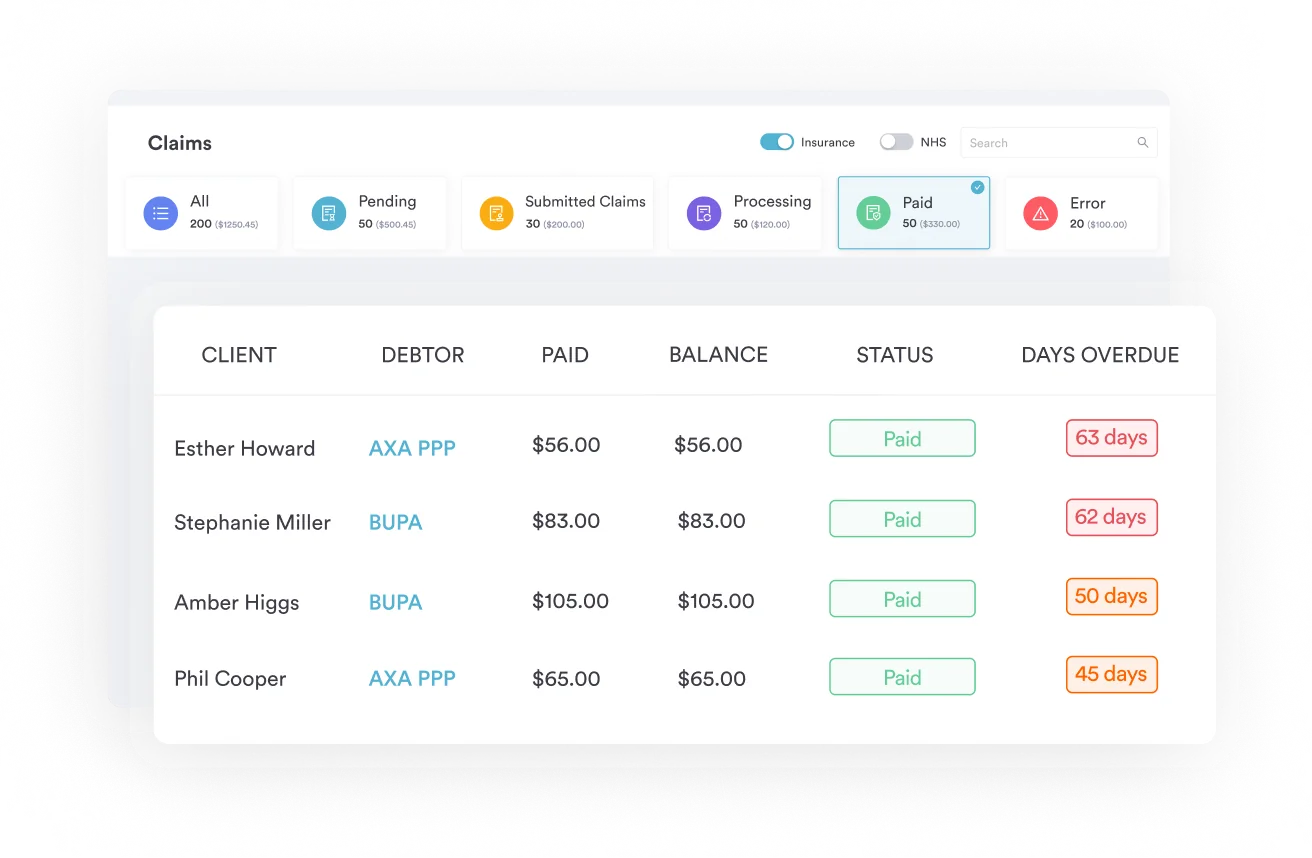

Pabau keeps intake answers, treatment notes and diagnosis codes on one patient record. Claims go out pre-filled from that record, and your team tracks each one to payment.

V04.92XS is the right code only when the record names a skateboard and a truck or bus but leaves the setting open. Each of those three facts has a sibling code waiting if the documentation says more.
Build the questions into the sequela visit, and the code choice becomes a lookup. Leave them out, and every late-effect claim depends on records from another practice.
Book a demo to see how Pabau keeps collision details, sequela codes and claim status on one record.

Coding the healing phase instead? ICD-10 Code V04.92XD covers subsequent encounters for the same skateboard collision.
Want to understand how clearinghouse validation prevents ICD-10 denials? Claim.MD clearinghouse overview explains how claim validation reduces rework on injury codes.
Need a reference on how external cause codes fit the billing cycle? What is revenue cycle management covers the process from code assignment to payment posting.
Looking for guidance on claims that survive payer edits? Medical billing compliance walks through the documentation standards that keep injury claims clean.
ICD-10 Code V04.92XS reports the sequela of an injury to a pedestrian on a skateboard who collided with a heavy transport vehicle or bus. It applies when the record does not say whether the collision was a traffic or nontraffic accident.
Yes. V04.92XS is a billable 7-character ICD-10-CM code valid for claim submission. It is always reported as an additional code, never as the first-listed or principal diagnosis.
V04.92XA is for active treatment of the injury. V04.92XD is for routine care while the injury heals. V04.92XS is for a condition that arose as a direct result of the injury, such as post-traumatic arthritis.
No. External cause codes can never be the principal or first-listed diagnosis. List the sequela condition first, then the injury code with 7th character S, then V04.92XS.
No. Under ICD-10-CM guidelines section I.C.20, place, activity and external cause status codes are reported once, at the initial encounter. They do not repeat on sequela claims.
Use V04.12XS when the record places the collision on a public road or street. Use V04.02XS when it happened entirely off the public highway. V04.92XS is only for records that leave the setting open.