ICD-10 Code V91.84XS: Other burn due to burning watercraft
ICD-10 Code V91.84XS: overview and key facts ICD-10 Code V91.84XS identifies the...

Last Updated: Oct 30, 2026
Billable Code Specific Code
V00.841A is the billable ICD-10-CM code for fall from standing electric scooter, initial encounter. It records how the injury happened when a rider falls from a standing e-scooter, and the A applies while the patient receives active treatment.
As an external cause code, V00.841A is never the principal diagnosis. It follows the injury code on the claim, and later visits take V00.841D or V00.841S instead. Precise use of V00.841A matters both for reimbursement and for population-level injury tracking.
Let Pabau's smart automation suggest the right codes, reduce claim denials, and keep your practice compliant—effortlessly.
Automate repetitive tasks and focus on what matters most—your patients.
Reduce coding errors and ensure compliance with the latest regulations.
Clean claims, fewer denials, and faster reimbursements.
Powerful insights and reporting to help your practice thrive.
HIPAA compliant SOC 2 certified GDPR-compliant Trusted by 4,000+ clinics worldwide

V00.841A is an external cause code: It must be sequenced after the primary injury code, never as the principal diagnosis.
Seventh character A applies only to the initial encounter, while follow-up visits take D and late-effect visits take S.
The code is specific to standing electric scooters, and falls from motorized mobility scooters route to V00.831A instead.
Pabau’s claim validation flags missing or invalid details before submission, and structured encounter notes help capture device type and rider posture.
ICD-10 Code V00.841A is a billable ICD-10-CM external cause code for a fall from a standing electric scooter, initial encounter. It applies while the patient receives active treatment for that injury. It belongs to the V00-V09 block (“Pedestrian injured in transport accident”) in Chapter 20 of ICD-10-CM, which covers external causes of morbidity. The CDC/NCHS ICD-10-CM web tool confirms the code as valid for HIPAA-covered claim submission.
The table below gives coders the reference details to check before placing this code on a claim.
V00.841A applies when a patient falls from or off a standing electric scooter and presents for their first healthcare encounter for that injury. The key inclusion criteria are that the device is electrically powered and the rider is in a standing position while operating it.
Covered clinical scenarios include:
The word “standing” in the descriptor decides the code. ICD-10-CM codes micromobility injuries by device type, which is why standing electric scooters (V00.84-) and motorized mobility scooters (V00.83-) have separate codes. If the chart note is silent on the device or the rider’s position, the coder must query the provider before assigning V00.841A.
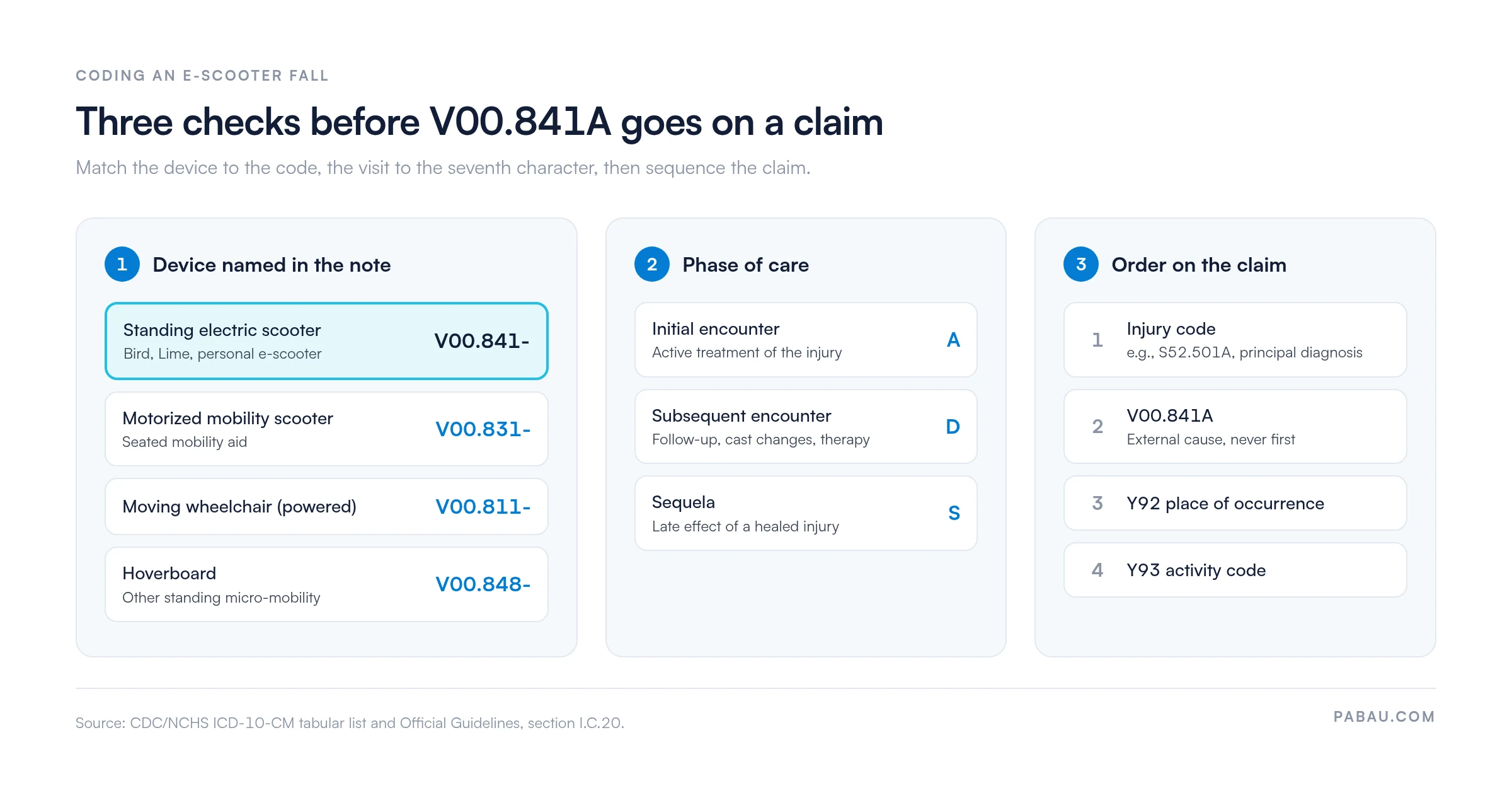
Three checks settle the code before it reaches a claim, as the diagram below shows: the device, the phase of care, and the claim order.
Several scenarios are explicitly outside the scope of V00.841A. Coding one of them to V00.841A instead of its own code creates an audit risk.
V00.841 is non-billable without a seventh character. The parent code requires one of three extensions, each representing a different phase of the patient’s care episode. Applying A on a follow-up visit is one of the most common coder errors on micromobility claims and a reliable trigger for audit scrutiny.
Clinical note wording trap: Providers often write “initial encounter” in a SOAP note to mean “my first visit with this patient.” They rarely mean “first treatment episode for this injury.” The ICD-10-CM definition of “initial encounter” means the phase of active treatment, not the ordinal visit. Coders must apply their own judgment here, not mirror the provider’s phrasing.
V00.841A and V00.831A are the two e-scooter fall codes most frequently confused. Swapping them is a common audit finding. Providers don’t always name the device type in chart notes, and coders sometimes default to one code without checking.
How to distinguish from chart notes: Look for phrases like “Bird scooter,” “Lime scooter,” “e-scooter,” or “electric scooter.” Each should come with a reference to standing or riding. If the note says “mobility scooter,” “power chair,” or “disability scooter,” route to V00.831A. When the note is ambiguous, query the provider before assigning either code.
V00.841A sits within the V00.8 subgroup covering accidents involving other pedestrian conveyances. Coders working micromobility injury claims regularly encounter the adjacent codes below.
The AAPC Codify ICD-10-CM lookup tool lets coders search the full V00 block by descriptor to confirm the correct code before assignment. Browsing the tabular list from the parent category down helps most when a chart note uses an unfamiliar, informal device name.
Because V00.841A is device-specific and posture-specific, the provider note must include details that many standard trauma notes omit. A note that says “patient fell off scooter” is not sufficient to support this code without a provider query.
The following elements must be present in the record to code V00.841A without a clinical query. Good medical billing documentation captures these at the point of care.
When documentation is ambiguous, coders should query the provider using a compliant query form. Never assume the device type from an informal phrase like “scooter” alone; kick scooters, motorized mobility scooters, and standing electric scooters all code differently.
Build a standing query template for e-scooter injuries. It asks providers for the device type (standing electric, seated or non-electric), the rider’s posture during the fall, and the place. A 30-second checkbox query prevents the back-and-forth that delays clean claim submission by days.
V00.841A cannot stand alone on a claim. As an external cause code, it describes the mechanism of injury but does not represent the injury itself. Under ICD-10-CM Official Guidelines Section I.C.20, external cause codes are supplementary. They are sequenced after the principal diagnosis, which must be the injury code.
The injury code drives the claim. Common injury codes paired with V00.841A include head injury codes such as concussion (S06.0X0A), fracture codes for the wrist, radius or clavicle, and laceration codes. The sequencing rule is absolute: Injury code first, then V00.841A.
Claims submitted with V00.841A in the principal position are likely to be rejected by payers that validate external cause code placement. They then need manual correction before resubmission.
E-scooter injury claims attract a predictable set of denial reasons. Catching them before submission costs less time than reworking a denied claim. Effective denial management workflows for micromobility codes generally center on five fixable problems.
For practices submitting high volumes of e-scooter injury claims, a pre-submission check of these five points is worth building. Coders can then fix errors before the payer sees them. Catching them at the point of care rather than after a denial keeps the clean claim rate for external cause codes up.
Run a monthly audit of all V00.841 claims across your practice. Pull any claim where V00.841A was used on a date of service more than 30 days after the original injury date. Those are high-probability seventh-character errors. Correcting them proactively prevents payer audits later.
For Medicare and most commercial payers, external cause codes including V00.841A are optional for claim adjudication purposes under standard outpatient billing rules. However, payer-specific contracts and state Medicaid policies may require them for trauma, liability, and auto-accident-related claims. Always verify with the specific payer’s local coverage determination (LCD) or contract terms.
Prior authorization triggers for e-scooter injuries typically relate to the services being rendered, not the external cause code itself. Services that commonly require prior auth following an e-scooter fall include:
The CMS ICD-10 codes page publishes the annual ICD-10-CM update files confirming valid codes and effective dates for each fiscal year. Practices should verify that V00.841A is active in the applicable ICD-10-CM fiscal year release for the date of service being billed.
V00.841A rework usually starts in the chart. A note that only says “fell off scooter” sends the coder back to the provider with a query. The claim then waits for the answer.
Pabau, the practice management platform we build, lets you set up structured encounter notes with fields for device type and rider posture. Providers fill them in at the point of care, so the details this code depends on are in the record before coding starts.
When the claim is ready, Pabau’s claims software for coders opens it pre-filled from the invoice. Its claim validation flags missing or invalid details before submission. If a payer still rejects the claim, Pabau marks it as needing action and shows the reason, so the coder can correct and resubmit it.

Pabau’s structured notes capture device type and rider posture at the point of care, and claim validation flags missing or invalid details before submission. See how it fits your billing workflow.

V00.841A itself is rarely the hard part. The descriptor is narrow, the seventh-character rules are clear, and the sequencing rule never changes. Denials tend to start earlier, when a note says “scooter” without the device type, or when the A stays on every follow-up visit.
So fix the inputs first. Use a standing query for device type, posture and place. Add a seventh-character check on every return visit, and the usual causes of rework on this code are covered. The trade-off is a few extra seconds of charting per e-scooter patient.
Pabau’s structured encounter notes help providers capture device type and posture, and its claim validation flags missing or invalid details before submission. Book a demo to see how it fits your external cause coding workflow.

Need to understand the clearinghouse that processes these claims? Pabau’s Claim.MD clearinghouse guide explains how electronic claim submission and real-time payer validation work end-to-end.
Seeing denials on external cause codes across your practice? Denial codes in medical billing breaks down the CARC codes payers return and how to address each one systematically.
Want to understand how claims move from code assignment to payment? Revenue cycle management explained covers the full workflow from eligibility check through final payment posting.
ICD-10 Code V00.841A is the billable ICD-10-CM external cause code for a fall from a standing electric scooter at the initial encounter. It belongs to the V00-V09 block covering pedestrians injured in transport accidents and must be sequenced after the primary injury diagnosis code on any claim. The ICD List reference tool confirms its billable status in the current ICD-10-CM fiscal year release.
V00.841A covers falls from standing electric scooters (Bird, Lime, personal e-scooters), while V00.831A covers falls from motorized mobility scooters used as medical or disability aids. The key distinction is device type and rider posture. A standing electric scooter routes to V00.841A, and a seated mobility device routes to V00.831A. When provider notes are silent on device type, query the provider before assigning either code.
V00.841 has three valid seventh-character extensions. A (initial encounter) covers active treatment of the injury. D (subsequent encounter) covers follow-up visits, cast changes, and physical therapy. S (sequela) covers treatment of a late effect of a healed e-scooter injury. Applying A on every visit regardless of the care phase is the most common coder error on micromobility claims.
V00.841A is always a secondary code. As an external cause of morbidity code under ICD-10-CM Chapter 20, it describes how the injury happened. It cannot represent the reason for the visit. The injury itself (fracture, laceration, head injury, etc.) must be the principal diagnosis, sequenced first on the claim.
Always report the primary injury code first (fracture, concussion, laceration, or other applicable S-code). After V00.841A, add a place-of-occurrence code (Y92) and an activity code (Y93) when documented. Some payers and state Medicaid plans require all three supplementary codes for trauma and liability claims; verify with the specific payer’s coverage policy.
No. V00.841A is specific to standing electric scooters. Hoverboards and electric skateboards code to V00.848A. Motorized mobility scooters code to V00.831A. Non-electric kick scooters code elsewhere in the V00 block. The CDC ICD-10-CM tabular list provides the full hierarchical structure of the V00 block.