ICD-10 Code R34: Anuria and oliguria
ICD-10 Code R34 is the billable ICD-10-CM diagnosis code for anuria and oliguria...

Last Updated: Oct 6, 2026
Billable Code Specific Code
V26.29XS is the billable ICD-10-CM code for unspecified rider of other motorcycle injured in collision with other nonmotor vehicle in nontraffic accident, sequela. It's reported after the residual condition being treated, such as post-traumatic arthritis from the earlier crash. The other vehicle is an animal-drawn vehicle, a ridden animal or a streetcar, and the crash happened away from a public highway.
Use it only when the chart doesn't say whether the patient was driving or riding as a passenger. If it does, V26.09XS (driver) or V26.19XS (passenger) applies instead, and the wrong pick can lead to claim edits or denials.
Let Pabau's smart automation suggest the right codes, reduce claim denials, and keep your practice compliant—effortlessly.
Automate repetitive tasks and focus on what matters most—your patients.
Reduce coding errors and ensure compliance with the latest regulations.
Clean claims, fewer denials, and faster reimbursements.
Powerful insights and reporting to help your practice thrive.
HIPAA compliant SOC 2 certified GDPR-compliant Trusted by 4,000+ clinics worldwide

V26.29XS is a valid, billable ICD-10-CM code, but only as a secondary external cause code.
It fits an unspecified rider of a motorcycle, other than an electric bicycle, who collided with a nonmotor vehicle away from a public highway.
The 7th character S means sequela: the injury has healed, and today’s visit is for a residual condition it caused.
The residual condition, such as post-traumatic arthritis, is always coded first, and Y92, Y93 and Y99 codes stay off sequela claims.
Pabau’s claims management software pre-fills the claim from the patient record and checks required fields before you send it.
ICD-10 code V26.29XS is the ICD-10-CM code for an unspecified rider of other motorcycle injured in collision with other nonmotor vehicle in nontraffic accident, sequela. It sits in Chapter 20, External causes of morbidity, of the CDC/NCHS ICD-10-CM classification. That chapter holds the transport accident codes, V00-V99.
In plain terms, the patient was on a motorcycle that collided with an animal-drawn vehicle, a ridden animal or a streetcar. The crash happened away from a public highway, and the chart doesn’t say whether they were driving. The injury has since healed, and today’s visit is for what it left behind.
The code is valid and billable, but only as a secondary code. It never takes the first-listed position on a claim.
Read the code left to right and it tells the payer who was hurt, how, and when. Knowing the structure heads off the two slips that cause the most rework: a missing placeholder X and the wrong rider role.
The placeholder X is mandatory. ICD-10-CM needs seven characters for this code, and nothing occupies the 6th position, so X holds the slot. V26.29S, with six characters, is structurally invalid and gets rejected.
The 7th character tells the payer which phase of care the visit belongs to. The three options don’t overlap, so only one can be right for a given visit.
Under the ICD-10-CM Official Guidelines, S marks a condition that remains after the injury itself has healed. Timing alone never decides it. Take a patient still in physical therapy for a broken collarbone from the crash. That visit takes D. Two years later, a visit for post-traumatic shoulder arthritis takes S.
Decision rule: ask whether the injury itself is still healing. If it is, use A during active treatment or D during recovery. If it has healed and today’s complaint is a consequence of it, switch to S and code that condition first.
Sequela coding follows a fixed order. The residual condition comes first, because it’s the reason for the visit. The original injury code, with 7th character S, comes next, and V26.29XS follows as the external cause.
Here’s how that looks in practice. A patient returns two years after a crash on a private farm road and now has post-traumatic arthritis in the right shoulder. The chart never says who was driving. You’d lead with the arthritis code, add the healed shoulder injury with S, then report V26.29XS.
V26.29XS never stands alone on a claim. If the residual condition’s own code is what’s holding you up, our ICD-10-CM code guides cover the conditions that usually lead these claims.
Category V26 covers motorcycle riders injured in a collision with other nonmotor vehicle. In ICD-10-CM, that means an animal-drawn vehicle, an animal being ridden, or a streetcar. A collision with a pedal cycle belongs in V21 instead.
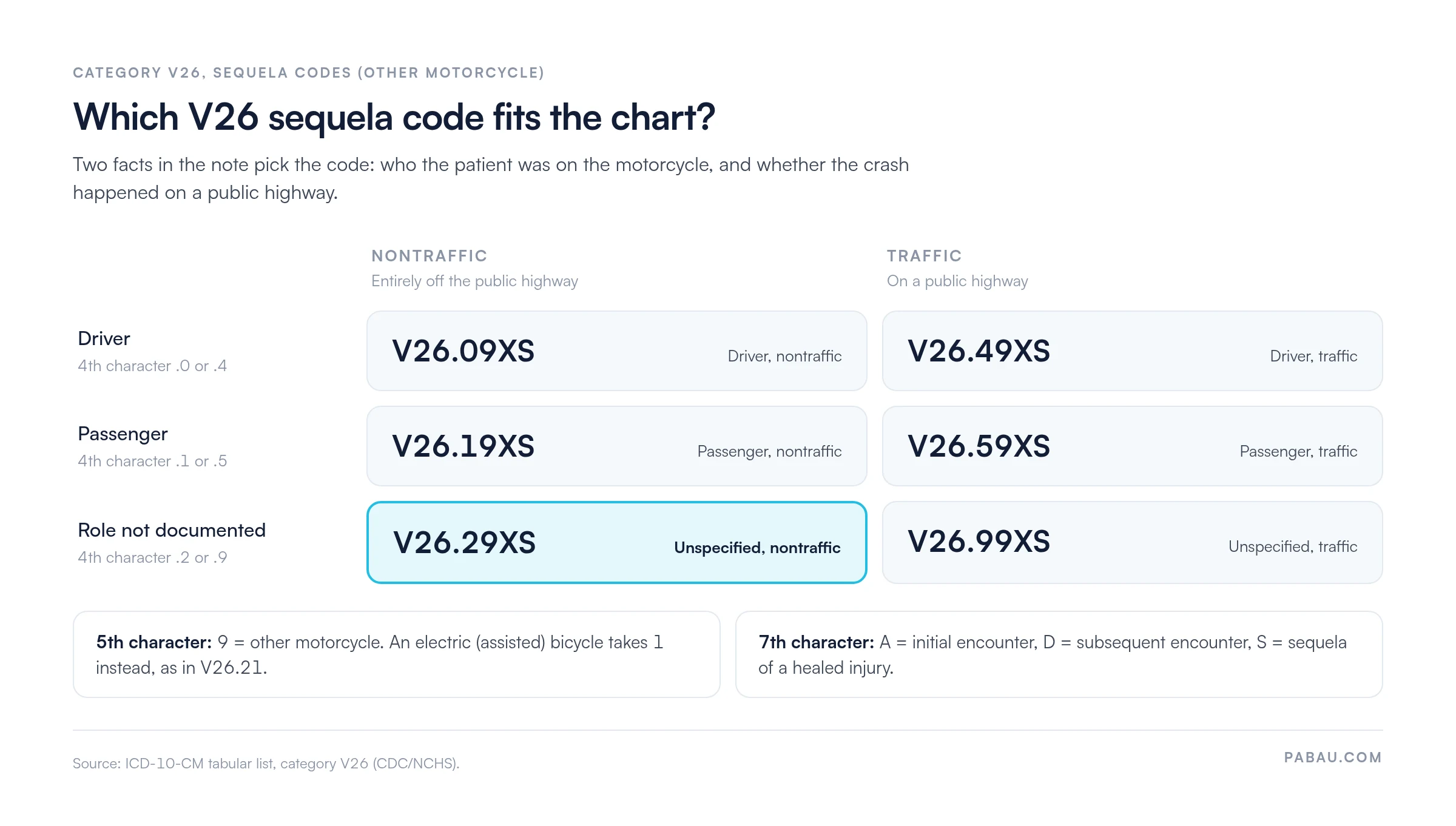
“Other motorcycle” means a rider of any motorcycle except an electric (assisted) bicycle, which takes 5th character 1, as in V26.21. The 4th character .2 makes this a nontraffic accident, one that happened entirely away from a public highway. The traffic versions use .4 for a driver, .5 for a passenger and .9 for an unspecified rider.
The grid below maps all six sequela codes in this corner of the category.
Residual conditions that bring these patients back for sequela visits include:
The category boundaries decide whether V26.29XS fits at all. A collision with the wrong kind of vehicle moves the claim to a different category entirely.
Collisions between a motorcycle and an animal-drawn vehicle, an animal being ridden, or a streetcar fall within scope.
For every sequela encounter, the residual condition leads. Chapter 20 codes are never first-listed, so V26.29XS always follows it.
Rider role trips coders up because charts often skip it. If the chart confirms the patient was operating the motorcycle, use the driver code. If it confirms a pillion rider, use the passenger code. If the note is silent or ambiguous, V26.29XS is correct.
Electric bicycles sit on a separate branch, with 5th character 1. V26.41XD shows that branch for a driver in a traffic accident, at a follow-up visit.
V26.29XS always travels with the diagnosis code for the residual condition. The rest of the claim depends on what you leave off as much as what you add.
So a status code such as Y99.8, which flags leisure activity, belongs on the first visit after the crash. It doesn’t come back on the sequela claim, even if the chart repeats it.
If any of these is missing, query the provider before you submit. Sound medical billing compliance means coders never infer external cause details the record doesn’t state.
V26.29XS is a valid secondary code, but no national rule requires external cause codes. The ICD-10-CM guidelines leave reporting to state mandates and payer policy, and encourage it voluntarily everywhere else.
Medicare: CMS doesn’t require external cause codes for Medicare fee-for-service claims. Some Medicare Advantage plans and state Medicaid programs do ask for them on injury claims, especially where auto insurance may pay first. Check the plan’s billing manual before you treat the code as optional.
State mandates: Many states require external cause codes in hospital claims data, and some state Medicaid programs extend that to professional claims. Your state Medicaid billing manual has the current rule.
How the claim moves: On a CMS-1500, list the residual condition in box 21 first, then the injury code with S, then V26.29XS. Point each service line in box 24E to the residual condition, never to the external cause code.
Motorcycle sequela claims tend to fail in the same few ways. Catching these before submission is cheaper than working them back through denial management after the payer responds.
A clean claim for a sequela visit passes every one of these checks before it leaves the practice:
A sequela claim often starts from a note written long after the crash. Someone has to pull the residual condition, the healed injury and the external cause into one claim by hand. A slip in any of the three sends it back.
Pabau, the practice management platform we build, handles this through simpler claims management. It pre-fills the claim form from the patient record, so the ICD-10-CM codes already on the problem list land in the diagnosis slots. A built-in code library lets you look up V26 siblings without leaving the claim.
Before the Send button unlocks, Pabau checks that required claim fields are complete, such as membership numbers and authorization codes.
US practices submit through the Claim.MD clearinghouse integration, with eligibility checks, claim-status tracking and remittance posting in the same place. Your team spends less time retyping codes and more time with the patients coming back for care.

Pabau pre-fills claim forms from the patient record, checks required fields before you send, and tracks each claim through Claim.MD. Fewer claims come back for missing details.

V26.29XS rewards a careful read of the note more than coding speed. Before you use it, confirm three things: the injury has healed, the crash happened away from a public highway, and the rider role is unknown. If any one of them fails, a sibling code fits better.
The trade-off is time. A provider query might hold the claim for a day, while a denied sequela claim costs far more in rework. When the note is thin, ask before you submit.
Book a demo to see how Pabau pre-fills sequela claims from the patient record and tracks them through to payment.

Need to understand how claim edits work end to end? What is revenue cycle management explains the full claims lifecycle from patient intake to payment posting.
Dealing with frequent external cause code rejections? Denial codes in medical billing covers the CARC and RARC codes that accompany rejected external cause claims.
Want to verify how clearinghouses handle secondary codes? Medical claims clearinghouse guide walks through how 837P transactions process diagnosis code sequencing.
Yes. V26.29XS is a valid, billable ICD-10-CM code, but only as a secondary code. External cause codes never take the first-listed position, so it always follows the residual condition on the claim.
Yes, if it happened entirely away from a public highway, such as on a private farm road closed to the public. If any part of the crash happened on a public highway, it’s a traffic accident. For an unspecified rider, that means V26.99XS instead.
There’s no time limit. Under the ICD-10-CM guidelines, a sequela code applies whenever the provider documents that the current condition was caused by the earlier injury. That can be months or years after the crash.
Not under any national rule. The ICD-10-CM guidelines leave it to state mandates and payer policies, and encourage voluntary reporting everywhere else. Check your payer’s manual, because auto insurance and coordination-of-benefits reviews can rely on it.