ICD-10 Code T32.87: Corrosions involving 80-89% body surface
ICD-10 code T32.87: Definition and clinical description ICD-10 code T32.87 is th...

Last Updated: Oct 26, 2026
Billable Code Specific Code
V09.01XS is the billable ICD-10-CM code for pedestrian injured in nontraffic accident involving military vehicle, sequela. It is reported as a secondary external cause code, sequenced after the condition being treated.
The seventh character S marks a sequela encounter, where the visit treats a late effect of the injury after active treatment has ended. The record needs three facts to support it: a nontraffic setting, a vehicle identified as military, and a condition linked to the original incident.
Let Pabau's smart automation suggest the right codes, reduce claim denials, and keep your practice compliant—effortlessly.
Automate repetitive tasks and focus on what matters most—your patients.
Reduce coding errors and ensure compliance with the latest regulations.
Clean claims, fewer denials, and faster reimbursements.
Powerful insights and reporting to help your practice thrive.
HIPAA compliant SOC 2 certified GDPR-compliant Trusted by 4,000+ clinics worldwide

V09.01XS identifies a pedestrian injured in a nontraffic accident involving a military vehicle, reported at the sequela encounter stage.
The seventh character S (sequela) means the active injury phase has resolved and the visit treats a late complication of the original incident.
The sequela condition is coded first as the principal diagnosis, and V09.01XS follows it as the external cause code.
Pabau, the practice management platform we build, checks each claim for missing or invalid details before it goes to Claim.MD for submission.
ICD-10 code V09.01XS carries the official descriptor “Pedestrian injured in nontraffic accident involving military vehicle, sequela.”
It is a secondary external cause code, reported when a visit treats a late effect of that injury. Each segment of the code answers a specific question about the original incident.
The placeholder X is not optional. Without it, the code truncates to six characters and fails the ICD-10-CM structural requirement for seventh character assignment. Coders sometimes omit it when transcribing the code manually, which produces an invalid string and triggers an automatic edit.
Per the ICD-10-CM tabular list, V09.01 covers a military vehicle involved in a nontraffic accident with a pedestrian. Code only the vehicle the record documents, and don’t stretch the subcategory to cover other vehicle types.
V09.01XS belongs to the external cause chapter of ICD-10-CM. Understanding its parent-to-child path helps coders navigate to adjacent codes when the clinical facts require a different selection. You can browse the full hierarchy using the CDC/NCHS ICD-10-CM web tool, which mirrors the current fiscal year tabular list.
The V09 category captures pedestrian incidents that do not fit neatly into the more specific V01-V08 blocks. Before settling on V09.01XS, check the ICD-10-CM code library for a more specific code elsewhere in the chapter.
Sequela, in ICD-10-CM terms, is a late effect or residual condition that persists after the acute phase of the original injury has ended. The seventh character S signals this condition to payers and reviewers. It is governed by ICD-10-CM Official Guidelines Section I.C.19.a.
Three seventh characters are valid for V09.01. Their meanings are mutually exclusive and cannot appear on the same claim for the same injury episode.
The clearest test for S versus D is the state of healing. If the original wound or fracture is still actively healing, D applies. If healing is complete and a complication of the original injury brings the patient in, S applies.
The V09.0 subcategory contains several codes that describe nontraffic pedestrian accidents but differ in the vehicle type involved. Selecting the wrong sibling code is a common specificity error that payers may flag during audits.
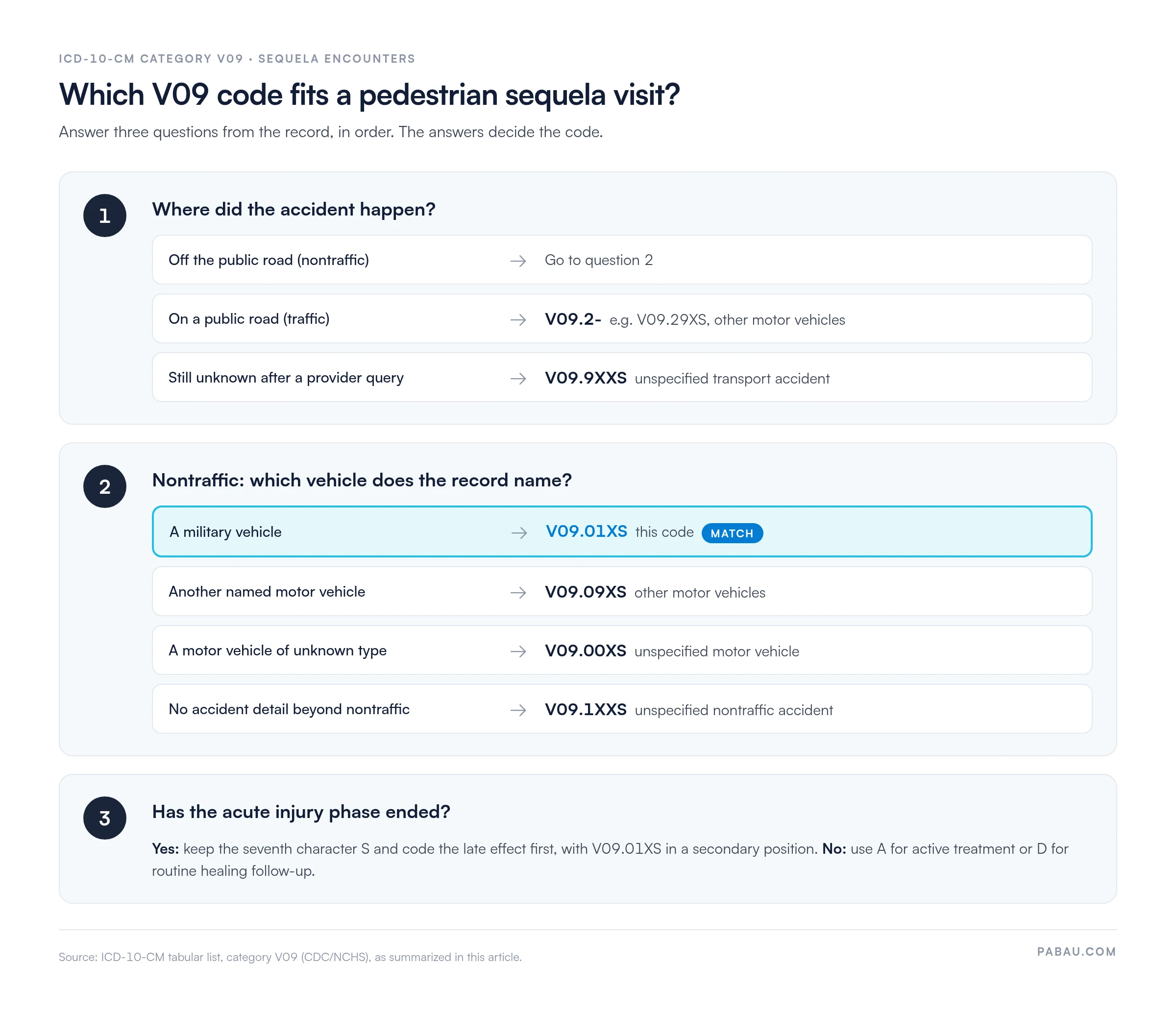
Traffic versus nontraffic is the single most consequential distinction in the V09 block. A nontraffic accident occurs on private property, a military base, an industrial site, or any location not classified as a public highway. If the documentation is ambiguous, query the provider before defaulting to “unspecified.” The decision path below runs those checks in order, from setting to vehicle to seventh character.
Code specificity obligations under medical billing compliance guidelines require the medical record to justify every granular element of a code. For V09.01XS, four documentation elements must be present.
When documentation is incomplete, the correct action is a physician query before coding, not an assumption. Assumptions that produce a more specific code without record support expose the practice to audit liability.
Sequela coding follows a defined sequence under ICD-10-CM guideline I.C.19.a. Getting the order wrong is one of the most reliable ways to generate a denial on a V09.01XS claim. The first rule of medical billing basics applies here too: an external cause code never leads the claim.
Run a pre-submission check: the claim’s principal diagnosis slot should contain a condition code, not an external cause code beginning with V09. If V09.01XS appears first, the sequencing is wrong and the claim will likely deny on the first pass.
External cause codes including V09.01XS are not universally required across all payers. Requirements vary by payer type and, for state Medicaid programs, by jurisdiction. Confirm requirements against current Local Coverage Determinations (LCDs) and payer-specific billing manuals before assuming any rule applies universally.
V09.01XS claims fail for predictable reasons. A structured denial management workflow reduces rework by catching these errors at the pre-submission stage rather than after a rejection.
Check five items before every V09.01XS claim goes out. Look for the seventh character S, the sequela condition in position 1, and V09.01XS in a secondary position. Then confirm the placeholder X and documentation of both the nontraffic setting and the military vehicle.
Without a claims tool, a coder keys V09.01XS by hand and checks its sequencing and seventh character by eye. One dropped placeholder X or a reversed code order sends the claim back.
Pabau’s claims management software scrubs each claim for missing or invalid details before it leaves Pabau, so a fix takes seconds. US claims then go out as electronic CMS-1500 submissions through Claim.MD, Pabau’s clearinghouse partner for thousands of payers.
Real-time eligibility checks run before the visit, so you know whether the patient’s plan covers the sequela treatment. Remittances flow back into Pabau, so a denied V09.01XS claim surfaces in one place for follow-up.

Pabau’s claim validation flags missing or invalid details on claims like V09.01XS before submission. Clean claims then go to thousands of US payers through Claim.MD.

V09.01XS rewards the coder who reads the record before reaching for the code. It applies only when three facts line up: a sequela encounter, a nontraffic accident, and a vehicle documented as military. If one is missing, query the provider or move to the matching sibling code in category V09.
The payoff is a claim that survives an audit and gets paid on the first pass. The cost is a few minutes of record review and a pre-submission scrub on every sequela claim. Book a demo to see how Pabau’s claim validation catches sequencing and seventh-character errors before your V09 claims reach the payer.

Need a clearinghouse that handles V09 external cause codes? Pabau’s Claim.MD clearinghouse guide explains how electronic claim submission handles ICD-10 external cause coding validation across thousands of US payers.
Want to understand denial patterns for external cause codes? Denial codes in medical billing covers the CARC denial codes most commonly returned on sequela and external cause submissions.
Looking for guidance on claim submission workflows? Revenue cycle management explained walks through the full claim lifecycle from coding through payment posting.
ICD-10 code V09.01XS is a billable ICD-10-CM external cause code for a pedestrian injured in a nontraffic accident involving a military vehicle. It is reported at the sequela stage, when the acute injury phase has resolved and the visit treats a late complication of the original incident. V09.01XS must appear in a secondary diagnosis position, never as the principal diagnosis.
Seventh character D (subsequent encounter) applies when the original injury is still actively healing and the patient returns for routine follow-up care. Seventh character S (sequela) applies when healing is complete and the patient now has a residual condition caused by the original injury. Chronic pain and functional deficits are typical examples. The two are mutually exclusive and cannot appear on the same claim for the same injury.
Yes. V09.01XS is an external cause code and cannot serve as the principal diagnosis on any claim. ICD-10-CM guideline I.C.19.a requires the sequela condition itself to be coded first. V09.01XS is sequenced after it to explain how that condition came about. Placing V09.01XS in the principal diagnosis position will typically trigger a claim edit or denial.
Yes, for fiscal year 2026. CMS lists V09.01XS as an active, billable code in the FY2026 ICD-10-CM code set. The FY2027 code set has been in effect since October 1, 2026, so confirm the code against the FY2027 tabular list and addenda from CDC/NCHS.
The medical record must confirm four elements. It must have happened in a nontraffic setting, and the vehicle involved must have been military. The current condition is a late consequence of the original injury, and the treating clinician states or clearly implies that sequela link. Missing any of these elements leaves the code unsupported and audit-vulnerable.
V09.00XS applies when the motor vehicle involved in the nontraffic accident is genuinely unidentified after querying the record. V09.01XS requires documented identification of the vehicle as military. If the record names or describes the vehicle in enough detail to confirm it is military, V09.01XS is the correct, more specific choice. Default to V09.00XS only when vehicle identification is genuinely impossible.