ICD-10 code S52.311P: Right radius shaft greenstick malunion
ICD-10 code S52.311P covers a right radius that healed out of line ICD-10 code S...

Last Updated: Oct 16, 2026
Billable Code Specific Code
V80.910A is the billable ICD-10-CM code for animal-rider injured in transport accident with military vehicle, initial encounter.
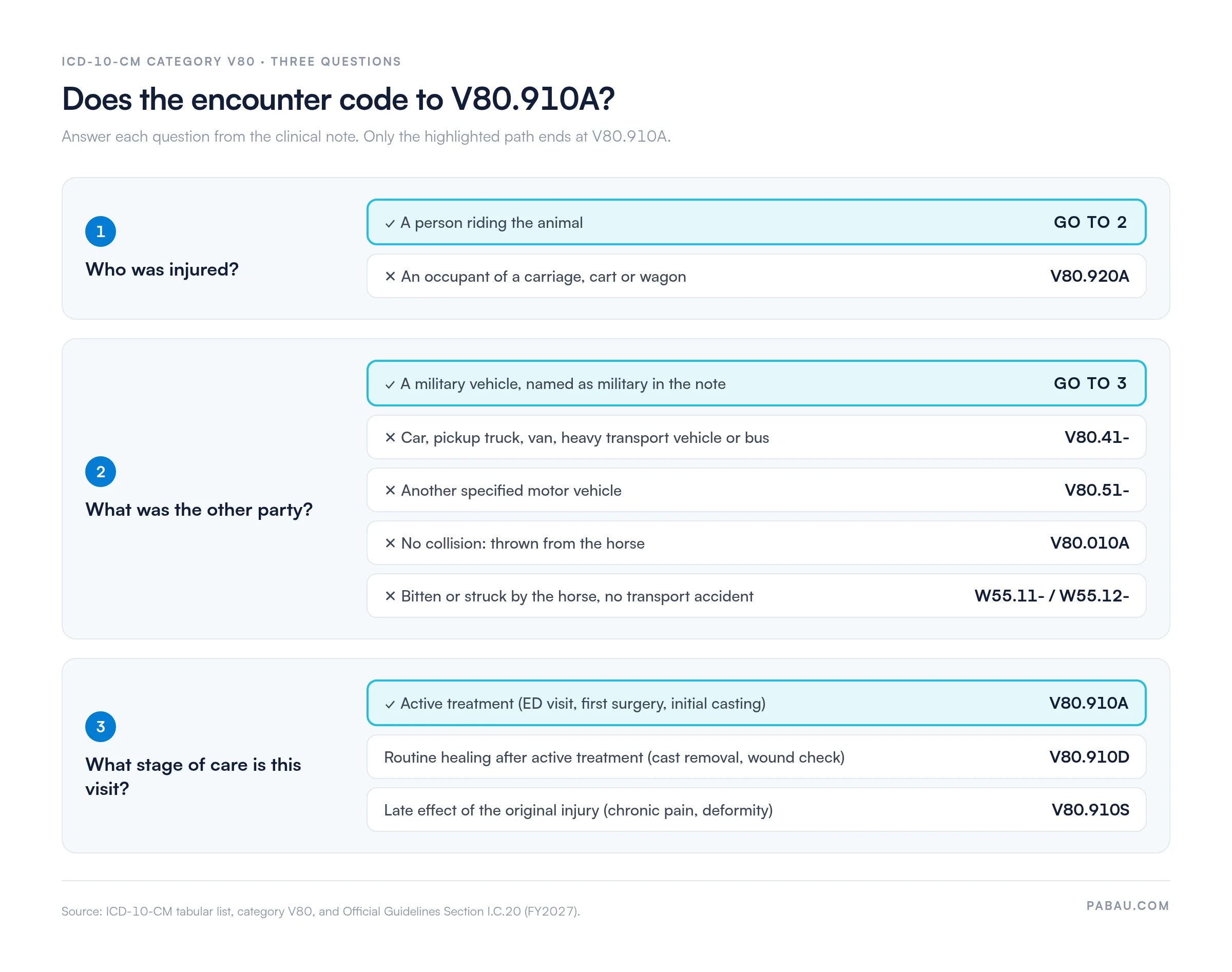
It records that a person riding a horse or other animal was hurt in a transport accident involving a military vehicle. The A marks the first treatment encounter. As an external cause code, it always follows the injury code on a claim. A rider who collides with a car, pickup truck, van, heavy transport vehicle or bus codes to V80.41- instead.
Let Pabau's smart automation suggest the right codes, reduce claim denials, and keep your practice compliant—effortlessly.
Automate repetitive tasks and focus on what matters most—your patients.
Reduce coding errors and ensure compliance with the latest regulations.
Clean claims, fewer denials, and faster reimbursements.
Powerful insights and reporting to help your practice thrive.
HIPAA compliant SOC 2 certified GDPR-compliant Trusted by 4,000+ clinics worldwide

V80.910A codes an animal rider injured in a transport accident with a military vehicle, at the initial encounter.
It is an external cause code, so it always follows the injury code and is never the principal diagnosis.
A rider who collides with a car, pickup truck, van, heavy transport vehicle or bus codes to V80.41-, not V80.910A.
The note must identify the other vehicle as military, or the claim belongs to a different V80 code.
ICD-10 Code V80.910A records an animal rider injured in a transport accident with a military vehicle, at the initial encounter. It belongs to Chapter 20 of ICD-10-CM (External Causes of Morbidity) and supplements an injury code rather than replacing it. The table below covers the facts coders need before touching a claim.
Specifically, V80.910A captures the external cause for a person riding an animal, most often a horse. Also, the rider is hurt in a transport accident involving a military vehicle. In addition, the 7th character A marks the encounter as active treatment. Therefore, three facts must all be present to use this code correctly.
Because this is a rare code, it often gets misused. For example, coders often reach for it when a rider is hit by any truck. In fact, the V80.41 subcategory carries an Excludes1 note that sends military-vehicle collisions here, so the vehicle type decides the code.
First, the parent chain below shows where V80.910A sits among the ICD-10-CM codes. It also shows which adjacent codes share its category.
Next, V80.910 has two siblings under V80.91: V80.918 for other transport accidents involving an animal rider, and V80.919 for unspecified ones. Similarly, V80.920, V80.928 and V80.929 mirror them for occupants of an animal-drawn vehicle.
Finally, the CDC/NCHS ICD-10-CM web tool lets coders verify the current hierarchy and confirm a code is valid for the fiscal year before submitting a claim.
Overall, the 7th character is the most common source of coding errors for V80.910A. For example, think of it as a clock. A starts the clock as active treatment begins, and D means healing is under way. Finally, S means the clock has stopped and a residual condition remains.
Critical distinction: under the ICD-10-CM Official Guidelines, “initial encounter” does not mean the first visit to any provider. A patient transferred from another facility for ongoing active treatment still receives the A suffix. Once active treatment ends and the visit is for routine healing, switch to D.
Consequently, V80.910A is always a secondary code. Under Section I.C.20 of the ICD-10-CM Official Guidelines for Coding and Reporting, an external cause code can never be the principal or first-listed diagnosis.
Thus, the correct sequencing approach follows this order for every claim using this code.
However, the companion injury code depends entirely on what the documentation states. For example, common primary diagnoses paired with V80.910A include the following.
Name the other vehicle in the clinical note, and say it was military. A note that only says ‘hit by a truck’ points a reviewer to V80.41- rather than V80.910A. Record the rider’s activity in the same note, so the external cause and the injury tell one story.
First, the tabular list for V80 splits animal-rider accidents by the other party involved. As a result, coders who miss these splits pick a code the tabular list sends elsewhere.
Most confusion comes from three directions: the 7th-character variants of V80.910, the other vehicle in the accident, and injuries with no transport accident at all. The decision path below runs through those questions in order, and the table after it maps common scenarios to the correct code.
Moreover, the AAPC Codify ICD-10-CM lookup shows the full V80 subcategory tree and adjacent code descriptors for side-by-side checks when a scenario is ambiguous.
Furthermore, four documentation elements must appear in the clinical note for V80.910A to survive a payer audit. Therefore, missing any one of them gives a reviewer grounds to reclassify or deny the external cause code.
When documentation is incomplete, query the provider in neutral language: “The record documents a transport accident involving a horse rider. Can you specify the type of vehicle involved, and confirm whether this is the first treatment encounter for this injury?”
There is no national requirement to report external cause codes, including for Medicare. However, some states mandate them, and some commercial payers require them by contract. Therefore, coders should check each payer before assuming V80.910A is always mandatory or always optional.
For practices submitting electronic claims, clean claim submission standards are the foundation for avoiding rejections. Specifically, with V80.910A, the weak points are sequencing, the 7th character and a note that never names the vehicle.
Overall, most denials tied to this code fall into four categories. Moreover, each has a defined corrective action.
Furthermore, structured denial management workflows track external cause code denials separately from clinical code denials. That shows whether a problem is systemic, such as an intake form that never captures the mechanism, or limited to specific coders.
The governing rules for external cause codes appear in Section I.C.20 of the ICD-10-CM Official Guidelines for Coding and Reporting. CMS and the National Center for Health Statistics (NCHS) also publish them each year. Specifically, key provisions affecting V80.910A include the following.
AHIMA and AAPC both publish annual coding resources with practical examples for these provisions. Additionally, the WHO ICD-10 browser gives the international context for V codes, which helps when a coding note references ICD-10 rather than ICD-10-CM.
Coding a rare transport injury often means copying details from ED notes into a claim by hand. As a result, fields go missing and claims come back.
Pabau, the practice management platform we build, keeps the patient record, the invoice and the claims management workflow in one system. As a result, your coder adds V80.910A and the injury code to a claim built from data already on file.
Meanwhile, in the US, Pabau submits claims through its Claim.MD clearinghouse integration. It also checks patient eligibility and tracks each claim’s status after submission. However, code choice and sequencing stay with your coder.

Pabau keeps the patient record and the claim in one place, submits US claims through Claim.MD, checks eligibility and tracks claim status. Your coders spend less time chasing returned claims.

In short, V80.910A is a narrow code, and most errors come from using it too broadly. If the record never names a military vehicle, the right code is almost always V80.41- or V80.51-.
So settle the vehicle question at the point of care. One line in the note naming the vehicle type decides the code, and it costs far less than a query or a denial later.
Book a demo to see how Pabau keeps injury claims tied to the patient record from submission to payment.

Need to understand how denial patterns build up across your claims? Denial management in healthcare covers how to categorize, track, and reverse claim denials by root cause.
Want to see how clearinghouse claim validation works end to end? Clean claim submission explains the pre-submission checks that prevent external cause code errors from reaching a payer.
Looking for guidance on how ICD-10 coding fits into your overall billing workflow? Medical billing workflows provides an end-to-end overview of the revenue cycle from encounter to payment posting.
ICD-10 Code V80.910A is the code for an animal rider injured in a transport accident with a military vehicle, initial encounter. In short, the patient was riding an animal, a military vehicle was involved, and the visit is for active treatment. It is an external cause code, so it always follows the injury code on the claim.
Use V80.910A while the patient is in active treatment for the injury. Use V80.910D for follow-up visits during healing, such as wound checks, cast removal or physical therapy. Use V80.910S for a late effect directly caused by the original accident, such as chronic pain or post-traumatic deformity.
V80.910A is always a secondary (supplementary) code. External cause codes can never be the principal or first-listed diagnosis under Section I.C.20 of the ICD-10-CM Official Guidelines. Therefore, a specific injury code must appear in the primary position on every claim that uses V80.910A.
Both codes describe a transport accident with a military vehicle. V80.910A applies to a person riding an animal, and V80.920A applies to an occupant of an animal-drawn vehicle, such as a carriage or wagon. If a rider collides with a civilian car, pickup truck, van or bus instead, use V80.41-.
There is no national requirement to report external cause codes, and Medicare does not mandate them. However, some states and commercial payers do require them. The Official Guidelines encourage voluntary reporting, so check each payer’s rules, which can change with annual policy updates.