

ICD-10 Code S42.444P: Medial epicondyle fracture, right humerus
ICD-10 Code S42.444P: full descriptor and code validity ICD-10 Code S42.444P car...

Last Updated: Oct 13, 2026
Billable Code Specific Code
T87.33 is the billable ICD-10-CM code for neuroma of amputation stump, right lower extremity.
Let Pabau's smart automation suggest the right codes, reduce claim denials, and keep your practice compliant—effortlessly.
Automate repetitive tasks and focus on what matters most—your patients.
Reduce coding errors and ensure compliance with the latest regulations.
Clean claims, fewer denials, and faster reimbursements.
Powerful insights and reporting to help your practice thrive.
HIPAA compliant SOC 2 certified GDPR-compliant Trusted by 4,000+ clinics worldwide

ICD-10 Code T87.33 is a billable diagnosis code for neuroma of amputation stump, right lower extremity.
Laterality is required. T87.33 covers the right lower extremity only, and left lower extremity neuromas use T87.34.
Documentation must confirm a stump neuroma rather than phantom limb pain, which is coded under G54.6.
The code has been in effect since October 1, 2015 and carries no seventh character.
Practice management software like Pabau supports ICD-10-CM code entry and electronic claim submission through its Claim.MD integration.
ICD-10 Code T87.33 is the billable ICD-10-CM code for neuroma of amputation stump, right lower extremity. In short, it applies when a nerve mass forms at the residual limb after a right leg amputation and the pain originates at the stump itself.
This reference covers the code’s clinical definition and its place in the ICD-10-CM hierarchy. It also sets out every T87.3x sibling code, the documentation payers look for, how it differs from phantom limb pain, and the CPT crosswalk. For reference, the tabular list is searchable by code or keyword in the CDC/NCHS official ICD-10-CM web tool.
Here are the billing facts worth checking before the claim goes out. ICD-10 Code T87.33 is fully billable, with no additional characters required.
T87.3 itself is the non-billable parent heading. Only the fifth-character subcodes, T87.30 through T87.39, carry billable status. So, ICD-10 Code T87.33 is one of them and needs no further extension. For the latest edition, the CMS ICD-10 codes page publishes the official tabular list and coding guidelines each October.
A stump neuroma forms when peripheral nerve axons try to regrow after amputation but have no distal target to reach. Instead, they grow into a disorganized mass at the residual limb tip. That mass is a structural complication of the amputation, not a stage of normal healing.
For coding under ICD-10 Code T87.33, the neuroma must sit at the residual limb of the right lower extremity. That includes both below-knee and above-knee amputations. Typically, presentation includes local tenderness at the stump tip, shooting or burning pain on touch, and extra sensitivity to prosthetic socket pressure.
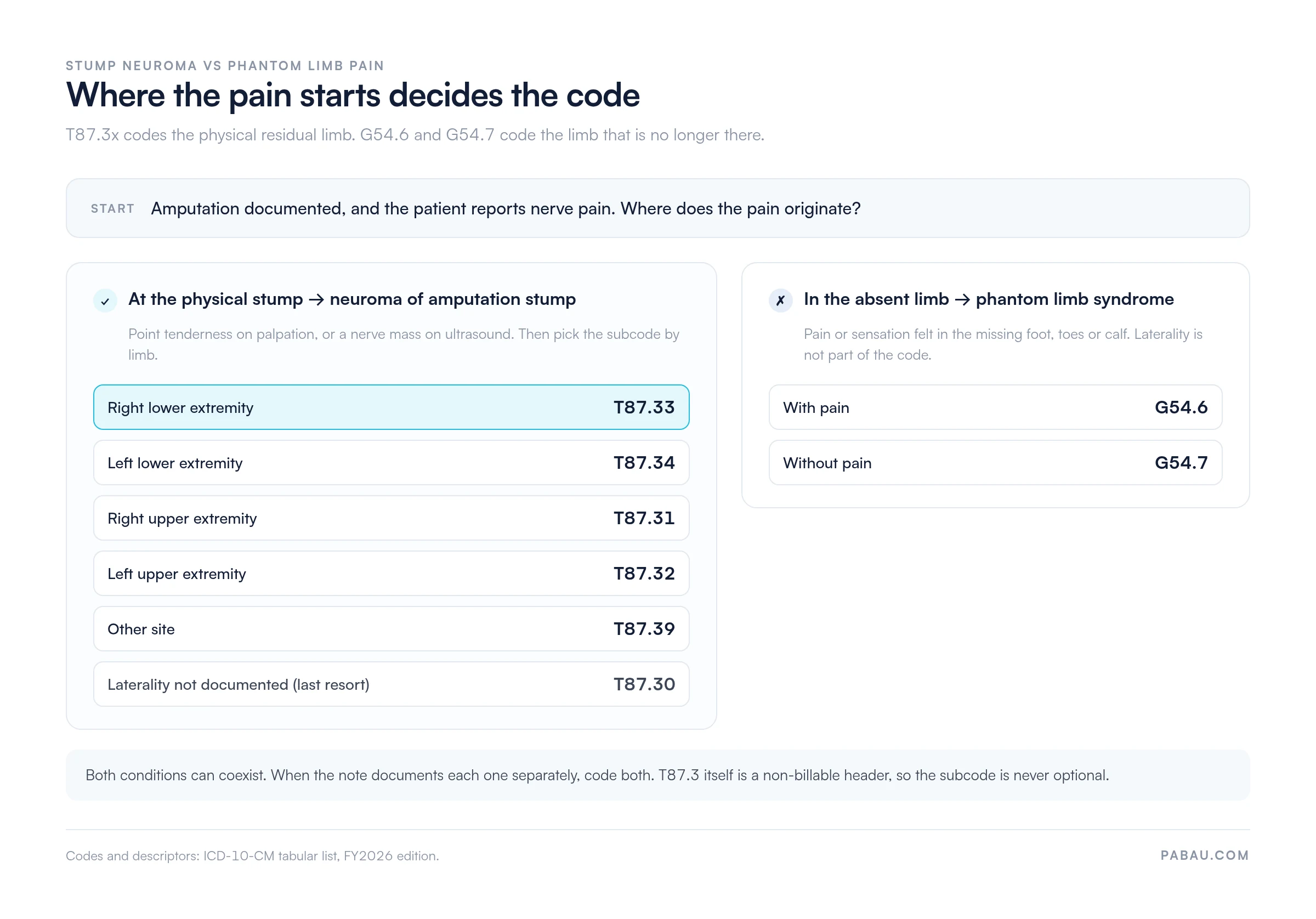
This distinction drives code selection. For example, a patient who reports pain in their missing foot is describing phantom limb pain. By contrast, a patient who winces when the clinician presses the stump end is showing signs of a stump neuroma. The two can coexist, and both get coded when both are documented.
Understanding the hierarchy helps coders find related codes and pick the most specific one. Specifically, ICD-10 Code T87.33 sits in the chapter for injury, poisoning and certain other consequences of external causes. Inside that chapter, a focused block covers reattachment and amputation complications.
The T87 category is reserved for complications specific to reattachment and amputation. So, T87.33 should only appear in records that document a previous amputation or reattachment. For the wider range, coders can explore it in the AAPC Codify ICD-10-CM lookup alongside clinical notes and crosswalk data.
The T87.3 subcategory covers neuromas at every amputation site, with the fifth character setting the limb and side. So, picking the right subcode needs documentation that names the affected limb. ICD-10 Code T87.33 covers the right lower extremity only, so any other subcode used for that location is a coding error.
When a patient has bilateral lower extremity amputations with neuromas at both stumps, T87.33 and T87.34 may both be coded. Each code stands alone, and no bilateral modifier is needed. Still, T87.30 is a fallback for genuinely undocumented laterality, used only after the operative and clinical records have been reviewed.
T87 covers every complication specific to reattachment and amputation. ICD-10 Code T87.33 belongs to the neuroma subgroup, and patients with complex amputation histories often carry more than one T87 complication. Knowing the shape of the whole category is what stops under-coding.
Multiple T87 codes may be given in one encounter when the patient carries more than one complication. For instance, a stump neuroma alongside a stump infection is the common case. ICD-10-CM places no limit on how many T87 codes appear on the same claim.
When a claim carries both T87.33 and T87.4x for stump infection, sequencing follows the reason for the encounter. List T87.33 first only if the neuroma prompted the visit. If the infection prompted it, sequence T87.4x first. Sequencing errors on multi-complication amputation claims are a common payer audit trigger.
Claim acceptance for ICD-10 Code T87.33 depends on what the medical record holds. Payers reviewing post-amputation neuroma claims look for a set number of elements. If one is missing, it can open a denial management workup that delays payment by weeks.
The detail in the note has to match the detail the code demands. T87.33 needs right-side, lower-extremity, neuroma-specific wording. Otherwise, generic wording such as amputation complication or stump pain prompts a coding query, or a downcode to T87.30 or T87.9.
Several ICD-10-CM rules shape how T87.33 is applied. These come from the tabular list and the official NCHS coding guidelines, and they answer the questions coders raise most often about this code.
The pattern holds across the code set. The most detailed code wins, unspecified codes are a last resort, and sequencing follows the reason for the encounter.
The most common error with ICD-10 Code T87.33 is treating a stump neuroma as phantom limb pain. In fact, they are separate clinical conditions with separate codes, and payers audit for the difference. The table below sets out when each code applies.
A patient with both a stump neuroma and phantom limb pain, which is common, may carry T87.33 and G54.6 in the same encounter. Even so, both conditions have to be documented separately by the treating clinician. The phantom limb codes sit outside T87 and need no sequencing tie to T87.33. The decision path below shows where each one lands.
ICD-10 Code T87.33 is a diagnosis code, so it pairs with a CPT procedure code to form a complete claim. Which CPT code applies depends on the treatment given. For the wider set, the CPT codes reference lists it in full, and the ones that pair with stump neuroma treatment are below.
Before billing, check each pairing against current AMA CPT guidelines and any local coverage determination that applies. After all, payers set their own rules on which CPT and diagnosis combinations they accept for stump neuroma treatment.
Practices billing neuroma excision alongside T87.33 should read the payer’s local coverage determination for the procedure. For instance, some Medicare Administrative Contractors need prior authorization, or proof of certain diagnostic criteria, before they approve an excision reported with T87.33.
Those pairings are US-specific. UK private medical insurers work from the CCSD schedule, where dividing the nerve for a stump neuroma is A6030.
Before billing CPT 64782 for neuroma excision paired with T87.33, check the applicable MAC’s local coverage determination. Some contractors require documented failure of conservative treatment, such as nerve blocks or desensitization therapy, before approving surgical excision as medically necessary. Building that trail at the time of care avoids retro-denial letters.
Medical records use several different terms for the condition coded as ICD-10 Code T87.33. So, knowing these synonyms lets coders reach the right code from a physician note, an operative report or a referral letter, without a direct code reference.
None of these terms points to phantom limb pain. A note describing pain in the foot, or in a missing toe, is phantom pain territory and belongs to G54.6. By contrast, a note describing pain at the stump, or at the end of the residual limb, belongs to T87.33.
Coding T87.33 correctly is one step. Even so, the claim still has to leave the practice with the diagnosis, the procedure code and the patient’s insurer details in agreement. Practice management software like Pabau holds all three in the same patient record. As a result, the coder is not matching a clinical note against a separate billing system.
Pabau’s claims management software runs eligibility checks before the visit, builds the CMS-1500 from the encounter record, and submits it through the Claim.MD integration. Claim status and electronic remittance advice come back into the same screen, so a denial on a T87.33 claim surfaces without a portal login.
Amputation patients are treated over years rather than visits, so that history matters. For this reason, prior amputation documentation, previous stump exams and earlier claims all sit in one record. That is the evidence a payer asks for when it reviews a T87.33 claim.

Pabau’s claims management tools support ICD-10-CM code entry, eligibility checks and electronic claim submission through our Claim.MD integration. Practices see claim status and remittance advice in the same record as the visit.

T87.33 is a narrow code, and that is its value. Three elements in the record make it defensible. The chart needs a documented right lower extremity amputation, a clinical finding of a stump neuroma, and clear laterality.
Practices rarely lose money on this code because of the code itself. Instead, the loss usually traces back to a note written before anyone expected the claim to be reviewed. Building the laterality and the stump finding into the routine assessment is what stops that.
Pabau builds the claim from the encounter record and routes it to thousands of US payers through Claim.MD. Book a demo to see how the coding and the claim stay in one place.

Need a framework for managing ICD-10 claim denials? Denial management in healthcare covers root causes, appeal workflows, and prevention strategies for common ICD-10 coding denials.
Want to understand how claims reach payers? How Claim.MD clearinghouse works explains the electronic claim pathway from practice management system to payer adjudication.
Looking for guidance on clean claim submission? Clean claim requirements details what payers check before processing any ICD-10 coded claim.
ICD-10 Code T87.33 is a billable ICD-10-CM diagnosis code for neuroma of amputation stump, right lower extremity. It reports a nerve mass at the residual limb of a right leg amputation. The code sits in the T87 category for complications peculiar to reattachment and amputation, and it has been in effect since October 1, 2015. It requires no seventh character.
Yes, T87.33 is a fully billable and specific ICD-10-CM code. It can be used directly on claims for reimbursement without any additional character extensions. Its parent code, T87.3 (Neuroma of amputation stump), is a non-billable header code and cannot be submitted on claims.
Commonly paired CPT codes include 64782 for neuroma excision in the foot, 64783 for each additional nerve, and 64450 for a peripheral nerve block. Stump revision that addresses a neuroma reports 27886. Ongoing management visits use 99213 through 99215. Verify each pairing against the applicable Medicare Administrative Contractor’s local coverage determination before billing.
The parent code is T87.3 (Neuroma of amputation stump), which is a non-billable subcategory header within the T87 category (Complications peculiar to reattachment and amputation). T87.3 cannot be used on claims. Only the fifth-character subcodes such as T87.33 carry billable status.




