ICD-10 Code Y76.0: Diagnostic obstetric and gynecological devices
ICD-10 Code Y76.0: Definition and billable status ICD-10 Code Y76.0 is a valid, ...

Last Updated: Oct 23, 2026
Billable Code Specific Code
T87.30 is the billable ICD-10-CM code for neuroma of amputation stump, unspecified extremity. It covers a painful nerve-end mass at the residual limb when the record doesn't say which side or limb is affected.
Assignment turns on documented laterality. If any note names the side and the limb, one of T87.31–T87.34 is the correct choice instead.
Let Pabau's smart automation suggest the right codes, reduce claim denials, and keep your practice compliant—effortlessly.
Automate repetitive tasks and focus on what matters most—your patients.
Reduce coding errors and ensure compliance with the latest regulations.
Clean claims, fewer denials, and faster reimbursements.
Powerful insights and reporting to help your practice thrive.
HIPAA compliant SOC 2 certified GDPR-compliant Trusted by 4,000+ clinics worldwide

T87.30 is the billable ICD-10-CM code for a neuroma of an amputation stump when the record doesn’t state the extremity or side.
When the chart supports it, use T87.31 (right upper), T87.32 (left upper), T87.33 (right lower) or T87.34 (left lower).
A Z89.x code is commonly added to show the level of amputation.
The provider has to document a neuroma, because stump pain or phantom pain alone points to different codes.
ICD-10 code T87.30 covers a neuroma of an amputation stump when the record doesn’t say which limb or side is affected. It has been billable since ICD-10-CM took effect on October 1, 2015, and it remains valid for FY2026.
Its four siblings, T87.31 to T87.34, each carry both a side and a limb. Use the table below as a quick check before you assign it.
Verify current-year validity against the CDC/NCHS ICD-10-CM web tool, which publishes the official tabular list each October 1. The wider ICD-10-CM code library covers the Z89 and G54 codes that come up later in this guide.
A neuroma of the amputation stump is a painful, disorganized mass of nerve fibers. It forms when cut nerve fibers try to regrow at the surgical site but have nowhere to go. The result is a tangled, hypersensitive nodule near the tip of the residual limb.
T87.30 applies when the record doesn’t identify the side or the limb. It covers stump neuromas whether the original amputation was traumatic, surgical or disease-related. You’ll see it in inpatient, outpatient and rehabilitation settings that care for amputees.
Veterans with service-connected limb loss and workers’ compensation patients with traumatic amputations are common T87.3x patients. Patients with diabetes-related lower-limb amputations are another large group. Their records often document the side clearly, which makes T87.33 or T87.34 (right or left lower extremity) the better fit.
Knowing the hierarchy matters because claims submitted at the non-billable parent T87.3 are rejected. A claim needs one of the five billable codes beneath it. T87.30 is the right one only when the side or limb is missing.
So a neuroma on a right below-knee stump goes to T87.33, and the same finding on the left goes to T87.34.
Choosing between these five codes is the decision that matters most on a stump neuroma claim. Using “unspecified” when the chart names the side and limb is a coding error, and it invites a payer query or an audit finding.
The diagram below walks through the choice in one step.
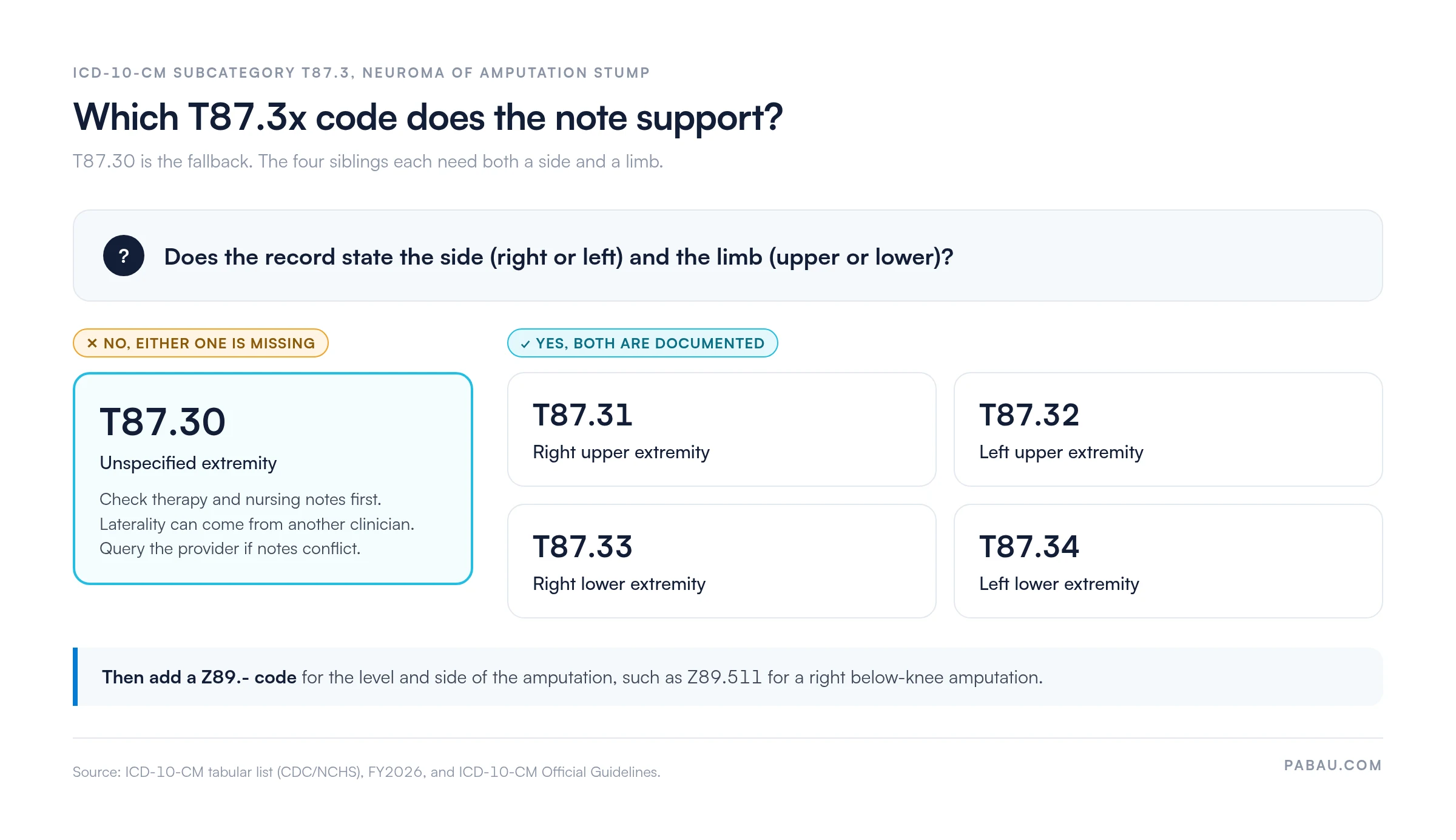
The operative report is the primary source for laterality. If it names the side and limb, use T87.31–T87.34, whatever the face sheet says. Defaulting to T87.30 because the face sheet is incomplete doesn’t meet the specificity rule in the ICD-10-CM Official Guidelines.
The guidelines also let you take laterality from another clinician’s note, such as a therapy or nursing entry. The neuroma diagnosis itself still has to come from the provider. When notes disagree on the side, query the attending provider.
A patient with a transtibial amputation returns with a tender nodule at the stump. The physician writes “neuroma, residual limb, positive Tinel’s” but never says which leg. Last week’s physical therapy note records a left below-knee amputation.
Because laterality can come from the therapy note, the claim carries T87.34 with Z89.512. If no note anywhere named the side, T87.30 with Z89.519 would be correct instead.
T87.30 covers neuromas that form as a direct complication of amputation, however the limb was lost. It doesn’t cover every painful condition at the residual limb.
Infection is the other common mix-up. It has its own codes, starting at T87.40 for an unspecified extremity, while T87.89 handles named complications that fit no other T87 code.
Stump neuroma and phantom limb pain are two common sources of pain after amputation, and notes often blur them. They need different ICD-10 codes, different documentation and, in some cases, different procedures.
Coders can’t select T87.30 on stump pain alone. The provider has to name the neuroma, not just “stump pain” or “residual limb pain.” When the note is ambiguous, a clinical documentation improvement (CDI) query is the right next step.
A Z89.x code (acquired absence of limb) is recommended alongside T87.30 to show the level and side of the amputation. The T87.3x code describes the complication, and the Z89 code describes the limb that is missing.
Keep the two jobs separate. Z89 identifies the level and side of the amputation, while T87.3x identifies the extremity and side of the neuroma. These Z89 categories come up most often with stump neuromas:
Sequencing follows the reason for the visit. When the patient comes in to treat the neuroma (nerve block, excision or revision), T87.3x is the first-listed diagnosis and the Z89 code follows. When the neuroma is a secondary issue at a visit for something else, list it after the main reason, with the Z89 code alongside.
The procedure code follows the treatment the provider chose. Check descriptors against the current-year manual for the AMA’s CPT code set, because annual revisions change procedure definitions.
Nerve blocks are usually the first treatment, and the guide to CPT code 64450 covers how to bill them.
Targeted muscle reinnervation (TMR) reroutes cut nerves into nearby motor nerves, and it is an established option for painful stump neuromas. It has no dedicated CPT code, so coding varies by payer and some claims go out as 64999. Check the current CPT manual and your MAC’s local coverage determination before you submit.
Before submitting claims pairing T87.30 with CPT 64999 for TMR, request a written prior authorization. Include the operative plan, documentation of failed conservative management, and a copy of the physician’s neuroma attestation. Payers treating 64999 as investigational will deny without this groundwork.
A T87.30 diagnosis in the chart doesn’t automatically support the code on a claim. Payers reviewing these claims look for the elements below, and a missing one can lead to denial or a query. A clean claim for T87.30 depends on having them in the chart before billing.
Run through this list before the claim leaves the practice. Each point maps to a common reason these claims come back.
T87.30 claims tend to come back for a small set of reasons. Denial management workflows that track them help you spot a pattern early. Watch for these five:
When a claim returns, read the adjustment reason code on the remittance advice before you edit the claim. A CO-16 needs the missing data added, while a CO-50 needs medical necessity evidence rather than a new code.
T87.30 shows up across three payer settings, each with its own documentation and authorization rules. One billing approach across all three is an easy way to collect preventable denials.
Medicare coverage for T87.30 procedures depends on the local coverage determination (LCD) from your Medicare Administrative Contractor (MAC). MACs differ on whether nerve blocks for stump neuroma fall under a pain management LCD or a surgical one. Confirm the LCD number with your MAC before scheduling.
The CMS ICD-10 codes page publishes current code files and cross-reference tables. When coverage is uncertain, give the patient an Advance Beneficiary Notice (ABN) before the service.
Workers’ compensation often pays for traumatic amputation cases, and it can scrutinize T87.30 claims closely. Causation documentation, tying the neuroma to the work injury, is essential.
Some state programs also require an independent medical examination before surgery, so check each state’s rules separately.
Many patients with stump neuromas are veterans. For service-connected amputees, T87.30 documentation may feed into VA disability ratings as well as treatment authorization.
Coding alone doesn’t establish service connection, which follows a separate administrative process. Confirm whether the visit is VA-funded or covered by a secondary payer such as Medicare or TRICARE.
ICD-9-CM 997.61 (Neuroma of amputation stump) carried no side or limb detail. In the General Equivalence Mappings (GEMs) it corresponds to the whole T87.30–T87.34 family, with T87.30 as the match when the record gives no extremity.
You’ll need this crosswalk for legacy system audits, historical claims reconciliation and remittance reviews involving claims from before October 2015. The AAPC Codify ICD-10-CM lookup and ICD List both keep crosswalk references for T87.30 and its siblings.
On a stump neuroma claim, the details that matter sit in different notes. The surgeon documents the neuroma, therapy records the side, and someone retypes both onto the claim form.
Pabau, the practice management platform we build, pre-fills the claim from the patient record and has ICD-10-CM and CPT lookup built in. Its simpler claims management checks that required claim fields are complete before you send. US claims then go through Claim.MD, with eligibility checks, claim tracking and remittance posting.
Your coder still chooses the code. What changes is the handoff. The code, the Z89 status and the patient details reach the payer without retyping, so fewer claims come back for missing data.

Pabau pre-fills claims from the patient record and checks required fields before submission. US claims go through Claim.MD, with eligibility checks and claim tracking included.

T87.30 is a legitimate code, but it should be the last one you reach for. Search every note for the side and limb before you accept “unspecified,” and add the Z89 code so the payer sees the full picture.
If the record lacks the side or limb, T87.30 is correct and defensible. If a quick query would settle it, send the query. A short delay costs less than a recoded claim or an audit finding.
Book a demo to see how Pabau carries the diagnosis, the Z89 status and the patient details from the record onto the claim.

Need to understand how claims reach payers? Medical claims clearinghouse overview explains how clearinghouse checks catch claim errors before a claim reaches Medicare or a commercial payer.
Working through a high denial rate on amputee claims? Denial codes in medical billing maps common CARC adjustment reasons to their root causes in code selection and documentation.
Reading a remittance after a denial? Electronic remittance advice shows how to read the adjustment codes on a returned claim before you resubmit.
Want to verify coverage before scheduling a neuroma procedure? Insurance eligibility verification covers the checks that confirm coverage before the appointment.
Billing Medicare amputee patients? Medical billing compliance covers the rules, notices and audits that apply to Medicare claims.
Use T87.34, neuroma of amputation stump, left lower extremity. A right leg stump neuroma is T87.33. Add a Z89 code for the amputation level, such as Z89.512 for a left below-knee amputation.
Diagnosis is mostly clinical. The provider looks for a tender nodule and a positive Tinel’s sign at the stump. Ultrasound can show the mass, and a diagnostic nerve block that relieves the pain supports the diagnosis.
Yes. In the CMS-HCC V28 model, the T87.3x codes map to HCC 409, amputation status, lower limb/amputation complications. HCCs reset each calendar year, so document and code the neuroma at a qualifying visit every year.
Yes. T87.3x covers a neuroma at any amputation stump, including digits. A finger counts as the upper extremity, so a documented right finger stump neuroma goes to T87.31, with a Z89.0- code for the missing finger.
Phantom limb syndrome with pain is G54.6, and G54.7 covers it without pain. These describe sensation in the missing limb, not a mass at the stump. Both a G54 code and a T87.3x code can appear when both are documented.