ICD-10 Code V28.01XD: E-bike driver noncollision accident, nontraffic, subsequent encounter
ICD-10 Code V28.01XD: Definition and billable status ICD-10 Code V28.01XD is the...

Last Updated: Oct 20, 2026
Billable Code Specific Code
T87.32 is the billable ICD-10-CM code for neuroma of amputation stump, left upper extremity.
Stump neuromas form when severed peripheral nerve axons proliferate abnormally at the residual limb, producing focal pain that is distinctly different from phantom limb sensation. Claims coded with T87.32 are denied far more often than necessary. The usual cause is a missing laterality statement or a coder defaulting to the non-billable parent T87.3.
Let Pabau's smart automation suggest the right codes, reduce claim denials, and keep your practice compliant—effortlessly.
Automate repetitive tasks and focus on what matters most—your patients.
Reduce coding errors and ensure compliance with the latest regulations.
Clean claims, fewer denials, and faster reimbursements.
Powerful insights and reporting to help your practice thrive.
HIPAA compliant SOC 2 certified GDPR-compliant Trusted by 4,000+ clinics worldwide

T87.32 is a billable ICD-10-CM code for neuroma of amputation stump on the left upper extremity, from shoulder to fingers.
The parent code T87.3 is not billable as a final code. Coders choose T87.30, T87.31, T87.32, T87.33, or T87.34 instead.
Phantom limb syndrome (G54.6/G54.7) is a separate diagnosis with no Excludes1 conflict, so report it alongside T87.32 when the record documents both.
Pabau’s claims management software validates T87.32 claims before submission and runs eligibility checks through its Claim.MD clearinghouse integration.
ICD-10 Code T87.32 is the billable, specific ICD-10-CM code for neuroma of amputation stump, left upper extremity. It needs no 7th character extension. The table below captures the key attributes coders verify before submitting a claim.
A neuroma of the amputation stump is a disorganized mass of Schwann cells, fibrous tissue, and regenerating axon sprouts. It forms at the cut end of a peripheral nerve after amputation.
All severed nerves form some degree of neuroma; the condition becomes clinically significant when the mass causes pain or hyperesthesia at the residual limb.
T87.32 applies when the affected site is any part of the left upper extremity. “Left upper extremity” is broad under ICD-10-CM coding conventions.
The diagnosis must be confirmed by the treating provider. Coders cannot assign T87.32 based on a symptom note alone (“stump pain”) without a documented neuroma diagnosis in the record.
Understanding the parent-child structure prevents the most costly T87.32 error: submitting the non-billable parent T87.3 as a final code. The hierarchy from chapter to billable code is as follows.
Per CMS ICD-10-CM guidance, subcategory codes like T87.3 serve as non-billable headers and instruct coders to select a more specific child code. Submitting T87.3 as a final claim code returns a claim edit reject in most clearinghouse validation workflows. You can verify current code status in the CDC/NCHS ICD-10-CM web tool.
ICD-10 Code T87.32 carries no Excludes1 note of its own, and neither do T87 or T87.3. The notes that matter are Excludes2 notes in the T80-T88 block and on the phantom limb codes. Misreading them leads coders to drop a valid second diagnosis or to add one the record does not support.
The T80-T88 block carries an Excludes2 note for burns and corrosions from local applications and irradiation (T20-T32). Excludes2 means the listed condition is not included here, but both may be coded together when both are documented. A stump with both a neuroma and a burn may carry both code families on the same claim.
Phantom limb syndrome with pain (G54.6) and without pain (G54.7) do not carry an Excludes1 relationship with T87.32. In the CMS ICD-10-CM tabular, the codes meet only through Excludes2 notes.
T87.89, other complications of amputation stump, lists phantom limb syndrome (G54.6-G54.7) as Excludes2. Chapter 6, where G54 sits, lists injury codes (S00-T88) as Excludes2.
Excludes2 means “not included here,” and it allows both codes on the same claim. When the provider documents a stump neuroma and phantom limb pain in the same patient, report T87.32 and G54.6 together. The provider establishes whether the patient has one condition or both, and the coder reports what the record states.
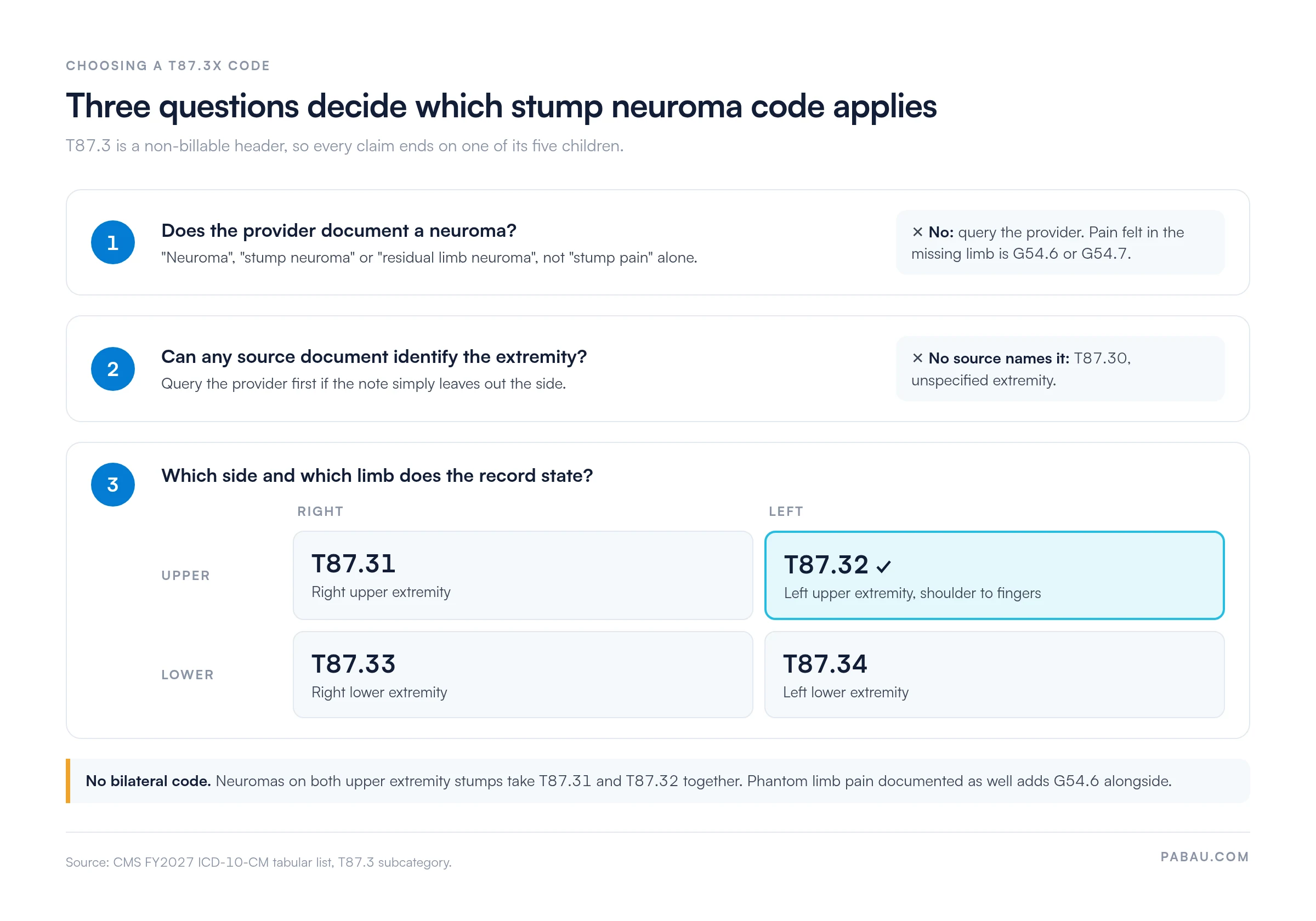
T87.32 is one of five billable codes within the T87.3 subcategory. Laterality is specified in the operative note, clinical assessment, or discharge summary. The coder must confirm which side and which limb before selecting the code.
T87.30 covers a stump neuroma when no available source document identifies the extremity. Notes that simply omit the side call for a provider query first. The subcategory has no bilateral code, so neuromas on both upper extremity stumps take T87.31 and T87.32 together.
Three questions settle which T87.3x code a claim carries, in the order shown below.
Stump neuroma (T87.32) and phantom limb syndrome (G54.6 with pain, G54.7 without pain) are distinct diagnoses that often occur in the same patient.
A stump neuroma is a localized lesion at the residual limb. Phantom limb syndrome is sensation or pain perceived in the part of the limb that is gone. The coding question is which of the two the record documents.
When a note describes amputation-related pain without saying where it is felt or what the exam found, query the provider before coding.
Assigning T87.32 for pain felt in the missing hand creates a diagnosis the record does not support. So does assigning G54.6 for a tender nodule at the stump. When the note documents both, both codes belong on the claim.
A clean claim for T87.32 depends on five elements being explicit in the medical record. Missing any one of them gives the payer grounds to deny on medical necessity or insufficient documentation.
Maintaining consistent documentation across the record also supports clean claim submission. When the encounter note, problem list, and plan of care use the same diagnostic language, the claim rarely triggers a payer edit.
Before coding T87.32, run a three-point check on the note: (1) Does the provider use the word ‘neuroma’ or an accepted synonym? (2) Is ‘left’ stated explicitly for the upper extremity? (3) Is there a reference to the prior amputation or a Z89.x status code in the problem list? All three must be present. If any is missing, query the provider before submitting the claim.
T87.32 is a diagnosis code, not a procedure code. It supports the medical necessity of the CPT procedure being billed on the same claim. The table below lists CPT codes that practices frequently bill with ICD-10 Code T87.32, based on standard coding practice for stump neuroma management. Verify specific CPT descriptors against the current AMA CPT codebook before submission.
Medicare covers treatment for stump neuromas when the service is medically necessary and the documentation supports the diagnosis. Coverage is governed by applicable Local Coverage Determinations (LCDs) administered by the Medicare Administrative Contractor (MAC) for the provider’s jurisdiction.
There is no single national LCD for stump neuroma. Check the CMS ICD-10 coding and billing page for applicable LCDs and coverage policies.
Prosthetics, physical therapy, and rehabilitation practices see T87.32 most often. It typically appears at prosthetic fitting encounters and post-surgical follow-up visits.
T87.32 denials cluster around three root causes: the wrong code level, missing laterality, and notes that never separate stump neuroma from phantom limb pain. Recognizing the pattern before submission is faster than appealing after the fact.
Most T87.32 denials are fixed with a clean resubmission rather than a formal appeal. That holds when the root cause is a documentation or coding error, not a coverage exclusion.
Systematic denial management workflows track T87.32 denials by reason code. They show whether the root cause sits in documentation training or in a payer policy that needs a coverage escalation.
These practical checks prevent the most common T87.32 errors before a claim leaves the practice.
Many billing teams still check T87.32 claims by hand. They read the encounter note, match the CPT code, and look up payer rules before each submission, and errors still slip through as denials.
Pabau, the practice management platform we build, moves that checking into the claim itself. Its software for billing teams validates each claim before submission, so an invalid T87.3 parent code is flagged before the payer sees it.
Claims go out through the Claim.MD clearinghouse integration, which reaches thousands of US payers and adds eligibility checks and electronic remittance advice.
The result is fewer rejected claims and less time spent on corrected resubmissions and appeals.

Pabau’s claims management software integrates with the Claim.MD clearinghouse, giving your billing team claim validation, real-time eligibility checks, and electronic remittance advice. Submit cleaner claims and catch errors before they reach the payer.

ICD-10 Code T87.32 rewards precise documentation: a confirmed neuroma, a stated left side, and an upper extremity site. Phantom limb syndrome sits beside it as a second diagnosis, reported whenever the provider documents it.
Coders who read the Excludes2 notes correctly send claims that match the record, and those claims get paid. To see how Pabau supports that workflow from note to remittance, book a demo.

Want to learn how clearinghouse submission works? Medical claims clearinghouse guide explains how claims move from practice to payer and where T87.32 edits are caught.
Working a lower extremity amputation instead? ICD-10 code T87.33 covers neuroma of the right lower extremity stump.
ICD-10 Code T87.32 is the billable diagnosis code for neuroma of amputation stump, left upper extremity. It describes a painful nerve overgrowth at the residual limb after amputation of any segment of the left arm, from shoulder to fingers. It sits within the T87.3 subcategory and requires confirmation of the diagnosis in the medical record before it can be submitted on a claim.
Yes, T87.32 is a fully billable, specific ICD-10-CM code valid for reimbursement submission. Unlike its non-billable parent T87.3, T87.32 carries a full anatomical descriptor. It may be used as a primary or secondary diagnosis on professional and facility claims.
T87.31 covers neuroma of amputation stump on the right upper extremity, while T87.32 covers the left upper extremity. Both are billable and otherwise identical in descriptor structure. The laterality must be confirmed in the medical record; selecting the wrong side is a correctable coding error that typically requires a corrected claim resubmission.
Stump neuroma (T87.32) is localized pain from abnormal nerve tissue at the residual limb, reproducible by direct pressure. It is coded in the injury chapter. Phantom limb syndrome (G54.6 with pain, G54.7 without) is sensation or pain perceived in the absent limb segment, coded in the nervous system chapter. No Excludes1 note separates them, so both may appear on the same claim when the provider documents both.
No. The T87 category does not have 7th character extensions in ICD-10-CM. T87.32 is complete as a five-character code and requires no encounter type suffix. This distinguishes it from many other injury-chapter codes in the S00-T88 range that do require 7th character designation.
CPT 64774 (cutaneous nerve neuroma excision) and CPT 64776 (digital nerve neuroma excision, same digit) are the most common surgical codes paired with T87.32. Outpatient evaluation visits use CPT 99213 or 99214. Verify all CPT descriptors against the current AMA CPT codebook, as specific procedure indications and code definitions change annually.