

HCPCS code E0198: Water pressure pad billing guide
HCPCS code E0198 is a water pad for a standard mattress HCPCS code E0198 is the ...

Last Updated: Oct 13, 2026
A6030 is the CCSD code for transection of peripheral nerve for neuroma. It covers surgery in which the surgeon divides a peripheral nerve proximal to a painful neuroma, after conservative treatment has failed. The cut end is then buried in protected tissue, such as nearby muscle.
The code sits in the peripheral nerves section of the CCSD schedule, beside the decompression, excision and repair codes. Assignment turns on the operative note, which must show the nerve was divided rather than released. Division of a major nerve is coded A6080 instead.
Let Pabau's smart automation suggest the right codes, reduce claim denials, and keep your practice compliant—effortlessly.
Automate repetitive tasks and focus on what matters most—your patients.
Reduce coding errors and ensure compliance with the latest regulations.
Clean claims, fewer denials, and faster reimbursements.
Powerful insights and reporting to help your practice thrive.
HIPAA compliant SOC 2 certified GDPR-compliant Trusted by 4,000+ clinics worldwide

CCSD code A6030 describes surgical transection of a peripheral nerve to treat a painful neuroma, not nerve decompression or excision of a nerve lesion.
Division of a major nerve is coded A6080, and cryosurgery of a minor peripheral nerve is A6012, which Bupa won’t accept alongside A6030.
Pair A6030 with the most specific ICD-10 code: G57.6 for Morton’s metatarsalgia, T87.3 for a stump neuroma, or G57.8 or G56.8 for other neuromas.
Most UK private insurers require pre-authorization before elective nerve surgery. Send evidence of failed conservative management with the request.
Pabau, the practice management platform we build, attaches operative notes and ICD-10 codes to each CCSD claim, so submissions go out complete.
CCSD code A6030 covers the surgical transection of a peripheral nerve performed specifically to treat a neuroma. The official descriptor is “Transection of peripheral nerve for neuroma.” In practice, the surgeon identifies the affected nerve, confirms the neuroma, and divides the nerve proximal to it. The cut end then sits away from the area of chronic irritation.
The procedure is distinct from nerve decompression, in which the nerve is released from scar tissue or a constricting structure but left intact. It is also distinct from excision of a lesion of the nerve, which has its own codes. When the nerve is cut and that division treats the neuroma, A6030 applies.
Orthopedic surgeons, podiatric surgeons, plastic surgeons, and neurosurgeons all bill A6030, depending on the anatomical territory involved. The code sits within the peripheral nerve section of the CCSD schedule and is recognized across the major UK private medical insurers.
Surgical transection for neuroma begins after failed conservative management has been documented. The surgeon approaches the nerve through an open incision (or, less commonly, endoscopically) and traces it to the neuroma.
Once the diagnosis is confirmed visually, the nerve is divided cleanly proximal to the neuroma. The proximal stump then retracts into protected tissue, typically an adjacent muscle belly or deep soft tissue.
Common nerve types addressed under this code include:
The anatomical site does not change the code, but it must be documented clearly in the operative report.
Operative notes often use “transection” and “nerve division” interchangeably, and A6030 covers either wording when a peripheral nerve was divided to treat a neuroma. “Neurectomy” is a different matter. Division of a major nerve is coded A6080, Neurectomy (major nerve), rather than A6030. What matters is which nerve was divided, and that it was divided rather than decompressed or explored.
The procedure is indicated when a painful neuroma has not responded to conservative measures and surgery is the agreed plan. Accepted indications include:
A6030 is not appropriate for nerve pain managed without surgical division, or for carpal tunnel or cubital tunnel decompression, which use separate decompression codes. Nor does it cover tumor excision where the nerve is not divided.
A nerve released at an earlier operation and compressed again by scar tissue takes A6900, the revision code. Repeat carpal tunnel and cubital tunnel releases are the operations most often billed under it.
If the operative record does not confirm that the nerve was transected, the claim will not satisfy the A6030 descriptor and should be coded differently.
A mismatch between the ICD-10 diagnosis and the CCSD procedure code is a common trigger for claim denial. Submit the most specific ICD-10 code available for the patient’s neuroma type and anatomical location. The table below lists the codes most commonly paired with A6030.
Confirm ICD-10 code descriptions against the WHO’s ICD-10 browser for the current coding year. Codes should reflect the patient’s confirmed diagnosis rather than a presenting symptom, and the clinical notes should describe the same condition as the code submitted.
The US version, ICD-10-CM, splits the stump neuroma code by limb and side. A US-coded record for a right leg stump neuroma would carry T87.33, for example, while UK insurers work from the WHO code T87.3.
Several codes sit near A6030 in the CCSD schedule and cover adjacent peripheral nerve procedures. Picking the wrong one is a straightforward route to denial. The decision path below starts from one question, which is what the surgeon did to the nerve.
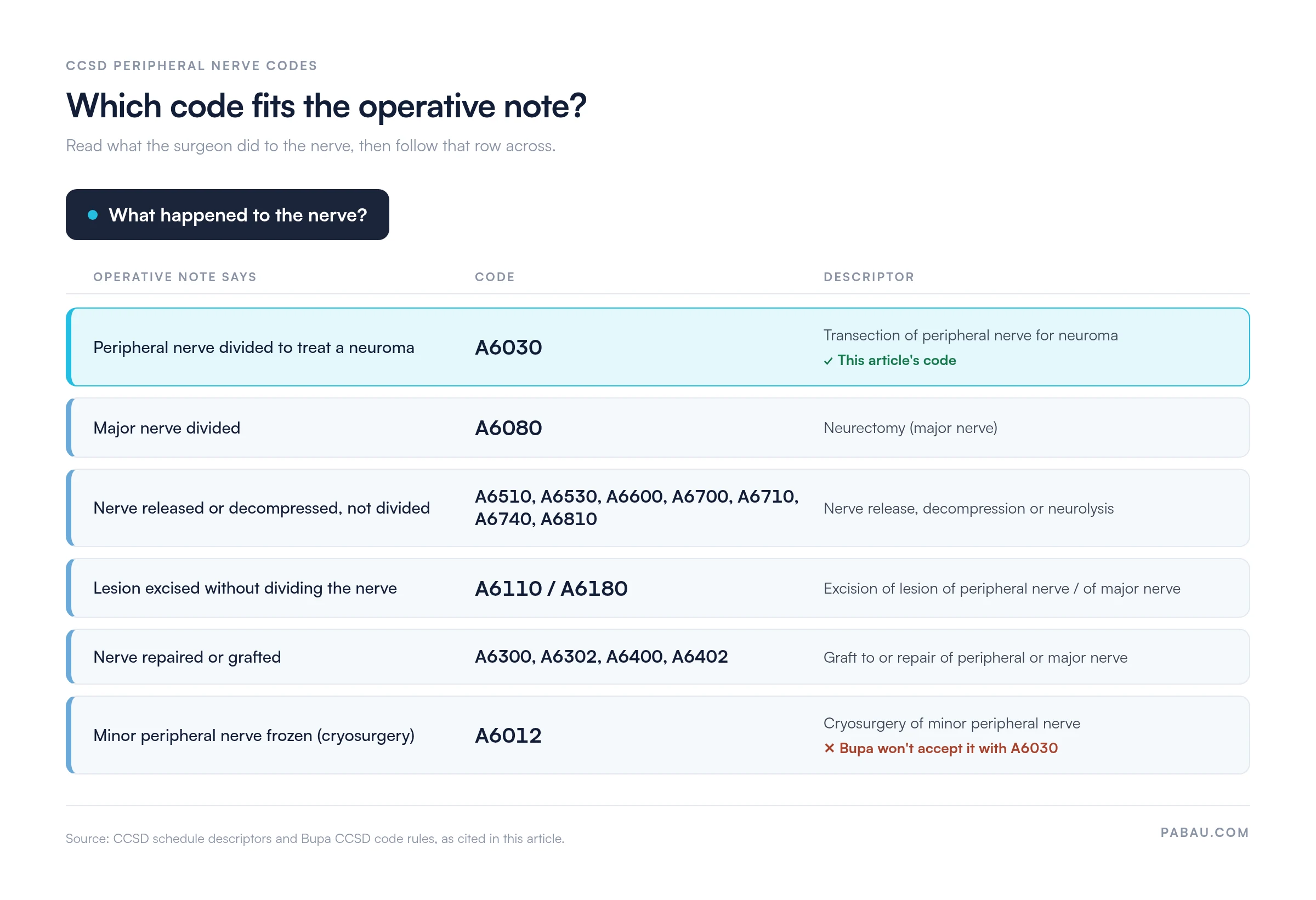
The table below sets the same codes side by side, with the point at which each one replaces A6030.
Each neighboring procedure has its own descriptor and billing rules, and our CCSD codes library covers them one by one. If the surgeon repairs the nerve rather than leaving the stump buried, start with A6400.
Our guide to Bupa CCSD codes explains how that insurer applies bundling and unbundling rules across the schedule. The CCSD official schedule is the primary source for current descriptors and any mid-year updates.
Operative notes sometimes say ‘excision of Morton’s neuroma’ when the surgeon divided the nerve to treat it. Clarify the wording before submitting. Insurers code from the operative report language. A note that says only ‘excision’ may trigger the wrong code review and end in repudiation, even though A6030 was the correct CCSD code.
When more than one peripheral nerve is transected in the same session, each nerve may be billed separately under A6030. The insurer’s scheme rules still apply. Payers differ in how they apply multiple-procedure discounts and whether they require a modifier to flag bilateral or multiple-nerve billing.
The general approach is to submit one unit of A6030 per nerve transected. The operative report should identify each nerve by name and confirm that each was addressed by transection.
Some insurers apply a percentage reduction (commonly 50 percent) to the second and subsequent procedures in the same session. Verify the scheme rules with each insurer before submitting, as they vary and change with annual tariff updates.
For bilateral procedures, such as bilateral Morton’s neuromas addressed in a single operation, add the bilateral modifier the insurer requires. Document both sides explicitly in the operative report, including laterality and the nerve name on each side.
The operative report is the primary document payers request when auditing an A6030 claim. It must be specific enough to confirm that the procedure matches the code descriptor. Missing or vague documentation is a common cause of claim disputes for peripheral nerve procedures.
A complete operative record for A6030 should include:
Patient records kept before, during, and after the procedure build the audit trail that supports both the initial claim and any appeal. Insurers conducting a review expect clinical notes spanning the conservative management period, the operative report, and the post-operative assessment.
Most UK private medical insurers classify peripheral nerve surgery as an elective procedure that needs pre-authorization before the operation takes place. Submitting a claim without the required authorization reference is a common cause of non-payment.
Pre-authorization requests for A6030 typically require:
Turnaround for pre-authorization decisions varies by insurer, from 24 hours for straightforward requests to five to ten working days where clinical review is required. Strong medical billing compliance means tracking authorization status for each patient before the procedure date, not after.
A6030 claims can be denied when the operative documentation leaves out a required detail or an adjacent code is used by mistake. The most common denial reasons for CCSD code A6030 claims and their corrections are listed below.
For appeals, attach the full operative report, the pre-operative clinical letter, and any imaging reports in a single submission. Reference the insurer’s clinical policy for peripheral nerve surgery and show how the case meets each criterion.
Effective denial management strategies treat each repudiated claim as a structured audit. Identify the failure point, correct it with documentary evidence, and resubmit within the insurer’s appeal window.
Reimbursement for A6030 is set by the insurer’s applicable fee schedule, not by a fixed universal tariff. Each UK private insurer maintains its own schedule of procedure fees. The amount paid for A6030 will differ between Bupa, AXA Health, Aviva, VitalityHealth, WPA, Cigna, and Healix.
Verify the current procedure fee for A6030 directly with each insurer at the start of each policy year, as fee schedules are typically updated annually.
The Healix fee schedule and the VitalityHealth fee guidelines let practitioners look up current reimbursement figures by CCSD code. For Bupa, use the Bupa code search tool to confirm the fee and any scheme-specific billing rules that apply to A6030.
Where a specialist has a recognized consultant agreement with the insurer, the contracted fee applies. Where no agreement exists, many insurers apply their standard schedule rate, which may differ from the consultant’s usual fee. Balance billing practices vary by insurer and must comply with the insurer’s recognition terms.
Many surgical practices track an A6030 claim across a paper diary, a shared drive of operative notes, and the insurer’s portal. When an insurer asks for the conservative treatment history, someone has to rebuild it from all three.
In Pabau’s claims management software, your billing team assigns the CCSD code and its paired ICD-10 code to each encounter. Operative reports and pre-authorization numbers attach to the same patient record, and claim status is tracked through to payment or denial.
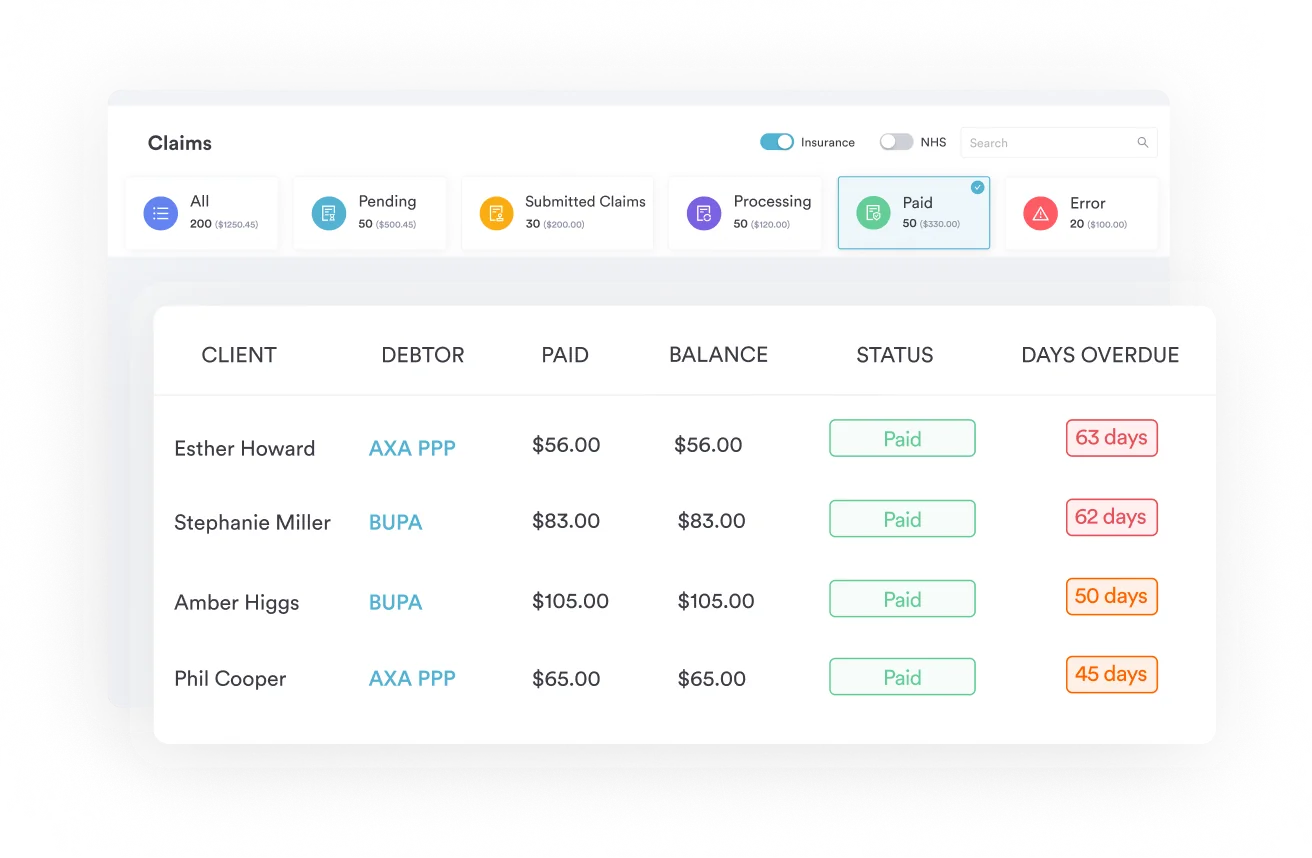
Reporting then shows denial patterns by code and insurer. If one insurer keeps rejecting A6030 for thin operative notes, the report shows it before the next appeal does.
Set up a pre-operative checklist in Pabau for every A6030 procedure. Confirm the ICD-10 code is selected, record the pre-authorization reference number, and assign the operative note template. Run this check before the surgery date, and your billing team can submit the claim the same day the operative report is signed.

Pabau lets your team attach ICD-10 codes, store operative reports, and track pre-authorization against every appointment, so claims go out complete the first time.

An A6030 claim is won or lost in the operative note. When the surgeon names the nerve, confirms the neuroma and records the division, the code choice follows and appeals become rare.
So start with the note. Agree an operative note template with your surgeons, and check each note against A6080, A6012 and the decompression codes before you submit. Confirm pre-authorization before the surgery date is booked. That adds a few minutes per case, and those minutes cost less than one repudiated claim.
Book a demo to see how Pabau keeps operative notes, codes and pre-authorization numbers on one claim for your surgical practice.

Need a reference for CCSD codes used by Bupa? Bupa CCSD codes walks through how Bupa applies the CCSD schedule, fee structure, and submission requirements.
Did the surgeon repair the nerve instead? CCSD code A6400 covers peripheral nerve repair coding and the denials that follow it.
Billing a different neuroma procedure? CCSD code A2952 explains how acoustic neuroma excision is coded and billed.
Want to reduce claim errors across your whole practice? Claims management software shows how Pabau handles CCSD code assignment, ICD pairing, and denial tracking in one workflow.
Managing billing compliance across multiple practitioners? Medical billing compliance covers the documentation and audit standards relevant to private surgical practices.
CCSD code A6030 covers surgical transection of a peripheral nerve to treat a painful neuroma. Its official descriptor is “Transection of peripheral nerve for neuroma.” The code applies when the surgeon divides the nerve proximal to the neuroma. It does not apply when the nerve is only decompressed or a nerve lesion is excised without division.
Use G57.6 for Morton’s metatarsalgia (interdigital neuroma of the forefoot), G57.8 for other lower-limb nerve neuromas, or G56.8 for upper-limb nerve neuromas. A stump neuroma after amputation takes T87.3. Avoid non-specific codes such as M79.2 unless no more precise code applies, as a vague diagnosis code is a common cause of claim denial.
Yes, most UK private medical insurers require pre-authorization before elective peripheral nerve surgery. Submit a consultant’s clinical letter, evidence of failed conservative management, and imaging or clinical findings alongside the ICD-10 and CCSD codes. Proceeding without an authorization reference number is a common cause of outright non-payment.
A6030 can generally be submitted once per nerve transected in the same session, subject to the insurer’s multiple-procedure rules. Those rules commonly apply a 50 percent reduction to the second and subsequent procedures. Each nerve must be named and documented separately in the operative report, so confirm the scheme rules with each insurer before submitting.
Yes, where the surgical treatment of Morton’s neuroma involves transection of the affected interdigital nerve, A6030 is the correct code. Pair it with ICD-10 code G57.6 (Lesion of plantar nerve). Cryosurgery of the nerve is A6012 instead, and Bupa won’t accept A6012 and A6030 together. Neurolysis or release without nerve division takes a decompression code.
A6030 covers transection of the nerve itself to treat the neuroma by division. Excision codes cover removal of a lesion of the nerve, using A6110 for a peripheral nerve and A6180 for a major nerve. The operative technique decides the code: If the nerve was cut to treat the neuroma, A6030 is correct. If only the lesion was excised, use the excision code.



