ICD-10 code T43.604S: Psychostimulant poisoning sequela
What does ICD-10 code T43.604S cover? ICD-10 code T43.604S covers the late effec...

Last Updated: Oct 22, 2026
Billable Code Specific Code
T86.03 is the billable ICD-10-CM code for bone marrow transplant infection. It applies when the physician documents an infection that affects the transplanted marrow and links it to the graft.
The code never goes out alone. A second code names the infection, such as B25.- for cytomegaloviral disease or B44.0 for invasive pulmonary aspergillosis. Z94.81 stays off the claim, because T86.03 already shows the transplant. Get that pairing right and a costly transplant claim keeps moving. Below are the graft-source check, sepsis sequencing and the six errors behind denials.
Let Pabau's smart automation suggest the right codes, reduce claim denials, and keep your practice compliant—effortlessly.
Automate repetitive tasks and focus on what matters most—your patients.
Reduce coding errors and ensure compliance with the latest regulations.
Clean claims, fewer denials, and faster reimbursements.
Powerful insights and reporting to help your practice thrive.
HIPAA compliant SOC 2 certified GDPR-compliant Trusted by 4,000+ clinics worldwide

T86.03 is the billable ICD-10-CM code for an infection of a bone marrow transplant, valid for FY2027 with no 7th character.
Assign it only when the physician links the infection to the graft, and add a second code that names the infection.
Leave Z94.81 off a T86.03 claim, because the complication code already shows the transplant status.
Stem cells from peripheral blood or cord blood move the complication to T86.5, so confirm the graft source first.
An infection that doesn’t affect the graft gets its own code, with Z94.81 for the transplant status instead of T86.03.
ICD-10 code T86.03 is the billable code for bone marrow transplant infection. Use it when the physician documents an infection that affects the transplanted marrow and states that link. It’s one of five codes under T86.0, Complications of bone marrow transplant.
The code sits in Chapter 19 of ICD-10-CM, in category T86 for complications of transplanted organs and tissue. You can browse its neighbors in our ICD-10-CM codes library. The FY2027 code set from CMS, effective October 1, 2026, keeps T86.03 valid and unchanged.
T86.03 never travels alone. The ICD-10-CM Official Guidelines, Section I.C.19.g.3.a, require two codes for a transplant complication. The first is the T86 code, and the second identifies the complication, which here is the infection itself.
Each T86.0 code answers one question about the marrow graft: what went wrong? The table sets the five codes side by side, so you can rule them out quickly.
An infection can sit alongside another complication. If the physician documents both an infection and graft failure, report T86.02 with T86.03 rather than picking one. Documented rejection goes to T86.01.
Two codes catch the leftovers. A note that only says “BMT complication” belongs to T86.00 until a query names the type. A named complication that isn’t rejection, failure or infection goes to T86.09.
Before you open T86.0, check where the donor cells came from. ICD-10-CM separates marrow grafts from stem cells collected any other way:
T86.5 is a single code with no infection subcode. You still add the code that names the infection. Many transplant teams now collect stem cells from blood, so “stem cell transplant” in a note doesn’t prove a marrow code. Query the physician when the source isn’t stated.
A marrow recipient stays immunosuppressed for months, so infections are common after transplant. Most of them don’t make T86.03 the right code. The guidelines assign a transplant complication code only when the complication affects the function of the transplanted organ.
The decision path below runs the three checks in order, from graft source to sequencing.
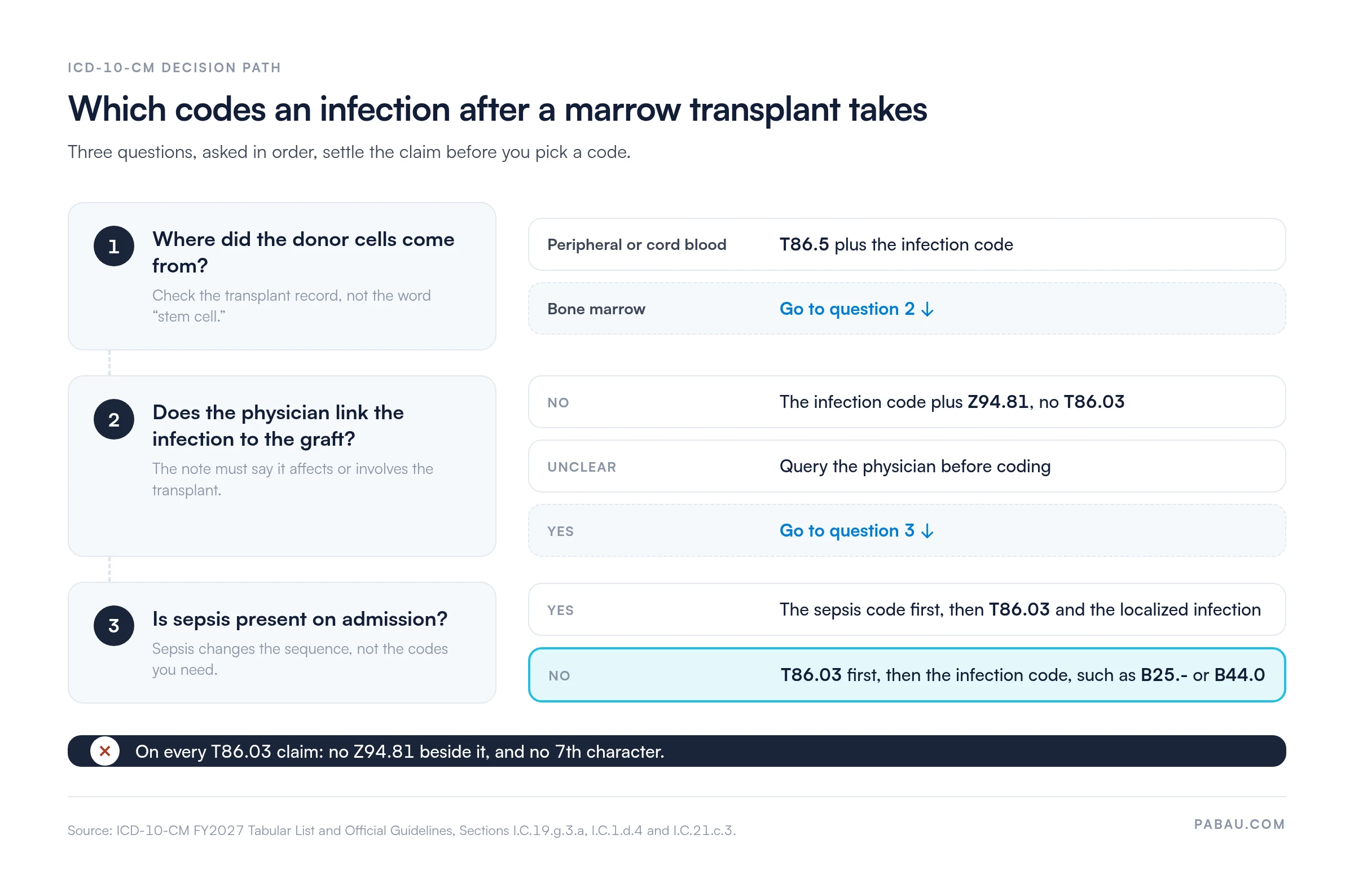
That puts the decision with the physician. The note has to say the infection involves or affects the graft. Here’s how common documentation maps to codes.
The central line row trips coders most often. T80.211A is the code for a bloodstream infection due to a central venous catheter, and it carries a 7th character. T86.03 has none, so the two codes are easy to tell apart on a claim.
Add one question to your post-transplant infection query: does this infection affect the graft? A yes supports T86.03 with the infection code. A no sends the claim to the infection code with Z94.81.
T86.03 says the graft is infected, but not with what. The second code names the organism or the condition. In the FY2027 Tabular List, kidney (T86.13) and liver (T86.43) transplant infections carry a “use additional code” note. T86.03 has no such note, yet the two-code guideline still applies.
Common partner codes after a marrow transplant include:
Sequencing follows the reason for the encounter. When the infected graft brings the patient in, T86.03 goes first and the infection code follows. Sepsis changes the order. The transplant guideline points to Section I.C.1.d.4, which puts the systemic infection first when sepsis is present on admission.
Add a code from R65.2- when the physician documents severe sepsis. T86.03 itself is complete at five characters. T86 codes take no 7th character, so T86.03XA isn’t valid and fails front-end claim edits.
Z94.81 is bone marrow transplant status. It looks like a natural partner for T86.03, but the classification blocks the pairing in two places:
So Z94.81 belongs on encounters where the transplant is background, not the problem. Use it for an infection that doesn’t affect the graft, or for a visit with no complication. A blood stem cell recipient takes Z94.84 in the same situations.
Long-term drug therapy codes are different, because they add detail the T86 code lacks. Report them when the physician documents the regimen:
Payers and auditors look for a clear chain from the transplant to the infection. Run these five checks against the record before the claim goes out.
A positive CMV PCR, for example, needs the provider’s interpretation in the note before it becomes a diagnosis. When the record is unclear, query during the stay. An addendum written after a denial is much harder to defend on audit.
T86.03 isn’t on the FY2027 POA-exempt list, so inpatient claims need a present-on-admission indicator. Report “Y” when the infection was present at admission and “N” when it developed during the stay. Ask the physician when the timing isn’t clear.
Risk adjustment adds one more reason to code it well. In the CMS 2027 ICD-10 mappings, T86.03 maps to HCC 454 in the V28 model. Z94.81 maps to the same HCC, so leaving it off a T86.03 claim costs no risk score credit.
A transplant infection claim passes several checkpoints before it’s paid. Each one can stall it, so it helps to know where they sit.
A rejection at the front-end edit is the cheapest one to fix. The claim hasn’t reached the payer yet, so a corrected code goes straight back out.
Each of these errors is easy to catch at the coding step, long before a payer sees the claim.
Tracking which of these keeps coming back shows where documentation needs work. A denial management workflow turns those patterns into fixes at the source.
Transplant admissions are costly, so a stalled claim is costly too. The usual problem is visibility. A rejected or unpaid claim sits in a payer portal until someone thinks to check it.
Pabau, the practice management platform we build, handles claim submission and tracking in one place. Its claims management software sends claims electronically through Claim.MD in the US, Healthcode in the UK and Tyro in Australia.
Each submitted claim then carries a status, such as paid, unpaid or reissued. Your billing team sees which T86.03 claims need follow-up, while coders keep ownership of the code choice.


Pabau submits claims through Claim.MD, Healthcode and Tyro, then tracks each one by status. Unpaid transplant claims surface for follow-up instead of going stale.

T86.03 asks coders two questions before they code. Did the cells come from marrow, and did the infection affect the graft? A yes to both, plus the infection code, makes a claim you can defend.
The trade-off sits with Z94.81. Leaving the status code off can feel like losing detail, but the classification bars it here and the HCC credit stays the same. Put the graft question into your query template, and fewer claims come back.
Book a demo to see how Pabau submits transplant claims and tracks each one until it’s paid.

Need a framework for handling claim denials systematically? Denial codes in medical billing walks through the most common CARC codes and the workflows that resolve them fastest.
Want to understand how clearinghouses handle ICD-10 claims? Medical claims clearinghouse explains how electronic claim scrubbing works and what gets flagged before a claim reaches the payer.
Looking for a structured approach to revenue cycle management? What is revenue cycle management covers the end-to-end billing process from coding through payment posting.
Coding an infected kidney graft instead? T86.13 covers kidney transplant infection, with the same two-code rule and the same status-code bar.
T86.03 is the billable ICD-10-CM code for bone marrow transplant infection. It applies when the physician documents an infection that affects the transplanted marrow, with a second code naming the infection.
No. Category Z94 carries an Excludes1 note for complications of transplanted organs and tissue. The guidelines also bar a status code when the diagnosis code already shows that status.
Yes, as long as the cells came from marrow. The T86.0 codes don’t separate a patient’s own marrow from a donor’s, so the note only needs to state the graft source.
Graft-versus-host disease (GVHD) isn’t an infection, so T86.03 doesn’t fit it. Code the transplant complication first, as the D89.81 note instructs. Then add D89.810 for acute, D89.811 for chronic, D89.812 for acute on chronic or D89.813 for unspecified GVHD.
ICD-9-CM used one code, 996.85, for every complication of a bone marrow transplant, infection included. ICD-10-CM split it into the five T86.0 codes, so claims since October 1, 2015 need T86.03.
Yes. In the CMS-HCC V28 model, T86.03 maps to HCC 454, which covers stem cell and bone marrow transplant status and complications. Z94.81 maps to the same HCC.