ICD-10 Code Y76.0: Diagnostic obstetric and gynecological devices
ICD-10 Code Y76.0: Definition and billable status ICD-10 Code Y76.0 is a valid, ...

Last Updated: Oct 23, 2026
Billable Code Specific Code
T86.02 is the billable ICD-10-CM code for bone marrow transplant failure.
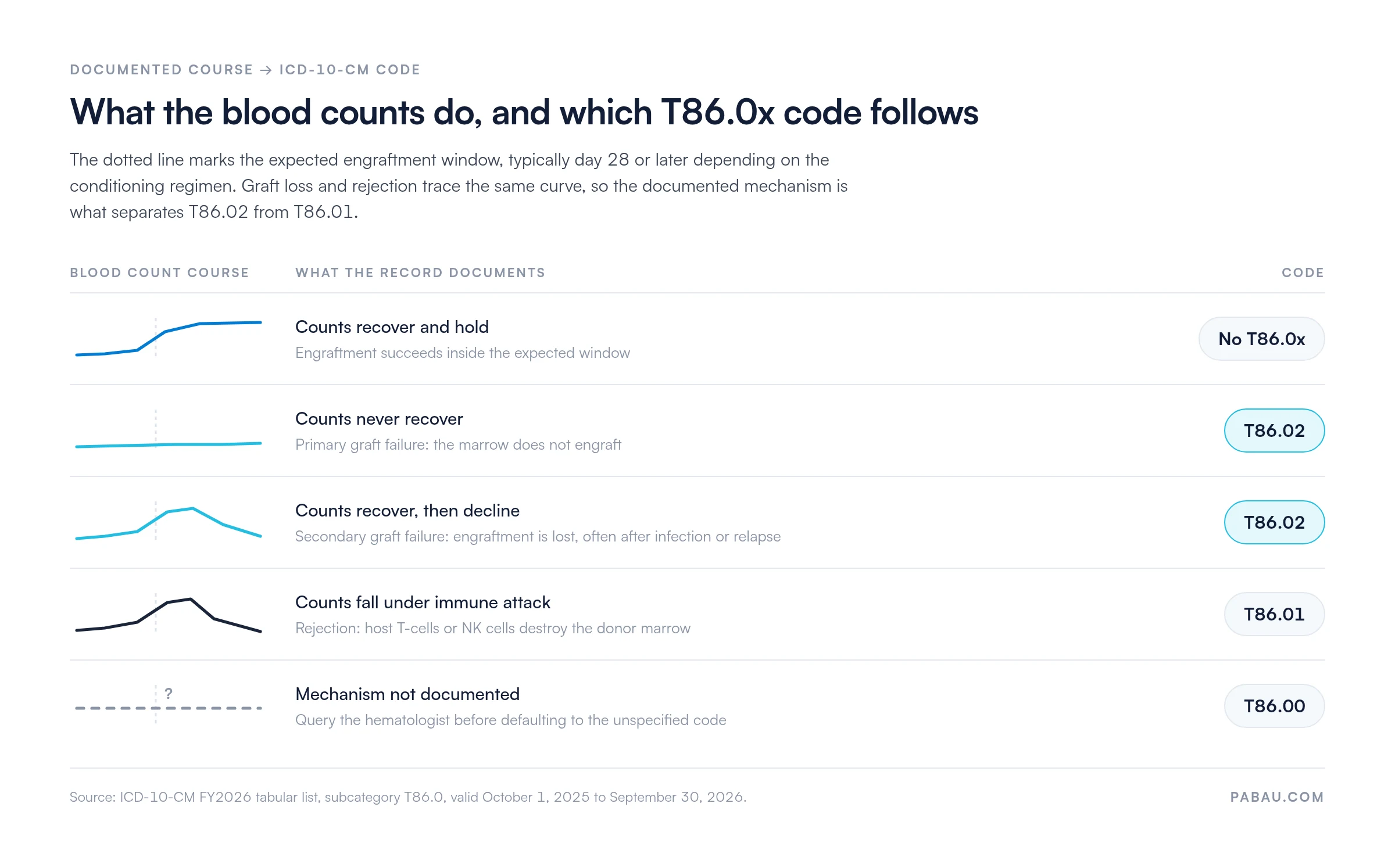
Coders frequently confuse T86.02 with T86.01, which codes rejection. T86.02 applies when the donor marrow does not engraft, or when engraftment is lost after it happens. T86.01 applies when the host immune system attacks and destroys the graft.
Let Pabau's smart automation suggest the right codes, reduce claim denials, and keep your practice compliant—effortlessly.
Automate repetitive tasks and focus on what matters most—your patients.
Reduce coding errors and ensure compliance with the latest regulations.
Clean claims, fewer denials, and faster reimbursements.
Powerful insights and reporting to help your practice thrive.
HIPAA compliant SOC 2 certified GDPR-compliant Trusted by 4,000+ clinics worldwide

T86.02 is a billable ICD-10-CM code for bone marrow transplant failure, covering both primary and secondary graft failure subtypes.
It is valid for fiscal year 2026 (October 1, 2025 through September 30, 2026) and accepted for HIPAA-covered electronic transactions.
T86.02 codes graft failure, where the marrow does not engraft or engraftment is lost after it happens.
T86.01 codes rejection, an immune-mediated attack on the graft, so selecting the wrong code misrepresents the clinical event.
Practice management software like Pabau supports accurate ICD-10-CM code submission and electronic claim routing for hematology and oncology practices.
T86.02 is a specific, billable ICD-10-CM code. The table below captures every field a coder or biller needs to confirm before submitting a claim.
The CDC/NCHS ICD-10-CM web tool confirms fiscal year validity and billable status for the current code year. Always verify against the active tabular list before submitting.
Bone marrow transplant failure, coded as T86.02, occurs when the transplanted hematopoietic stem cells do not produce adequate blood cell counts in the recipient. Two subtypes are captured under this code:
Both primary and secondary graft failure are coded T86.02 under the ICD-10-CM tabular structure. The subtype changes the clinical picture without changing the code. Rejection is a separate event, and it routes to T86.01. Plotting the post-transplant courses side by side shows how far the documentation has to carry the code selection.
The SNOMED CT browser maps related hematopoietic stem cell transplant complications, which helps practices that report in both SNOMED CT and ICD-10-CM.
ICD-10-CM inclusion terms guide coders toward T86.02 when a diagnosis is documented using clinical language rather than the code’s official description. The following terms and synonyms map to T86.02:
When the attending physician documents any of these phrases in the discharge summary or clinical note, T86.02 is the correct ICD-10-CM code to assign. That holds provided the documentation supports failure rather than rejection. See the failure versus rejection rules below.
T86.02 sits within the ICD-10-CM chapter structure as follows:
Category T86 also covers complications of transplanted kidney (T86.1x), heart (T86.2x), lung (T86.3x), liver (T86.4x), skin (T86.8x), and other organs. A post-transplant complication in another organ therefore leaves the T86.0x subcategory entirely.
The T86.0x subcategory covers five distinct bone marrow transplant complication codes. Using the most specific code available is required under ICD-10-CM Official Guidelines.
T86.00 is a valid last resort when the physician documents a BMT complication without naming the type. Most payers require greater specificity, so query the physician before defaulting to the unspecified code. Our ICD-10-CM code reference covers the neighboring categories a transplant admission tends to pull in.
Graft failure and graft rejection are distinct events, and the ICD-10-CM code selection must reflect exactly what the physician documented. Selecting the wrong code changes the coded diagnosis, affects DRG assignment, and can trigger payer denials on medical necessity or clinical inconsistency grounds.
If the record is ambiguous, a clinical documentation integrity (CDI) query to the attending hematologist is warranted before code assignment. Never assume failure when rejection is clinically possible, or vice versa. A complication that fits neither event belongs under T86.09, the other-specified code in the same subcategory. Solid denial management starts at this documentation step.
Run a CDI query whenever the discharge summary says only ‘BMT complication’ or ‘graft problem’ without naming the mechanism. The physician’s clarification decides between T86.01, T86.02, T86.03 and T86.09, and each carries different DRG implications.
The ICD-10-CM Official Guidelines for Coding and Reporting govern how T86.02 is sequenced and what additional codes must accompany it. Key rules for hematology and oncology coders:
For facilities submitting claims electronically, T86.02 has to travel with the matching DRG and modifier combination. Cleaner claims management at that step keeps a transplant complication encounter from coming back as a rebill.
Documentation the coder needs to assign T86.02 with confidence:
Payer rules for transplant complication codes vary. Some commercial plans require pre-authorization documentation to accompany claims for post-transplant complication management, so confirm the payer’s requirement before the claim is built.
T86.02 rarely appears on a claim by itself. Hematology encounters for bone marrow transplant failure typically involve multiple concurrent diagnoses, each requiring its own code.
Graft-versus-host disease (GVHD) is coded separately from graft failure. GVHD represents the donor immune cells attacking the host, while graft failure (T86.02) represents the failure of donor cells to establish. They can co-exist but are clinically and mechanistically distinct. According to the CMS ICD-10-CM codes page, GVHD subcodes include:
When GVHD occurs alongside documented graft failure, code both T86.02 and the appropriate D89.81x. The sequencing follows which condition drove the admission.
A code combination checklist for T86.02 encounters helps coders capture every relevant diagnosis consistently. It also reduces the risk of under-coding a complex hematology case.
T86.02 has been active since the introduction of ICD-10-CM in the United States. The code has not been revised or retired through FY2026.
The AAPC Codify ICD-10-CM lookup provides year-specific code validity and cross-references for the full T86 category. Confirm annual status each October when CMS releases the new code year. A prior-year code on a FY2026 claim is rejected, so flag the October 1 switchover in the billing calendar.
Most hematology practices build a transplant complication claim in two places. The coder assigns T86.02 and its companion codes in the record, then someone re-keys the set into a clearinghouse portal. Every re-key is another chance for the code to drift from what the physician documented.
Pabau carries the coded diagnosis straight from the clinical record onto the claim. Built-in ICD-10-CM and CPT catalogues mean the coder picks T86.02 once. The Claim.MD integration then turns the invoice into an electronic claim, with no clearinghouse portal and no X12 file to build.
That shortens the path between the hematologist’s documentation and the submitted claim. Fewer hands touch the code, so a T86.02 encounter is less likely to reach a payer as T86.01 or T86.00.


Pabau builds the ICD-10-CM code set on the claim inside the patient record, then submits it electronically through Claim.MD. Your coders enter T86.02 once and it travels to the payer unchanged.

Treat the T86.0x selection as a documentation question rather than a coding one. The blood counts will not tell you whether the graft failed or the host rejected it. Neither will the discharge summary, unless the hematologist writes the mechanism down.
Build the query into the workflow at the point the complication is first coded. Waiting until the denial arrives costs a rebill and a second round of documentation.
A practice that queries early submits T86.02 once and keeps the record consistent with what the transplant team saw. Book a demo to see how Pabau moves a coded hematology encounter to the payer without a re-key.

Need to understand how claims route from code to payer? Medical claims clearinghouse guide explains how electronic claim submission works across payer networks.
Coding a denial on a transplant complication claim? Denial codes in medical billing covers the most common CARC codes and how to respond to them.
Submitting 837P claims for complex hematology encounters? 837 file guide breaks down the electronic claim format and common submission errors.
ICD-10 code T86.02 is the billable ICD-10-CM diagnosis code for bone marrow transplant failure, covering both primary non-engraftment and secondary graft failure. It sits under subcategory T86.0 (Complications of bone marrow transplant), within category T86 for complications of transplanted organs and tissue. The code is valid for HIPAA-covered transactions in fiscal year 2026.
Bone marrow transplant failure (T86.02) means the donor marrow did not engraft, or that engraftment was subsequently lost. Infection or relapse is often behind it. Bone marrow transplant rejection (T86.01) is an immune-mediated event where the host’s immune system attacks and destroys the graft. The physician’s documentation must specify which event occurred before the coder assigns either code.
Yes, T86.02 is a fully billable ICD-10-CM code for HIPAA-covered electronic transactions. It is valid for fiscal year 2026, which runs October 1, 2025 through September 30, 2026. The code requires no additional specificity suffix and is complete at five characters.
Graft-versus-host disease (GVHD) is coded from the D89.81x subcategory. Use D89.810 for acute GVHD, D89.811 for chronic, D89.812 for acute-on-chronic, and D89.813 when the type is unspecified. These codes are assigned separately from T86.02 when both conditions are documented.
Use the T86.0x subcategory: T86.00 for unspecified complications, T86.01 for rejection, T86.02 for failure, T86.03 for infection, and T86.09 for other complications. Always sequence the most specific code supported by physician documentation, and add codes for associated conditions (GVHD, underlying hematologic diagnosis, infections) as documented. Query the attending hematologist when documentation is ambiguous.
Yes, T86.02 is valid for fiscal year 2026, covering claims with service dates from October 1, 2025 through September 30, 2026. The code has been active without revision since the US adoption of ICD-10-CM. CMS and NCHS update releases list no scheduled changes for FY2026.