ICD-10 code S61.201A: Open wound of left index finger without nail damage
ICD-10 code S61.201A covers a left index finger wound of unstated type ICD-10 co...

Last Updated: Oct 16, 2026
Billable Code Specific Code
T86.00 is the billable ICD-10-CM code for unspecified complication of bone marrow transplant. It applies when the record confirms a complication of a bone marrow or hematopoietic stem cell transplant. The type of complication is not documented.
The code is not specific to rejection. ICD-10-CM gives rejection its own code, T86.01, and separates failure (T86.02), infection (T86.03) and other complications (T86.09). Assign T86.00 only after the record has been reviewed and no complication type is stated.
Let Pabau's smart automation suggest the right codes, reduce claim denials, and keep your practice compliant—effortlessly.
Automate repetitive tasks and focus on what matters most—your patients.
Reduce coding errors and ensure compliance with the latest regulations.
Clean claims, fewer denials, and faster reimbursements.
Powerful insights and reporting to help your practice thrive.
HIPAA compliant SOC 2 certified GDPR-compliant Trusted by 4,000+ clinics worldwide

T86.00 is the ICD-10-CM code for an unspecified complication of bone marrow transplant, used when the complication type is undocumented.
T86.00 is not a rejection code. Rejection has its own code, T86.01, alongside failure (T86.02) and infection (T86.03).
Do not report Z94.81 with T86.00. An Excludes1 note at Z94 blocks that pair for the same transplant.
T86.0 without a fifth character is a non-billable header and is rejected at adjudication.
Pabau’s claims management software validates ICD-10-CM assignment before submission, so transplant claims reach payers with a complete code set.
ICD-10 code T86.00 is the billable ICD-10-CM diagnosis code for an unspecified complication of bone marrow transplant.
It is the catch-all within the T86.0 subcategory. Use it when the record confirms a complication of a bone marrow or hematopoietic stem cell transplant but never names it. The code sits in Chapter 19 of ICD-10-CM, which covers injury, poisoning, and certain other consequences of external causes (S00–T88).
T86.00 carries no clinical meaning of its own beyond “something went wrong with the graft, and the note does not say what.” That distinction matters on every claim. Four sibling codes carry the specific meanings — rejection, failure, infection, and other complications.
The fourth of those siblings is T86.09, which covers a named complication the subcategory does not list on its own.
Verify current-year billable status against the CDC/NCHS ICD-10-CM web tool before submitting claims for any fiscal year. CMS releases annual tabular list updates each October.
T86.00 covers an encounter where a complication of a bone marrow or hematopoietic stem cell transplant is documented, but the note never names the complication. Three situations appropriately land on T86.00:
The code does not cover the following scenarios. Each one has its own billable code, and each one outranks T86.00 whenever the documentation supports it:
Rejection and GVHD run in opposite directions. In rejection, the host attacks the donor cells. In GVHD, the donor immune cells attack the host. Conflating the two on a claim is both a coding error and a documentation accuracy problem. The CMS ICD-10 coding guidance expects a transplant complication code to match the documented clinical event.
Knowing where T86.00 sits in the ICD-10-CM hierarchy prevents the most common claim error on this family. That error is submitting the non-billable parent T86.0 in place of T86.00. The ladder from chapter to specific code runs as follows:
T86.0 with no trailing digit is a header code, and it will be rejected as invalid. Every claim must carry a five-character code from the family. Practice systems that autofill parent codes create this error silently, so verify the full code string before submission.
T86.0 splits into five five-character codes, and four of them are more specific than T86.00. Coders who work bone marrow transplant encounters regularly need to distinguish the following:
Documentation specificity separates T86.00 from its four siblings, and clinical severity plays no part. A minor documented infection still goes to T86.03. A life-threatening but unnamed graft problem still goes to T86.00. The ladder below shows how a single line in the record moves the encounter between the five codes.
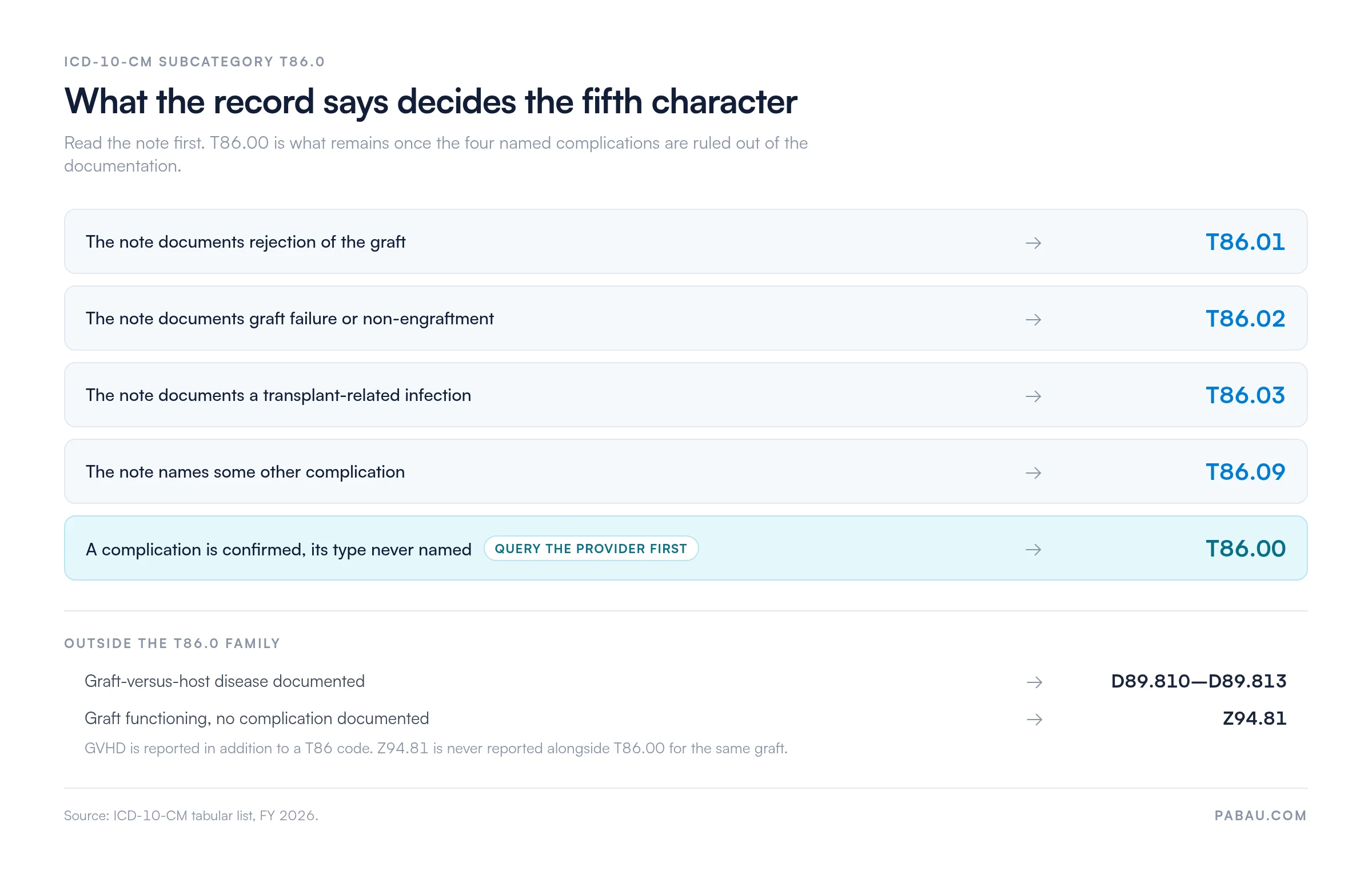
Before coding T86.00, read the pathology report and the attending note for the words rejection, failure, engraftment, or infection. Any one of them moves the encounter to T86.01, T86.02, or T86.03. Assigning T86.00 when a sibling code is supported by the documentation is a specificity error. That kind surfaces in an audit rather than at adjudication.
Coding cheat sheets, EHR pick lists, and online code lookups often label T86.00 as “bone marrow transplant rejection.” The mislabel has a traceable origin in a different classification.
The World Health Organization’s international ICD-10 is the base classification used outside the United States. Its four-character T86.0 is titled “Bone-marrow transplant rejection and graft-versus-host reaction or disease.” Beneath that parent, WHO ICD-10 does carry its own five-character T86.00, and there it means bone-marrow transplant rejection. That code, with that meaning, is where the mislabeling starts.
ICD-10-CM reuses the same five characters for something else. When the United States built its clinical modification, it subdivided T86.0 into the five codes in the table above and narrowed rejection to T86.01. Reference tools that mapped WHO titles onto ICD-10-CM codes carried “rejection” across to a code that no longer means it.
Any US claim, audit, or risk-adjustment submission follows the ICD-10-CM tabular list. There, T86.00 means the complication type was not documented, and nothing more.
T86.00 is appropriate only when the documentation confirms a bone marrow transplant complication and stops short of naming it. The decision logic runs as follows:
The AAPC ICD-10-CM code reference restates the ICD-10-CM Official Guidelines on this point. They discourage routine use of unspecified codes where the documentation supports a more specific one. T86.00 has a legitimate clinical use, because records genuinely do close without a named complication. It should never become a default coding shortcut.
ICD-10-CM Official Guidelines Section I.C.19 governs transplant complication coding. The sequencing rule for T86.00 follows the broader transplant complication framework: when the transplant complication is the reason for the encounter, it sequences first.
Practices can route transplant complication claims electronically through Claim.MD, the US clearinghouse that practice management software like Pabau integrates with. It validates ICD-10-CM codes against current payer edits before submission. Invalid code strings and conflicting pairs get flagged before the claim reaches the payer.
A single transplant encounter can generate more than one code, and the T86 tabular note names the three companions explicitly. Each is reported in addition to the T86 code when the record documents it.
ICD-10-CM allows codes from different chapters to be reported together, and no Excludes1 note prevents the concurrent use of T86.00 and D89.8xx. The one pairing to avoid is Z94.81, which Chapter 21 excludes from any encounter already carrying a T86 complication code.
Medicare and commercial payers treat unspecified transplant complication codes with elevated scrutiny. T86.00 is billable, but its “unspecified” qualifier signals to payers that documentation may be incomplete. That can trigger a medical necessity review or an automated audit flag. Payers generally expect the following before a T86.00 claim clears without challenge:
Pre-submission edits for T86.00 encounters can be built into claims software for practices. Those edits flag a missing document, or an excluded code pair that has slipped onto the claim. Catching either one before adjudication is what keeps payer touchbacks off the billing team’s desk. For the statutory framework, CMS Physician Fee Schedule guidance sets out the medical necessity documentation standards that apply to transplant complication encounters.
Documentation for a transplant encounter runs deeper than code selection alone. Every element of the encounter record should be present and internally consistent before the claim goes out. That runs from the transplant history through to the plan of care.
ICD-10 code T86.00 claims are denied more often than the specific T86.0x codes, because the unspecified qualifier attracts additional payer scrutiny. Five denial triggers appear most consistently in transplant coding audits:
Reviewing the denial codes a payer returns helps coders match each failure mode to its CARC or RARC reason code. Appeals can then target the specific documentation weakness that caused the denial. Knowing which pattern a T86.00 submission is most likely to trigger is what makes that appeal quick.
Providers who name the complication let coders reach T86.01, T86.02, or T86.03 instead of falling back on T86.00. That single habit lowers audit exposure and payer friction across the whole transplant caseload. Four documentation practices make the difference:
Strong documentation does more than improve coding specificity. It underpins the revenue cycle integrity that payers audit when transplant claims are pulled for medical necessity review. Coders should raise a provider query whenever a note describes a graft problem without naming it. Defaulting to T86.00 to close the encounter is the shortcut that later costs the practice a recoupment.
Most practices catch a T86.00 problem after the remittance arrives. The claim goes out with a header code, an excluded Z94.81 pairing, or an unspecified code the note could have supported more precisely. The billing team learns about it weeks later, through a denial or an audit letter.
Practice management software like Pabau moves that check to the point of coding. Diagnosis codes are held against the current ICD-10-CM tabular list, so an invalid four-character string never reaches a claim form. The clinical note stays attached to the encounter the coder is working from. Claims then leave through the Claim.MD clearinghouse integration, which runs payer edits before submission rather than after it.
A transplant-treating practice sees a shorter denial list and a quicker appeal when one does land. The documentation supporting the code is already filed against the encounter. Coders spend their time on provider queries that improve specificity instead of on rework.

Pabau validates ICD-10-CM assignment, keeps clinical documentation attached to the encounter, and submits electronically through Claim.MD, so transplant-treating practices see fewer denials and faster payment.

ICD-10 code T86.00 fills a narrow slot: a bone marrow transplant complication that the record confirms but never names. Treat it as the code of last resort within T86.0, reached only after rejection, failure, and infection have each been ruled out of the documentation.
The two most preventable errors sit either side of the code itself. Submitting the non-billable parent T86.0 gets the claim rejected outright. Attaching Z94.81 to a T86.00 encounter breaks an Excludes1 rule that payer edits increasingly enforce. Both are pre-submission checks, not appeals problems.
Pabau supports pre-submission ICD-10 validation, so T86.00 claims reach payers with a complete code set and their documentation links already in place. To see how Pabau handles transplant and specialty billing workflows end to end, book a demo.

Need a framework for managing claim denials systematically? Denial management in healthcare covers the end-to-end workflow for identifying, appealing, and preventing recurring denials.
Want to understand how clearinghouses validate ICD-10 codes before submission? How the Claim.MD clearinghouse works explains real-time eligibility checks and claim edit logic in plain terms.
Looking for guidance on building clean claims from the start? What makes a clean claim outlines the elements payers expect to see on every submitted claim, from code sets to supporting documentation.
ICD-10 code T86.00 is the billable diagnosis code for an unspecified complication of bone marrow transplant. It identifies an encounter where the record confirms a transplant complication but never names it. The transplant may be bone marrow or hematopoietic stem cell. T86.00 is not specific to rejection.
Yes. T86.00 is a valid, billable ICD-10-CM code for FY 2026, which runs from October 1, 2025 to September 30, 2026. Its parent, T86.0 with no trailing digit, is a non-billable header code and must never appear on a submitted claim.
T86.01 is the ICD-10-CM code for bone marrow transplant rejection. T86.00 is the code for a complication whose type the documentation never names. If the record documents rejection anywhere in the encounter, T86.01 is the correct code and T86.00 is a specificity error.
The confusion comes from WHO ICD-10, the international classification. There, T86.0 is titled Bone-marrow transplant rejection and graft-versus-host reaction or disease, and the five-character T86.00 beneath it means bone-marrow transplant rejection. ICD-10-CM reuses those same five characters for an unspecified complication and gives rejection its own code, T86.01.
T86.0, with four characters and no fifth digit, is the non-billable subcategory header for complications of bone marrow transplant. T86.00, with five characters, is a billable specific code within that subcategory. Submitting T86.0 on a claim results in an invalid-code rejection.
No. Category Z94 carries an Excludes1 note for complications of transplanted organ or tissue. Bone marrow transplant status is not reported alongside T86.00 for the same graft. Z94.81 applies when the graft is functioning and no complication is documented. The T86 tabular note asks instead for additional codes covering graft-versus-host disease (D89.81-), transplant-associated malignancy (C80.2), and post-transplant lymphoproliferative disorder (D47.Z1).
No. T86.00 is a five-character ICD-10-CM code and does not require or accept a seventh-character extension. Seventh characters apply to fracture, injury, and certain other Chapter 19 codes, not to the transplant complication codes in the T86 family.
Graft-versus-host disease is coded in Chapter 3 of ICD-10-CM. D89.810 is acute, D89.811 chronic, D89.812 acute on chronic, and D89.813 unspecified. GVHD is biologically distinct from transplant rejection and is reported in addition to a T86 code, never in place of one.
Three causes dominate. The first is submitting the non-billable T86.0 instead of T86.00. The second is reporting Z94.81 alongside it, against the Excludes1 rule. The third is coding T86.00 when the note names the complication. Unspecified codes may also trigger pre-payment medical necessity review, and incorrect sequencing can lead to a denial or a DRG downgrade.