ICD-10 Code Y76.0: Diagnostic obstetric and gynecological devices
ICD-10 Code Y76.0: Definition and billable status ICD-10 Code Y76.0 is a valid, ...

Last Updated: Oct 23, 2026
Billable Code Specific Code
T86.09 is the billable ICD-10-CM code for other complications of bone marrow transplant. It covers a complication the physician has named, such as engraftment syndrome, when that complication isn't rejection, failure or infection. Those three have their own codes, and graft-versus-host disease is reported with D89.81- instead.
The code is complete at five characters, so it never takes a 7th character. Getting it right matters because payers look for the transplant history behind it, and a vague "BMT complication" note invites a denial. The sections below start with the sibling codes, since that's where most T86.09 mix-ups begin.
Let Pabau's smart automation suggest the right codes, reduce claim denials, and keep your practice compliant—effortlessly.
Automate repetitive tasks and focus on what matters most—your patients.
Reduce coding errors and ensure compliance with the latest regulations.
Clean claims, fewer denials, and faster reimbursements.
Powerful insights and reporting to help your practice thrive.
HIPAA compliant SOC 2 certified GDPR-compliant Trusted by 4,000+ clinics worldwide

T86.09 is for a named bone marrow transplant complication with no code of its own. T86.00 is unspecified, T86.01 rejection, T86.02 failure and T86.03 infection.
Graft-versus-host disease is D89.81-, never a T86.0x code.
T86.09 is a complete, billable five-character code for FY2026, so it never takes a 7th character such as XA.
Transplants of stem cells from peripheral blood or cord blood use T86.5, so confirm the graft source first.
A clean T86.09 claim shows a documented transplant, a named complication and a stated link between the two.
ICD-10 code T86.09 is the billable code for other complications of bone marrow transplant. Use it when the physician names a complication and no other T86.0 code describes it. It’s an “other specified” code, so it never stands in for a vague note.
The code sits in Chapter 19 of ICD-10-CM, under category T86 for complications of transplanted organs and tissue. You can browse the neighboring codes in our ICD-10-CM codes library. CMS lists T86.09 as valid and billable for FY2026, which began October 1, 2025.
Complications that commonly land here include:
A few conditions never belong here. Graft-versus-host disease (GVHD) is D89.81-, never a T86.0x code. Rejection is T86.01, failure is T86.02, and an infected transplant is T86.03. When the provider documents one of these, the more specific code wins.
Each sibling code answers one question: what went wrong with the graft? The table lines up all five, so you can rule codes out quickly.
Two of these sound alike but do opposite jobs. T86.00 means the type of complication is unknown. T86.09 means the type is known and has no code of its own. Mixing them up is easy, and payers notice when the record doesn’t match.
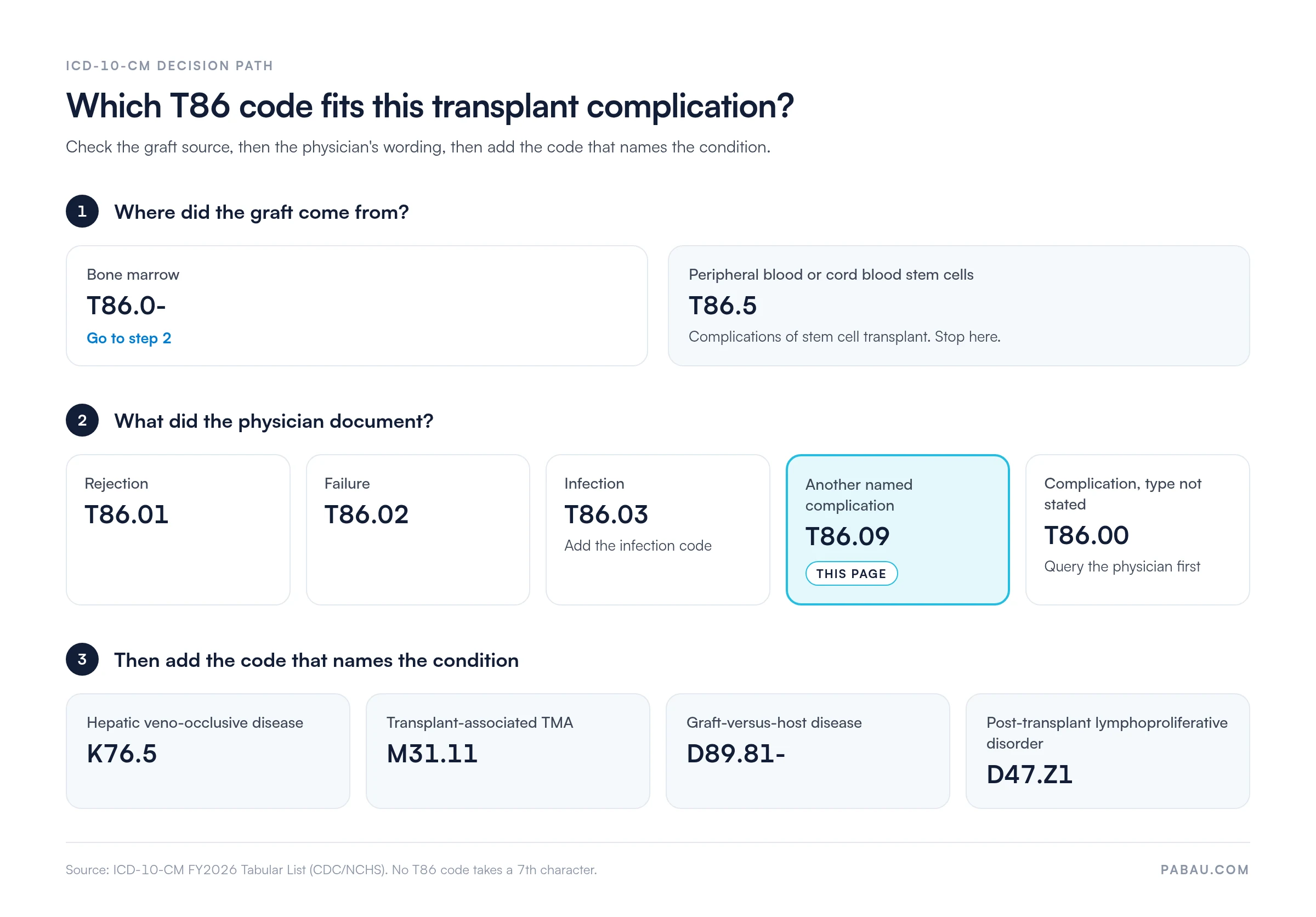
Before you open T86.0 at all, check where the graft came from. ICD-10-CM separates marrow grafts from stem cells collected any other way:
Many transplant teams now collect stem cells from blood rather than marrow. So a note that says “stem cell transplant” doesn’t prove a bone marrow code. Check the transplant record, and query the physician when the source isn’t stated.
The right code depends on what the physician wrote, not on what the coder infers. Here’s how common phrases in the record map to the codes.
The rule of thumb is short. A named complication that isn’t rejection, failure or infection goes to T86.09. Documented rejection always goes to T86.01, and graft failure goes to T86.02.
The decision path below puts the graft check, the wording check and the partner codes in one view.
Send a physician query whenever the record says “bone marrow transplant complication” without a type. A named answer moves the code from T86.00 to T86.09 or a more specific sibling. That supports accurate DRG assignment and lowers audit exposure.
T86.09 is complete at five characters. Many injury codes in Chapter 19 need a 7th character, but T86 codes take none. So T86.09XA isn’t a valid code, and a claim carrying it fails the payer’s front-end edits.
What T86.09 does need is a second code. The ICD-10-CM Official Guidelines describe a transplant complication with two codes. One is the T86 code, and the other names the specific condition. Common partners include:
Here’s how that plays out. Say a patient is admitted two weeks after an allogeneic marrow transplant with TA-TMA, and the attending links it to the transplant. You’d report T86.09 first, then M31.11, because the M31.11 note asks for the T86 code first.
The guidelines also set a limit. A T86 code applies only when the complication affects the function of the transplanted tissue. A post-transplant problem unrelated to the graft gets its own code, without T86.09.
Payers want the record to show a clear chain from the transplant to the complication. Before you code, confirm these five points.
Sound medical billing compliance means this record is complete before the claim goes out. An addendum written after a denial is much harder to defend on audit.
Medicare Part A covers most inpatient transplant admissions. Meanwhile, the MS-DRG depends on the principal diagnosis, the procedures and any complications, not on T86.09 alone.
Two groupings come up often in transplant care. MS-DRG 014 covers allogeneic bone marrow transplant stays. MS-DRG 803 is “Other O.R. procedures of blood and blood-forming organs with MCC” in MDC 16. Confirm the final grouping in the CMS MS-DRG definitions, since it reacts to the full code set.
Medical necessity works the same way. T86.09 alone doesn’t justify an inpatient stay. Instead, the severity and treatment of the named complication do, so the note has to show both. Commercial payers usually follow Medicare’s lead, though each one may add its own transplant rules.
T86.09 denials follow a predictable pattern. Catching these five before submission beats appealing them later.
Tracking denials by reason code shows which of these keeps coming back at your practice. A structured denial management workflow makes that pattern visible, so you can fix documentation where it starts. Pair it with a clean claim process to stop avoidable errors before submission.
A short manual pass catches most T86.09 errors. Work through it with the chart open, because these are judgment calls for the coder.
Review the T86 notes each October 1, when the new fiscal year code set takes effect. New partner codes, such as M31.11, change what you report alongside T86.09. Build that review into your team’s fall schedule.
Transplant claims often stall on admin. A coder retypes codes from the chart, chases a missing member ID and then resubmits. Each round trip pushes back payment on a costly stay.
In Pabau’s claims management software, the claim pre-fills from the patient record. Its ICD-10-CM lookup library helps coders find T86.09 and its partner codes quickly. Pabau also checks that required claim fields are complete before the claim can be sent.
In the US, claims go out through Claim.MD, with eligibility checks and submission to thousands of US payers. Your coders still own the code choice. They just spend less time retyping and chasing missing fields.

Pabau pre-fills claims from the patient record, gives coders a searchable ICD-10-CM library and checks required fields before submission. Fewer claims come back for missing details.

T86.09 rewards coders who slow down at two points. The first is the graft source, since stem cells collected from blood belong to T86.5. The second is the physician’s wording, because only a named complication earns this code.
If your team sees transplant patients often, turn the checklist above into a standing query template. Queries sent during the stay cost far less than appeals after discharge. The trade-off is a little extra time with the physician up front, and it pays for itself.
Book a demo to see how Pabau pre-fills transplant claims and checks required fields before they reach the payer.

Need a framework for tracking transplant-related claim denials? Denial codes in medical billing explains common CARC denial reason codes and how to build an appeal workflow around them.
Submitting 837P claims for complex inpatient cases? Understanding the 837 file covers the electronic claim format, loop structure, and how ICD-10 codes map to the 837P transaction.
Verifying patient eligibility before a transplant-related admission? Insurance eligibility verification outlines the real-time eligibility process and what to confirm before complex claims are built.
Use Z94.81, bone marrow transplant status, when the graft is working and no complication is documented. For a stem cell transplant from blood, the status code is Z94.84. Switch to a T86 code only when the physician documents a complication.
No. T86 codes describe complications in the transplant recipient. A living donor is identified with Z52.3, bone marrow donor, and any problem the donor develops is coded to that condition.
ICD-9-CM used 996.85 for complications of transplanted bone marrow. ICD-10-CM split that into the T86.0 family, so converted records need the code that matches the documented complication type.
ICD-10-CM has no dedicated code for engraftment syndrome. After a bone marrow transplant, it’s reported with T86.09, or with T86.5 when the stem cells came from blood. Add codes for documented signs, such as fever or rash.
Yes. In the CMS-HCC V28 model, T86.09 maps to HCC 454, stem cell, including bone marrow, transplant status/complications. Clear documentation therefore matters for Medicare Advantage risk scores as well as for the claim.