

ICD-10 code S61.201A: Open wound of left index finger without nail damage
ICD-10 code S61.201A covers a left index finger wound of unstated type ICD-10 co...

Last Updated: Oct 16, 2026
Billable Code Specific Code
T86.5 is the billable ICD-10-CM code for complications of stem cell transplant, including stem cells from peripheral blood or umbilical cord. It has no subcodes, so the specific complication is reported with additional codes.
The code sits in category T86, which covers complications of transplanted organs and tissue. Assignment turns on the procedure the physician documented. A record that names a bone marrow transplant routes the complication to the T86.0- subcodes, such as T86.09, instead.
Let Pabau's smart automation suggest the right codes, reduce claim denials, and keep your practice compliant—effortlessly.
Automate repetitive tasks and focus on what matters most—your patients.
Reduce coding errors and ensure compliance with the latest regulations.
Clean claims, fewer denials, and faster reimbursements.
Powerful insights and reporting to help your practice thrive.
HIPAA compliant SOC 2 certified GDPR-compliant Trusted by 4,000+ clinics worldwide

T86.5 is a billable ICD-10-CM code for complications of stem cell transplant from peripheral blood or umbilical cord, with no subcodes by complication type.
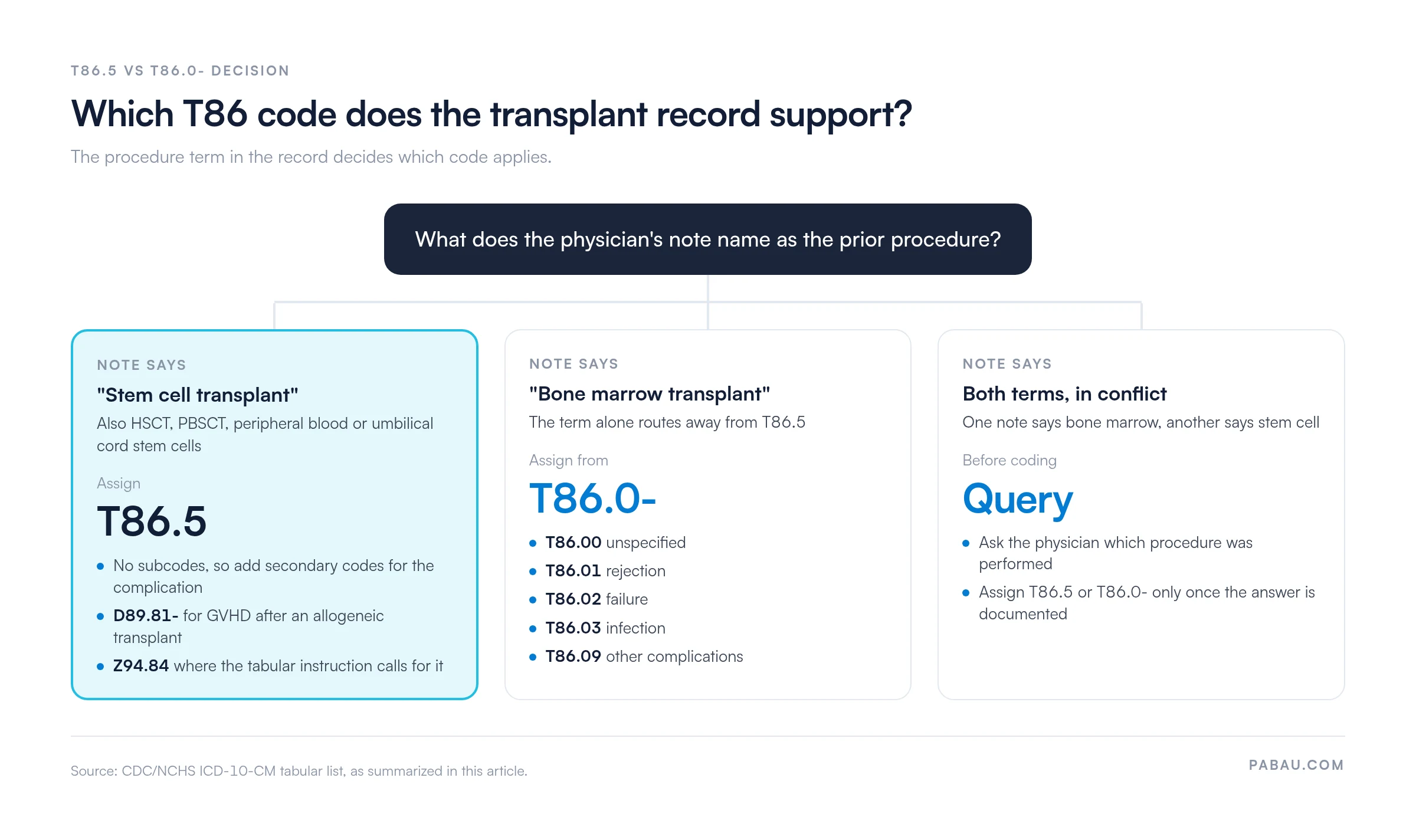
Use T86.5 when physician documentation names ‘stem cell transplant’ as the prior procedure. A documented ‘bone marrow transplant’ routes to the T86.0- subcodes instead.
GVHD is expected only after allogeneic transplants. An autologous HSCT claim coded with GVHD is likely to trigger a payer audit.
Pabau’s claims management software integrates with Claim.MD to submit, track, and reconcile transplant complication claims against Medicare and commercial payer requirements.
ICD-10 Code T86.5 is the official diagnosis code for complications of stem cell transplant, valid and billable for fiscal years 2025, 2026, and 2027. ICD-10-CM is maintained by the Centers for Medicare and Medicaid Services (CMS) and the National Center for Health Statistics (NCHS).
The code sits within the T80-T88 range (complications of surgical and medical care, not elsewhere classified) inside Chapter 19. Its parent category is T86 (complications of transplanted organs and tissues), which covers every transplanted organ type from kidney through liver.
T86.5 applies to complications of a hematopoietic stem cell transplant (HSCT) when the physician’s documentation uses the term “stem cell transplant.” A complication of a bone marrow transplant codes to T86.0- instead.
The CDC/NCHS ICD-10-CM tabular list gives two inclusion terms for this code:
T86.5 has no subtypes for failure, rejection, infection or graft-versus-host disease (GVHD). Those details are captured with secondary codes under the “use additional code” instruction, with GVHD coded from D89.81-.
GVHD is the most clinically significant complication of allogeneic HSCT. Autologous HSCT does not produce GVHD under normal circumstances, so a GVHD code on an autologous transplant claim is a payer audit risk.
The T86 category and the T86.5 code carry official instructional notes that govern what can and cannot be coded alongside them. Coders must read these before assigning T86.5 on any claim.
For the T86 category, the tabular list tells coders to use additional codes for any applicable transplant complications, such as graft-versus-host disease. Secondary codes also identify the infectious organism and the nature of a failure or rejection. Always verify the current year’s instructional notes in the active ICD-10-CM tabular list from the AAPC codify tool or the official CMS release.
Check the ‘use additional code’ notes at both the T86 category level and the T86.5 code level. Category-level instructions apply to every code under T86, including T86.5. Missing a category-level instruction is one of the cleanest ways to generate a claim denial.
T86.5 covers complications of stem cell transplant. T86.09 covers other complications of bone marrow transplant (T86.0- covers unspecified, rejection, failure, infection and other). The two codes describe distinct procedures, and physician documentation language determines which applies.
The key audit point: a bone marrow transplant codes to T86.0-, and a stem cell transplant codes to T86.5. When the record mixes “bone marrow transplant” and “stem cell transplant”, query the physician before you assign either code. The diagram below maps each documentation term to the code it supports.
The full T86 category covers complications of every major transplant type. Understanding where T86.5 sits helps coders recognize when to step to a more specific code and when T86.5 is the right level of specificity.
T86.5 stands out within this category because it has no subcodes by complication type. The kidney and heart ranges, by contrast, break out failure, rejection, and infection separately. Use the “use additional code” instruction to provide that specificity through secondary diagnosis codes.
Correct T86.5 assignment depends on six documentation elements. A record missing any of these is a denial risk before the claim reaches the payer. Coding teams who know the basics of medical billing can turn the list below into a pre-submission checklist.
T86.5 applies to both allogeneic and autologous HSCT complications. The distinction matters for secondary code assignment, not for the primary T86.5 assignment itself.
Allogeneic transplants use donor cells, creating the immunological conflict that produces GVHD. When GVHD is documented in an allogeneic HSCT patient, assign the appropriate GVHD code as a secondary diagnosis.
Autologous transplants use the patient’s own cells, so GVHD is not expected. A claim pairing autologous HSCT documentation with a GVHD code will likely trigger a payer audit and a denial. Record the transplant type clearly so the coder never has to infer it.
Z94.84 (stem cell transplant status) indicates the patient has received a stem cell transplant. When a complication is coded as T86.5, Z94.84 may be added per the instructional notes in the current tabular list.
Verify the exact instruction in the active code year. Some payers apply their own rules about whether Z94.84 is redundant when T86.5 is present. Never assign Z94.84 alone when an active complication warrants T86.5.
Payer requirements for stem cell transplant complication claims vary by MAC jurisdiction and insurer. The guidelines below reflect general Medicare and commercial payer patterns. Always confirm with the specific payer’s LCD or coverage policy before submitting.
Meeting medical billing compliance requirements for transplant claims means documenting three facts in every encounter note, not only at admission. Those are the transplant history, the complication type, and the medical necessity.
T86.5 claims deny for a predictable set of reasons. Most trace back to documentation or sequencing errors made before the claim leaves the practice. A denial management workflow logs each pattern per claim, so the same error isn’t repeated on the next transplant encounter.
Run a monthly audit of T86.5 denials sorted by denial code. CARC 50 (not deemed a medical necessity) usually signals thin necessity documentation or an unmet LCD requirement. CARC 11 (diagnosis inconsistent with procedure) usually signals a T86.0- vs T86.5 mix-up or a missing secondary code. Sorting by CARC narrows the root cause without reviewing every denied claim individually.
Without dedicated software, a coder checks each T86.5 claim by hand. They read the transplant history, confirm the procedure term, then hunt for every secondary code the tabular instructions call for. When a claim comes back denied, someone matches the denial code to the error and resubmits.
Pabau, the practice management platform we build, includes claims management software that connects to the Claim.MD clearinghouse. Claims go out electronically, eligibility checks run before submission, and electronic remittance advice (ERA) comes back against the claim.
For a T86.5 claim, that means a coverage problem shows up before submission instead of as a denial weeks later. Primary and secondary payers run through the same workflow, which suits HSCT patients with both Medicare and commercial coverage.

Pabau integrates with Claim.MD to handle electronic claim submission, eligibility checks and ERA for oncology and transplant billing teams.

T86.5 is easy to find and easy to get wrong, because the physician’s wording decides it. Build the procedure-term check into your coding workflow before the claim is created. A coder who confirms “stem cell transplant” and the instructed secondary codes up front avoids the denials described above.
The trade-off is a slower first pass on each transplant claim. It pays back when a clean claim gets paid on first submission instead of returning weeks later with a CARC.
Book a demo to see how Pabau checks eligibility and submits T86.5 claims through Claim.MD before they reach the payer.

Need a framework for tracking transplant claim denials? Denial management in healthcare covers the workflows that reduce CARC-coded rejections before they affect your reimbursement cycle.
Want to understand the clearinghouse behind your claims? Claim.MD clearinghouse overview explains how payer routing, real-time eligibility, and ERA processing work for inpatient and outpatient claims.
Confused about 837 file submission for inpatient transplant claims? 837 file guide covers the structure, required fields, and common submission errors for 837I and 837P transactions.
ICD-10 Code T86.5 is the billable diagnosis code for complications of stem cell transplant, including stem cells from peripheral blood or umbilical cord. It has no subcodes by complication type, so failure, rejection, infection and GVHD are added with secondary codes. It sits under the T86 category (complications of transplanted organs and tissues) in Chapter 19 of ICD-10-CM.
Yes, T86.5 is a valid billable ICD-10-CM code for fiscal years 2025, 2026, and 2027. It can be submitted on claims as a principal or secondary diagnosis when physician documentation supports a complication of stem cell transplant.
T86.5 applies when the physician documents “stem cell transplant” as the prior procedure. T86.09 covers other complications of bone marrow transplant, one of the T86.0- subcodes alongside T86.00 unspecified, T86.01 rejection, T86.02 failure and T86.03 infection. When the record mixes both terms, query the physician.
T86.5 covers the stem cell transplant complication itself. GVHD is coded as a secondary diagnosis from D89.81- (D89.810, D89.811, D89.812 or D89.813 for unspecified), per the “use additional code” instruction. GVHD is expected only after allogeneic transplants. A GVHD code on an autologous HSCT claim will likely trigger a payer audit.
Z94.84 is the ICD-10-CM status code for stem cell transplant history. It may be assigned alongside T86.5 per the tabular instructional notes when the complication code is present. Verify the current year’s instruction in the active CMS tabular list. Payer rules on whether Z94.84 is required or redundant alongside T86.5 can vary by MAC jurisdiction.
The most common reasons are a T86.0- bone marrow code used where T86.5 is correct, missing transplant history, and T86.5 assigned without a documented complication. Sequencing T86.5 as principal when it should be secondary also triggers denials. So do missing secondary codes for the causative organism, GVHD or immunosuppressant adverse effects.
Yes, T86.5 applies to complications of both allogeneic and autologous hematopoietic stem cell transplants. The transplant type affects secondary code assignment, particularly for GVHD, which is expected only after allogeneic procedures. Autologous HSCT claims that include a GVHD secondary code are a payer audit trigger.



