ICD-10 Code Y76.0: Diagnostic obstetric and gynecological devices
ICD-10 Code Y76.0: Definition and billable status ICD-10 Code Y76.0 is a valid, ...

Last Updated: Oct 23, 2026
Billable Code Specific Code
T86.13 is the billable ICD-10-CM code for kidney transplant infection.
Coders working with transplant patients often reach for the unspecified T86.10 out of habit. When the note supports an infection, T86.13 is the more specific and correct choice.
Let Pabau's smart automation suggest the right codes, reduce claim denials, and keep your practice compliant—effortlessly.
Automate repetitive tasks and focus on what matters most—your patients.
Reduce coding errors and ensure compliance with the latest regulations.
Clean claims, fewer denials, and faster reimbursements.
Powerful insights and reporting to help your practice thrive.
HIPAA compliant SOC 2 certified GDPR-compliant Trusted by 4,000+ clinics worldwide

T86.13 is the billable ICD-10-CM code for kidney transplant infection, distinct from rejection (T86.11) and failure (T86.12).
The code has been valid for HIPAA-covered transactions since October 1, 2015, and remains current for FY2026.
Documentation must confirm the infection and, where possible, name the causative organism for co-coding.
Practice management software like Pabau tracks ICD-10 submissions and claim denials for transplant encounters.
ICD-10 Code T86.13 is a billable and specific code under the International Classification of Diseases, 10th Revision, Clinical Modification (ICD-10-CM).
It is valid for use in HIPAA-covered electronic transactions, confirmed by the CDC/NCHS ICD-10-CM web tool. The code sits within the broader T86 chapter covering complications of transplanted organs and tissues. Its parent is T86.1, complications of kidney transplant.
Per CMS ICD-10 coding guidance, T86.13 has not been revised since its introduction and carries no pending modifications for FY2026. Coders who work across several complication categories can check the sibling entries in the ICD-10-CM code index before settling on a specificity tier.
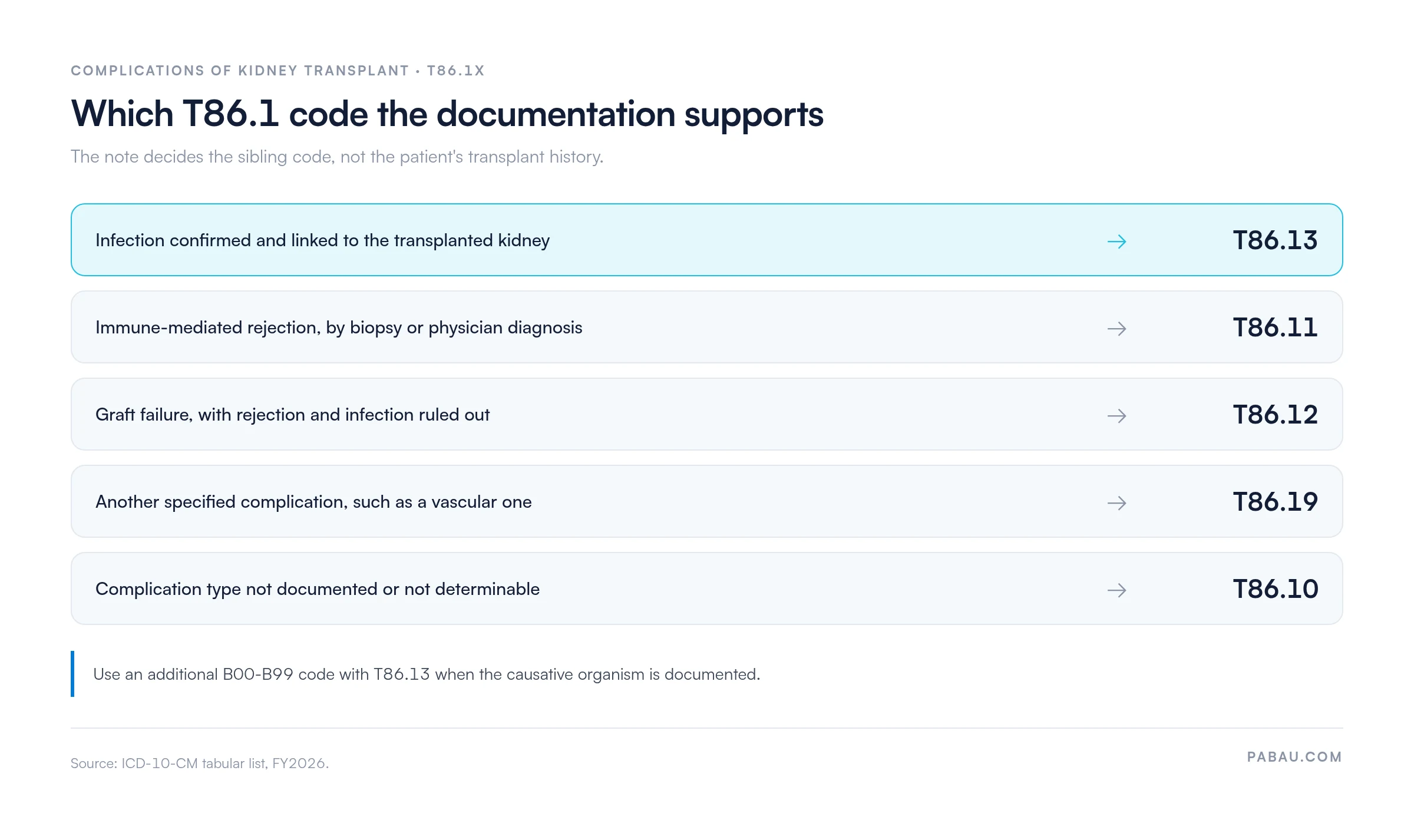
T86.13 belongs to the T86.1x family, which covers complications specific to kidney transplants. Each sibling code maps to a distinct clinical complication type. Using the wrong sibling produces a claim that misstates the encounter, which can trigger denials or audit flags.
Every code in the T86.1x family assumes the record names the kidney as the transplanted organ. When the documentation leaves the graft unnamed, a transplant infection codes to T86.93 instead.
Which sibling applies comes down to what the physician wrote. Read as a single decision, the choice is quicker to make than a table of definitions.
Several clinical terms and index references map to T86.13 in the ICD-10-CM alphabetic index. Coders and clinicians may encounter these descriptions in documentation:
These synonyms all index to T86.13 in the official ICD-10-CM tabular list. When one of these phrases appears in physician documentation, T86.13 is the appropriate code.
The complication still has to belong to the transplanted kidney, rather than to a post-operative infection unrelated to the graft. The AAPC ICD-10-CM code lookup can help coders confirm index pathways for edge-case terminology.
ICD-10-CM instructional notes for the T86.1x family carry clinical and billing weight. Misreading an Excludes1 note can produce a claim that is non-compliant with official guidelines.
Use additional code instruction: The ICD-10-CM tabular list instructs coders to add a second code identifying the causative organism where it is documented. A T86.13 claim should therefore carry a B-series code from the B00-B99 infectious diseases chapter whenever the treating clinician has named the pathogen.
Common pairings include bacterial, fungal, and viral organisms. The B-code you select has to match documented laboratory or clinical findings. Coders should never assign an organism code on assumption alone.
Excludes1 consideration: The T86 category carries Excludes1 notes for conditions that cannot be coded together. An Excludes1 note means the two conditions do not coexist, so neither may be reported alongside the other on one claim. Always verify the current official tabular list before coding. The AAPC entry for T86.13 works as a quick cross-check against the CMS tabular file.
Accurate documentation is the foundation of a defensible T86.13 claim. Incomplete records push coders toward the unspecified T86.10, which carries lower clinical specificity and can flag for payer review.
The following elements should appear in the medical record to justify T86.13:
Flag T86.13 encounters for a documentation pre-bill review. Ask the treating physician to confirm the infection-to-transplant linkage in their note before submission. A single clarification query at coding time prevents an administrative denial that takes three to five times longer to resolve.
T86.11 (rejection) and T86.12 (failure) are the sibling codes most often confused with T86.13 (infection). The clinical and billing stakes differ for each. Payers, transplant registries, and clinical quality programs all use these codes to track distinct post-transplant outcomes.
When documentation is ambiguous, coders should query the physician rather than default to T86.10. The query takes minutes at coding time, and it protects both the practice at audit and the accuracy of the patient record.
Even experienced coders make avoidable errors with T86.13 claims. Most originate from documentation habits rather than from misunderstanding the code itself.
Denial reason codes show which T86.13 claims failed and why. Practices that process electronic remittance advice through their clearinghouse can trace those codes back to sequencing and specificity errors. The same documentation fault then stops repeating next quarter.
Run a quarterly audit of all T86.10 claims. For each, pull the underlying physician note and check whether infection, rejection, or failure was documented. If T86.13 or a sibling code was supportable, those claims represent rebillable revenue and a documentation education opportunity for the clinical team.
In most practices the transplant note lives in one system and the claim is built in another. A coder re-keys the diagnosis, and the denial only surfaces when the remittance arrives weeks later. By then the encounter is cold and the physician has moved on.
Practice management software like Pabau holds the encounter, the diagnosis code, and the claim in one patient record. Pabau’s first-pass claims management checks the code against the note before submission, so an unspecified T86.10 gets caught inside the practice.
For US practices, the Claim.MD integration submits coded claims electronically to thousands of US payers and processes remittances back into the same record. Real-time eligibility checks run across over 400 payers, so staff spend less time on manual lookups before a transplant visit.
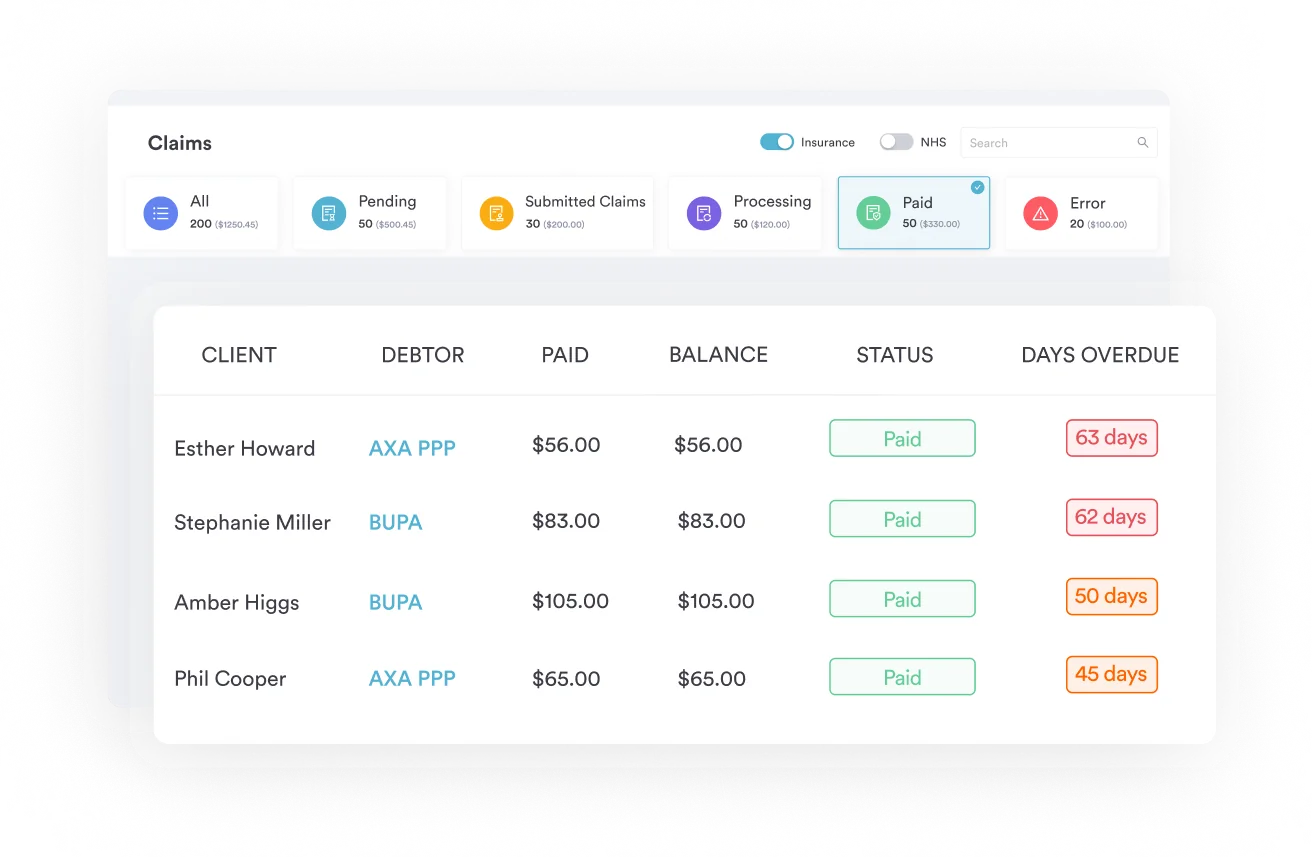

Pabau builds the claim from the encounter note and submits it electronically through Claim.MD to thousands of US payers. Eligibility checks across over 400 payers and ERA processing cut the manual steps that create T86.13 denials.

T86.13 applies whenever a kidney transplant patient has a documented infectious complication, and nothing about the code is optional once the note supports it. Defaulting to the unspecified T86.10 understates the encounter, distorts case mix data, and puts DRG accuracy at risk.
The work that decides the code happens before the claim goes out. Confirm the infection, link it to the transplanted kidney, and name the organism where the lab results allow it. Book a demo to see how Pabau turns a transplant note into a coded claim that survives payer review.

Need to understand how transplant claims move through the clearinghouse? Claim.MD clearinghouse overview explains how electronic claims reach US payers and where ICD-10 codes are validated.
Seeing repeated claim rejections on complex diagnosis codes? Denial management in healthcare covers how to categorize, track, and resolve claim denials systematically.
Want a primer on how ICD-10 fits into the broader billing cycle? Revenue cycle management fundamentals walks through each stage from encounter to payment, including diagnosis coding workflows.
ICD-10 Code T86.13 is the billable diagnosis code used to document infectious complications in patients who have received a kidney transplant. It applies when a physician has confirmed an infection tied to the renal allograft. That separates the encounter from unspecified transplant complications (T86.10), rejection (T86.11), and failure (T86.12).
Yes, T86.13 is a billable and specific ICD-10-CM code valid for HIPAA-covered transactions. It has been effective since October 1, 2015, and is current for fiscal year 2026 with no revisions pending.
T86.13 covers kidney transplant infection, where a pathogen is responsible for the complication. T86.11 covers kidney transplant rejection, an immune-mediated process where the recipient’s immune system attacks the graft. The documented mechanism decides which one applies. Infectious workup results and a physician infection diagnosis support T86.13, while biopsy-confirmed rejection supports T86.11.
Records must include a confirmed infection, documentation of the patient’s transplant status, and an explicit clinical link between the infection and the transplanted kidney. Where culture or clinical workup identifies the causative organism, assign a secondary B-series code as well. The use-additional-code instruction in the ICD-10-CM tabular list requires it.
Assign T86.13 as the primary complication code. Then add the appropriate ICD-10-CM B-series organism code from the infectious diseases chapter, B00-B99, as an additional code. The organism code must match documented laboratory findings or a physician-stated diagnosis of the causative pathogen, not a clinical assumption.
The T86.1x family includes T86.10 (unspecified complication), T86.11 (rejection), T86.12 (failure), T86.13 (infection), and T86.19 (other specified complication). All are children of parent code T86.1, complications of kidney transplant. The parent code is not billable and should never be reported in place of a more specific sibling.