ICD-10 Code Y76.0: Diagnostic obstetric and gynecological devices
ICD-10 Code Y76.0: Definition and billable status ICD-10 Code Y76.0 is a valid, ...

Last Updated: Oct 23, 2026
Billable Code Specific Code
T86.01 is the billable ICD-10-CM code for bone marrow transplant rejection.
Let Pabau's smart automation suggest the right codes, reduce claim denials, and keep your practice compliant—effortlessly.
Automate repetitive tasks and focus on what matters most—your patients.
Reduce coding errors and ensure compliance with the latest regulations.
Clean claims, fewer denials, and faster reimbursements.
Powerful insights and reporting to help your practice thrive.
HIPAA compliant SOC 2 certified GDPR-compliant Trusted by 4,000+ clinics worldwide

T86.01 is a billable ICD-10-CM code for bone marrow transplant rejection, effective October 1, 2025.
Five codes share the T86.0 subcategory, so read all five before you settle on T86.01.
T86.01 is distinct from T86.02 (transplant failure) and T86.00 (unspecified), and the physician must name rejection.
Graft-versus-host disease belongs to the D89.81- series and is never reported as T86.01.
The T86 category asks for additional codes covering GvHD, transplant-related malignancy (C80.2), and PTLD (D47.Z1).
ICD-10 Code T86.01 is a billable, specific ICD-10-CM diagnosis code valid for reimbursement submissions in FY2026. Below is the core reference data coders need at a glance.
Billable status means T86.01 can be submitted as a principal or a secondary diagnosis. It does not guarantee reimbursement. Payer medical necessity policy and the clinical documentation still have to support the diagnosis independently.
Bone marrow transplant rejection is an immune-mediated process. The recipient’s immune system recognizes the transplanted hematopoietic cells as foreign and mounts a response to destroy them. Graft-versus-host disease runs the other way, with donor immune cells attacking the recipient’s tissues.
Rejection occurs most commonly in allogeneic transplants, where donor and recipient are different individuals. The recipient’s residual or recovering immune system generates cytotoxic T lymphocytes and antibodies against donor marrow antigens. That response either prevents engraftment or destroys engrafted cells after an initial success.
Clinical indicators that support a rejection diagnosis include:
For coding purposes, the distinction between rejection and failure rests entirely on physician documentation, not on laboratory values alone. A coder cannot assign T86.01 from declining blood counts without an explicit physician statement of rejection.
Understanding the hierarchy helps coders navigate the T86 category and select the correct level of specificity. The ICD-10-CM classification places T86.01 under a layered parent structure.
T86.0 is a subcategory, not a billable code. Coders have to select a specific code at the T86.0x level. Code to the highest level of specificity the documentation supports, and T86.01 is that level when rejection is stated.
Five codes share the T86.0 subcategory, each covering a distinct clinical scenario. Picking the wrong one is the most frequent transplant coding error coders report.
T86.09 takes a documented complication that falls outside rejection, failure and infection, so rule it out before settling on T86.01.
When the record supports rejection alongside another complication, assign both codes in the correct sequence. Never fall back on an unspecified code where the documentation supports a more specific one. Our ICD-10-CM code index lists the neighboring T86 entries if you need to check one.
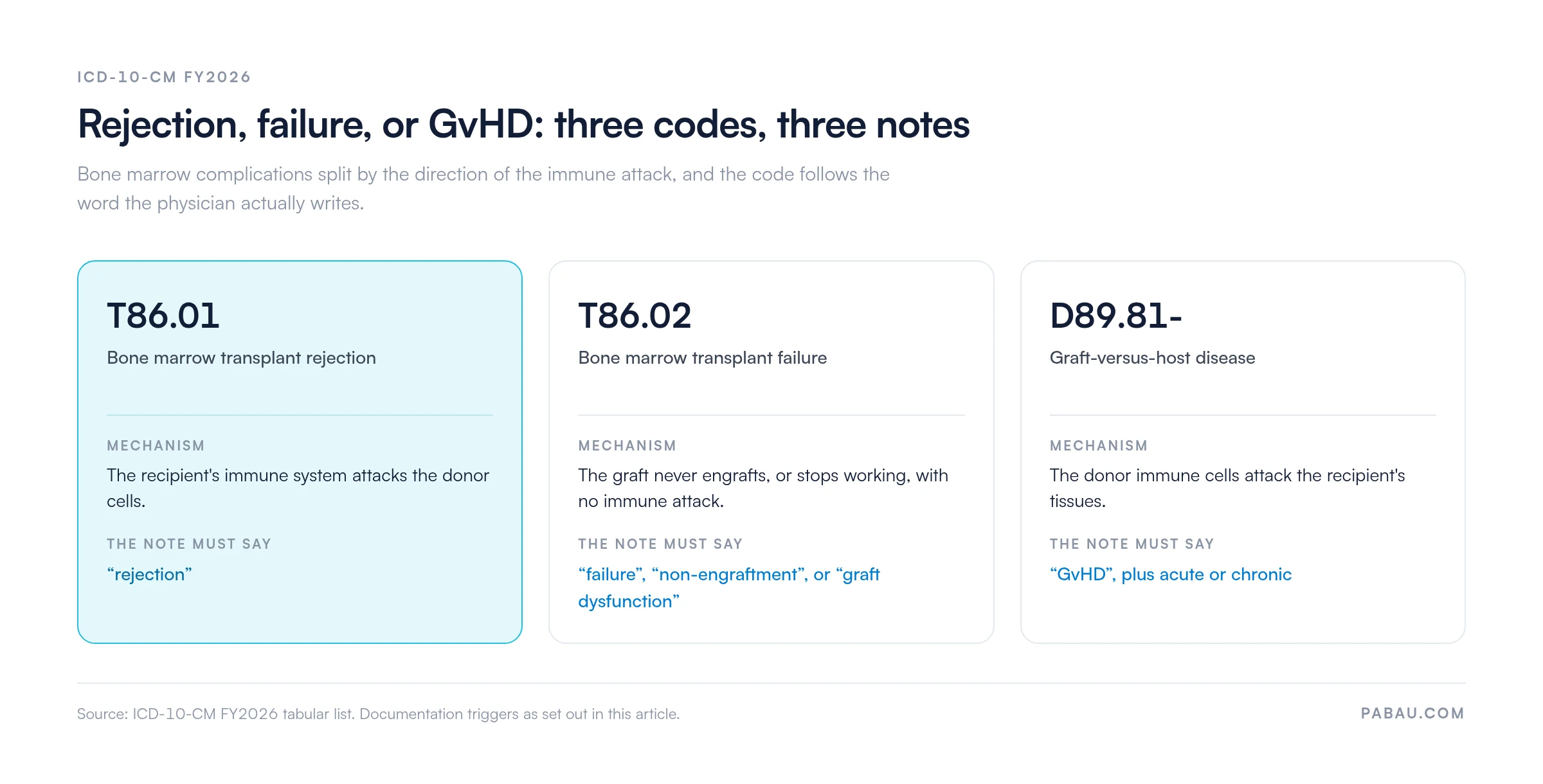
Rejection and failure are clinically and mechanistically distinct, yet coders frequently assign T86.02 when T86.01 is correct, or the reverse. The clinical record is the deciding document.
If the physician’s note says “graft failure” but later clarifies “immune-mediated rejection,” query the physician or code to the most specific documented term. Never read ambiguous language in favor of a more specific code without physician clarification.
Graft-versus-host disease (GvHD) is coded using the D89.81x series, not under T86. The pathophysiology runs in the opposite direction from rejection, and the codes reflect that distinction.
GvHD subcodes under D89.81x separate acute (D89.810), chronic (D89.811), acute on chronic (D89.812), and unspecified (D89.813) presentations. The physician must document the GvHD type for the coder to select the appropriate subcode.
Using T86.01 for a GvHD presentation, or D89.81x for a rejection presentation, is a coding error that may attract audit scrutiny. The three possibilities separate cleanly once you line up the mechanism against the word in the note.
The ICD-10-CM Official Guidelines require that a diagnosis code be supported by physician documentation in the medical record. For T86.01, that means the record must contain specific language confirming rejection.
Required elements in the medical record:
Where the documentation is ambiguous, query the physician rather than default to an unspecified code. A note reading “possible rejection” does not support T86.01 in the outpatient setting. ICD-10-CM guidelines prohibit coding a possible diagnosis as though it were confirmed.
The ICD-10-CM Tabular List carries instructional notes at the T86 category level. Payers can deny a claim where those notes are not followed.
Sequencing errors are cheapest to catch before the claim leaves the practice. A scrubbing step that reads the T86 instructional note and checks for the additional codes will stop most of them at entry.
Run a pre-submission check on every T86.01 claim. Confirm that GvHD, C80.2 and D47.Z1 codes appear wherever the record documents them. Confirm too that the attending physician has signed the rejection diagnosis in the note. Three minutes of review prevents the three-week rework cycle a denial triggers.
Five error patterns account for most T86.01 denials and audit flags. Each one has a documentation fix that costs less than an appeal.
Where the record confirms a complication but never names its type, T86.00 is the correct assignment. Query the provider first, since a named complication type always outranks the unspecified code.
Tracking which denial reasons recur on T86.01 claims points to the upstream documentation problem causing them.
A run of identical denials usually traces back to one phrase the transplant team keeps writing, and a short education session fixes it. Root-cause work of this kind is what denial management in healthcare means in practice, rather than appealing claims one at a time.
T86.01 applies to rejection following both classic bone marrow transplantation and hematopoietic stem cell transplantation. That includes peripheral blood stem cell and cord blood transplants. The ICD-10-CM classification does not distinguish between these procedural sources at the T86.01 level.
Clinically, rejection in allogeneic transplantation follows the same immune-mediated pathway whatever the source. The recipient’s reconstituting immune system identifies donor hematopoietic cells as non-self and attacks them.
Whether the cells came from marrow, from peripheral blood after mobilization, or from cord blood, the coding is the same once rejection is documented.
The documentation requirement does not change with the cell source. The physician must state rejection, rather than failure or a generic complication. Practices treating haploidentical or mismatched recipients see rejection more often, so those records deserve a closer read.
The billing team’s claims management software should hold that distinction at the coding stage. Doing so protects both revenue integrity and audit readiness.

Most hematology billing teams catch a T86.01 problem after the denial arrives. The coder reads the note in one system and submits the claim from another. The missing D89.81- code only surfaces when the payer sends the claim back.
Practice management software like Pabau keeps the clinical note and the claim in one record. The diagnosis the physician documented is the diagnosis attached to the charge. A coder checking T86.01 can read the rejection statement without opening a second system.
Claims go out electronically with the code set the note supports, and denials come back tagged by reason and by code. That gives the billing lead a count of how many T86.01 claims failed, and why, instead of a stack of individual appeals.

Pabau’s claims management software helps hematology and oncology practices submit clean transplant complication claims, track denials by code, and keep documentation audit-ready. See how it works for your team.

T86.01 turns on one word in the medical record. Where the physician writes rejection, the code is right. Where the note says failure, or describes GvHD, it is the wrong code.
So the work worth doing sits upstream of the claim. A short query to the transplant physician, sent before the encounter is coded, settles the question the payer would otherwise settle for you. Add the D89.81-, C80.2 and D47.Z1 codes the record supports, and the claim carries its own justification.
The trade-off is a few minutes of query time against a rework cycle measured in weeks. Book a demo to see how Pabau ties the rejection statement in the note to the code on the claim.

Need a primer on medical billing fundamentals? What is medical billing covers the end-to-end claim lifecycle from documentation through payment posting.
Want to understand how clearinghouses validate ICD-10 claims? Medical claims clearinghouse guide explains how payer edits catch sequencing errors before submission.
Looking to reduce transplant claim denials systematically? Denial management in healthcare outlines root-cause analysis approaches for persistent claim denial patterns.
ICD-10 Code T86.01 is the billable ICD-10-CM diagnosis code for bone marrow transplant rejection. It sits in the T86 category, which covers complications of transplanted organs and tissue. The code took effect on October 1, 2025, under the FY2026 edition. Use it when a physician documents rejection of transplanted marrow or hematopoietic stem cells.
Yes. T86.01 is a billable, specific ICD-10-CM code valid for FY2026 claim submissions. It can be submitted as a principal or a secondary diagnosis. The record still has to carry explicit physician documentation of rejection, and billable status alone does not guarantee payment.
T86.01 codes rejection, where the recipient’s immune system attacks the donor cells. T86.02 codes failure, where the graft never engrafts or stops working without an immune attack. The distinction rests on documentation. Rejection needs the word rejection in the note. Failure needs failure, non-engraftment, or graft dysfunction.
The ICD-10 code for bone marrow transplant rejection is T86.01, billable under the FY2026 ICD-10-CM edition. It is the most specific code available for rejection. Use it whenever the physician documents rejection of transplanted marrow, including after allogeneic hematopoietic stem cell transplantation.
T86.01 became effective on October 1, 2025, as part of the 2026 edition of the ICD-10-CM code set. CMS and the National Center for Health Statistics update the code set every year. Each new edition takes effect on October 1 of the preceding calendar year.
The T86 category carries a use-additional-code note. Add the applicable D89.81- code where the record documents graft-versus-host disease. Add C80.2 for a malignancy associated with the transplant, and D47.Z1 for post-transplant lymphoproliferative disorder.
Yes. T86.01 covers rejection after hematopoietic stem cell transplantation, including peripheral blood and cord blood transplants, as well as classic bone marrow transplantation. ICD-10-CM does not differentiate by stem cell source at this level. What matters is the physician’s documentation of rejection.