ICD-10 code S61.201A: Open wound of left index finger without nail damage
ICD-10 code S61.201A covers a left index finger wound of unstated type ICD-10 co...

Last Updated: Oct 16, 2026
Billable Code Specific Code
T38.5X2S is the billable ICD-10-CM code for poisoning by other estrogens and progestogens, intentional self-harm, sequela. It applies to a later encounter that treats a condition caused by an earlier intentional estrogen or progestogen poisoning. Typical agents include oral contraceptives and HRT products.
The code is sequenced after the residual condition it explains. Assigning it requires provider documentation of self-harm intent, a resolved acute poisoning, and the specific late effect being treated.
Let Pabau's smart automation suggest the right codes, reduce claim denials, and keep your practice compliant—effortlessly.
Automate repetitive tasks and focus on what matters most—your patients.
Reduce coding errors and ensure compliance with the latest regulations.
Clean claims, fewer denials, and faster reimbursements.
Powerful insights and reporting to help your practice thrive.
HIPAA compliant SOC 2 certified GDPR-compliant Trusted by 4,000+ clinics worldwide

T38.5X2S is the billable ICD-10-CM code for a later visit that treats a condition caused by an intentional estrogen or progestogen poisoning.
Code the residual condition first as the principal diagnosis, then T38.5X2S as its cause, per ICD-10-CM Guidelines Section I.B.10.
T38.5X2A covers active treatment of the poisoning, and T38.5X2D covers routine recovery follow-up. Neither situation takes the S character.
Only the provider can document self-harm intent. When the note is unclear, query the provider before assigning the code.
Using T38.5X2S for an encounter where the poisoning is still being treated is the leading cause of denials on this code.
ICD-10 code T38.5X2S is the fully specified, billable ICD-10-CM code for “Poisoning by other estrogens and progestogens, intentional self-harm, sequela.” It is valid for claims submitted under CMS ICD-10-CM FY2025 and FY2026, and the current addenda carry no deletion notice for it. The code can’t be assigned while the poisoning is under active treatment, which is the job of T38.5X2A. Routine recovery follow-up for the poisoning itself takes T38.5X2D. T38.5X2S is reserved for a later encounter focused on the residual condition the poisoning left behind.
Use this code reference table to confirm the key facts before claim submission:
Each character in T38.5X2S encodes a specific clinical and encounter-type fact. Misreading position 6 (intent) or position 7 (encounter type) causes most coding errors in this code family. The table below maps every character to its meaning.
The placeholder X at position 5 carries no clinical meaning. It exists solely to push the intent character into position 6 and the encounter-type character into position 7. Omitting it produces an invalid code that payers reject outright. So does coding the parent T38.5X2 without a seventh character. The CDC/NCHS ICD-10-CM web tool flags T38.5X2 as a non-billable parent. Only the seven-character forms, such as T38.5X2S and its A and D siblings, are reportable.
Positions 6 and 7 carry the same meanings across Chapter 19. T63.442D, for example, covers the toxic effect of bee venom from intentional self-harm at a subsequent encounter.
T38.5X2S covers poisoning involving the drug classes listed under “other estrogens and progestogens” in the ICD-10-CM Table of Drugs and Chemicals. These include both estrogen-containing and progestogen-containing preparations. Confirm each substance against the official table rather than memory or product labeling.
Other T38 subcategories cover substances such as corticosteroids (T38.0), thyroid hormones (T38.1), and insulin (T38.3). T38.5X2S doesn’t cover them, even when they accompany an estrogen or progestogen product. Code each substance to its own T38 subcategory when multiple agents are involved.
T38.5X2S is applicable only when three conditions are simultaneously present in the medical record. Missing any one of them means a different code applies instead.
The ICD-10-CM Official Guidelines, Section I.B.10, govern sequela coding across all code families. When all three criteria are met, the late effect is the principal (first-listed) diagnosis. That may be a mental health condition or another residual problem, and T38.5X2S is coded second as its cause. The decision flow below shows how the encounter and intent questions narrow the choice to one code.
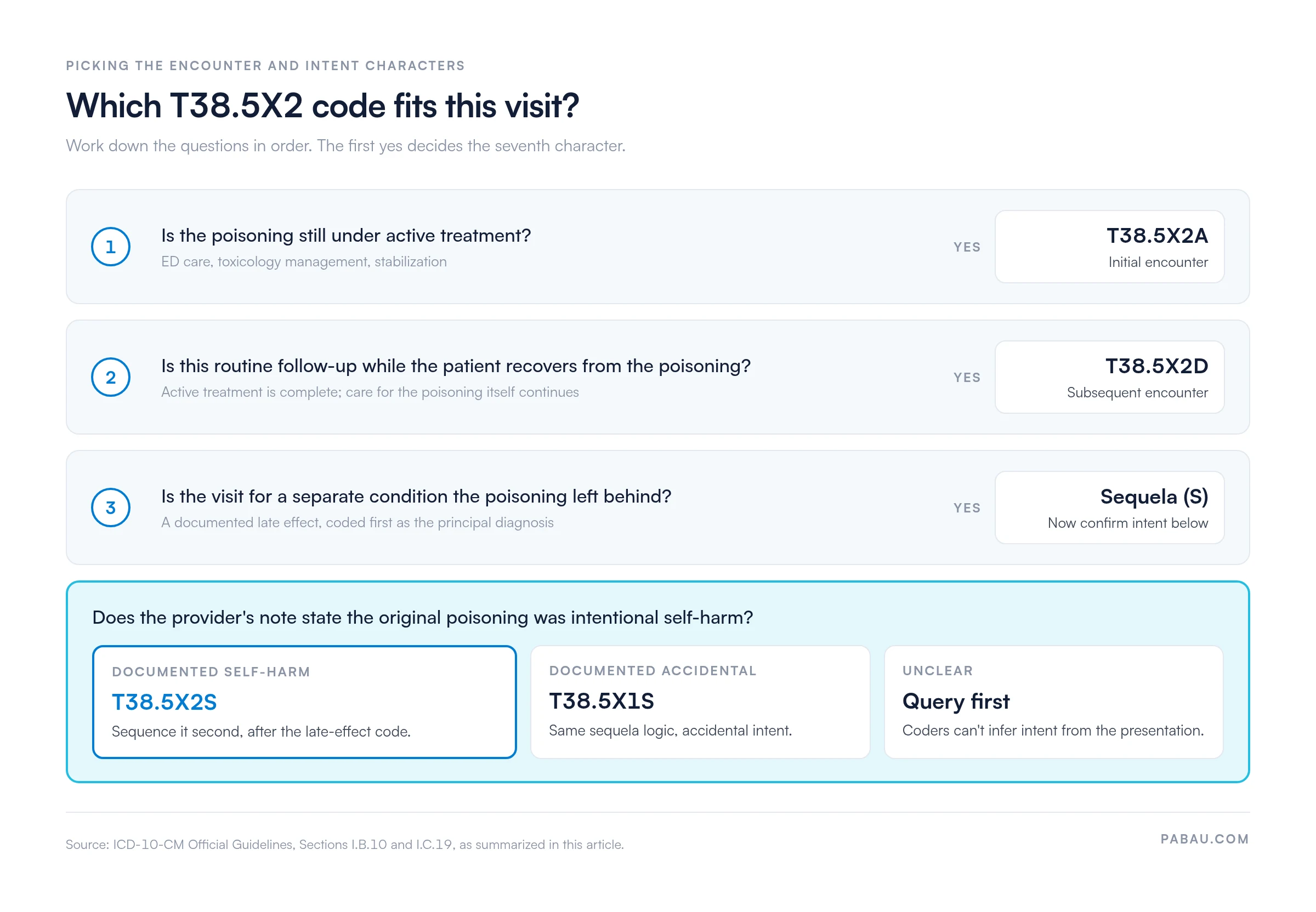
Verify the encounter type before assigning T38.5X2S. If the note describes ongoing toxicity, active management, or emergency stabilization, the correct code is T38.5X2A. Routine recovery follow-up for the poisoning itself takes T38.5X2D. Sequela means the visit treats a separate condition the poisoning left behind.
The T38.5X2S vs T38.5X1S distinction is the most frequent source of coding confusion in this code family. The intent character in position 6 is the only difference between the sibling codes. It must come from documented provider intent, never from inference.
T38.5X4S (undetermined) is not a fallback for ambiguous documentation. The guidelines reserve it for records that state intent can’t be determined. When intent is simply unclear, query the provider rather than defaulting to undetermined. If intent stays unknown, the guidelines default to accidental intent. The same A/D/S encounter logic applies throughout Chapter 19.
That restriction holds across other poisoning categories too. T44.1X4A covers cholinergic agonist poisoning of undetermined intent at the initial encounter. It also requires a note that explicitly states intent cannot be determined.
These intent distinctions run past the T36-T50 block. T61.773S sits in the T51-T65 range, covering a sequela visit after another person caused a fish poisoning. Section I.B.10 sequences it exactly as it sequences T38.5X2S.
The T38.5 subcategory carries tabular instructions that affect sequencing and code selection. Reviewing these before assigning ICD-10 code T38.5X2S prevents both claim denials and audit flags.
T38.5X2S is the etiology/cause code at a sequela encounter. It is never the only code on the claim. The claim line must include at minimum one additional code identifying the residual condition that brought the patient in.
According to the AAPC ICD-10-CM code reference, the sequela residual condition must be a distinct, separately codeable clinical entity. A vague symptom that could apply to any visit doesn’t qualify. A claim listing only T38.5X2S with no accompanying residual-condition code is incomplete and will be denied.
The medical record must contain explicit statements supporting every character in T38.5X2S before it is assignable. Ambiguous documentation is the second most common driver of denials and audits on this code, after incorrect encounter-type selection.
The provider note for a T38.5X2S encounter must document all of the following:
When documentation is incomplete or ambiguous regarding intent or sequela status, coders should submit a provider query before assigning the code. Assigning T38.5X2S based on assumption rather than documentation creates audit liability. ICD-10-CM documentation standards require the same rigor across all diagnosis code families: The provider, not the coder, determines and documents the clinical facts.
The same documentation rule applies regardless of the substance involved. It governs T40.422A, which codes tramadol poisoning with intentional self-harm at the initial encounter rather than a later sequela visit.
Structured clinical note templates make it easier to capture the residual-condition and intent language T38.5X2S requires. When those fields are part of every follow-up note, fewer claims reach a payer without support.
Most denials on ICD-10 code T38.5X2S trace to a handful of recurring errors. Catching them at coding review, before submission, costs far less than working them through appeals. A clearinghouse front-end edit check also catches many of them before the claim reaches a payer adjudicator.
Flagging Chapter 19 poisoning codes for documentation review before submission cuts rework for coding and billing teams. A clean claim for T38.5X2S carries the full seven-character code and a paired residual-condition principal diagnosis. It also needs documented provider support for both intent and sequela status.
Medicare, Medicaid, and commercial payers apply different coverage and documentation standards to intentional self-harm sequela claims. Knowing them prevents denials that clear documentation alone can’t stop.
Behavioral health practices that see many self-harm sequela patients need payer-specific billing rules set up alongside structured ICD-10-CM documentation. Keeping payer LCD and parity references current reduces audit exposure on sensitive claim categories like T38.5X2S.
Electronic remittance advice (ERA) data is the most useful source for spotting payer-specific denial patterns on T38.5X2S claims. Sorting ERA lines by CARC denial codes shows whether missing documentation, sequencing errors, or payer policy drives each denial. Billing teams can then fix the cause instead of resubmitting the same claim.
Many billing teams still check poisoning sequela claims by hand. Someone confirms the late effect is listed first, the seventh character is S, and the note states self-harm intent. Each missed check comes back weeks later as a denial.
Practice management software like Pabau moves those checks ahead of the claim. Pabau’s claims management software sends claims through Claim.MD, whose front-end edits flag invalid codes and sequencing errors before a payer sees them.
The provider’s note, the diagnosis codes, and the claim sit in the same patient record. Coders can check the intent and sequela language without requesting a separate chart, so fewer T38.5X2S claims go out unsupported.

Pabau’s claims management software works with Claim.MD to check ICD-10-CM codes and sequencing before submission, so errors get fixed before a payer sees them.

Treat T38.5X2S as a second-line code. Code the late effect first and T38.5X2S after it. Before the claim goes out, confirm the acute poisoning has resolved and the provider’s note states self-harm intent.
The trade-off is a slower coding review on a small share of claims. That time costs less than an appeal, and far less than an audit on a self-harm diagnosis.
Book a demo to see how Pabau flags sequencing and documentation errors on poisoning sequela claims before they reach a payer.

Handling high volumes of behavioral health ICD-10 claims? Revenue cycle management for healthcare practices covers the end-to-end billing workflow from diagnosis coding through payment posting.
Want to reduce denials on complex diagnosis codes? Denial codes in medical billing explains the most common CARC codes that affect Chapter 19 poisoning and sequela claims.
Building a repeatable denial process? Denial management in healthcare sets out how to track, appeal, and prevent claim denials.
Reading payer responses line by line? Electronic remittance advice explains how ERA data shows why a claim was paid or denied.
Worried about audit exposure on self-harm claims? Medical billing compliance covers the rules and documentation habits that keep claims defensible.
ICD-10 code T38.5X2S is the billable diagnosis code for poisoning by other estrogens and progestogens, intentional self-harm, sequela. It’s used when the provider treats a condition that an earlier intentional estrogen or progestogen poisoning caused. Examples include persistent psychiatric symptoms or hormonal effects. The code is valid for FY2025 and FY2026.
Yes. T38.5X2S is a fully specified, billable ICD-10-CM code valid for claims submission in FY2025 and FY2026. The parent code T38.5X2 is not billable without a seventh character. Every claim needs the full seven-character form ending in A, D, or S.
T38.5X2S and T38.5X1S both describe sequela encounters for estrogen or progestogen poisoning. The difference is intent. T38.5X2S indicates intentional self-harm, while T38.5X1S indicates accidental poisoning. Provider documentation decides the intent character, and coders can’t infer it from the clinical presentation.
Use T38.5X2S only when the visit treats a separate condition the poisoning caused. T38.5X2A covers encounters where the poisoning is under active treatment. T38.5X2D covers routine follow-up after active treatment, while the patient recovers from the poisoning itself.
The provider note must document three elements. They are a specific residual condition from the prior poisoning, a statement that the poisoning was intentional self-harm, and a resolved acute episode. Without all three, query the provider before assigning the code.
Most denials trace to five errors. Coders apply T38.5X2S while the poisoning is still under active treatment, or omit the residual-condition principal diagnosis. Other claims use the non-billable parent T38.5X2, list T38.5X2S first, or lack provider documentation of self-harm intent. Reviewing ERA denial codes shows which error is driving rejections.
Generally, no. The intent character 2 in T38.5X2S already encodes intentional self-harm under ICD-10-CM guidelines, so a separate external cause code isn’t required. Some payers still request place-of-occurrence codes, so check individual payer policy first.