ICD-10 code S61.201A: Open wound of left index finger without nail damage
ICD-10 code S61.201A covers a left index finger wound of unstated type ICD-10 co...

Last Updated: Oct 16, 2026
Billable Code Specific Code
T63.442D is the billable ICD-10-CM code for toxic effect of venom of bees, intentional self-harm, subsequent encounter. It applies when a patient returns for routine follow-up care after active treatment of a deliberate, self-inflicted bee venom exposure is complete.
The code sits in category T63, under subcategory T63.44 for bee venom. The sixth character 2 records intentional self-harm, and the seventh character D marks the subsequent encounter. The provider's note has to support the agent, the intent, and the encounter type.
Let Pabau's smart automation suggest the right codes, reduce claim denials, and keep your practice compliant—effortlessly.
Automate repetitive tasks and focus on what matters most—your patients.
Reduce coding errors and ensure compliance with the latest regulations.
Clean claims, fewer denials, and faster reimbursements.
Powerful insights and reporting to help your practice thrive.
HIPAA compliant SOC 2 certified GDPR-compliant Trusted by 4,000+ clinics worldwide

T63.442D codes the toxic effect of bee venom from intentional self-harm at a subsequent encounter, after active treatment is complete.
The seventh character D separates routine follow-up care from T63.442A (initial encounter) and T63.442S (sequela). A wrong seventh character is a common denial trigger.
Self-harm intent needs provider attestation in the record, and many payers also expect a supporting psychiatric diagnosis code.
Practice management software like Pabau submits claims electronically, checks eligibility in real time, and tracks each claim through to the remittance.
ICD-10 Code T63.442D is a valid, billable ICD-10-CM code for FY2026, confirmed in the CDC/NCHS official ICD-10-CM web tool. Its full official descriptor is Toxic effect of venom of bees, intentional self-harm, subsequent encounter. Read it as three stacked qualifiers. They are the toxic agent (bee venom), the intent (intentional self-harm), and the encounter type (subsequent).
The CMS ICD-10 coding page publishes the annual update files confirming each code’s active status. Check that file for the date of service before you submit a claim.
Each character segment of T63.442D carries a distinct meaning. Reading the code left to right reveals the complete clinical picture a coder must confirm before assignment.
T63.44 covers bees only, inside the T63.4 group for venom of other arthropods. Wasp stings, ant stings, and scorpion envenomation each have their own codes, so none of them belongs under T63.44. The AAPC ICD-10-CM lookup tool displays the full subcategory tree for verification.
The seventh character D means the patient is receiving routine care while the toxic effect is healing or recovering, distinct from the initial acute encounter. The ICD-10-CM Official Guidelines, Section I.C.19, apply “subsequent encounter” once active treatment of the injury is complete. From then on, the patient is receiving follow-up care such as wound checks, medication adjustments, or monitoring of residual effects.
Coders sometimes assign T63.442A across several visits because the patient is still symptomatic. Symptoms alone do not make an encounter “initial.” Once active treatment is complete, each later visit for routine care takes the seventh character D, even if symptoms persist.
Document the transition point explicitly. When the provider moves the visit from active management to monitoring, note it in the record. For example: ‘Patient presents for follow-up evaluation of bee envenomation. Acute treatment phase complete.’ That note protects the seventh-character D assignment if a payer audit questions the encounter type.
The intent digit 2 in T63.442D classifies the exposure as intentional self-harm. The patient deliberately exposed themselves to bee venom with the intent to cause harm. That separates it from accidental envenomation (T63.441D) and from exposure with undetermined intent. The classification carries legal, psychiatric, and reporting implications, so the documentation has to be unambiguous.
Assault is the third value the intent character takes, written as a digit 3. T52.0X3D codes a petroleum product case at a follow-up visit. T61.773S applies the same intent digit to a fish poisoning, with S for the sequela stage.
Undetermined intent takes the digit 4, used when the provider records that the circumstances cannot be established. Elsewhere in T63, T63.034S carries that digit on a taipan venom case at the sequela stage.
The self-harm code captures the toxic mechanism, but it rarely stands alone on the claim. When a psychiatric condition drives the self-harm behavior and the provider documents it, that condition gets its own code as well.
The T63.44 subcategory holds parallel codes built from intent and encounter type. Two questions, answered in order from the provider’s note, lead to the right one.
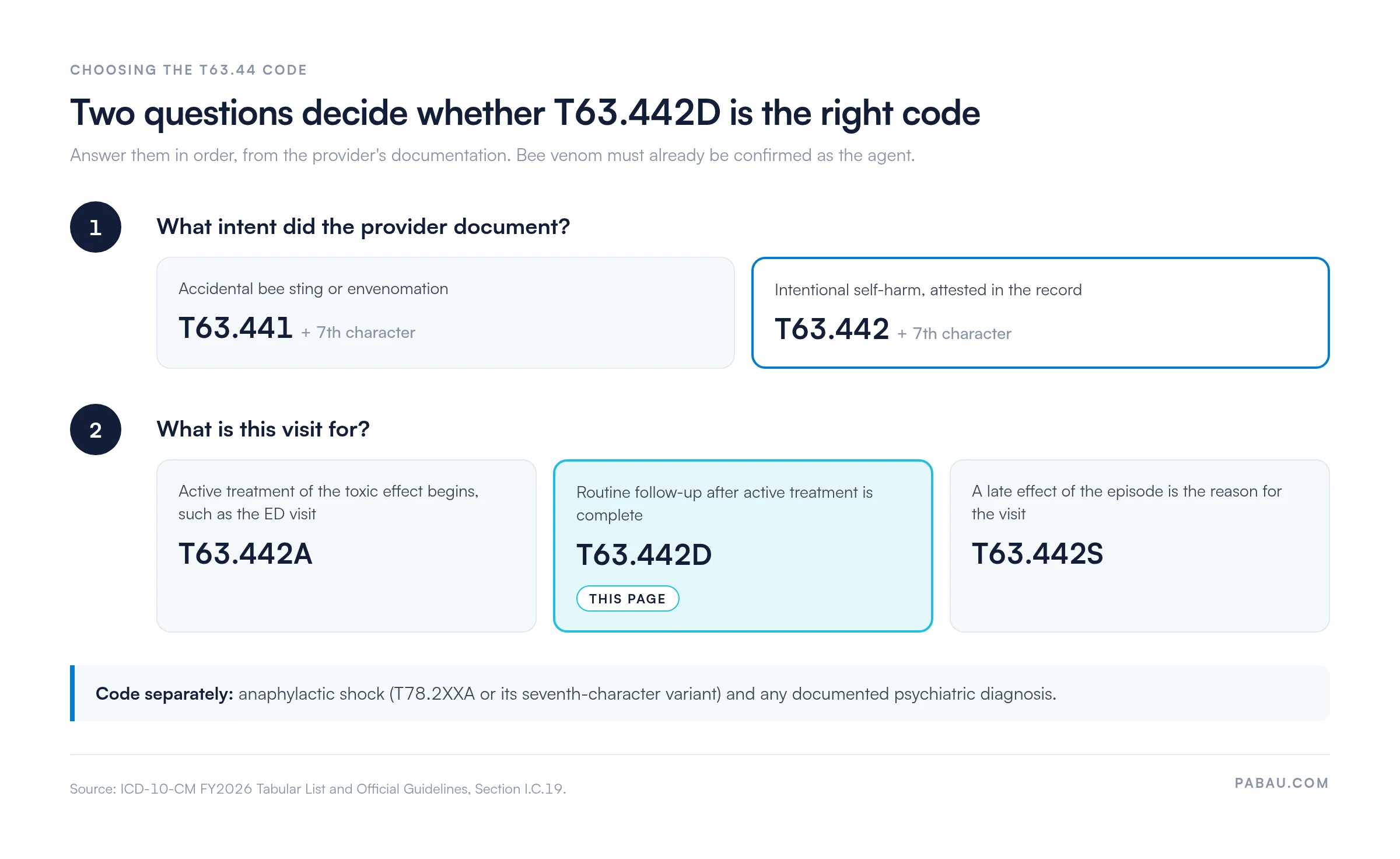
On anaphylaxis: anaphylactic shock is coded separately, typically as T78.2xxA (or the appropriate seventh-character variant). Anaphylaxis is not subsumed under T63.442D. Per standard ICD-10-CM coding conventions, if the record documents anaphylactic shock in addition to bee venom toxicity, assign both codes. Verify the current Excludes1 and Excludes2 notes in the FY2026 Tabular List, as these notes govern whether codes may be assigned together. The WHO ICD-10 browser provides the international classification context for cross-reference.
For T63.442D, the clinical record has to support all three qualifier layers at once. Coders can only assign what the provider has documented, so the elements below belong in the note before the claim is built.
Claims carrying intentional self-harm injury codes tend to attract heightened payer scrutiny. The patterns below reflect common payer conventions; specific requirements vary by plan, and coders should verify against each payer’s current LCD, NCD, or coverage policy.
Checking eligibility before a T63.442D claim goes out confirms the patient’s active coverage. It also shows whether a behavioral health carve-out applies with that payer. When a claim is not paid as expected, the electronic remittance advice carries CARC denial reason codes that tell coders exactly what to fix.
T63.442D denials cluster around five patterns, and each one is preventable at the coding or documentation stage. Once a denial lands, the denial codes in medical billing reference decodes the payer’s reason. Our denial management in healthcare guide covers the appeal workflow.
A clean claim catches these errors before transmission. Add a check to your pre-submission review: does every self-harm code have a supporting psychiatric code where the payer expects one? That one question takes care of the third trigger.
Run a monthly query on all T63.44x claims submitted in the prior 30 days. Look for patients whose follow-up visits kept A as the seventh character. A run of A-to-A submissions points to a coding habit that one short staff training session can correct.
Self-harm follow-up claims often pass through several hands. Eligibility is checked by phone, claims are keyed into a payer portal, and remittances are matched against a spreadsheet. A denied T63.442D claim can sit unnoticed for weeks.
Practice management software like Pabau brings that work into the patient record. Its claims management software runs on the Claim.MD clearinghouse, with real-time eligibility checks across 400+ payers. Claims go out electronically, their status is tracked in one place, and electronic remittances come back against the right visit.
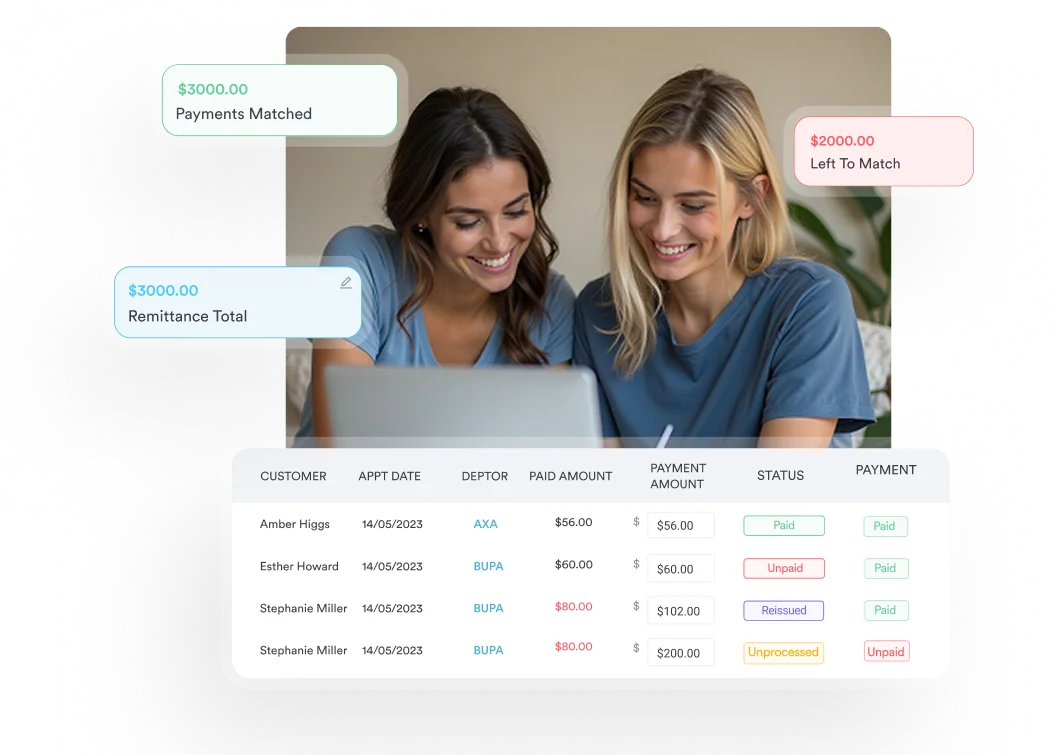
The result is a shorter loop. A denial on a follow-up visit shows up with its reason code the day it arrives. Your coder can then query the provider and resubmit while the encounter is still fresh.

Pabau’s claims management software checks eligibility in real time, submits claims electronically, and tracks each one to the remittance. Your team sees a denial the day it lands and fixes it while the chart is fresh.

Assign T63.442D only after the note confirms three points: bee venom as the agent, attested self-harm intent, and a visit that follows completed active treatment. If any one is missing, query the provider before the claim goes out.
The trade-off is a slower first pass for a faster payment. A query today costs minutes, while a denied self-harm claim can take weeks to appeal. Book a demo to see how Pabau tracks every T63.442D claim from eligibility check to remittance.

Need a framework for working denials after submission? Denial management in healthcare covers the appeal and resubmission workflow for complex diagnosis code denials.
Want to understand clearinghouse submission for ICD-10 claims? Medical claims clearinghouse explains how electronic claims move from practice management system to payer adjudication.
Want fewer claims coming back for rework? Clean claims in medical billing sets out the checks a claim should pass before it leaves the practice.
Reading CARC codes on a remittance? Electronic remittance advice shows how to read an ERA and act on its denial reason codes.
ICD-10 Code T63.442D is the billable ICD-10-CM diagnosis code for the toxic effect of venom of bees, intentional self-harm, subsequent encounter. It applies when a patient returns for follow-up care after a self-inflicted bee envenomation, once active treatment is complete. The clinical record must support all three qualifiers (bee venom, intentional self-harm, subsequent encounter) before the code is assigned.
Yes, T63.442D is a valid billable ICD-10-CM code for FY2026 submissions, confirmed in the CDC/NCHS official ICD-10-CM code set. It carries sufficient specificity (seven characters) for claim submission and is accepted by Medicare, Medicaid, and commercial payers that require ICD-10-CM coding.
T63.441D covers accidental toxic effect of bee venom at a subsequent encounter, while T63.442D covers intentional self-harm at a subsequent encounter. The intent digit is the only difference: 1 = accidental, 2 = intentional self-harm. Coders cannot infer that distinction. It requires explicit provider documentation of intent. Assigning the wrong intent code when documentation does not clearly support it is both a compliance risk and a common audit finding.
The most common trigger is the wrong seventh character, such as A instead of D on a follow-up visit. Next comes a missing provider attestation of self-harm intent. Claims also fail without a required psychiatric code or with incorrect inpatient sequencing. A prior year’s code set on a FY2026 date of service causes denials too.