ICD-10 code T86.03: Bone marrow transplant infection
ICD-10 code T86.03 covers infection of a bone marrow transplant ICD-10 code T86....

Last Updated: Oct 22, 2026
Billable Code Specific Code
T43.604S is the billable ICD-10-CM code for poisoning by unspecified psychostimulants, undetermined, sequela. Use it when a patient returns with a lasting condition caused by an earlier stimulant poisoning that has resolved. The record names no specific stimulant, and the provider documents that intent cannot be determined.
The seventh character S marks the visit as care for a late effect. When the record does identify the drug, a named-drug code such as T43.634S for methylphenidate applies instead. The late effect itself is coded first, and T43.604S follows it to explain the cause.
Let Pabau's smart automation suggest the right codes, reduce claim denials, and keep your practice compliant—effortlessly.
Automate repetitive tasks and focus on what matters most—your patients.
Reduce coding errors and ensure compliance with the latest regulations.
Clean claims, fewer denials, and faster reimbursements.
Powerful insights and reporting to help your practice thrive.
HIPAA compliant SOC 2 certified GDPR-compliant Trusted by 4,000+ clinics worldwide

T43.604S codes a lasting condition left by a resolved psychostimulant poisoning, when the drug is unnamed and intent is undetermined.
The sixth character 4 means undetermined intent, and the seventh character S marks the visit as care for a sequela.
Code the late effect first, such as cardiomyopathy or persistent psychosis, then add T43.604S as the second code.
Intent is built into the code itself, so the claim needs no separate external cause code for intent.
Pabau’s claims software connects to Claim.MD, so billing teams send and track T43.604S claims from one system.
ICD-10 code T43.604S covers the late effects of a psychostimulant poisoning when intent is undetermined. The official descriptor reads “Poisoning by unspecified psychostimulants, undetermined, sequela.” It is a billable code in Chapter 19 of ICD-10-CM, which spans S00-T88.
You usually meet this code months after the overdose has passed. By then, the patient needs care for what the poisoning left behind. Mental health teams see these visits often, because lasting anxiety or psychosis brings patients back.
Check the CMS ICD-10 codes page before each fiscal year starts. Codes in the T43 block can change in the annual October 1 update.
The seventh character tells the payer which stage of care the visit covers. For T43.604, three values exist.
Guideline section I.C.19.a reserves S for complications or conditions caused directly by the original event. Section I.B.10 adds that a sequela has no time limit. A late effect can surface within weeks or years later.
The choice between D and S trips up many coders. If the visit monitors recovery from the poisoning itself, it takes the D character. If the visit treats a new condition that the poisoning caused, S applies.
Subcategory T43.6- covers poisoning by, adverse effect of and underdosing of psychostimulants. T43.604S belongs to T43.60-, the branch for an unspecified psychostimulant. When the record names the drug, a more specific branch applies. You can browse the neighboring codes in our ICD-10-CM code library.
For example, a documented methylphenidate overdose of undetermined intent becomes T43.634S at the sequela visit. Within T43.604, the seventh character then separates the three encounter codes.
The AAPC ICD-10-CM code lookup and ICD List show every code in the T43 block. Also check the Excludes notes in the CDC ICD-10-CM tabular tool. Cocaine (T40.5-) is the only Excludes1 at T43.6-, so it never pairs with these codes.
Benzodiazepines (T42.4-), barbiturates (T42.3-), methaqualone (T42.6-), appetite depressants (T50.5-) and psychodysleptics (T40.7-T40.9-) are Excludes2 notes at category T43. They code elsewhere, but you can report both codes together when both conditions apply.
Guideline section I.C.19.e separates these two events. Poisoning covers an overdose, the wrong substance, or a drug taken against instructions. An adverse effect means a correctly prescribed drug, taken as directed, caused a reaction.
Watch the undetermined row closely. The guidelines tell you to code unknown or unspecified intent as accidental. Use the sixth character 4 only when the record says intent cannot be determined.
When the reaction came from a drug taken as prescribed, choose an adverse effect sequela instead. The options are T43.605S, T43.615S, T43.625S, T43.635S, T43.655S and T43.695S. Ecstasy has no adverse effect code, because T43.64- covers poisoning only.
T43.604S names the cause of the visit. A second code names the condition the provider treats today. Common psychostimulant late effects include:
Code each condition separately, using its own code from the relevant chapter. Persistent psychosis or anxiety codes to Chapter 5, while cardiomyopathy and arrhythmia code to Chapter 9.
The provider also needs to link each condition to the earlier poisoning in the note. Without that statement, the pairing has nothing to support it.
Work through these steps before you finalize the claim:
This order follows guideline I.B.10. The condition or nature of the sequela comes first, and the sequela code follows it. Guideline I.C.20.a.8 confirms that no Chapter 20 code is needed when the T code already includes intent. The same order holds for other undetermined-intent sequela codes in category T43, such as T43.224S.
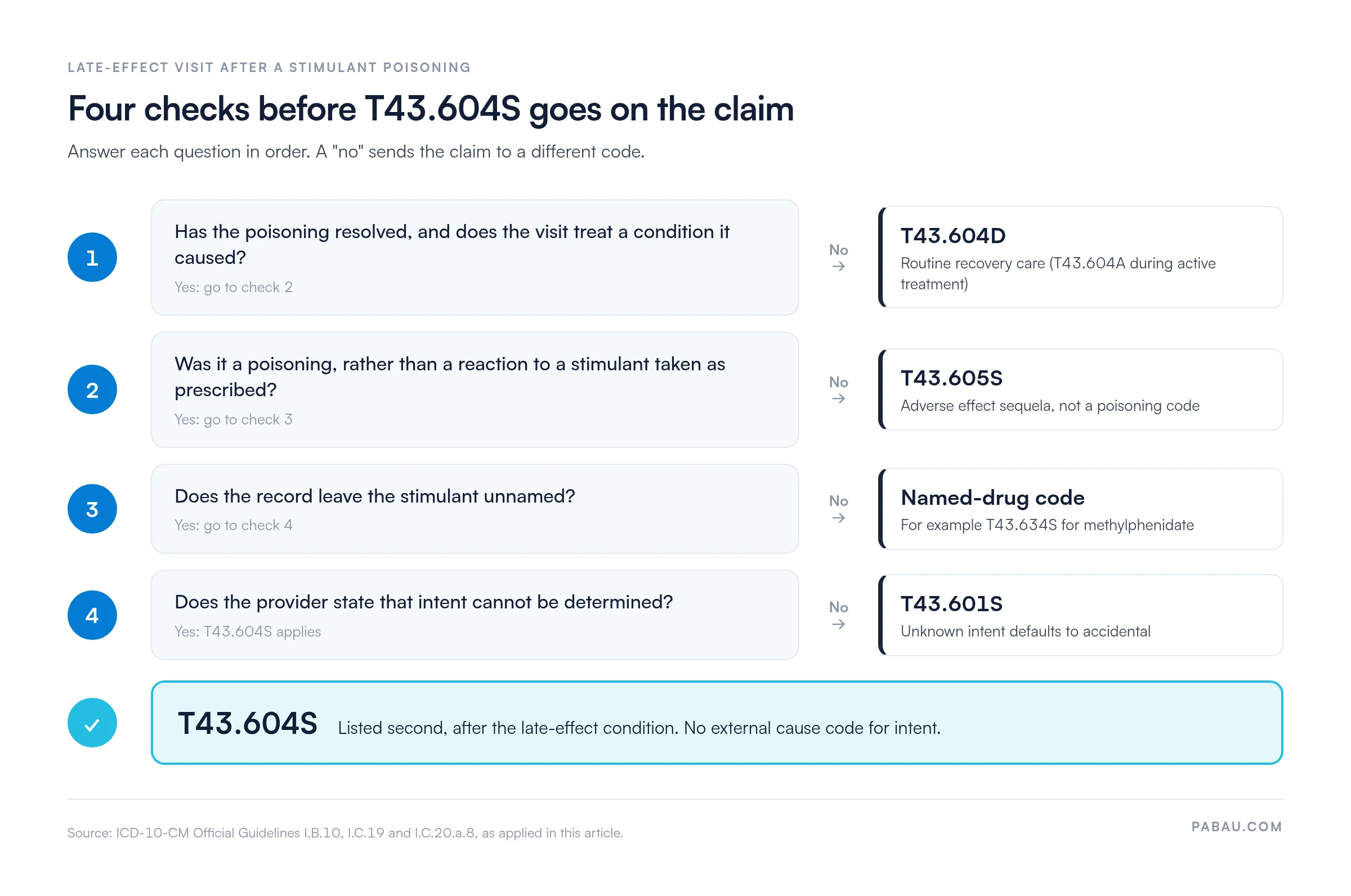
The decision path below shows where each check sends the claim when the answer is no.
A 34-year-old patient visits a cardiology practice in March. Last summer, the emergency department treated them for a stimulant overdose. The ED note names no specific drug and states that intent could not be determined.
Today, the cardiologist manages a cardiomyopathy. The note documents that it resulted from that overdose, which has fully resolved.
The claim therefore lists the cardiomyopathy code first, and T43.604S follows as the second diagnosis. No external cause code for intent is added. Had the ED note named methylphenidate, T43.634S would take the place of T43.604S.
Payers look for a clear chain from the old poisoning to today’s condition. Practices with strong medical billing compliance habits capture these points at the visit, before a denial forces a chart review.
Most errors with this code follow a handful of patterns. The table maps each one to its fix.
When one of these errors slips through, a clear denial management workflow helps your team trace the cause and resubmit quickly.
Run through this list on every claim that carries T43.604S:
The ICD-10-CM Official Guidelines for Coding and Reporting govern how poisoning and sequela codes are reported. HIPAA requires them for all covered entities, so Medicare, Medicaid and commercial payers apply the same base rules.
A medical claims clearinghouse sits between your practice and the payer. It sends claims electronically and returns status updates to your team.
Sequela claims depend on a clean handoff from the chart to the payer. When the chart and the clearinghouse sit in separate systems, staff re-key codes and check claim status in two places.
Pabau, the practice management and EHR platform we build, sends claims electronically through Claim.MD. Its claims tracking software shows each claim’s status in one place, so billing teams submit and follow up without switching systems.
Because the provider’s note and the claim sit in the same system, your team can confirm the causal statement before a claim goes out.
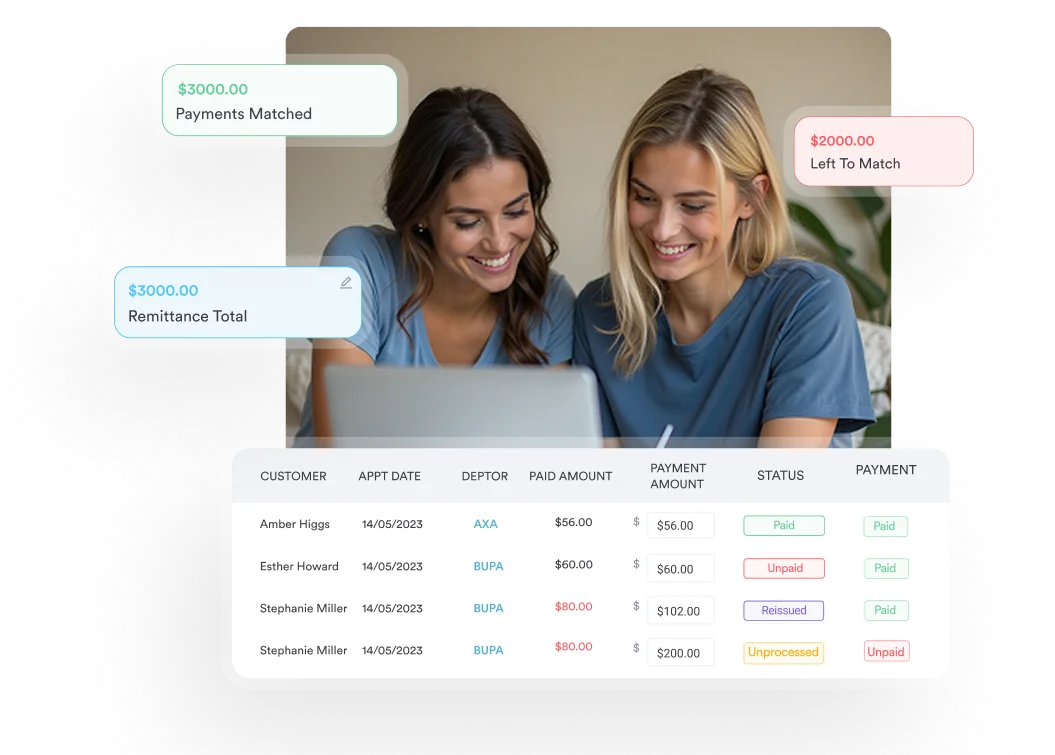

Pabau connects to Claim.MD for electronic claims submission. Your billing team can send and track diagnosis-coded claims, including sequela claims, from one place.

T43.604S rewards coders who read the record closely. Three questions decide it. Has the poisoning resolved? Does the note leave the stimulant unnamed? Did the provider state that intent could not be determined?
If any answer is no, another code fits better. If all three hold, list the late effect first and T43.604S second. That order, plus a clear causal statement, gives the payer what it needs.
Book a demo to see how Pabau sends and tracks your practice’s claims through Claim.MD.

Need to understand what happens when a claim is rejected on code-combination grounds? Denial codes in medical billing breaks down the most common CARC and RARC codes and what they mean for your revenue cycle.
Looking for a structured approach to catching claim errors before submission? Clean claim submission requirements outlines the 10 elements payers check before adjudicating any claim.
Want to understand how clearinghouse validation fits into the billing workflow? Revenue cycle management explains how pre-submission edits connect to overall reimbursement performance.
No. Cocaine is an Excludes1 at T43.6- and codes to T40.5- instead. A sequela of cocaine poisoning with undetermined intent is T40.5X4S.
Yes, when the provider documents both. The T43 category lists F10-F19 disorders as Excludes2, which allows both codes on one claim. A stimulant use disorder codes to F15.-, with its own documentation.
No. Guideline I.B.10 sets no time limit on a sequela. A late effect can appear soon after the poisoning or years later.
No. Place of occurrence code Y92 is generally assigned only once, at the initial encounter, so it is not repeated on sequela visits. Y93 activity codes do not apply to poisonings or sequela.