ICD-10 code S61.201A: Open wound of left index finger without nail damage
ICD-10 code S61.201A covers a left index finger wound of unstated type ICD-10 co...

Last Updated: Oct 16, 2026
Billable Code Specific Code
T44.1X4A is the billable ICD-10-CM code for poisoning by other parasympathomimetics [cholinergics], undetermined, initial encounter. Coders assign it when documentation confirms cholinergic drug toxicity and the clinician states that the intent cannot be determined. When intent is simply unknown or not recorded, the guidelines direct coders to accidental intent (T44.1X1A) instead.
Codes in categories T36-T65 are combination codes that capture both the substance and the intent, so no separate external cause code is required. Payers do expect a manifestation code for each documented sign of cholinergic toxidrome, such as bradycardia or bronchospasm.
Let Pabau's smart automation suggest the right codes, reduce claim denials, and keep your practice compliant—effortlessly.
Automate repetitive tasks and focus on what matters most—your patients.
Reduce coding errors and ensure compliance with the latest regulations.
Clean claims, fewer denials, and faster reimbursements.
Powerful insights and reporting to help your practice thrive.
HIPAA compliant SOC 2 certified GDPR-compliant Trusted by 4,000+ clinics worldwide

T44.1X4A is a billable ICD-10-CM code for direct-acting cholinergic agonist poisoning when the record documents that intent cannot be determined.
When the record simply doesn’t state intent, the guidelines direct coders to accidental intent (T44.1X1A) instead.
The 7th character A covers every encounter during active treatment, including a transfer from the ED to the ICU.
Poisoning codes are sequenced first, followed by manifestation codes. No separate external cause code is required, because T44.1X4A already captures the drug and the intent.
Claims management software like Pabau captures companion manifestation codes at the point of documentation, which cuts T44.1X4A denials.
ICD-10 code T44.1X4A is the fully specified, billable terminal code for poisoning by other parasympathomimetics (cholinergic agonists), undetermined intent, initial encounter. Coders assign it only when the record states that the intent behind the poisoning cannot be determined. Every character carries a specific clinical meaning that payers validate at claim adjudication, as the table below shows. Per the CDC/NCHS ICD-10-CM official code tool, T44.1X4A is valid and billable for FY2025 and FY2026.
Note that T44.1X4 without the 7th character is a non-billable parent code. Claims submitted with the truncated form will reject at the clearinghouse. Only T44.1X4A, T44.1X4D, or T44.1X4S are valid for submission.
T44.1 covers direct-acting cholinergic agonists, also called muscarinic agonists or parasympathomimetics. These are drugs that bind directly to cholinergic receptors, as opposed to anticholinesterase agents that prevent acetylcholine breakdown.
According to the CMS ICD-10-CM Tabular List, T44.1 includes the following drug classes and examples:
What T44.1 does NOT include: Anticholinesterase agents (neostigmine, physostigmine, donepezil, rivastigmine) are classified under T44.0, not T44.1. Autonomic ganglionic blockers fall under T44.2. Beta-adrenergic blockers belong to T44.7. Confusing these categories is a common coding error that puts the wrong drug category on the claim and leads to denials.
Understanding where T44.1X4A starts and stops prevents miscoding across the T44 family. The Excludes1 and Excludes2 notes in the Tabular List are binding.
Accurate boundary identification matters because coders sometimes encounter patients on combination regimens. A patient on both bethanechol and a cholinesterase inhibitor who experiences toxicity requires separate code analysis for each drug involved. The guidelines direct coders to report each drug individually unless a combination code exists.
“Undetermined intent” applies when the medical record provides no clinical basis to decide whether the poisoning was accidental, intentional self-harm, or the result of assault. Per the ICD-10-CM Official Guidelines Section I.C.19.e, it is coded only when the documentation specifically states that the intent cannot be determined.
When the intent is simply unknown or unspecified, the guidelines direct coders to code it as accidental. The flow below shows how the two questions a coder asks lead to each intent character.
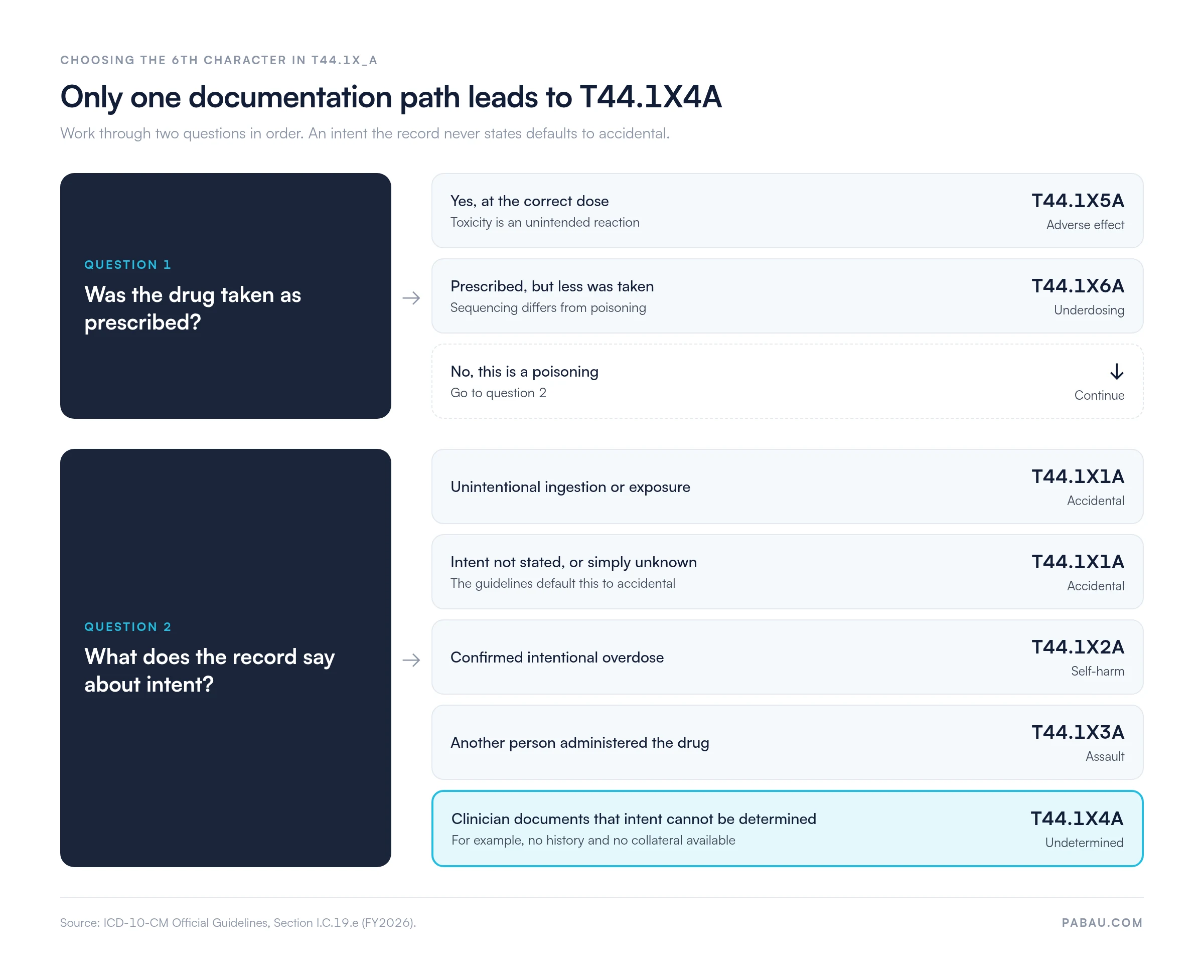
Selecting T44.1X4A when documentation supports accidental intent creates compliance exposure. Payers cross-reference emergency department notes, toxicology reports, and nursing assessments during audits.
When a coder cannot determine intent from the available chart, the correct action is to query the physician before assigning T44.1X4A. Undetermined intent without a documented clinical basis is unlikely to survive an audit. Physician queries resolved before billing keep the claim out of the denial cycle.
Most coding errors within the T44.1X family involve confusing intent characters or episode suffixes. The table below maps every sibling code so coders can verify selection before submitting. The AAPC Codify ICD-10-CM lookup provides current descriptor text for each.
The 7th character “A” means the patient is receiving active treatment for the cholinergic poisoning. It does not mean this is literally the first time they have been seen. A patient transferred from the ED to the ICU on day three of treatment still carries “A” if active treatment continues. The character changes only when the care context changes.
Switching prematurely to “D” during an active inpatient stay is a common audit finding. The ICD-10-CM Official Guidelines Section I.C.19.a confirm that “A” applies through the entirety of the active treatment encounter, regardless of visit count.
T44.1X4A rarely travels alone on a claim. ICD-10-CM Official Guidelines Section I.C.19.e require the poisoning code to be sequenced as the principal diagnosis, followed by codes for its manifestations. Codes in categories T36-T65 are combination codes that already include the substance and the intent, so no additional external cause code is required.
Codes to report, in order of sequencing:
A clearinghouse that validates companion code requirements catches a missing manifestation code before the payer sees it. It also flags a truncated parent code or an incomplete code set before the claim leaves the practice.
Coders cannot assign ICD-10 code T44.1X4A without specific clinical elements in the medical record. Payers audit these claims against toxicology results and nursing notes, and missing elements found after payment trigger recoupment.
Practices using error-checking claims software tied to clinical documentation catch these omissions while the chart is still open. The fix happens before the claim is built, so the denial never arrives.
Medicare and Medicaid adjudicate T44.1X4A under standard poisoning rules. Commercial payer requirements vary, and some trigger additional review for undetermined-intent poisoning claims, particularly when the clinical setting is outpatient rather than emergency or inpatient.
Real-time eligibility verification before the encounter reduces the risk of submitting to an ineligible payer or missing secondary coverage. Pabau’s integration with Claim.MD runs real-time eligibility checks at over 400 US payers. It also supports the CMS-1500 and 837P claim formats that T44.1X4A billing uses.
Denial patterns for T44.1X4A are predictable. Five errors recur across these claims, and each is preventable with a structured pre-submission review. Pabau’s guide to denial codes in billing explains the claim adjustment reason codes (CARCs) that usually accompany these rejections.
Running a clean claim review on every T44.1X4A claim catches most of these errors before submission. The pro tip below turns that review into a monthly routine.
Run a pre-submission audit specifically on your T44.1X4A claims before month-end batch processing. Filter for claims carrying T44.1X4A and confirm each documented complication carries its own manifestation code. Then verify that the physician documentation explicitly supports undetermined rather than accidental intent. Catching these denials in pre-submission review saves hours of appeals work downstream.
Recognizing the cholinergic toxidrome lets coders check that the documented drug class matches the code selected. The SLUDGE/DUMBELS mnemonics describe the classic presentation that emergency toxicology notes record, and coders will meet them when assigning T44.1X4A.
Each documented sign or symptom that meets the threshold of a separately identifiable condition should carry its own manifestation code alongside T44.1X4A. This completeness signals clinical severity to the payer and is particularly important for inpatient DRG optimization. Undercoded complications on T44.1X4A inpatient claims regularly result in lower DRG weights. That can mean thousands of dollars in unrealized reimbursement per case.
Without a check at the point of documentation, a missing manifestation code or the wrong intent character usually surfaces as a denial. By then the encounter is weeks old, and fixing it means chasing the physician for an addendum.
Pabau’s claims management tools validate ICD-10 code combinations before submission, so an incomplete companion code set is flagged while the chart is still open. Claims then route through Claim.MD, Pabau’s US clearinghouse integration, which catches a truncated parent code before the 837P file goes out.
Electronic remittance advice comes back into the same system. Your billing team can see which poisoning claims paid and which need attention without logging in to a separate portal.

Pabau’s claims management tools validate ICD-10 code combinations, flag incomplete companion code sets, and route clean claims through Claim.MD before they reach the payer. See how it works for your practice.

T44.1X4A holds up on audit only when the chart says, in the clinician’s own words, that intent cannot be determined. If that statement is missing, query the physician or code accidental intent before the claim goes out.
From there, pair the code with a manifestation code for each documented sign, and keep the 7th character at A until active treatment ends. Build those checks into your pre-submission review and the denial patterns above become rare exceptions.
Book a demo to see how Pabau flags missing companion codes on poisoning claims before they reach the payer.

Need guidance on medical billing compliance for poison and toxicology claims? Medical billing compliance requirements covers the audit triggers and documentation standards that govern T36-T65 poisoning claims.
Confused about how denials are categorized after a T44.1X4A rejection? Denial management in healthcare explains how to read CARC denial codes and build a systematic appeals process.
Want to understand how 837P claim files carry ICD-10 codes to payers? 837 file format guide explains loop and segment structure for diagnosis code submission.
Looking for a structured framework for superbill design that captures companion codes? Superbill guide covers how to build a superbill that captures all required companion codes at the point of care.
ICD-10 code T44.1X4A is the billable diagnosis code for poisoning by other parasympathomimetics (cholinergic agonists), undetermined intent, initial encounter. Each character specifies the drug category (T44.1), a structural placeholder (X), the intent (4 = undetermined), and the phase of care (A = active treatment). It is valid and billable for FY2025 and FY2026 per the official CDC/NCHS release.
T44.1X1A is poisoning by cholinergic agonists with accidental (unintentional) intent, while T44.1X4A is used when intent cannot be determined from the clinical record. T44.1X1A is correct when documentation describes an unintentional ingestion or exposure. T44.1X4A applies only when the physician documents that intent cannot be determined. One example is a patient who cannot provide a history when no collateral information is available.
No. T44.1X4A is a combination code that already captures both the substance and the intent. ICD-10-CM Official Guidelines Section I.C.19.e confirm that no additional external cause code is required for poisoning codes. Place (Y92), activity (Y93), and status (Y99) codes are optional secondary data. Report them only where a state mandate or a specific payer policy asks for them.
Yes. T44.1X4A is a fully specified, terminal, billable ICD-10-CM code. The parent code T44.1X4 (without the 7th character) is non-billable and will reject if submitted. Always include the 7th character: A for initial encounter, D for subsequent encounter, or S for sequela.
Use T44.1X2A when documentation confirms intentional self-harm, such as a documented overdose attempt or a psychiatric assessment supporting suicidal intent. Use T44.1X4A only when the record explicitly states that intent cannot be determined. If documentation later clarifies intent after the initial encounter, query whether the chart should be amended before claim submission.
Five denial patterns recur. The first is coding an anticholinesterase such as neostigmine under T44.1 instead of T44.0. Others are submitting the non-billable parent T44.1X4 and using undetermined intent when documentation supports accidental intent. Missing manifestation codes and a 7th character that doesn’t match the phase of care complete the list. Each is preventable with a structured pre-submission audit.